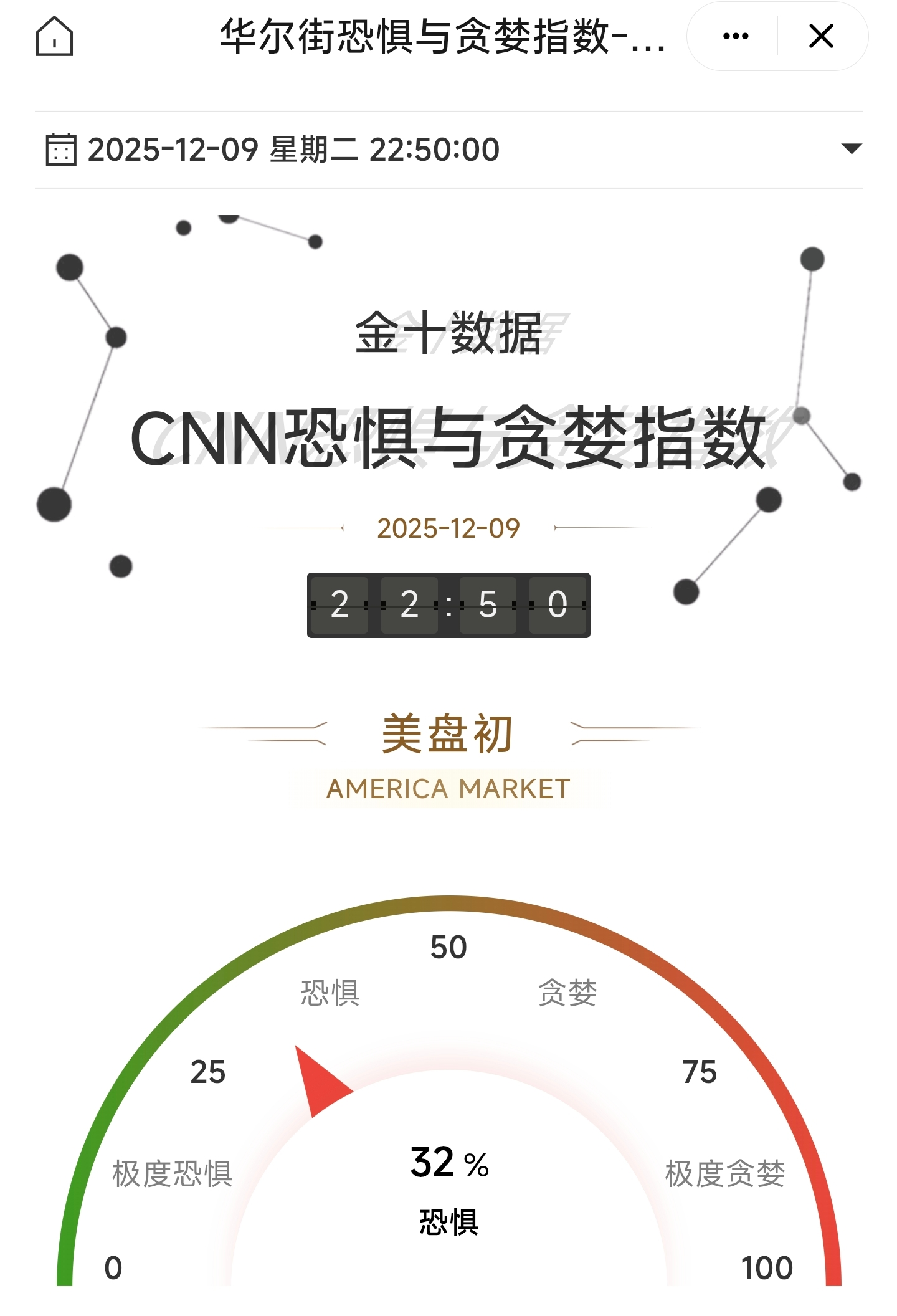
On December 09, 2025, during the initial trading hours in the U.S., the Fear and Greed Index on Wall Street was fixed at 32%, falling within the 'fear' range. This value has neither reached the 0-25 range that represents extreme market panic nor crossed the neutral threshold of 50, reflecting the subtle state of sentiment in the current U.S. stock market.
1. Behind the 32% fear level: What is the market afraid of?
The Fear and Greed Index, as a key indicator reflecting market sentiment, tends to show a lower value corresponding to investors' risk-averse tendencies. A fear level of 32% indicates that current market participants are cautious about short-term trends, and the core driving factors can be summarized in several aspects:
On a macro level, the expectation of a shift in the Federal Reserve's monetary policy has not yet materialized, and with interest rates remaining high, concerns about corporate earnings resilience and slowing economic growth persist;
Industry dimension, the performance realization rhythm of popular tracks such as technology and new energy is below expectations, combined with geopolitical disturbances, further amplifying the market's wait-and-see sentiment;
From the perspective of capital flows, the allocation ratio of safe-haven assets such as government bonds and gold has slightly increased, while the short-term trading activity of equity assets has declined.
However, it is worth noting that 32% did not fall into the 'extreme fear' range, indicating that market panic has not spiraled out of control, and more is a rational caution - investors are neither blindly selling off nor aggressively bottom-fishing, but are in a middle state of 'not daring to be greedy, not extremely fearful.'
II. Investment implications of the fear range: Crisis or opportunity?
From historical patterns, the 'fear range' of the fear and greed index often hides layout opportunities. When the index is in the moderate fear range of 20-40%, the market's overly pessimistic pricing often brings about the potential for valuation recovery:
For long-term value investors, the valuation premium of quality targets being compressed at this time is a window for selecting undervalued, high cash flow companies;
For short-term traders, it is necessary to be wary of the risk of emotions further dipping into 'extreme fear,' but there is no need to be overly bearish - a value of 32% indicates that there is still room for market play, and signals such as favorable policies and better-than-expected earnings could quickly boost sentiment;
Overall, the current market sentiment has not reached extremes; it is neither appropriate to follow the panic selling nor blindly bottom-fish. A strategy focused on phased allocation and core assets is more suitable for the current environment.
III. Subsequent focus: Key variables for sentiment shift
To determine whether fear sentiment can ease, it is crucial to track two core variables closely:
1. The Federal Reserve's December meeting statement: If clear forward guidance for interest rate cuts is released, it will directly boost market risk appetite and push the index closer to a neutral range;
2. The performance of the US stock earnings season: The realization degree of fourth-quarter earnings of S&P 500 constituents, especially the profit guidance of leading companies, will validate the fundamental economic support and become an important lever for sentiment recovery.
A fear value of 32% is an intuitive feedback from the market regarding current uncertainties, but it also provides rational investors with a window to see the essence of the market. In a phase where emotions dominate short-term fluctuations, returning to the intrinsic value of assets may be the core logic for navigating the emotional cycles of the market.