
When I first looked at Kite, it wasn’t because I was hunting for another chain. It was because I kept seeing the same small failure show up in places that were otherwise “working.” Agents could call tools, spin up compute, negotiate a price, even complete multi-step workflows, and then everything got weird at the moment value had to move. The smartest part of the system would suddenly behave like it was waiting in a bank line.
That mismatch has a texture to it. AI systems now act at the tempo of software, but payments still act at the tempo of humans. Even in crypto, a lot of what we call “payments” are really transfers that humans can tolerate waiting for, with fees humans can rationalize, backed by trust assumptions humans can absorb. Machine-to-machine commerce is less forgiving. It wants tiny amounts, paid continuously, settled fast, and bounded by rules that don’t require a manager watching a dashboard.
The market right now makes that contrast sharper, not softer. Bitcoin trading around $91,377 today is a reminder that volatility is still the background radiation of the space. Meanwhile Ethereum at about $3,134 keeps the “everything onchain” dream alive, but it also highlights that general-purpose settlement is not the same thing as high-frequency metering. And stablecoins, which used to be treated as plumbing, are now a headline. TRM Labs says stablecoins make up about 30% of all on-chain transaction volume, and that their 2025 volume so far passed $4 trillion by August, which is an 83% increase versus the same period in 2024. That number matters because it suggests people are already using crypto rails for the one thing machines actually need, predictable units.
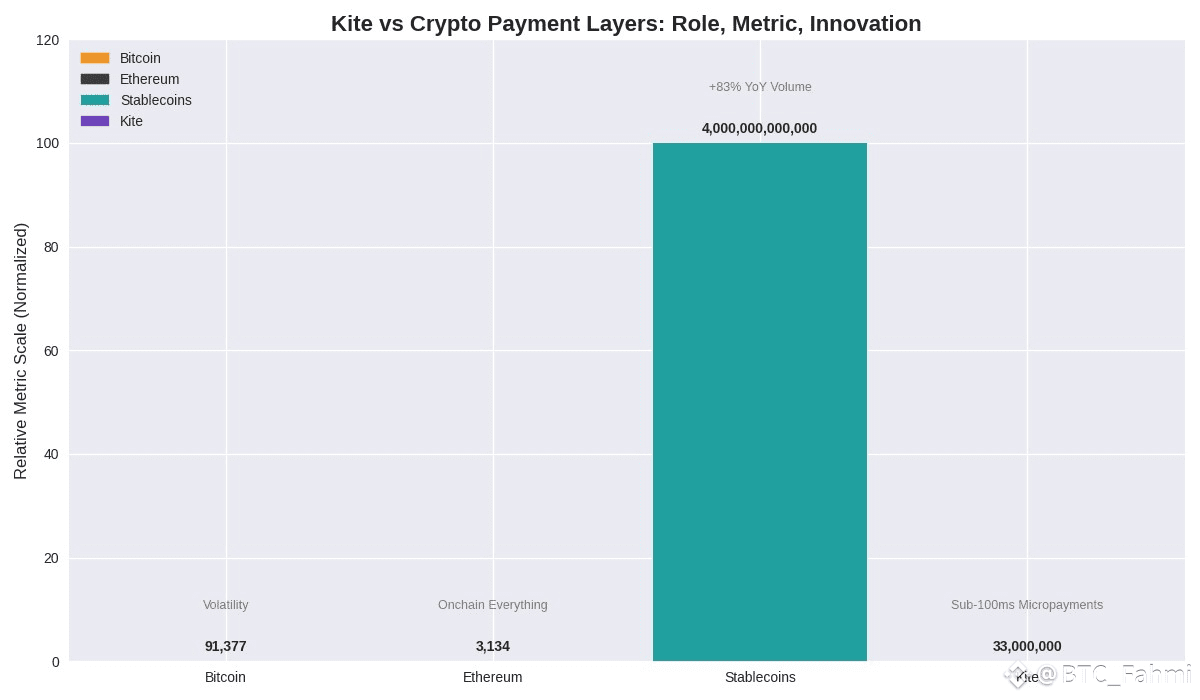
Kite’s bet is that the next wave of that volume is not retail payments or DeFi loops, but agents paying other agents, services, and systems in the background. It frames itself as an “AI payments blockchain,” but the interesting part is underneath the slogan: it’s trying to make a payment feel like an API call. Not “send $10,” but “pay per request, right now, with rules attached.”
On the surface, the flow is simple. An agent requests something, like an inference, a dataset slice, a mapping API call, or a burst of compute time. The request is metered, the agent pays, and the service responds. Kite leans into stablecoin-native settlement because machines don’t want to manage token price risk while they’re trying to manage task risk.
Underneath, the harder problem is not the payment, it’s the permission. If you’ve ever shipped an “agent” into production, you know the quiet dread: either the agent can’t do anything without you approving each action, or it can do too much and you’re praying it doesn’t go off-script at 3 a.m. Kite’s whitepaper and Binance Research summary both emphasize a three-layer identity model, user, agent, session, that tries to make delegation legible and survivable. If the session key gets compromised, it should not mean the treasury is compromised. If the agent starts misbehaving, there needs to be a revocation path that is fast enough to matter.
Then comes the part most people hand-wave, micropayments at scale. Kite points to state-channel style rails for off-chain micropayments with on-chain security, and claims sub-100 millisecond latency for its micropayment channels. That sounds like a technical flex until you translate it. Under 100 milliseconds is the difference between “paying” and “streaming.” It enables a world where an agent can buy 2 seconds of GPU time, then stop, then buy 2 more, without batching it into a monthly invoice. It enables APIs that charge fractions of a cent per call without fees eating the whole payment. And it makes collaboration between agents economically viable, because the coordination itself can be priced per message instead of per relationship.
Kite’s angle on Binance Square recently leaned into this “velocity of payments” idea through its x402 payment engine, describing near-zero fees and instantaneous micropayments designed for agents buying data streams, API calls, and compute time. If this holds, it’s not just cheaper payments. It’s a different business model for software. You stop selling subscriptions to humans and start selling verified, metered outcomes to machines.
There’s another layer here that’s easy to miss: accountability. We’re entering a regulatory and institutional moment where “the model decided” is not an acceptable explanation. Kite’s whitepaper talks about proof chains and auditability, the idea that agent actions should be anchored in a way that can be inspected later, and selectively disclosed when needed. You can hear the real-world pressure behind that when you look around the market. China’s central bank reiterated a hard line on crypto and specifically raised concerns about stablecoins and compliance, which shook Hong Kong-linked crypto names in early December. At the same time, a consortium of major European banks just announced a company, qivalis, to pursue a euro stablecoin for 2026, explicitly framing it as a payments alternative in a world where regulation is tightening and dollar infrastructure dominates. Stablecoins are becoming more institutional, not less.
So Kite is building in a narrow corridor. Agents need stablecoins because they need predictability, but stablecoins are now being pulled toward stricter identity, licensing, and disclosure. That tension is not a footnote, it’s the arena.
The bullish case is straightforward. Kite has real capital and serious backers, with an $18 million Series A led by PayPal Ventures and General Catalyst, bringing total funding to $33 million. It’s also already thinking about distribution through the existing crypto funnels, with Binance Research listing a 10 billion maximum supply, 1.8 billion circulating as of November 3, 2025, and a 150 million token Launchpool allocation. Those numbers matter because they hint at the go-to-market strategy: onboard users as token holders, then try to convert speculation into actual service usage over time.
The skeptical case is also clean. Machine-to-machine payments sound inevitable, but “agent” is still a moving target. Many agents today are wrappers around brittle tool calls and permission scopes, and adding money to that mix increases the blast radius. Even with layered keys and spending policies, you still have integration risk. A bad prompt, a compromised tool, a poisoned data source, and the agent can do exactly what it was authorized to do, very quickly.
There’s also the perennial crypto problem: networks can say “fees are near-zero” until demand shows up, incentives shift, and the cheap lane gets crowded. State channels and off-chain rails reduce on-chain load, but they introduce their own complexity around channel management, disputes, liveness assumptions, and operational overhead. If the goal is “payments as an API call,” the system has to hide that complexity so well that builders trust it. That remains to be seen.
And then there’s the softer risk: do we actually want everything metered. Streaming money per request is efficient, but it can turn the internet into a toll road where every small interaction is priced, logged, and settled. The same audit trail that helps with compliance can also become a map of behavior. Kite talks about selective disclosure and privacy-preserving design, but privacy tends to erode through convenience, not ideology.
Still, I can’t shake the feeling that this is where the foundation is being poured. The most important shift in crypto lately isn’t another narrative rotation, it’s that stablecoins have become the steady instrument for real economic movement, and that movement is starting to escape the human interface. Circle’s CEO described the ambition to build an “economic OS” for an AI era, which is a grand phrase, but the practical interpretation is simple: money needs to become programmable infrastructure the way compute became programmable infrastructure.
Kite is a focused attempt to do that for agents, not by making them smarter, but by making them economically legible. It treats identity, constraint, payment velocity, and proof as one system, because if any one of those is missing, you don’t get autonomy, you get liability.
The sharpest way I can say it is this: if the next internet is full of agents, the real question isn’t whether they can talk, it’s whether they can pay with boundaries, and whether we can live with the trail they leave behind.

