

When I first started paying attention to YGG, it was because the story people told about it felt too clean. The common version went like this: Axie got expensive, scholarships fixed the access problem, then the whole thing faded when the play to earn cycle broke. Neat arc, beginning to end. But the details I kept bumping into had more texture than that, and the texture matters because it reveals what YGG was really building underneath.
The scholarship era is easy to remember because it was visible. In 2021, Axie Infinity hit a scale that still reads like a glitch in hindsight, with reports putting peak daily active users above 2.8 million. Around that same period, scholar programs became the dominant on ramp, with estimates that a large share of Axie players were scholars, often clustered in Southeast Asia. And YGG’s model, the simple split of earnings between players, managers, and the guild, turned a Discord-native arrangement into something you could run at scale, complete with training and accountability.
What made it feel more than a charity story was the math. One snapshot from mid 2021 reported YGG scholars generating about 11.7 million SLP in July alone, with the guild’s take structured as a small slice compared with what went to players and managers. Numbers like that are not interesting because they prove “traction.” They are interesting because they show the scholarship system was a production line. Players were the labor, NFTs were the capital equipment, and the guild was the coordination layer that reduced churn, taught the meta, and standardized payouts.
On the surface, scholarships looked like access. Underneath, they were a way to turn scattered, high-friction participation into an economy with rules. If you want a mental model that feels less like crypto and more like normal life, think of it like a franchising system for a game economy. The game supplies the storefront and the reward currency, but it does not supply training, recruiting, community management, or dispute resolution. YGG did, which is why it could talk about tens of thousands of scholars by mid 2022.
Then the obvious counterargument shows up, and it is real. If the entire machine depends on a reward token staying valuable, the machine becomes fragile. We saw that fragility across GameFi as token emissions outpaced demand and the “income” story collapsed for many players. The scholarship model in that light starts to resemble a bandage, not a foundation, and even Binance Square commentary has framed early scholarships as a response to Axie’s entry cost spiking into the thousands of dollars. If the primary reason people show up is to cash out, the moment cash out stops working, retention turns to dust.
But here’s the part that doesn’t get enough attention. The scholarship era forced YGG to learn something that most token projects never learn: how to run a network of humans, across countries and time zones, tied together by incentives that are partly financial and partly social. That’s not a slogan. That is operational craft, and it is portable.
You can see the evolution by looking at what is happening now, not in 2021 nostalgia. In the current market, crypto has been in a risk-off mood to start December 2025. Reuters described Bitcoin dropping below $90,000 around December 1, 2025, with November marked as its steepest monthly decline since the 2021 crash. That kind of tape is brutal for the long-tail tokens that depend on speculative oxygen, and YGG’s token reflects that reality. As of today’s live trackers, YGG is trading around $0.075 to $0.076, with roughly $14 million to $17 million in 24-hour volume and a market cap around $50 million. Those numbers matter because they tell you the market currently values YGG less as a growth story and more as an option that might pay off later, if a new product layer sticks.
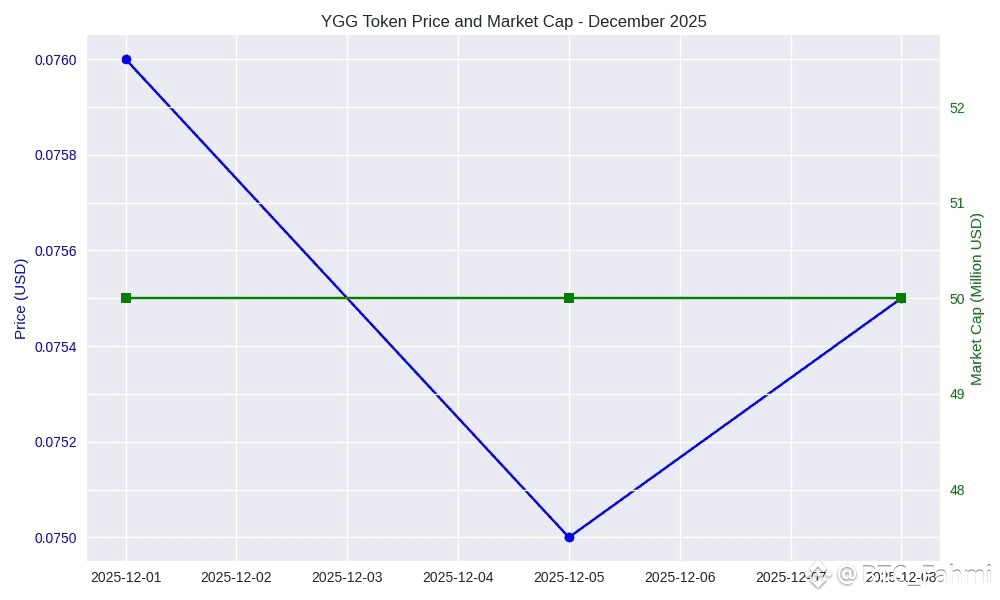
It is tempting to read that as failure. I read it as evidence that the asset YGG is trying to monetize has shifted. In 2021, the most legible asset was the inventory of NFTs you could lend. In 2025, the scarcer asset might be distribution, onboarding, and retention in a world where most Web3 games struggle to keep real players after the first wallet connect.
That shift changes what “guild” means. On the surface, a modern guild partnership announcement can sound like the old playbook, “we onboard players for your game.” But underneath, it is closer to publishing. When YGG partners with projects positioning themselves around catalogs and expansion, what they are really selling is a repeatable funnel: community reach, local operators, education loops, and a social layer that can make a new game feel less like a strange fintech app. That’s the point of recent partnership framing around scaling ecosystems and accessing large player bases.
If this holds, YGG becomes less like a scholarship house and more like a gaming economy architect, meaning it designs the pipes that let value move between players, games, and communities without the whole system depending on one token’s price chart. The irony is that the scholarship story, which critics often describe as “labor disguised as play,” might have been the training ground for building the safer version: play that stays play, with earned perks and ownership as the layer underneath, not the entire reason to log in.
There are risks in that direction too, and they are not small. The first is reputational. The scholarship period left a lasting debate about exploitation versus empowerment, and that debate does not go away just because the strategy changes. The second is business-model clarity. If the token no longer maps cleanly to a single revenue stream like lending yield, then token value becomes a proxy for trust in YGG’s ability to keep striking partnerships and converting community into durable engagement. In a choppy macro environment like December 2025, when even majors are wobbling and liquidity thins out fast, that is a hard story to sell.
The third risk is structural: guilds can accidentally recreate the worst parts of Web2 platform dependence. If games outsource too much of their player relationship to guilds, they lose direct signal about their own community. If guilds become the gatekeepers for attention, they can also become rent-seeking layers that make the overall ecosystem less healthy. Early signs suggest the better path is when guilds act like scaffolding, helping a game get to critical mass, then stepping back as the game’s own social gravity takes over. It remains to be seen whether YGG can repeatedly choose the scaffolding role when the business incentives push toward being the center.
Still, I keep coming back to the quiet lesson hidden in those old scholarship numbers. A machine that could coordinate tens of thousands of players and managers, paying out on time and keeping participation stable, was never only about Axie. It was a proof that digital work can be organized without a traditional employer, and that coordination itself can be productized. In a market where speculation is unsteady and attention is expensive, coordination might be the most undervalued commodity in Web3 gaming.
So the evolution of YGG is not really from “scholarships” to “something else.” It is from lending assets to building infrastructure for how people enter, learn, stay, and eventually identify with a game economy. The token price around seven cents tells you the market is skeptical today. The partnerships tell you YGG is still trying to earn relevance the slow way, by being useful.
The sharpest way I can put it is this: YGG started by renting out NFTs, but the thing it is really trying to own now is the relationship between a player and an economy, and that relationship is harder to farm, but much harder to replace.
@Yield Guild Games #YGGPlay $YGG
