


When you look at the blockchain industry today, one of the most persistent challenges is the so‑called oracle problem. Smart contracts are brilliant at executing code on‑chain, but they are blind to the world outside their network. They cannot see market prices, weather data, supply chain records, or legal contracts unless someone finds a way to feed that information in. That’s where oracles come in, acting as bridges between the blockchain and the real world. For years, oracles have been about price feeds and simple data points. Apro (AT) is trying to change that narrative completely. It’s not just another oracle project. It’s positioning itself as a hybrid infrastructure that blends decentralized data services with artificial intelligence and real‑world asset tokenization. In other words, it wants to be the oracle that powers the next generation of Web3.
Let’s take a deep dive into what Apro is, how it works, why its tokenomics matter, and what makes it stand out in a crowded field.
The Core Idea Behind Apro
At its heart, Apro is a decentralized oracle network. Its mission is to provide reliable, secure, and verifiable data to smart contracts, decentralized applications, and even AI models. Unlike first‑generation oracles that focused on simple feeds like asset prices, Apro is building a more sophisticated infrastructure designed for the complex data needs of tomorrow.
The architecture is hybrid. That means it uses off‑chain processing for speed and efficiency, while final verification happens on‑chain with cryptographic proof. This combination ensures that data is both trustworthy and scalable. It’s a system designed to handle large volumes of information without clogging the blockchain.
Apro’s vision rests on three pillars. The first is the APRO Data Service, which delivers flexible feeds to decentralized applications, especially in DeFi. The second is the APRO AI Oracle, which is designed to provide real‑time, verifiable data to Large Language Models and other AI systems. The third is the APRO RWA Oracle, which specializes in converting complex, unstructured real‑world assets—documents, images, contracts—into verifiable on‑chain records. Together, these pillars make Apro more than just a bridge. They make it a foundation for the next wave of decentralized innovation.
Tokenomics: Why AT Matters
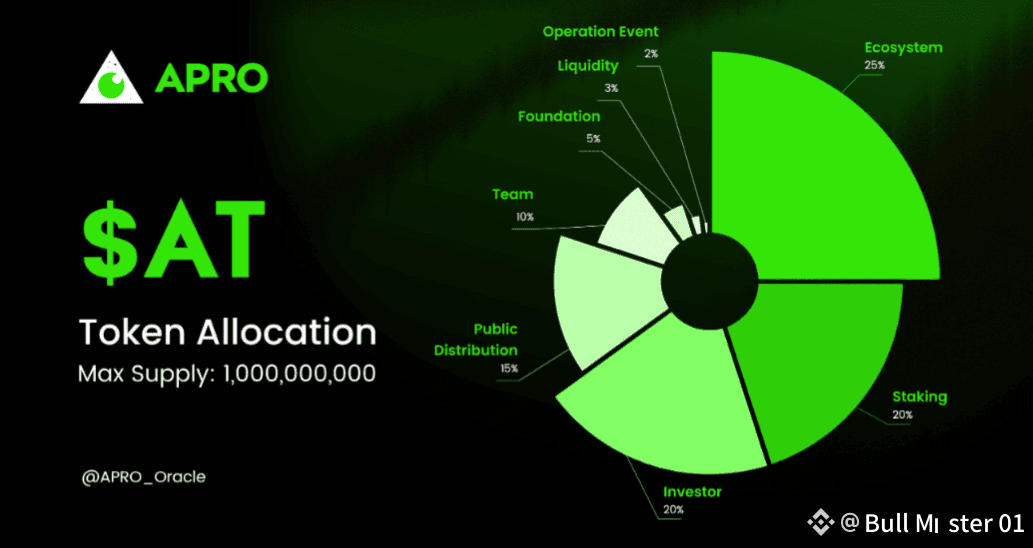
No blockchain project can survive without a well‑designed token model. Apro’s native token, AT, is capped at 1 billion. That cap makes it deflationary by design. No new tokens can be minted beyond the maximum supply, which creates scarcity and potential long‑term value.
Currently, the circulating supply stands at 230 million AT. The distribution strategy is carefully balanced: 25% goes to ecosystem growth, 20% to staking, 20% to investors, 15% to public distribution, 10% to the team, 5% to the foundation, 3% to liquidity, and 2% to operational events. This allocation ensures that resources are directed toward development, community incentives, and liquidity support. It’s a model that rewards participation while maintaining sustainability.
The AT token isn’t just a placeholder. It has real utility. It powers network operations, supports staking, and grants access to specialized data services. Node operators stake AT to secure the network, while applications use AT to pay for data requests. Holders also gain governance rights, allowing them to propose and vote on upgrades. In short, AT is the fuel that keeps Apro running.
How Apro Works in Practice
To understand Apro’s utility, you need to look at its three core services in detail.
APRO Data Service
This is the foundational layer. It operates on two models: Push and Pull.
In the Push model, decentralized nodes continuously monitor data and push updates to the blockchain when certain conditions are met. For example, if a price changes by a set percentage or a time interval passes, the update is sent automatically. This is perfect for DeFi protocols that need constant, real‑time feeds for lending, borrowing, or trading.
In the Pull model, applications request data only when they need it. This reduces unnecessary costs and makes the system more efficient. It’s ideal for platforms like derivatives trading, where updates are required only at execution.
APRO AI Oracle
Large Language Models are powerful, but they have a weakness: they can hallucinate. That means they sometimes produce confident but factually incorrect outputs. Apro’s AI Oracle solves this by grounding AI in verifiable, real‑time data. It aggregates information from multiple sources, verifies it, and delivers cryptographically signed facts. This ensures that AI systems can provide accurate insights for tasks like market analysis or portfolio tracking.
APRO RWA Oracle
Real‑world assets represent a trillion‑dollar market, but many of them are unstructured. They exist as contracts, deeds, images, or logistics records. Traditional oracles cannot process this type of data. Apro introduces a dual‑layer system. The first layer uses AI to interpret unstructured data. The second layer uses decentralized consensus to verify authenticity before recording it on‑chain. This allows for tokenization of complex assets like real estate titles, insurance claims, or pre‑IPO equity. It’s a revolutionary approach that opens new possibilities for decentralized finance.
Security and Reliability
Apro’s architecture is designed for resilience. It uses a hybrid node approach that combines on‑chain and off‑chain resources. Multi‑network communication ensures there are no single points of failure. The Time‑Weighted Average Price mechanism protects against volatility and manipulation by delivering fair and accurate data.
These features make Apro a trusted source of information for mission‑critical applications. Whether it’s a DeFi protocol relying on price feeds or an AI system needing real‑time data, Apro provides the reliability required to operate securely.
Developer Offerings
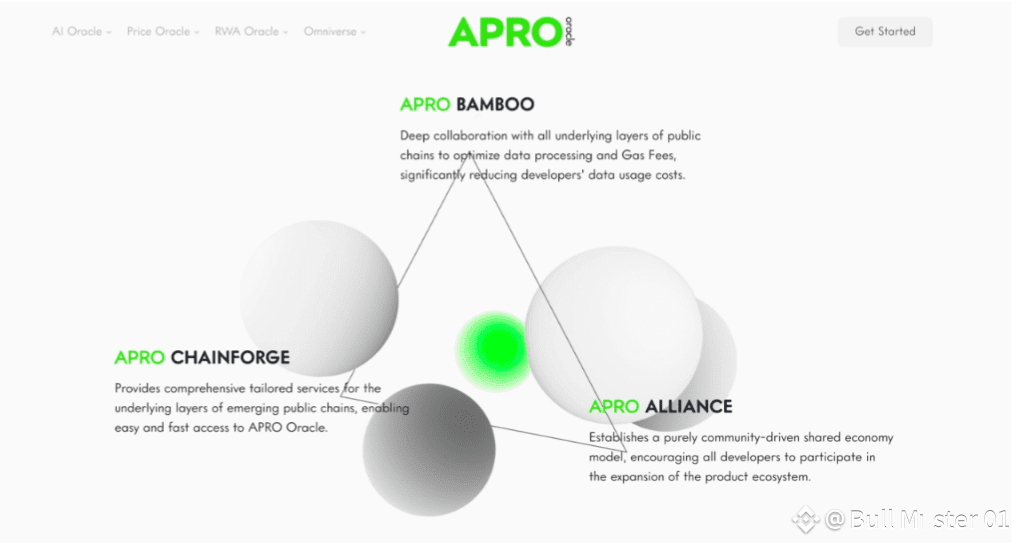
Apro isn’t just about data. It’s also about empowering developers. It offers tools like APRO BAMBOO, which optimizes data processing and gas fees. APRO CHAINFORGE provides tailored services for emerging public chains, making integration seamless. APRO ALLIANCE encourages developers to participate in ecosystem expansion through a shared economy model.
These offerings make Apro developer‑friendly. Startups can access reliable, affordable services, while enterprises can benefit from high‑performance infrastructure. It’s a system designed to support growth at every level.
Market Position
The oracle sector is competitive. Established players already serve DeFi and dApps. Apro differentiates itself by focusing on AI and RWAs. By enabling tokenization of complex assets and grounding AI in verifiable data, Apro expands the scope of what oracles can achieve.
Its integration across multiple blockchains strengthens its position. With support for more than 40 networks, Apro ensures interoperability and broad adoption potential.
Investment Perspective
Apro’s strengths are clear. It has a first‑mover advantage in AI and RWA oracles. Its token model is deflationary and well‑structured. Its architecture is robust, and its developer offerings encourage adoption.
Risks remain. The oracle space is crowded, and Apro must continue innovating to capture market share. Market volatility also poses challenges, as with all digital assets. Execution of its ambitious roadmap will be crucial.
The Bigger Picture
Oracles are indispensable for Web3. Without them, smart contracts remain isolated. Apro’s hybrid model, AI integration, and RWA tokenization capabilities make it more than just another oracle. It’s a foundational layer for decentralized infrastructure.
By bridging blockchain with complex external data, Apro enables smarter, more reliable applications. Whether in finance, artificial intelligence, or asset management, its services expand the possibilities of decentralized technology.
Conclusion
Apro (AT) is redefining the role of oracles in blockchain. With its hybrid architecture, AI Oracle, and RWA Oracle, it addresses challenges that traditional solutions cannot. Its deflationary tokenomics, developer offerings, and strong market debut highlight its potential to become a cornerstone of Web3 infrastructure.
As decentralized applications grow more complex, the demand for sophisticated data solutions will only increase. Apro’s ability to deliver reliable, verifiable, and multi‑layered data positions it as a key player in shaping the future of blockchain adoption.


