

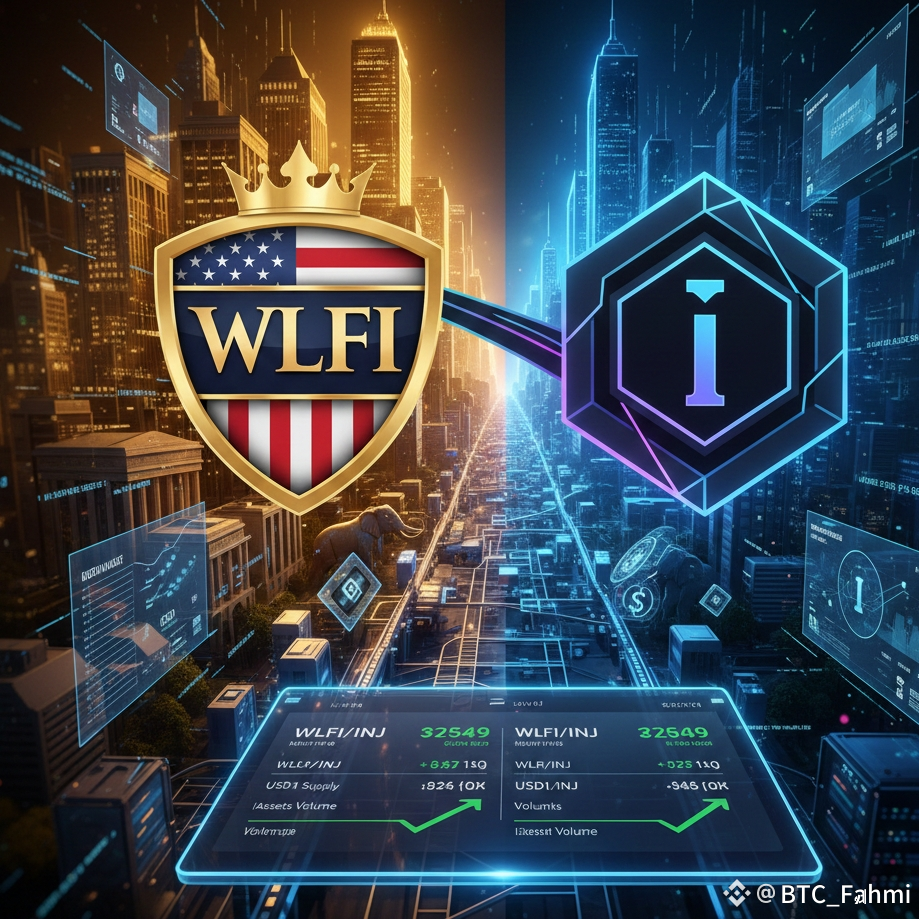
World Liberty Financial is already one of the loudest stories in crypto, sitting right on the fault line between markets and politics. Injective is on the other side of the spectrum, a relatively quiet but very serious layer 1 that is laser focused on derivatives, real world assets, and institutional grade infrastructure. Put those two worlds together in an asset management context and you get a narrative traders are naturally curious about, even if, to be clear, there is no publicly confirmed strategic partnership between World Liberty Financial and Injective as of 4 December 2025. What follows is how such a tie up would fit into what both projects are already doing, and why the market is paying attention to the overlap.
First, a quick recap of World Liberty Financial. WLFI is the Trump family DeFi project that went live in late 2024 and really took off after the 2024 US election. It runs the WLFI governance token and USD1, a dollar backed stablecoin that launched in March 2025. By mid 2025, USD1 had reached around 2 billion dollars in circulation, with most of the float reportedly sitting on Binance. That positioning lets World Liberty earn something like 80 million dollars a year on the underlying treasuries and money market funds that back the coin. External researchers estimated that by 9 February 2025, WLFI controlled roughly 327 million dollars in assets, with about 37.8 million on chain and about 289 million held at centralized venues such as Coinbase Prime. On top of that, Arkham and others have tracked sizeable treasury moves, including 21.5 million dollars deployed into ETH, wrapped BTC, and MOVE in early 2025. This is not a meme only project, it is already running a sizable book.
World Liberty has also been busy on the partnership side, particularly around real world assets. In early 2025 it aligned with Ondo Finance, planning to use Ondo tokenized treasuries and other RWAs as reserve assets and yield sources for its ecosystem. In June 2025 it teamed up with PancakeSwap to drive USD1 liquidity, helped along by a swarm of patriotic themed memecoins and a liquidity incentive program with up to 1 million dollars in prizes. Later in the year, Sui announced a collaboration with WLFI and saw its native token jump about 14 percent on the news. Most recently, on 3 December 2025, Reuters reported that World Liberty plans to roll out a full suite of real world asset products in January 2026, and that USD1 has already been used by Abu Dhabi backed MGX to fund an investment in Binance. Whether you like the project or not, it is clearly positioning itself as a big on chain asset manager, not just a token.
Injective is walking a similar road, but from the infrastructure side. It is a high speed layer 1 built for finance, with Helix as its flagship exchange and a growing ecosystem of derivatives and real world asset products. The Volan mainnet upgrade in 2024 added modules for tokenized fiat pairs, treasury bills, and credit products, explicitly targeting RWAs. In 2025 Injective launched its iAssets framework, which turns things like stocks, ETFs, and bonds into programmable DeFi building blocks rather than simple wrapped tokens. Nvidia stock and even Nvidia H100 GPU rental prices are now available as on chain markets that can be traded, used as collateral, or inserted into structured strategies. On chain activity has exploded over the last couple of years, with weekly transactions rising to tens of millions by early 2025 according to Token Terminal data cited in several analyses.
On top of that, Injective has just wired itself into Chainlink Data Streams. That upgrade, announced on 21 November 2025, gives Helix and other Injective apps sub second market data, which matters a lot for perpetuals, low latency AMMs, and RWA products that need tight pricing. The picture you get is a chain designed to host serious asset management activity: institutional treasuries, on chain funds, and exotic derivative structures.
So what would it actually look like if World Liberty Financial decided to use Injective as one of its asset management rails. Start with the obvious fit: USD1 and WLFI treasury assets could be deployed into Injective’s iAssets ecosystem as collateral and liquidity. Today, Injective supports tokenized treasuries, fiat pairs, equities, and AI linked indices like an AI basket perpetual and pre IPO markets such as the OpenAI perpetuals listed on Helix. A WLF treasury that is already buying tokenized treasuries through partners like Ondo could route part of that flow into Injective based products, gaining 24 by 7 liquidity, leverage, and composability with other DeFi strategies.
For traders, the interesting bit would not just be another listing, it would be how USD1 and WLFI show up in the Injective ecosystem. At the moment, WLFI and INJ are already casually compared in market cap and volume tools. One calculator site, for example, currently shows WLFI at about 4.34 billion dollars in market cap with roughly 27.24 billion tokens in circulation, versus Injective at about 595 million dollars in market cap with 100 million tokens. These snapshots move around, but they tell you that WLFI is already trading at a size where new venues and cross ecosystem liquidity can matter. If USD1 or WLFI pairs became native on Helix with deep books, you would immediately get basis trades between centralized venues, WLFI’s own platform, and Injective, plus new funding rate dynamics if perpetuals were added on top.
The bigger story, though, is the convergence of narratives. World Liberty is selling a politically charged pitch: US aligned stablecoin, treasury backed yield, and a very visible presidential family at the center. Injective is selling performance and institutional grade plumbing: tokenized RWAs, compliant service providers, and now high speed oracles. Markets love clean narratives, and a hypothetical WLFI Injective asset management relationship combines three hot themes in 2025: real world assets, AI driven markets, and political power wrapped in tokens. That is why traders are already poking at the overlap, even in the absence of a formal deal.
From a practical trading perspective, I would treat any deepening link between these ecosystems as an opportunity, not a reason to ape in blindly. On the positive side, more on chain treasury activity on Injective means more flows through Helix and the iAssets module, which can translate into higher volume and more diverse markets. On the World Liberty side, routing part of its reserves into transparent on chain strategies could give traders better data on how the project is actually managing risk, instead of just reading press releases. You would want to watch metrics like USD1 supply growth, the share of reserves in tokenized treasuries or RWAs, and Injective volumes in related markets.
On the risk side, you have to remember what you are plugging into. World Liberty is heavily centralized around a single family and has been criticized for the tight link between private profit and public office. That introduces political and regulatory tail risk that is very different from a neutral stablecoin issuer. Injective, for its part, is pushing into complex products like pre IPO perpetuals and AI hardware derivatives. These are powerful tools but they rely on oracle quality and market structure that can break under stress. If you are managing a book, you size positions for those tail scenarios, not just for the smooth days.
Personally, if I saw World Liberty start parking serious size on Injective, I would not rush to chase price on either token. I would map out the actual integration points: which assets are bridged, where the yields come from, how concentrated the liquidity is, and what the unwind would look like in a correlated selloff. Then I would look for relative value and structural edges. Maybe that is a persistent funding spread between WLFI related perps on Helix and spot on centralized venues. Maybe it is a discount on some iAsset that the WLF treasury is forced to hold for partnership reasons. In other words, I would trade the structure rather than the headline.
In the end, the idea of World Liberty Financial partnering with Injective for asset management is less about one press release and more about a direction the market is already heading. Politically connected DeFi treasuries want sophisticated, on chain tools for running large portfolios. Purpose built chains like Injective want large, sticky asset managers to prove that their infrastructure is not just for degens. If those incentives line up, we will see more flows between these two worlds, whether it is called a partnership or not. As traders and developers, our job is to understand the plumbing, respect the risks, and be ready when the next narrative bridge turns from speculation into actual on chain positions.
