

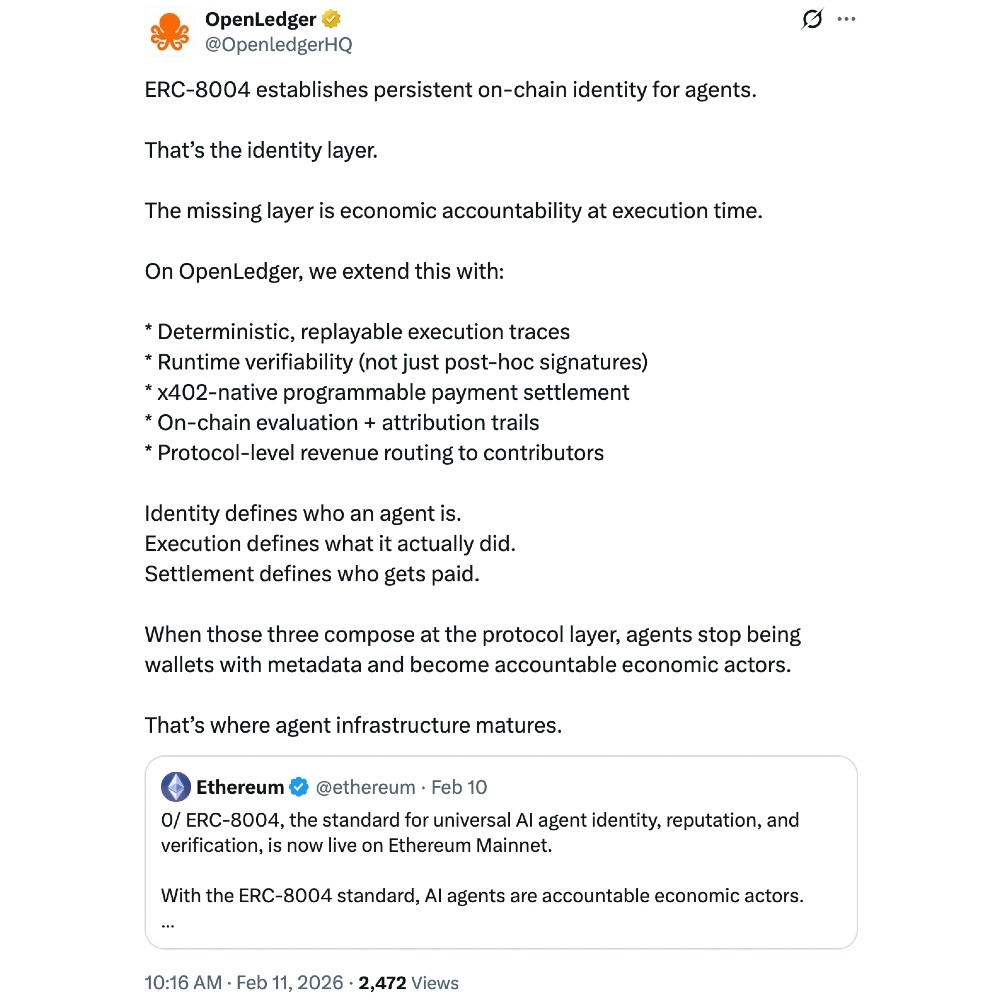
I was going through the materials @OpenLedger about x402 and I stopped at one phrase from their tweet - "x402-native programmable payment settlement". Simple, no fluff. Then I checked out a third-party article that paraphrased the same thing - it said, "OpenLedger launches x402, the World's first payment protocol". Same partnership, two different takes. The first one is spot on. The second one is rewritten for marketing. And I thought, the difference between them is definitely worth unpacking.
First, what is x402 really, without recapping press releases. It’s an open payment standard launched by Coinbase in May 2025 and in September was spun off into a separate fund together with Cloudflare. Technically, it relies on HTTP code 402, Payment Required, which has existed in HTTP specification since 1997 and has been unused for almost thirty years. The logic is simple to the point of being banal. The server responds not with 200 OK and data, but with 402 and payment conditions. The client - whether a person or an AI agent - pays in crypto, repeats the request with confirmation, and receives the data. No accounts, no subscriptions, no manual card input. Micro-payments from thousandths of a cent per request.
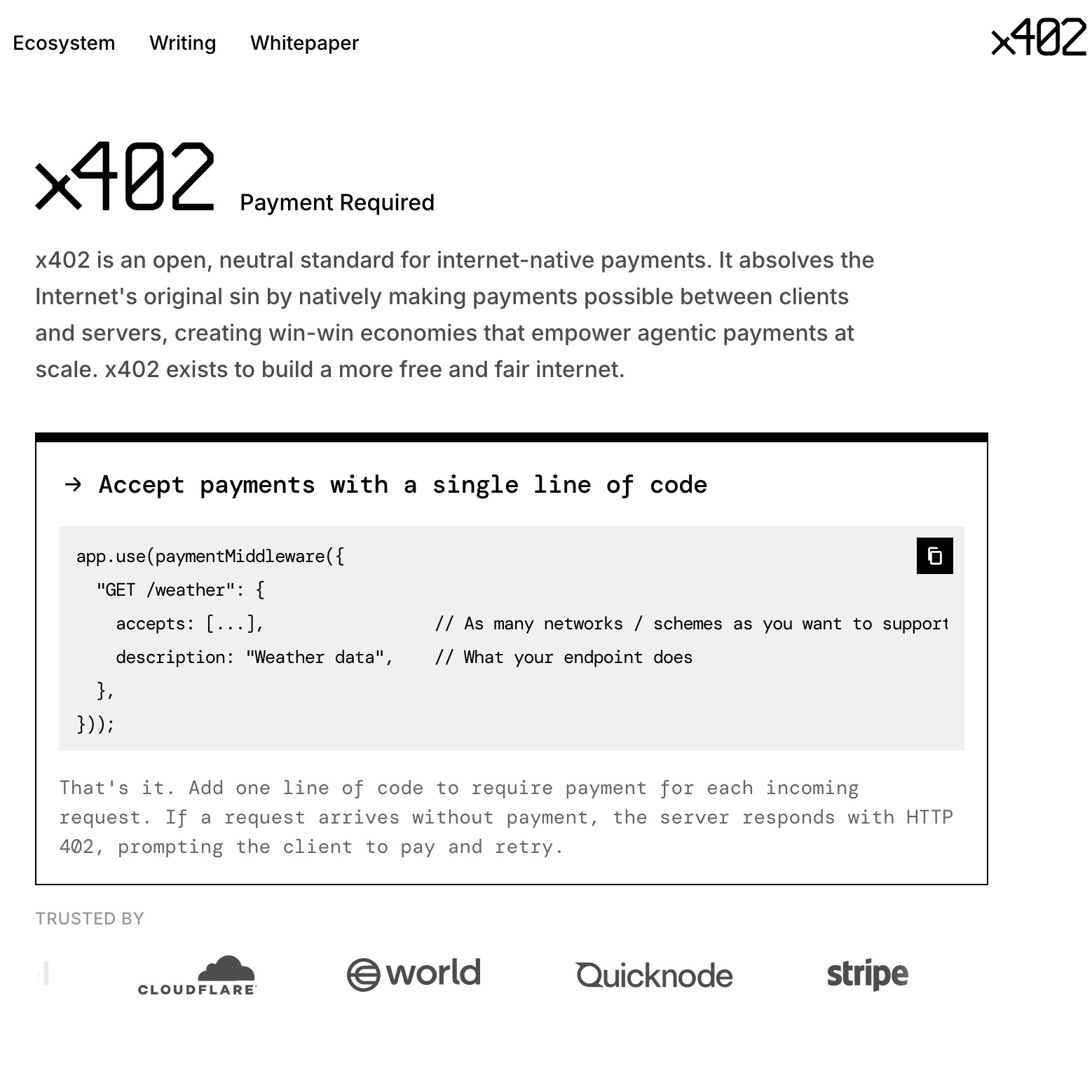
What OpenLedger did - they didn’t invent this protocol. They made it a native settlement layer in their architecture for AI agents. These are different actions. Creating a standard means proposing a specification and waiting for others to pick it up. Integrating the standard as native means "embedding" it into the network's operation so that for an agent living inside OpenLedger, the payment logic doesn’t require external calls. The first is what Coinbase does. The second is what many projects are doing simultaneously - Google adds x402 to its Agents Payment Protocol, Cloudflare offers integration to developers, OpenLedger makes it part of the stack for the AI economy.
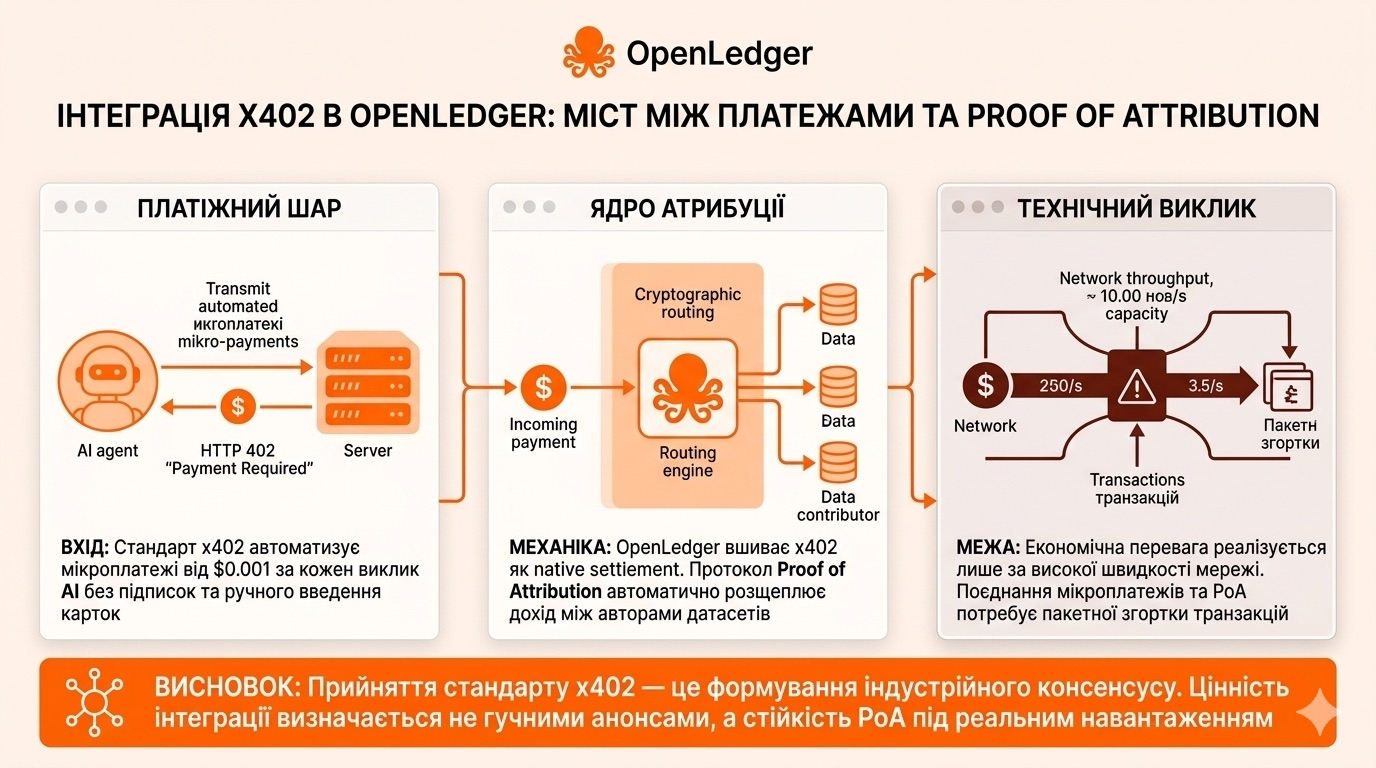
And this is where it gets interesting for OpenLedger specifically. In their tweet from February 2026, x402 is mentioned not just by itself, but as part of three points. First - x402 as a payment layer. Second - on-chain evaluation and attribution trails. Third - protocol-level revenue routing to contributors. When you read these three lines together, it’s clear the project is packaging: when an AI agent pays for a model call via x402, the funds don’t just go to the API owner. They are split according to whose dataset influenced the response. This split routing is provided by Proof of Attribution, the foundational protocol of OpenLedger. So, x402 here is not an independent value - it’s a bridge between the external world of payments and the internal world of attribution.
Here it’s worth pausing to think about how this actually works, because it's easy to buy into a pretty scheme. Thought scenario. An AI agent makes a request to a model trained on medical datasets from Maria, Boris, and over a hundred other authors. The OpenLedger server returns x402 with a condition - a certain amount of cents per call. The agent pays. PoA calculates whose dataset influenced the response the most. Revenue is split into one hundred plus one share. Sounds like a ready product. But there are two technical conditions without which it doesn't work. First - PoA must provide sufficiently accurate attribution for micro-payments; otherwise, someone gets $0.0001, and that loses its meaning. Second - the network must handle that number of microtransactions. I’ve previously noted that OpenLedger's throughput is currently around 5 transactions per second. If each model call generates one x402 transaction plus one attribution transaction - 5 TPS for the entire network is closed off by two and a half users.
Maybe I’m overestimating the problem - the real architecture might write on-chain not every call, but a batch "wrap" over a period. Maybe I’m underestimating - if PoA calculation goes as a separate transaction rather than embedded in the settlement, the load doubles. This isn’t explained in public materials. What is clear is that x402 as a settlement layer for the AI economy is technically beautiful, but its economic advantage is realized only when the throughput allows for a large volume of cheap transactions. Cheap transactions are x402’s strong suit according to Coinbase's whitepaper, which promises payments from $0.001. Large volume is a function of the network in which it operates.
To keep in mind while reading the next news about OpenLedger and x402. The adoption of the standard is not an event; it’s a process with many players. Google, Coinbase, Cloudflare, OpenLedger, dozens of others - all adding x402 to their stacks simultaneously. This is not a race for first. It’s the formation of industry consensus, where the advantage will not go to whoever integrates first, but to whoever makes it work best in conjunction with their own mechanics. For OpenLedger, this own mechanic is Proof of Attribution. And I return to the same thought from previous days. The value of integrating x402 for OpenLedger will not be determined by how loudly it is written about, but by whether PoA can withstand the real load of microtransactions.
Imagine yourself as a developer choosing which infrastructure to use for collecting micro-payments for your AI service. You have several stacks supporting x402. What’s more important for you in the selection - purely payment speed and cost, or additional logic like automatic splits among contributors via attribution? The first is offered by everyone. The second - so far, very few.