
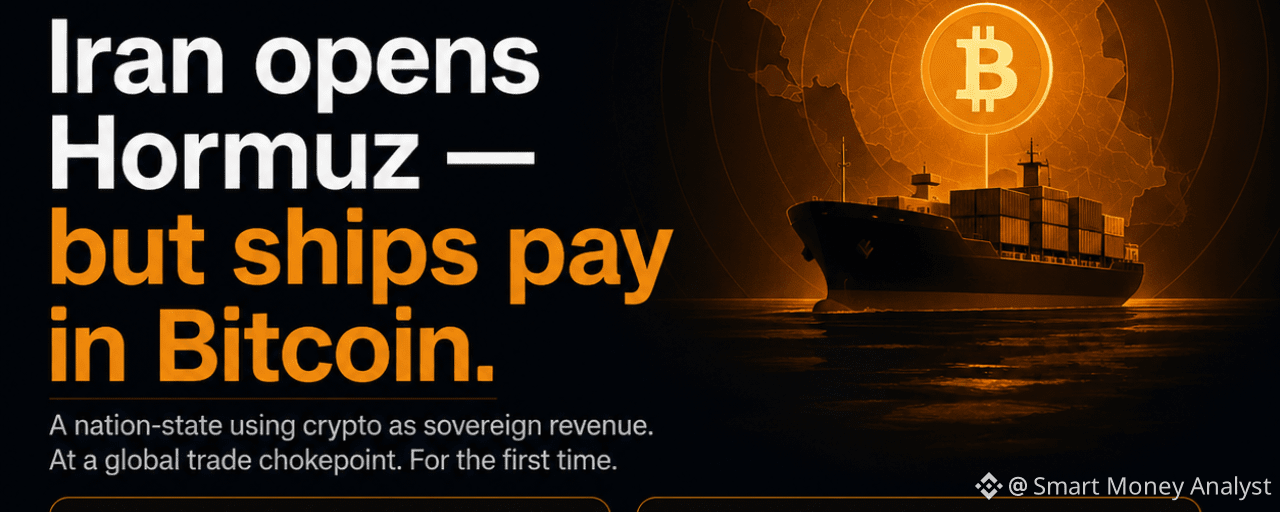
The Strait of Hormuz is open again following a US-Iran ceasefire, but the story doesn't end there. Iran is collecting cryptocurrency as transit fees from oil tankers passing through the strait, charging roughly $1 per barrel and instructing crews to settle in digital assets like Bitcoin.
This isn't informal. Iran's parliament formally codified the system through the "Strait of Hormuz Management Plan," approved in late March 2026, the first time a nation-state has used crypto infrastructure as a sovereign revenue mechanism at a major maritime chokepoint. NFT Plazas
The scale is staggering. The IRGC charges up to $2 million per vessel, with estimates suggesting the toll system could generate up to $20 million per day from oil tankers alone, potentially $600–800 million per month if LNG vessels are included. NFT Plazas
The crypto angle goes deeper. Analytics firm TRM Labs confirmed Iran's military has accepted Bitcoin and potentially USDT as payment, alongside Chinese yuan, all outside the US correspondent banking system. Coin Insider
Why this matters for crypto:
This is the first real-world proof that crypto works as a parallel financial rail at the sovereign level under the harshest sanctions pressure on earth. Love it or hate it, that's a use case no one can dismiss.
Markets are watching. When the ceasefire was first announced, crude oil prices dropped and crypto rallied, Bitcoin($BTC ) climbed toward $77K. Geopolitics is now a direct crypto catalyst. Blockonomi
Not financial advice. DYOR.
#IranDealHormuzOpen #bitcoin #crypto #Geopolitics #BinanceSquare