
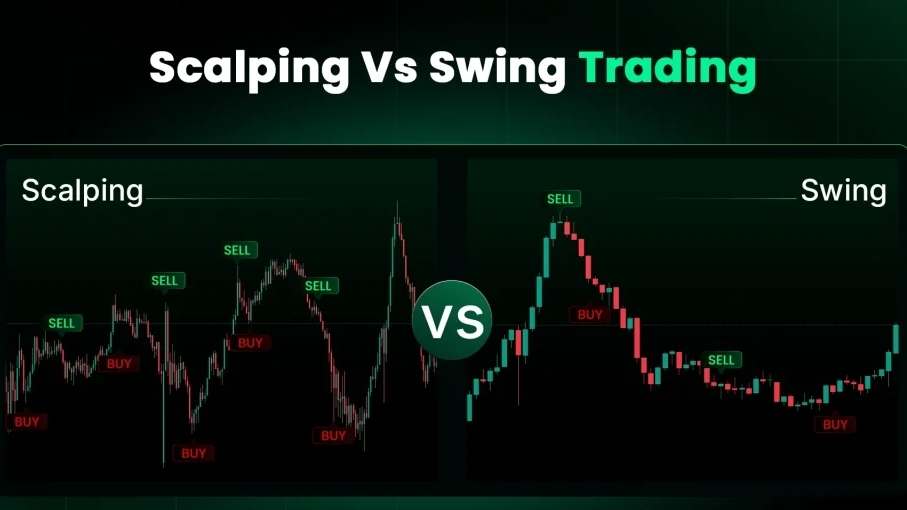


Crypto trading in 2026 is faster, more competitive, and more data-driven than ever before. New tools, deeper liquidity, and algorithmic participation have changed how traders approach the market. This evolution has intensified one of the oldest debates in trading scalping or swing trading. Both strategies promise profit, but the real question is which one actually fits the modern market structure.
Scalping thrives on speed. Traders operating on very short timeframes aim to capture small price movements repeatedly throughout the day. In today’s environment, where volatility can spike within minutes, this approach can feel highly attractive. Rapid execution, tight risk control, and constant chart monitoring allow scalpers to react to micro-opportunities that longer-term traders might ignore. For skilled participants, consistency in small gains can compound into meaningful returns.
However, the landscape for scalping has become more demanding. AI-driven bots and high-frequency strategies are now deeply embedded in futures markets. These systems analyze order flow, liquidity gaps, and momentum shifts in real time. Competing against such precision requires not only experience but also access to fast execution tools and disciplined risk management. Without preparation, scalping can quickly turn into overtrading, where transaction costs and emotional fatigue eat into profits.
Swing trading, on the other hand, focuses on broader market moves that unfold over days or weeks. Instead of chasing every fluctuation, swing traders aim to position around key support and resistance zones, trend structures, and macro narratives. This strategy benefits from patience. It allows traders to step back from noise and align with directional momentum that develops gradually. In trending markets, a single well-timed swing trade can outperform dozens of short-term positions.
The advantage of swing trading in 2026 is clarity. As institutional flows, tokenization narratives, and sector rotations shape market sentiment, larger trends become more meaningful. Traders who understand these narratives can build positions with defined risk and avoid the constant stress of monitoring every tick. Yet swing trading also requires psychological strength. Holding through pullbacks, ignoring short-term volatility, and resisting the urge to micromanage positions are not easy tasks.
Risk dynamics differ significantly between the two approaches. Scalpers face frequent decision points and must maintain strict discipline to prevent small losses from accumulating. Swing traders risk wider stop losses but often benefit from stronger reward-to-risk ratios. The choice between them is not purely about profitability — it is about personality, time availability, and tolerance for market noise.
In reality, 2026 is not about choosing a single winning strategy. The most adaptive traders combine elements of both. They may scalp during high-volatility sessions to exploit short bursts of momentum while maintaining swing positions aligned with larger trends. This hybrid mindset reflects how modern markets function — fast on the surface but structured underneath.
Ultimately, neither scalping nor swing trading guarantees success. What wins is execution, consistency, and emotional control. Markets reward traders who understand when to be aggressive and when to wait. In a cycle defined by speed and complexity, the true edge belongs to those who can balance precision with patience.