

Markets don’t move in straight lines. They fall, they panic, they stabilize — and sometimes, they surprise everyone. A market rebound is more than prices going up again. It’s a psychological shift. It’s the moment fear slowly loosens its grip and investors begin to believe that the worst may be behind them.
In 2026, the rebound story isn’t loud or explosive. It’s cautious. It’s selective. And it’s evolving.
What Is a Market Rebound, Really?
A market rebound happens after a period of decline when asset prices begin to recover. But not all rebounds are equal. Some are short-lived reactions driven by technical buying. Others mark the beginning of a longer recovery fueled by stronger fundamentals.
Right now, the rebound feels different from previous cycles. It’s not a dramatic V-shaped recovery where everything rallies at once. Instead, it’s more like a careful repositioning — investors are stepping back in, but with discipline.
The Mood Shift: From Panic to Patience
Earlier downturns were fueled by uncertainty around inflation, interest rates, and global tensions. Investors pulled back. Risk appetite shrank. High-growth sectors that had previously soared became vulnerable.
But sentiment has shifted. Not because all problems disappeared — they haven’t — but because expectations have adjusted. Markets don’t need perfect conditions to rise. They just need conditions that are “less bad” than feared.
That’s exactly what we’re seeing.
Investors are no longer pricing in extreme worst-case scenarios. And that alone can fuel a rebound.
Leadership Has Changed
One of the most telling signs of the current rebound is who is leading it.
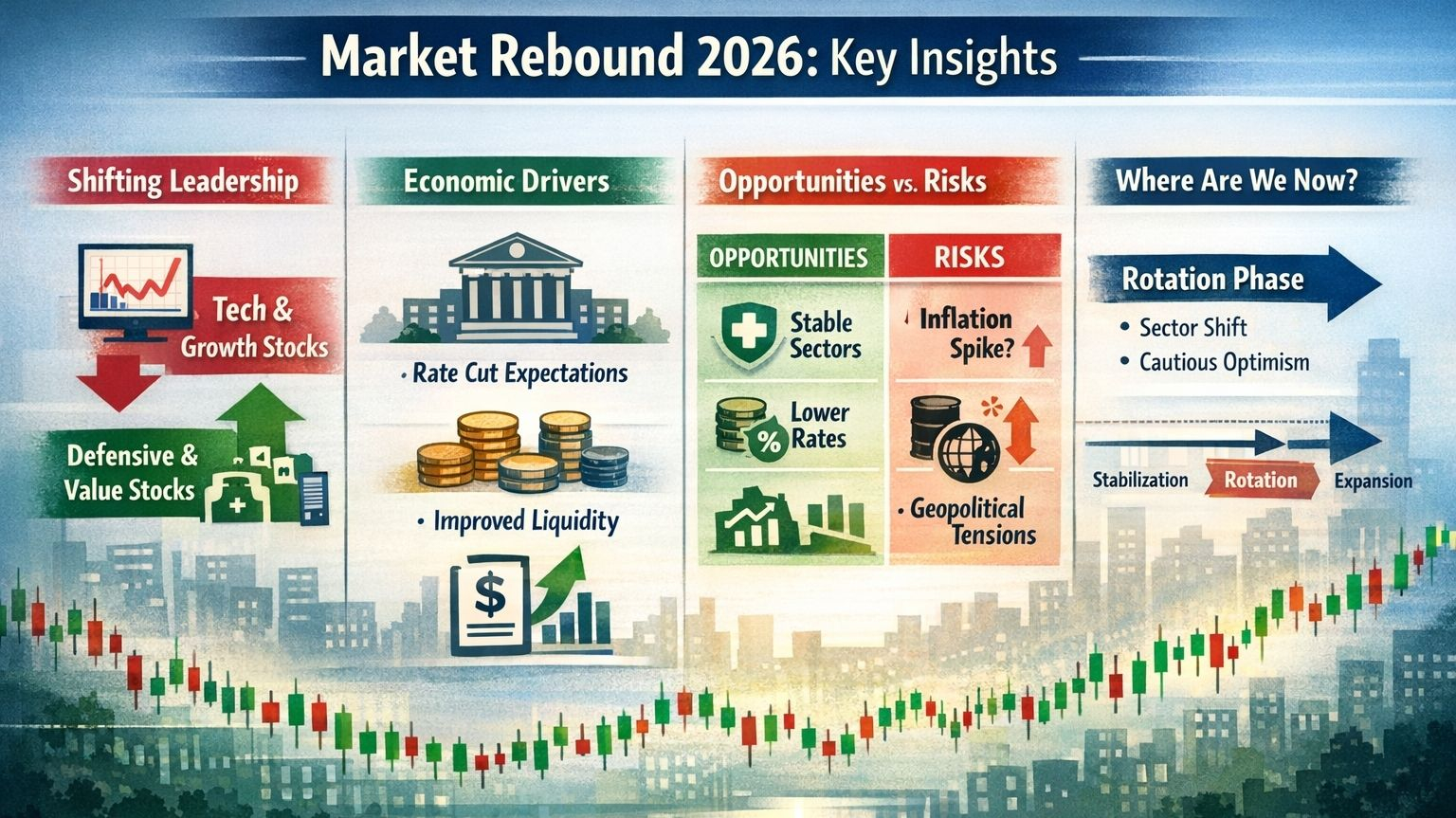
Instead of high-growth, hype-driven sectors dominating the headlines, more stable industries are stepping forward. Companies with steady cash flow, reliable earnings, and strong balance sheets are attracting attention. Investors are choosing predictability over speculation.
This isn’t blind optimism. It’s selective confidence.
When defensive and traditional sectors outperform, it suggests that investors are willing to buy — but they still want protection. It’s a rebound built on balance, not excitement.
The Role of Interest Rates
Interest rates are the heartbeat of modern markets. When borrowing costs rise, risk assets struggle. When expectations shift toward stability or modest easing, markets breathe easier.
In 2026, central bank signals have become less aggressive. While dramatic rate cuts are not guaranteed, the expectation that tightening may ease over time has reduced pressure on equities and other assets.
Lower expected rates mean future earnings look more valuable. It also makes financing cheaper for businesses and households. That combination can quietly support a rebound without needing spectacular headlines.
Liquidity: The Invisible Force
Liquidity often drives markets more than fundamentals in the short term. When money is flowing and credit conditions are stable, assets tend to perform better.
Recent shifts in policy have slowed the removal of liquidity from the financial system. This doesn’t mean money is flooding markets — but it does mean one major headwind has softened.
Rebounds often begin not because conditions are perfect, but because conditions stop getting worse.
Corporate Strength Still Matters
While macroeconomic headlines dominate news cycles, corporate performance plays a crucial role.
Many large companies continue to report stable earnings. Share buybacks and dividends remain strong in certain sectors. This creates a foundation under the market. Investors may debate economic forecasts, but solid earnings give them something concrete to trust.
When businesses show resilience, markets respond.
What About Other Asset Classes?
The rebound isn’t limited to stocks.
Bond markets have shown signs of stabilization as long-term yields cooled from previous highs. This helps mortgage markets and reduces strain on consumers.
Digital assets have also experienced renewed inflows, particularly through institutional investment vehicles. While volatility remains high, the return of capital suggests risk appetite is not gone — just recalibrated.
Each asset class is telling the same story: caution, but participation.
Risks That Could Disrupt the Rebound
No rebound is guaranteed to last. Several risks still hover over global markets.
If inflation unexpectedly rises again, central banks could tighten policy further. If financial stress emerges in credit markets, confidence could weaken quickly. Geopolitical tensions could also inject sudden volatility into commodities and equities.
The current rebound is not built on euphoria. It’s built on relative stability. That makes it stronger in some ways — but still sensitive to shocks.
How Investors Are Measuring Strength
Professionals don’t just look at index levels. They look deeper.
Are more stocks participating in gains, or just a handful? Are credit markets supportive? Are earnings estimates improving? Are fund flows positive?
Healthy rebounds show broad participation and improving internal indicators. Weak rebounds are narrow and fragile.
Right now, signals are mixed — but gradually improving.
Is This the Start of a New Cycle?
That’s the big question.
Markets typically move through stages:
First comes stabilization — volatility cools and selling pressure fades.
Then comes rotation — money shifts into new sectors.
Finally comes expansion — broad participation and rising confidence.
Today’s market appears to be in the rotation phase. Investors are repositioning. They are testing new leadership. They are becoming selective rather than aggressive.
Whether this becomes a sustained uptrend depends on continued economic resilience and policy clarity.
The Bigger Picture
A market rebound is not just about numbers on a screen. It reflects collective psychology. It reflects how millions of participants interpret risk and opportunity.
The 2026 rebound is not loud or reckless. It is thoughtful. It shows that investors are willing to move forward — but with discipline.
This isn’t a return to the excess of previous rallies. It’s a reset.
And sometimes, the healthiest recoveries begin not with excitement, but with quiet confidence.