Binance Square

kite

3M views
29,128 Discussing
SanjiHunter - CryptoNews
--
Symbiotic architecture: autonomous agents, autonomous payments – the final step to true delegation The promise of autonomous agents—software capable of executing complex goals without human intervention—has long been handicapped by a fundamental dependency: the human financial bottleneck. we could build agents capable of planning and negotiating, but every transaction, no matter how small, required a human to manually authorize payment, destroying the agent’s autonomy and efficiency kite ($KITE ) eliminates this crippling dependency. it is the first architecture built to treat autonomous agents and autonomous payments as a single, symbiotic system. this fusion is the final, non-negotiable step required to transition the digital economy from a human-driven system to a fully self-executing one i. The agent: identity and accountability (the autonomous actor) 🛂 True financial autonomy requires accountability. kite ensures agents are not simply anonymous scripts, but trustworthy economic actors capable of being delegated real capital Verifiable cryptographic identity: every agent is issued an agent passport, providing a unique, non-repudiable identity. this enables traceability and provenance, ensuring users know exactly who is executing the action.Programmable governance: the core of autonomous safety is embedded here. users set spending rules and permissions that are cryptographically enforced by the protocol itself. this means the user delegates the task (autonomy) while maintaining absolute financial control (safety). the agent can act freely within its mathematical boundaries, but cannot exceed themChain of trust: every decision the agent makes—from purchasing a data feed to executing a trade—is logged with its passport, creating an immutable audit trail that proves the agent adhered to its programmed constraints {spot}(KITEUSDT) ii. The payments: velocity and sovereignty (the autonomous finance) 💳 For an autonomous agent to execute an action, the payment must be instantaneous and cost-effective. the human process of seconds is fatal; the machine process requires milliseconds x402 protocol velocity: the x402 protocol is the engine of autonomous payment. it enables machine-to-machine (m2m) micropayments with ultra-low latency and near-zero fees. this speed is essential because complex agent workflows might require hundreds of micro-transactions per minute (paying for compute, data, api access)Stablecoin sovereignty: agents require a reliable unit of account. x402 facilitates native settlement in stablecoins, eliminating the volatility risk associated with utility tokens. this financial sovereignty allows agents to price services reliably and execute trades confidentlyZero-human-intervention: the x402 protocol processes transactions only after verifying the agent’s cryptographic identity and confirming the payment adheres to the pre-set programmable governance rules. the entire settlement loop is trustless and requires zero human approval, fulfilling the promise of true autonomy {future}(KITEUSDT) iii. The symbiotic loop: unlocking true autonomy 🔄 The power of kite lies in the seamless, instantaneous loop between the autonomous agent and the autonomous payment system Agent action: an agent makes a decision (e.g., "i need to buy data")Constraint check: the kite l1 verifies the agent's identity and checks the transaction against the user's programmable governance rules (e.g., "is the cost < $5? yes.")x402 settlement: the payment is executed instantly and near-free via x402Continued action: the agent receives the data and continues the task without waiting for human confirmation This loop removes the single biggest bottleneck in delegated commerce, allowing agents to operate at computational speed, not human speed. the resulting increase in efficiency and scale is exponential {alpha}(560x904567252d8f48555b7447c67dca23f0372e16be) 🔑 Conclusion: the mandated architecture Kite is not just facilitating payments for ai; it is building the mandated architecture where the actor and the financial instrument are unified. by coupling autonomous agents with autonomous payments, kite has created the only system capable of handling the speed, complexity, and fiduciary accountability required for the multi-trillion-dollar agentic economy @GoKiteAI #kite $KITE

Symbiotic architecture: autonomous agents, autonomous payments – the final step to true delegation

The promise of autonomous agents—software capable of executing complex goals without human intervention—has long been handicapped by a fundamental dependency: the human financial bottleneck. we could build agents capable of planning and negotiating, but every transaction, no matter how small, required a human to manually authorize payment, destroying the agent’s autonomy and efficiency
kite ($KITE ) eliminates this crippling dependency. it is the first architecture built to treat autonomous agents and autonomous payments as a single, symbiotic system. this fusion is the final, non-negotiable step required to transition the digital economy from a human-driven system to a fully self-executing one

i. The agent: identity and accountability (the autonomous actor) 🛂
True financial autonomy requires accountability. kite ensures agents are not simply anonymous scripts, but trustworthy economic actors capable of being delegated real capital
Verifiable cryptographic identity: every agent is issued an agent passport, providing a unique, non-repudiable identity. this enables traceability and provenance, ensuring users know exactly who is executing the action.Programmable governance: the core of autonomous safety is embedded here. users set spending rules and permissions that are cryptographically enforced by the protocol itself. this means the user delegates the task (autonomy) while maintaining absolute financial control (safety). the agent can act freely within its mathematical boundaries, but cannot exceed themChain of trust: every decision the agent makes—from purchasing a data feed to executing a trade—is logged with its passport, creating an immutable audit trail that proves the agent adhered to its programmed constraints

ii. The payments: velocity and sovereignty (the autonomous finance) 💳
For an autonomous agent to execute an action, the payment must be instantaneous and cost-effective. the human process of seconds is fatal; the machine process requires milliseconds
x402 protocol velocity: the x402 protocol is the engine of autonomous payment. it enables machine-to-machine (m2m) micropayments with ultra-low latency and near-zero fees. this speed is essential because complex agent workflows might require hundreds of micro-transactions per minute (paying for compute, data, api access)Stablecoin sovereignty: agents require a reliable unit of account. x402 facilitates native settlement in stablecoins, eliminating the volatility risk associated with utility tokens. this financial sovereignty allows agents to price services reliably and execute trades confidentlyZero-human-intervention: the x402 protocol processes transactions only after verifying the agent’s cryptographic identity and confirming the payment adheres to the pre-set programmable governance rules. the entire settlement loop is trustless and requires zero human approval, fulfilling the promise of true autonomy

iii. The symbiotic loop: unlocking true autonomy 🔄
The power of kite lies in the seamless, instantaneous loop between the autonomous agent and the autonomous payment system
Agent action: an agent makes a decision (e.g., "i need to buy data")Constraint check: the kite l1 verifies the agent's identity and checks the transaction against the user's programmable governance rules (e.g., "is the cost < $5? yes.")x402 settlement: the payment is executed instantly and near-free via x402Continued action: the agent receives the data and continues the task without waiting for human confirmation
This loop removes the single biggest bottleneck in delegated commerce, allowing agents to operate at computational speed, not human speed. the resulting increase in efficiency and scale is exponential

🔑 Conclusion: the mandated architecture
Kite is not just facilitating payments for ai; it is building the mandated architecture where the actor and the financial instrument are unified. by coupling autonomous agents with autonomous payments, kite has created the only system capable of handling the speed, complexity, and fiduciary accountability required for the multi-trillion-dollar agentic economy
@KITE AI #kite $KITE
#kite $KITE The future of AI-powered Web3 is taking flight with @GoKiteAI. From smart automation to real-time insights, $KITE is becoming the fuel for a next-gen digital ecosystem. Excited to see where goes next!
Kite : Blockspace Markets Become The First Marketplace Agents Treat Like InventoryKite has this habit of shipping things that sound small on paper and then you look closer and realize they quietly rewrote the entire rulebook. The blockspace market is the one almost nobody outside the core agent world has wrapped their head around yet. Everyone in crypto keeps talking about MEV auctions and PBS upgrades and who gets to order what packet first. Humans obsess over latency wars because that is the world they built. Agents do not care about any of that. They care about one thing only. Can they guarantee the right slot at the right microsecond without gambling against arbitrage bots. Kite finally gave them a system where blockspace feels less like a chaotic mosh pit and more like a warehouse where they can just buy shelves and use them however they want. It is a tiny framing shift but it changes almost everything. Most chains still treat blockspace like a public auction. You show up, you bid, you pray your transaction does not get sandwiched or replaced or mempooled into dust. If ten thousand bots want the same slot the fees go vertical and half of them still miss. The entire thing becomes a battle for who can throw more money at the problem in the shortest time. For humans this structure is annoying but survivable. For autonomous trading agents that need to fire thousands of micro actions per block without leaking alpha, it is impossible. You cannot build a machine fleet on top of a casino style auction. You just burn your runway into someone else’s mempool sniping script. Kite’s blockspace market is something else. It takes the whole idea of bidding on individual transactions and throws it away. Instead of fighting for every slot, an agent fleet buys a blockshare commitment inside its own shard. It is like renting a guaranteed portion of the next block ahead of time. You lock in that allocation with a predictable fee, the kind that does not balloon just because everyone panicked at the same second. Once the share is yours, you can fill it with whatever your agents need to emit. Ten thousand cancels. Five hundred micro hedges. One giant unwind. A weird combination of all of it. Nobody can reorder you because the sequencers treat the whole share as one atomic package. It enters as a unit. It clears as a unit. Not a single outsider even sees the internal order flow. And the way agents use these blockshares looks nothing like how humans think about blockspace. Humans see a slot. Agents see inventory. They stock it. They manage it. They buy more when volatility starts to climb and everyone else begins to panic. They sell it back to the treasury when the market goes quiet and the need for microsecond execution melts away. The blockspace becomes this fluid, programmable resource they can shape to whatever strategy they are running that day. In practice it turns out to be the missing piece of how to run an autonomous firm in a crypto environment without bleeding to death from priority fees. The economics behind it are even stranger. Because the shares are purchased by reputation weighted identities, the fleets that behave the cleanest get blockspace at a discount. They show up early, keep their internal nets tight, avoid spamming the network, and the system notices. Their blockshare costs drop. Their competitors show up late and end up overpaying. The whole structure becomes a permanent curve where the most disciplined fleets buy their execution rights at a cheaper price forever. Once a fleet hits that upper tier of reputation it does not need to fight anyone. It just reserves its share and quietly gets to work. There is this story circulating from late last quarter. A large routing fleet was running tens of thousands of micro executions per block. On any L2 the fees would have torched them. On any MEV exposed chain they would have been eaten alive. On Kite they simply expanded their blockshare during a volatility spike and kept doing what they do. Their total cost for the entire episode was lower than what a single whale spent on priority fees on a competitor network during the same event. The contrast is so dramatic that when people finally see the logs they assume the numbers are wrong. The weirdest part is how calm the whole thing feels. As the blockspace market heats up, agents just buy a bigger slice. As it cools, they give it back. There is no panic bidding. Kite did not tinker with MEV. It sidestepped the entire argument. It built a system where blockspace is purchased like inventory instead of gambled for like a lottery ticket. And once the first trillion dollar agent fleet relies on that predictability for its entire operating model, every other network will be left arguing about auctions while the machines quietly move on. #kite $KITE @GoKiteAI

Kite : Blockspace Markets Become The First Marketplace Agents Treat Like Inventory

Kite has this habit of shipping things that sound small on paper and then you look closer and realize they quietly rewrote the entire rulebook. The blockspace market is the one almost nobody outside the core agent world has wrapped their head around yet. Everyone in crypto keeps talking about MEV auctions and PBS upgrades and who gets to order what packet first. Humans obsess over latency wars because that is the world they built. Agents do not care about any of that. They care about one thing only. Can they guarantee the right slot at the right microsecond without gambling against arbitrage bots. Kite finally gave them a system where blockspace feels less like a chaotic mosh pit and more like a warehouse where they can just buy shelves and use them however they want. It is a tiny framing shift but it changes almost everything.
Most chains still treat blockspace like a public auction. You show up, you bid, you pray your transaction does not get sandwiched or replaced or mempooled into dust. If ten thousand bots want the same slot the fees go vertical and half of them still miss. The entire thing becomes a battle for who can throw more money at the problem in the shortest time. For humans this structure is annoying but survivable. For autonomous trading agents that need to fire thousands of micro actions per block without leaking alpha, it is impossible. You cannot build a machine fleet on top of a casino style auction. You just burn your runway into someone else’s mempool sniping script.
Kite’s blockspace market is something else. It takes the whole idea of bidding on individual transactions and throws it away. Instead of fighting for every slot, an agent fleet buys a blockshare commitment inside its own shard. It is like renting a guaranteed portion of the next block ahead of time. You lock in that allocation with a predictable fee, the kind that does not balloon just because everyone panicked at the same second. Once the share is yours, you can fill it with whatever your agents need to emit. Ten thousand cancels. Five hundred micro hedges. One giant unwind. A weird combination of all of it. Nobody can reorder you because the sequencers treat the whole share as one atomic package. It enters as a unit. It clears as a unit. Not a single outsider even sees the internal order flow.
And the way agents use these blockshares looks nothing like how humans think about blockspace. Humans see a slot. Agents see inventory. They stock it. They manage it. They buy more when volatility starts to climb and everyone else begins to panic. They sell it back to the treasury when the market goes quiet and the need for microsecond execution melts away. The blockspace becomes this fluid, programmable resource they can shape to whatever strategy they are running that day. In practice it turns out to be the missing piece of how to run an autonomous firm in a crypto environment without bleeding to death from priority fees.
The economics behind it are even stranger. Because the shares are purchased by reputation weighted identities, the fleets that behave the cleanest get blockspace at a discount. They show up early, keep their internal nets tight, avoid spamming the network, and the system notices. Their blockshare costs drop. Their competitors show up late and end up overpaying. The whole structure becomes a permanent curve where the most disciplined fleets buy their execution rights at a cheaper price forever. Once a fleet hits that upper tier of reputation it does not need to fight anyone. It just reserves its share and quietly gets to work.
There is this story circulating from late last quarter. A large routing fleet was running tens of thousands of micro executions per block. On any L2 the fees would have torched them. On any MEV exposed chain they would have been eaten alive. On Kite they simply expanded their blockshare during a volatility spike and kept doing what they do. Their total cost for the entire episode was lower than what a single whale spent on priority fees on a competitor network during the same event. The contrast is so dramatic that when people finally see the logs they assume the numbers are wrong.
The weirdest part is how calm the whole thing feels. As the blockspace market heats up, agents just buy a bigger slice. As it cools, they give it back. There is no panic bidding.
Kite did not tinker with MEV. It sidestepped the entire argument. It built a system where blockspace is purchased like inventory instead of gambled for like a lottery ticket. And once the first trillion dollar agent fleet relies on that predictability for its entire operating model, every other network will be left arguing about auctions while the machines quietly move on.
#kite
$KITE
@KITE AI
$KITE is building something that feels almost futuristic, yet surprisingly real. It’s a world where AI isn’t just a tool it becomes a financial decision maker on its own. Imagine intelligent agents that can pay, trade, and follow rules without anyone pushing buttons or watching over them. This is where the Kite blockchain steps in. It’s an EVM Layer-1 network designed specifically for agentic payments, meaning AI agents can interact and transact in real time with a verified digital identity. Kite’s three-layer identity system protects the user, controls the agent, and secures every session. Nothing moves without trust. At the center of this system is the KITE token. It begins by rewarding activity and building the ecosystem. Later, it grows into something more powerful, unlocking governance, staking, and fee utilities that shape the network itself. $KITE is not just technology. It’s a shift in how intelligence, money, and autonomy connect. A step toward a future where financial decisions aren’t just made by humans, but by the intelligent systems we create. #BTCVSGOLD #BTC86kJPShock #TrumpTariffs #kite $KITE
$KITE is building something that feels almost futuristic, yet surprisingly real. It’s a world where AI isn’t just a tool it becomes a financial decision maker on its own. Imagine intelligent agents that can pay, trade, and follow rules without anyone pushing buttons or watching over them.

This is where the Kite blockchain steps in. It’s an EVM Layer-1 network designed specifically for agentic payments, meaning AI agents can interact and transact in real time with a verified digital identity. Kite’s three-layer identity system protects the user, controls the agent, and secures every session. Nothing moves without trust.

At the center of this system is the KITE token. It begins by rewarding activity and building the ecosystem. Later, it grows into something more powerful, unlocking governance, staking, and fee utilities that shape the network itself.

$KITE is not just technology. It’s a shift in how intelligence, money, and autonomy connect. A step toward a future where financial decisions aren’t just made by humans, but by the intelligent systems we create.

#BTCVSGOLD #BTC86kJPShock #TrumpTariffs #kite $KITE
My Assets Distribution
USDT
HOME
Others
89.41%
7.54%
3.05%
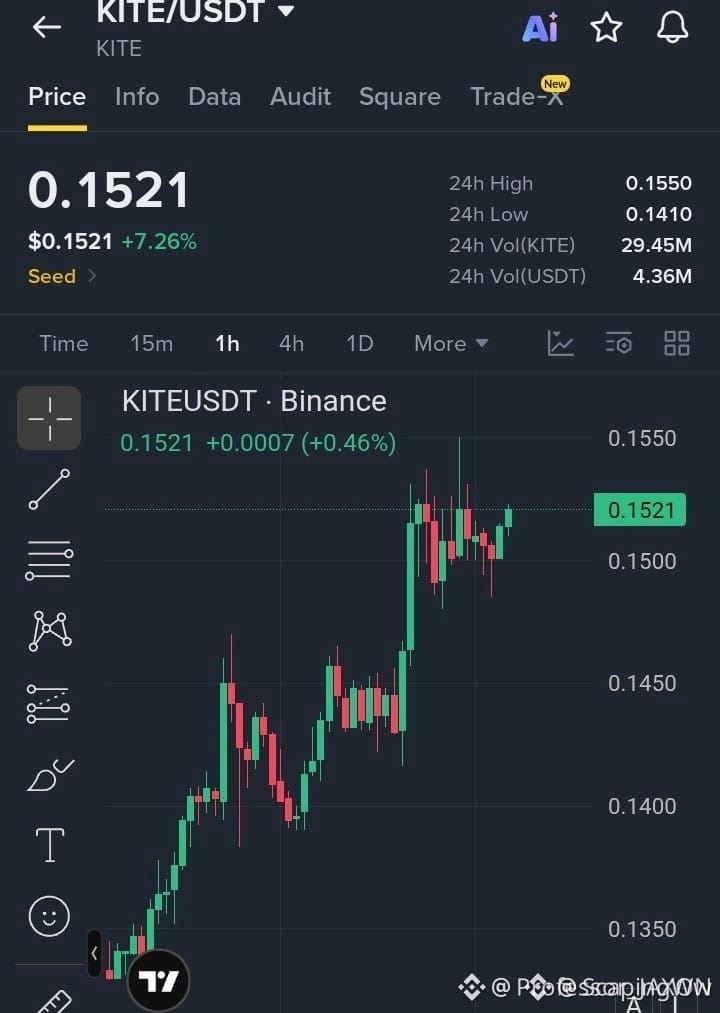
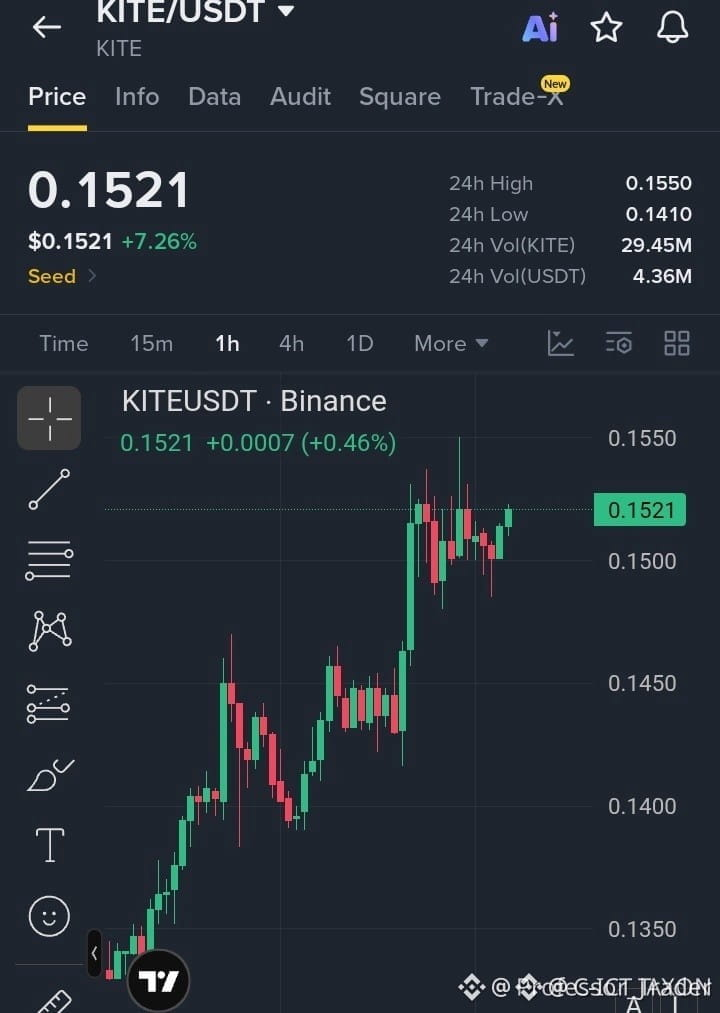
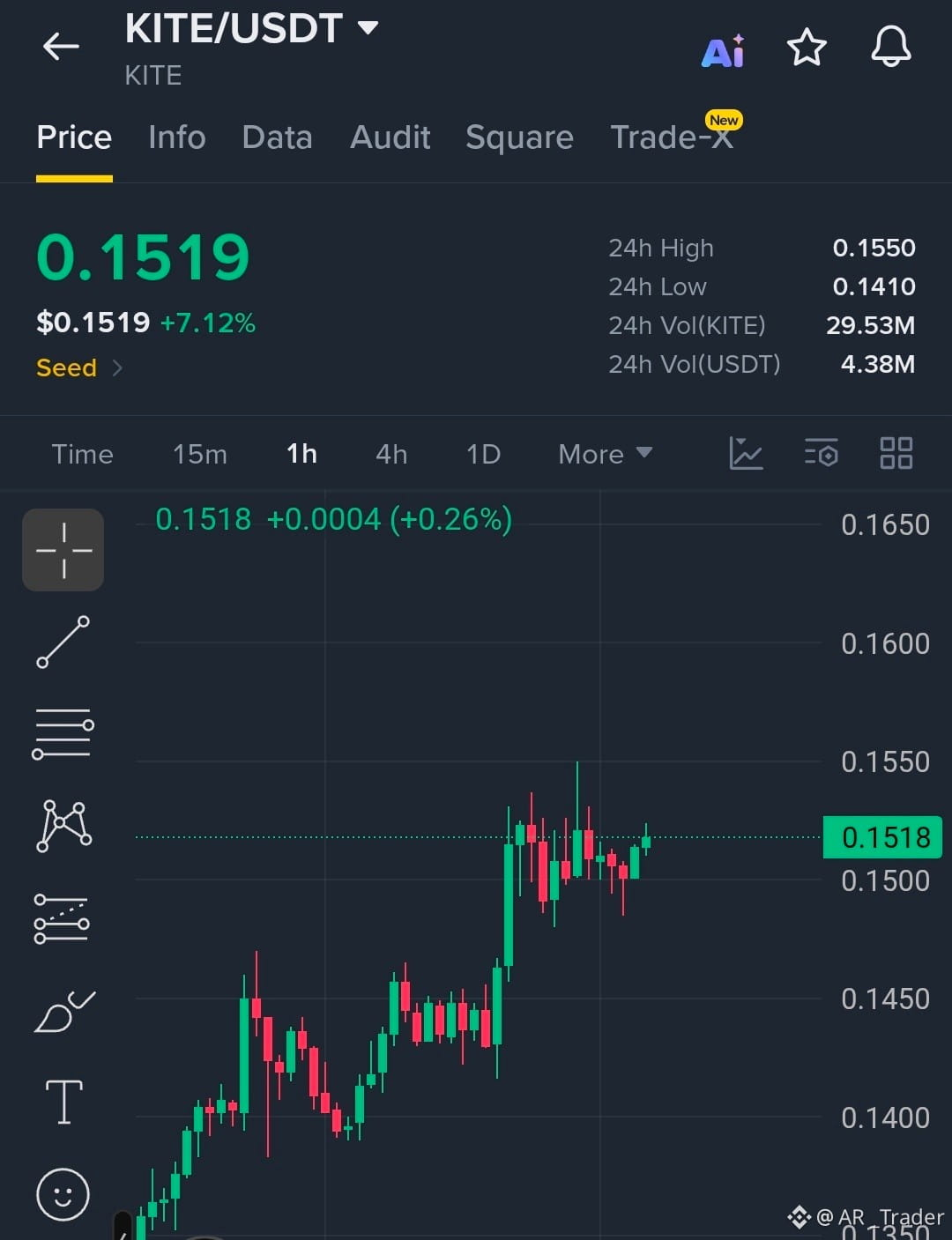
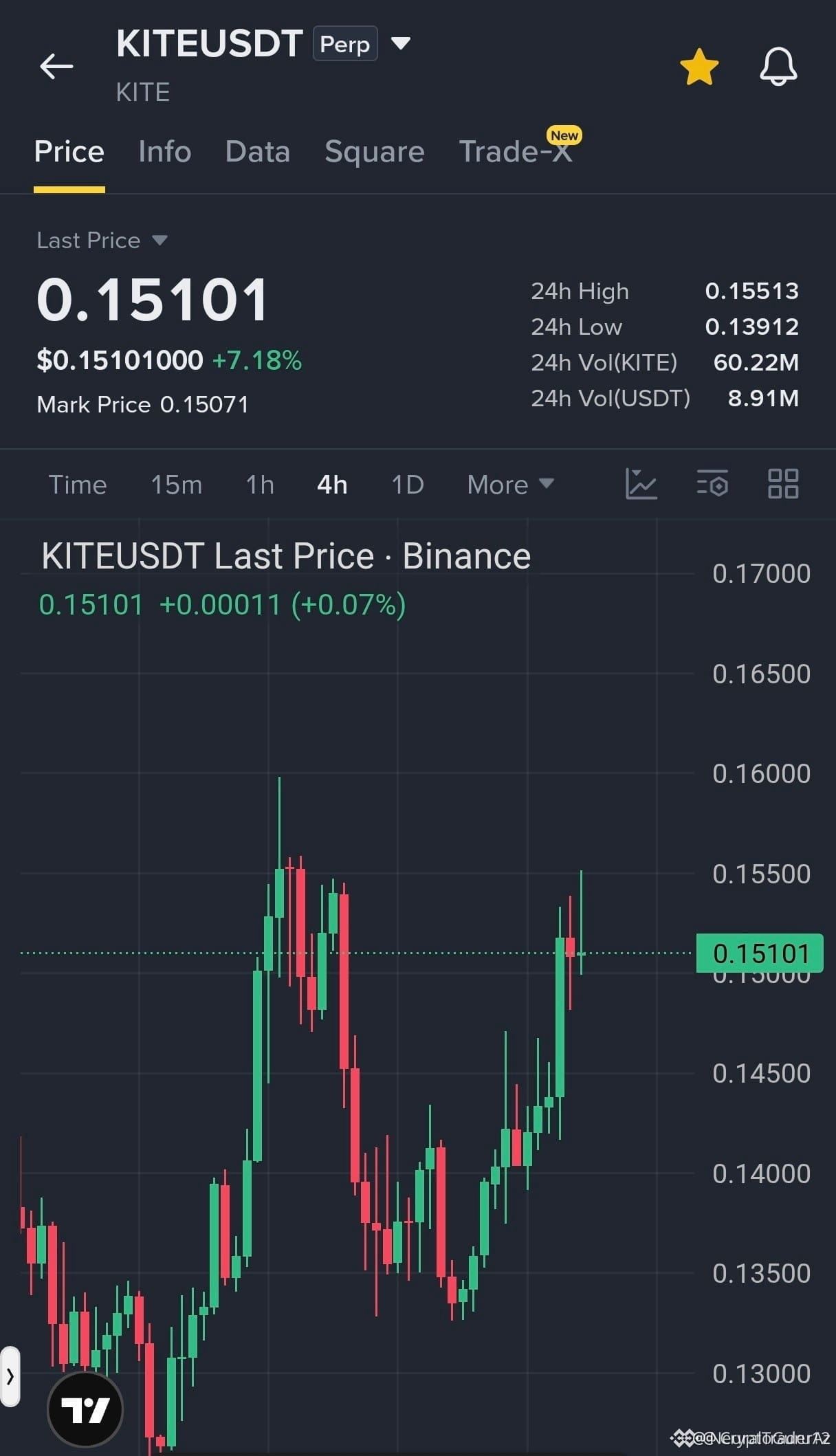
#kite $KITE chart analysis short ya long term trading benefits too chart analysis short term 5x benfite {future}(KITEUSDT)
#kite $KITE chart analysis short ya long term trading benefits too chart analysis short term 5x benfite
Where the Quiet Currents Flow: A Long Reflection on KITE and the Subtle Mechanics Where the Quiet Currents Flow: A Long Reflection on KITE and the Subtle Mechanics of Modern Coordination KITE did not begin as a grand idea. Most systems that end up reshaping a landscape rarely do. They emerge as quiet necessities—small bridges built to cross specific rivers—only later revealing themselves as the early bones of a much larger structure. In the case of KITE, its earliest purpose was simple enough: make autonomous actions on-chain feel less like isolated commands and more like unfolding conversations. But as the years went on, the question turned from how do systems act? to something much more human in nature: how do they stay consistent with themselves over time? That question is where KITE found its voice. There is something profoundly fragile about digital intentions. A human can wake up with a clear plan and alter it slightly without breaking continuity, but a system does not enjoy such luxury. It understands only what it is told at the moment it is told it. A task is a task; a command is a command; a state is a state. And yet, the world does not reward rigidity. Markets shift. Conditions drift. One moment bleeds into the next. What KITE offered—without ever announcing itself—is a way for tasks, decisions, and conditional behaviors to carry their memory forward, so that what begins as a single step does not lose its coherence as it becomes a journey. You could say that this is a technical achievement, but that would be a reduction. KITE is less about technology and more about honoring the natural shape of processes. Anyone who has managed a long endeavor knows how quickly intention erodes without structure. A project drifts. A plan forgets what it originally meant to achieve. A small change made for convenience grows into a contradiction. KITE approached this familiar human problem by building a quiet spine through which long-running tasks could align themselves. Instead of chasing novelty, it offered something rarer: continuity. The first people to understand its significance were those who had spent enough time in digital systems to see their limitations. To them, the problem was never raw computation; it was the erosion of meaning over time. A system could execute flawlessly but drift conceptually. It could follow rules while losing the reason those rules existed. KITE brought a kind of internal gravity: the ability for a sequence of actions to stay oriented toward its original purpose, whether the task lasted seconds or stretched into weeks. In practice, this meant that an autonomous system could respond to new information without betraying its past decisions. It meant that long workflows—settlements, compliance checks, predictive operations, agentic payments—no longer needed to be micromanaged to remain correct. And it meant that the relationship between intention and action could finally be treated not as a series of stop-and-start executions, but as a single woven thread. There is a quiet dignity in allowing systems to remember what they are trying to do. The real world does not permit clear separation between moments; it is a continuum. KITE took this truth and embedded it into machinery that was otherwise blind to time. If the world changed, KITE recalibrated without rewriting the intention. If the inputs shifted, it preserved the logic behind the outputs. Nothing about this was loud. In fact, most people interacting with systems powered by KITE might not even notice that anything had changed. And perhaps that was the point. One of the overlooked qualities of stable systems is how unremarkable they tend to feel. People often mistake quietness for simplicity, when in reality it signals that the complexity has been handled elsewhere. The builders took the weight so the user didn’t have to. KITE embraces this ethos fully. Its design is not concerned with spectacle or novelty. It is concerned with ensuring that the slow-moving structures—those that matter in finance, governance, logistics, and autonomous coordination—do not fracture under the pressure of time. As KITE matured, its role shifted again. It became less something people consciously used and more a quiet undercurrent shaping how systems behaved. Long-running strategies acted like intentions rather than scripts. Automated tasks behaved more like ongoing conversations than rigid sequences. Decisions made at one moment remained interpretable and coherent hours, days, or months later. In a digital era defined by fragmentation, this kind of durability felt strangely humane. There is a gentle metaphor in all of this: KITE operates the way memory operates in a well-lived life. Not as an archive, not as a list, but as a continuity of meaning. You carry your earlier choices with you. You adapt to the present without discarding your past. You take the changing world into account without losing who you were before it changed. Systems built on KITE behave the same way—not because they are human, but because they were designed with an understanding of how humans experience time. If someone were to trace the history of automation decades from now, they might overlook KITE entirely. Not because it lacked impact, but because it aimed for something deeper than attention. Its influence shows up in the smoothness of workflows, the steadiness of autonomous operations, the absence of contradictions in evolving tasks. It is the kind of system that proves itself not by being seen, but by eliminating the friction that would have otherwise been unmissable. In the end, KITE is a quiet reminder that progress in digital systems is not always about acceleration. Sometimes it is about coherence. Sometimes it is about honoring the long arc of a task, the unseen weight of responsibility, the subtle discipline required to keep a process honest over time. And sometimes the most meaningful innovations are not the ones that push forward loudly, but the ones that allow everything else to move with a little more clarity, a little more steadiness, and a little more grace. @GoKiteAI #kite $KITE

Where the Quiet Currents Flow: A Long Reflection on KITE and the Subtle Mechanics

Where the Quiet Currents Flow: A Long Reflection on KITE and the Subtle Mechanics of Modern Coordination
KITE did not begin as a grand idea. Most systems that end up reshaping a landscape rarely do. They emerge as quiet necessities—small bridges built to cross specific rivers—only later revealing themselves as the early bones of a much larger structure. In the case of KITE, its earliest purpose was simple enough: make autonomous actions on-chain feel less like isolated commands and more like unfolding conversations. But as the years went on, the question turned from how do systems act? to something much more human in nature: how do they stay consistent with themselves over time? That question is where KITE found its voice.
There is something profoundly fragile about digital intentions. A human can wake up with a clear plan and alter it slightly without breaking continuity, but a system does not enjoy such luxury. It understands only what it is told at the moment it is told it. A task is a task; a command is a command; a state is a state. And yet, the world does not reward rigidity. Markets shift. Conditions drift. One moment bleeds into the next. What KITE offered—without ever announcing itself—is a way for tasks, decisions, and conditional behaviors to carry their memory forward, so that what begins as a single step does not lose its coherence as it becomes a journey.
You could say that this is a technical achievement, but that would be a reduction. KITE is less about technology and more about honoring the natural shape of processes. Anyone who has managed a long endeavor knows how quickly intention erodes without structure. A project drifts. A plan forgets what it originally meant to achieve. A small change made for convenience grows into a contradiction. KITE approached this familiar human problem by building a quiet spine through which long-running tasks could align themselves. Instead of chasing novelty, it offered something rarer: continuity.
The first people to understand its significance were those who had spent enough time in digital systems to see their limitations. To them, the problem was never raw computation; it was the erosion of meaning over time. A system could execute flawlessly but drift conceptually. It could follow rules while losing the reason those rules existed. KITE brought a kind of internal gravity: the ability for a sequence of actions to stay oriented toward its original purpose, whether the task lasted seconds or stretched into weeks.
In practice, this meant that an autonomous system could respond to new information without betraying its past decisions. It meant that long workflows—settlements, compliance checks, predictive operations, agentic payments—no longer needed to be micromanaged to remain correct. And it meant that the relationship between intention and action could finally be treated not as a series of stop-and-start executions, but as a single woven thread.
There is a quiet dignity in allowing systems to remember what they are trying to do. The real world does not permit clear separation between moments; it is a continuum. KITE took this truth and embedded it into machinery that was otherwise blind to time. If the world changed, KITE recalibrated without rewriting the intention. If the inputs shifted, it preserved the logic behind the outputs. Nothing about this was loud. In fact, most people interacting with systems powered by KITE might not even notice that anything had changed. And perhaps that was the point.
One of the overlooked qualities of stable systems is how unremarkable they tend to feel. People often mistake quietness for simplicity, when in reality it signals that the complexity has been handled elsewhere. The builders took the weight so the user didn’t have to. KITE embraces this ethos fully. Its design is not concerned with spectacle or novelty. It is concerned with ensuring that the slow-moving structures—those that matter in finance, governance, logistics, and autonomous coordination—do not fracture under the pressure of time.
As KITE matured, its role shifted again. It became less something people consciously used and more a quiet undercurrent shaping how systems behaved. Long-running strategies acted like intentions rather than scripts. Automated tasks behaved more like ongoing conversations than rigid sequences. Decisions made at one moment remained interpretable and coherent hours, days, or months later. In a digital era defined by fragmentation, this kind of durability felt strangely humane.
There is a gentle metaphor in all of this: KITE operates the way memory operates in a well-lived life. Not as an archive, not as a list, but as a continuity of meaning. You carry your earlier choices with you. You adapt to the present without discarding your past. You take the changing world into account without losing who you were before it changed. Systems built on KITE behave the same way—not because they are human, but because they were designed with an understanding of how humans experience time.
If someone were to trace the history of automation decades from now, they might overlook KITE entirely. Not because it lacked impact, but because it aimed for something deeper than attention. Its influence shows up in the smoothness of workflows, the steadiness of autonomous operations, the absence of contradictions in evolving tasks. It is the kind of system that proves itself not by being seen, but by eliminating the friction that would have otherwise been unmissable.
In the end, KITE is a quiet reminder that progress in digital systems is not always about acceleration. Sometimes it is about coherence. Sometimes it is about honoring the long arc of a task, the unseen weight of responsibility, the subtle discipline required to keep a process honest over time. And sometimes the most meaningful innovations are not the ones that push forward loudly, but the ones that allow everything else to move with a little more clarity, a little more steadiness, and a little more grace.
@KITE AI #kite $KITE
--
Bullish
#kite $KITE Kite focuses on creating a secure environment where AI agents can manage payments and interactions without human involvement. Its Layer 1 blockchain supports fast and verifiable communication, making it suitable for automation at scale. The three-layer identity system adds strong oversight and control, ensuring every action is accountable. The KITE token launches with participation incentives and later expands into staking, governance, and fee-based functions, giving the ecosystem long-term sustainability in AI-driven markets @GoKiteAI #KİTE $KITE
#kite $KITE Kite focuses on creating a secure environment where AI agents can manage payments and interactions without human involvement. Its Layer 1 blockchain supports fast and verifiable communication, making it suitable for automation at scale. The three-layer identity system adds strong oversight and control, ensuring every action is accountable. The KITE token launches with participation incentives and later expands into staking, governance, and fee-based functions, giving the ecosystem long-term sustainability in AI-driven markets
@KITE AI #KİTE $KITE
My 30 Days' PNL
2025-11-07~2025-12-06
+$0.86
+79.93%
Kite: The Blockchain Built for Agentic Payments and Autonomous AI Economies #kite $KITE Kite is emerging at a moment when the world is shifting from simple automation to fully autonomous digital actors—AI agents that can think, communicate, negotiate, transact, and execute tasks without continuous human oversight. While most blockchains were designed for human-to-human or human-to-contract interactions, Kite is taking a different path. It is building a foundational Layer-1 network tailored specifically for real-time coordination between intelligent agents, creating a secure, programmable, and identity-verified environment where machines can operate as economic participants. At the heart of Kite’s vision is the concept of agentic payments. Traditional payment systems are not optimized for autonomy: they require manual approvals, central authentication, and trust assumptions that break down when machines must interact at scale. Kite recognizes that the next generation of digital economies will involve millions of AI agents working on behalf of humans, businesses, and decentralized systems. These agents need their own identity layer, their own rules for governance, and their own transaction pathways that remain verifiable, fast, and secure. Kite positions itself as the infrastructure that ties all of this together. Built as an EVM-compatible Layer 1, Kite ensures familiar developer tooling while offering enhancements specifically engineered for autonomous systems. Developers can deploy smart contracts as they would on any Ethereum-like chain, but with added protocol-level features for agent classification, session management, and permissioned interactions. This compatibility not only lowers the barrier for builders but also ensures that AI-focused projects can migrate existing smart contracts or integrate with the broader Ethereum ecosystem without redesigning their architecture. One of Kite’s most innovative breakthroughs is its three-layer identity framework. While many chains treat every address as equal, Kite introduces a separation between users, agents, and sessions. A user represents the human or entity behind the system. Agents are specialized autonomous units with defined roles, permissions, and behavioral constraints. Sessions act as temporary operation windows that limit what an agent can do at a given time. This layered approach dramatically improves security and operational control, preventing agents from exceeding their intended scope and reducing risks associated with compromised keys, unauthorized actions, or unpredictable AI behavior. The identity model also lays the foundation for programmable governance. Instead of rigid top-down rules, Kite allows governance logic to be embedded directly into the interaction flows between agents. This could mean dynamic trust scores, verifiable credentials, automated dispute systems, or hierarchical permissions—opening the door to complex, rule-driven AI economies that mimic real-world institutions but operate at machine speed. At the center of the ecosystem is the KITE token, which acts as the fuel powering the network. The token’s utility is being introduced in two deliberate phases. The first phase focuses on ecosystem participation, ensuring that developers, users, and early builders have incentives to join and experiment with Kite’s AI-oriented infrastructure. This early-stage utility encourages adoption, community formation, and experimentation, allowing the network to grow organically. The second phase expands the token’s role into the core economic engine of the chain. KITE will function in staking mechanisms, governance participation, gas payments, and security provisioning. This phased approach ensures stability: the network avoids premature responsibility overload while still setting the stage for long-term decentralization and robust community-led evolution. When fully activated, KITE will help secure the chain, empower agents with verifiable economic capabilities, and enable a sustainable ecosystem where participants—from humans to algorithms—can interact under transparent, predictable rules. Kite is ultimately building more than just another blockchain. It is preparing the infrastructure for a completely new type of digital society—one where autonomous AI entities can act on behalf of individuals, collaborate across borders, conduct business, manage resources, and even form decentralized organizations composed entirely of agents. As AI grows more capable and integrated into daily life, the need for secure, identity-aware, machine-native transaction networks will only become more pressing. With its specialized architecture, clear roadmap, and strong focus on agent-first design, Kite positions itself as a cornerstone of the emerging autonomous machine economy. Its blend of EVM familiarity and AI-native innovation offers a powerful blueprint for the next era of on-chain coordination—one where transactions are no longer just between people, but between the intelligent agents shaping our digital future. @GoKiteAI #KITE $KITE

Kite: The Blockchain Built for Agentic Payments and Autonomous AI Economies

#kite $KITE Kite is emerging at a moment when the world is shifting from simple automation to fully autonomous digital actors—AI agents that can think, communicate, negotiate, transact, and execute tasks without continuous human oversight. While most blockchains were designed for human-to-human or human-to-contract interactions, Kite is taking a different path. It is building a foundational Layer-1 network tailored specifically for real-time coordination between intelligent agents, creating a secure, programmable, and identity-verified environment where machines can operate as economic participants.

At the heart of Kite’s vision is the concept of agentic payments. Traditional payment systems are not optimized for autonomy: they require manual approvals, central authentication, and trust assumptions that break down when machines must interact at scale. Kite recognizes that the next generation of digital economies will involve millions of AI agents working on behalf of humans, businesses, and decentralized systems. These agents need their own identity layer, their own rules for governance, and their own transaction pathways that remain verifiable, fast, and secure. Kite positions itself as the infrastructure that ties all of this together.

Built as an EVM-compatible Layer 1, Kite ensures familiar developer tooling while offering enhancements specifically engineered for autonomous systems. Developers can deploy smart contracts as they would on any Ethereum-like chain, but with added protocol-level features for agent classification, session management, and permissioned interactions. This compatibility not only lowers the barrier for builders but also ensures that AI-focused projects can migrate existing smart contracts or integrate with the broader Ethereum ecosystem without redesigning their architecture.

One of Kite’s most innovative breakthroughs is its three-layer identity framework. While many chains treat every address as equal, Kite introduces a separation between users, agents, and sessions. A user represents the human or entity behind the system. Agents are specialized autonomous units with defined roles, permissions, and behavioral constraints. Sessions act as temporary operation windows that limit what an agent can do at a given time. This layered approach dramatically improves security and operational control, preventing agents from exceeding their intended scope and reducing risks associated with compromised keys, unauthorized actions, or unpredictable AI behavior.

The identity model also lays the foundation for programmable governance. Instead of rigid top-down rules, Kite allows governance logic to be embedded directly into the interaction flows between agents. This could mean dynamic trust scores, verifiable credentials, automated dispute systems, or hierarchical permissions—opening the door to complex, rule-driven AI economies that mimic real-world institutions but operate at machine speed.

At the center of the ecosystem is the KITE token, which acts as the fuel powering the network. The token’s utility is being introduced in two deliberate phases. The first phase focuses on ecosystem participation, ensuring that developers, users, and early builders have incentives to join and experiment with Kite’s AI-oriented infrastructure. This early-stage utility encourages adoption, community formation, and experimentation, allowing the network to grow organically.

The second phase expands the token’s role into the core economic engine of the chain. KITE will function in staking mechanisms, governance participation, gas payments, and security provisioning. This phased approach ensures stability: the network avoids premature responsibility overload while still setting the stage for long-term decentralization and robust community-led evolution. When fully activated, KITE will help secure the chain, empower agents with verifiable economic capabilities, and enable a sustainable ecosystem where participants—from humans to algorithms—can interact under transparent, predictable rules.

Kite is ultimately building more than just another blockchain. It is preparing the infrastructure for a completely new type of digital society—one where autonomous AI entities can act on behalf of individuals, collaborate across borders, conduct business, manage resources, and even form decentralized organizations composed entirely of agents. As AI grows more capable and integrated into daily life, the need for secure, identity-aware, machine-native transaction networks will only become more pressing.

With its specialized architecture, clear roadmap, and strong focus on agent-first design, Kite positions itself as a cornerstone of the emerging autonomous machine economy. Its blend of EVM familiarity and AI-native innovation offers a powerful blueprint for the next era of on-chain coordination—one where transactions are no longer just between people, but between the intelligent agents shaping our digital future.
@KITE AI #KITE $KITE
#kite $KITE @GoKiteAI is making waves with its powerful AI-driven automation tools, helping projects scale faster and smarter in the Web3 space. The momentum behind $KITE is only getting stronger, and the community energy is next level. Excited for what’s coming! #KITE
#kite $KITE @KITE AI is making waves with its powerful AI-driven automation tools, helping projects scale faster and smarter in the Web3 space. The momentum behind $KITE is only getting stronger, and the community energy is next level. Excited for what’s coming! #KITE
THE HIDDEN SPARK THAT ERUPTED INTO A FIRESTORM AND IS NOW SET TO REDEFINE THE FUTURE OF CRYPTOEvery market cycle has that one moment—an unexpected turning point when a project that no one saw coming suddenly begins to dominate the conversation. A moment when charts start moving faster, communities start growing louder, and investors start whispering the same question with a mix of excitement and disbelief: “What is happening with this coin?” This cycle, that whisper has a name. A name that is spreading across feeds, across chats, across trading screens with a speed that feels almost unreal. That name is Kite Coin. And what began as a quiet ripple is now transforming into a full-blown financial storm. Kite Coin isn’t just another project thrown into the crypto arena. It is a movement born out of frustration—a response to the crypto world’s never-ending flood of complicated systems, high fees, slow transactions, and overhyped tokens with no real purpose. Kite was built with one mission: to bring simplicity, accessibility, and velocity back into blockchain. To give people a token they can use, trust, and actually enjoy being part of. Where most projects aim to impress with technical jargon, Kite built itself around user experience. Where most tokens chase hype, Kite chases utility. Where most coins fade within months, Kite is preparing itself for the long road ahead. In a world where speed matters, Kite offers lightning-fast transactions. In a market where users fear high costs, Kite brings extremely low fees. In an ecosystem where beginners constantly feel overwhelmed, Kite opens the door with simplicity. The brilliance of the project lies in how it balances power with comfort—delivering real utility without forcing users to become blockchain experts. That alone gives Kite an advantage over hundreds of competitors struggling to find their identity. But technology is just one piece of the story. What truly ignites a project is the narrative behind it. And the narrative of Kite is magnetic. It is the story of a digital currency designed not for elites, but for the world. It is the story of a coin created to fly higher every time new users join the movement. Investors aren’t simply buying into a token—they’re buying into a vision. A vision of a future where blockchain becomes as normal as daily mobile payments, where sending and receiving digital assets feels effortless, and where millions of people can participate in a financial revolution without fear or confusion. This is where Kite stands out from everything else. It makes crypto feel human again. It brings back that excitement of discovering something early—something with raw potential, something with heart, something rising faster than anyone predicted. And that emotional connection is what suddenly turns a small project into a global force. People relate to the journey of Kite because it mirrors their own desire to rise, to grow, to break the limits the world places around them. Look at the crypto market carefully and you’ll notice a pattern. Every major breakout starts with a period of silence—where only a few sharp investors notice the early signs. Then comes the phase where the project starts making noise, but the world still underestimates it. And then, the explosion—the moment when the wave finally hits and everything changes. Kite is standing right at the edge of that explosion point. The community is expanding at a pace that projects five times its size rarely experience. The trading activity is increasing. The social discussions are multiplying. The curiosity is rising. The sentiment is shifting from “What is Kite?” to “Kite might be big” to “Why didn’t we buy earlier?” This progression is the signature of an upcoming breakout. The developers behind Kite also understand something crucial—reputation is built through consistent progress, not flashy promises. And this is exactly why Kite’s roadmap is becoming one of its strongest weapons. Instead of rushing into big announcements before they are ready, the team is taking a calculated approach. They are building features step by step: payment tools, staking utilities, enhanced scalability, cross-chain support, integrations with decentralized apps, and partnerships that slowly but steadily increase Kite’s real-world presence. This is how sustainable projects grow—not overnight, but with purpose. When a project blends utility, narrative, community, and steady development, something incredible begins to happen. Momentum forms. Momentum doesn’t ask for permission—it builds itself. And once it becomes unstoppable, it pushes everything higher: price, user base, adoption, and global visibility. Right now, Kite is in that momentum-building phase. Everything is aligning. Everything is accelerating. Everything is pointing toward a future where Kite will not just participate in the market—it will lead it Imagine the near future for a moment. Payment solutions using Kite become mainstream. Thousands of small and large merchants integrate Kite for daily transactions. Exchanges begin spotlighting it as one of the fastest-growing assets of the year. Investors who once ignored it now rush to join the movement. Analysts start predicting the next phase of its rise. Crypto influencers begin posting charts that show Kite’s upward trajectory. And everywhere you look—Reddit threads, Telegram groups, X feeds, trading communities—you see one coin being mentioned over and over again: Kite. This is not a fantasy. This is a very real outcome supported by the project’s fundamentals, its growth rate, and the sheer force of its community. Every cycle has a coin that becomes the unexpected hero. A coin that shocks the market by rising far beyond early expectations. Kite is perfectly positioned to be that coin. It has the timing, the branding, the technology, the emotional appeal, and the viral trajectory needed to become the surprise success story of this cycle. People often talk about “the next big thing” in crypto. The next trend. The next moonshot. The next leader. What they forget is that these moments aren’t obvious when they first appear. They’re subtle. They start with a spark. And only those who pay attention early—those who understand how narratives form and how momentum works—recognize the potential before the rest of the world catches on. Kite is currently in that golden window. Not too early, not too late. It is at the perfect stage where belief can turn into fortune Kite’s emotional impact cannot be ignored either. It speaks to everyone who has ever dreamed of catching a project before its explosion. It speaks to those who missed the massive runs of the past. It speaks to the investors who have waited patiently for something with real strength, real structure, and real imagination. Kite doesn’t feel like a gamble—it feels like a rising movement powered by logic and energy at the same time. And when you combine those forces, the result is nothing short of explosive. There is also something symbolic about a coin named Kite rising through the ranks. Kites are fragile until they catch enough wind. But once they do, even storms cannot bring them down. They cut through turbulence. They ride chaos. They dance above the world while everything below gets lost in confusion. That is exactly what Kite Coin is beginning to represent: strength in motion, beauty in momentum, clarity in a chaotic market. It is the kind of coin that doesn’t just rise—it elevates everything around it. If you look deeper, you’ll notice that investors aren’t just buying a token—they’re joining a story. A story of growth. A story of resilience. A story of taking flight. That emotional storytelling power is what turns coins into legends. And legend-building is exactly what is happening right now around Kite. You can see it in the comments, in the excitement, in the holders proudly calling themselves early believers. This sense of unity, ambition, and energy creates a wave no market can ignore. The truth is simple: Kite is at the beginning of something remarkably big. The surge hasn’t even started yet. The world hasn’t fully realized what’s coming. But those watching closely can already see the signs. What was once a whisper is now a rising chant. What was once overlooked is now becoming impossible to ignore. What was once small is now preparing to become unstoppable. The skies ahead are clear. The winds of innovation are strong. The community below is pulling Kite upward with every passing day. This is the moment that defines generations of investors. This is the moment before the breakthrough. This is the moment where belief becomes destiny. Kite Coin is not just rising— it is preparing to soar beyond everything the market thought possible. $KITE @GoKiteAI #kite {spot}(KITEUSDT)

THE HIDDEN SPARK THAT ERUPTED INTO A FIRESTORM AND IS NOW SET TO REDEFINE THE FUTURE OF CRYPTO

Every market cycle has that one moment—an unexpected turning point when a project that no one saw coming suddenly begins to dominate the conversation. A moment when charts start moving faster, communities start growing louder, and investors start whispering the same question with a mix of excitement and disbelief: “What is happening with this coin?” This cycle, that whisper has a name. A name that is spreading across feeds, across chats, across trading screens with a speed that feels almost unreal. That name is Kite Coin. And what began as a quiet ripple is now transforming into a full-blown financial storm.
Kite Coin isn’t just another project thrown into the crypto arena. It is a movement born out of frustration—a response to the crypto world’s never-ending flood of complicated systems, high fees, slow transactions, and overhyped tokens with no real purpose. Kite was built with one mission: to bring simplicity, accessibility, and velocity back into blockchain. To give people a token they can use, trust, and actually enjoy being part of. Where most projects aim to impress with technical jargon, Kite built itself around user experience. Where most tokens chase hype, Kite chases utility. Where most coins fade within months, Kite is preparing itself for the long road ahead.
In a world where speed matters, Kite offers lightning-fast transactions. In a market where users fear high costs, Kite brings extremely low fees. In an ecosystem where beginners constantly feel overwhelmed, Kite opens the door with simplicity. The brilliance of the project lies in how it balances power with comfort—delivering real utility without forcing users to become blockchain experts. That alone gives Kite an advantage over hundreds of competitors struggling to find their identity.
But technology is just one piece of the story. What truly ignites a project is the narrative behind it. And the narrative of Kite is magnetic. It is the story of a digital currency designed not for elites, but for the world. It is the story of a coin created to fly higher every time new users join the movement. Investors aren’t simply buying into a token—they’re buying into a vision. A vision of a future where blockchain becomes as normal as daily mobile payments, where sending and receiving digital assets feels effortless, and where millions of people can participate in a financial revolution without fear or confusion.
This is where Kite stands out from everything else. It makes crypto feel human again. It brings back that excitement of discovering something early—something with raw potential, something with heart, something rising faster than anyone predicted. And that emotional connection is what suddenly turns a small project into a global force. People relate to the journey of Kite because it mirrors their own desire to rise, to grow, to break the limits the world places around them.
Look at the crypto market carefully and you’ll notice a pattern. Every major breakout starts with a period of silence—where only a few sharp investors notice the early signs. Then comes the phase where the project starts making noise, but the world still underestimates it. And then, the explosion—the moment when the wave finally hits and everything changes. Kite is standing right at the edge of that explosion point. The community is expanding at a pace that projects five times its size rarely experience. The trading activity is increasing. The social discussions are multiplying. The curiosity is rising. The sentiment is shifting from “What is Kite?” to “Kite might be big” to “Why didn’t we buy earlier?” This progression is the signature of an upcoming breakout.
The developers behind Kite also understand something crucial—reputation is built through consistent progress, not flashy promises. And this is exactly why Kite’s roadmap is becoming one of its strongest weapons. Instead of rushing into big announcements before they are ready, the team is taking a calculated approach. They are building features step by step: payment tools, staking utilities, enhanced scalability, cross-chain support, integrations with decentralized apps, and partnerships that slowly but steadily increase Kite’s real-world presence. This is how sustainable projects grow—not overnight, but with purpose.
When a project blends utility, narrative, community, and steady development, something incredible begins to happen. Momentum forms. Momentum doesn’t ask for permission—it builds itself. And once it becomes unstoppable, it pushes everything higher: price, user base, adoption, and global visibility. Right now, Kite is in that momentum-building phase. Everything is aligning. Everything is accelerating. Everything is pointing toward a future where Kite will not just participate in the market—it will lead it
Imagine the near future for a moment. Payment solutions using Kite become mainstream. Thousands of small and large merchants integrate Kite for daily transactions. Exchanges begin spotlighting it as one of the fastest-growing assets of the year. Investors who once ignored it now rush to join the movement. Analysts start predicting the next phase of its rise. Crypto influencers begin posting charts that show Kite’s upward trajectory. And everywhere you look—Reddit threads, Telegram groups, X feeds, trading communities—you see one coin being mentioned over and over again: Kite.
This is not a fantasy. This is a very real outcome supported by the project’s fundamentals, its growth rate, and the sheer force of its community. Every cycle has a coin that becomes the unexpected hero. A coin that shocks the market by rising far beyond early expectations. Kite is perfectly positioned to be that coin. It has the timing, the branding, the technology, the emotional appeal, and the viral trajectory needed to become the surprise success story of this cycle.
People often talk about “the next big thing” in crypto. The next trend. The next moonshot. The next leader. What they forget is that these moments aren’t obvious when they first appear. They’re subtle. They start with a spark. And only those who pay attention early—those who understand how narratives form and how momentum works—recognize the potential before the rest of the world catches on. Kite is currently in that golden window. Not too early, not too late. It is at the perfect stage where belief can turn into fortune
Kite’s emotional impact cannot be ignored either. It speaks to everyone who has ever dreamed of catching a project before its explosion. It speaks to those who missed the massive runs of the past. It speaks to the investors who have waited patiently for something with real strength, real structure, and real imagination. Kite doesn’t feel like a gamble—it feels like a rising movement powered by logic and energy at the same time. And when you combine those forces, the result is nothing short of explosive.
There is also something symbolic about a coin named Kite rising through the ranks. Kites are fragile until they catch enough wind. But once they do, even storms cannot bring them down. They cut through turbulence. They ride chaos. They dance above the world while everything below gets lost in confusion. That is exactly what Kite Coin is beginning to represent: strength in motion, beauty in momentum, clarity in a chaotic market. It is the kind of coin that doesn’t just rise—it elevates everything around it.
If you look deeper, you’ll notice that investors aren’t just buying a token—they’re joining a story. A story of growth. A story of resilience. A story of taking flight. That emotional storytelling power is what turns coins into legends. And legend-building is exactly what is happening right now around Kite. You can see it in the comments, in the excitement, in the holders proudly calling themselves early believers. This sense of unity, ambition, and energy creates a wave no market can ignore.
The truth is simple: Kite is at the beginning of something remarkably big. The surge hasn’t even started yet. The world hasn’t fully realized what’s coming. But those watching closely can already see the signs. What was once a whisper is now a rising chant. What was once overlooked is now becoming impossible to ignore. What was once small is now preparing to become unstoppable.
The skies ahead are clear. The winds of innovation are strong. The community below is pulling Kite upward with every passing day. This is the moment that defines generations of investors. This is the moment before the breakthrough. This is the moment where belief becomes destiny.
Kite Coin is not just rising—
it is preparing to soar beyond everything the market thought possible.

$KITE @KITE AI #kite
#kite $KITE Exploring the future of AI-driven crypto tools with @GoKiteAI! The $KITE ecosystem is quickly becoming a hub for creators, traders, and builders who want smarter automation and real utility. Loving how #KITE pushes boundaries with seamless AI integrations and community-first innovation. Excited to see how far this project flies! 🪁✨
KITE AI (KITE): The Bets, the Reality, and What Lies AheadWhen I first heard about KITE, the native token of Kite AI, I was intrigued but a little wary. The idea of a blockchain built specifically for autonomous artificial intelligence agents sounded bold, and honestly, a bit ahead of what most of the industry is ready for. But as the chatter intensified, backed by new listings, fresh documentation and investor interest, I found myself revisiting the project with a more critical eye. And the deeper I went, the more it became clear that Kite is attempting something unusually ambitious, even by Web3 standards. What Kite Says It Is At its core, Kite AI positions itself as a Layer One network designed for what the team calls the agentic economy. In simple terms, it aims to let autonomous agents manage verifiable identities, pay for services with crypto or stablecoins, interact with data providers or compute suppliers and operate in a decentralized environment without constant human involvement. The network is compatible with EVM smart contracts and uses a proof based model often described as Proof of Attributed Intelligence to achieve fast, low cost transactions suitable for the constant micro interactions these agents would need. One thing that stood out to me is the modular architecture. Rather than running everything on a single chain, Kite allows specialized modules to operate somewhat independently. These modules can host data pools, AI models, compute resources or marketplaces and still settle their activity on the main chain for identity checks, payments and reputation tracking. It is an ecosystem vision rather than a simple platform. And it is one that tries to anticipate how real autonomous systems might need to function at scale. Momentum and Real World Signals While a lot of projects talk about futuristic designs, Kite has begun to show some early signs of traction. It secured listings on major exchanges including KuCoin, where the KITE to USDT pair has seen active interest. That sort of visibility does not guarantee success, but it certainly helps. It also signals that the project is stepping into the broader crypto arena rather than remaining a purely technical experiment. There is also the funding. Reports indicate that Kite raised more than thirty million dollars in 2025 from firms like PayPal Ventures, General Catalyst and Coinbase Ventures. My personal take is that institutional investors do not write checks for ideas alone. They look for potential infrastructure plays that could matter if the industry shifts in certain directions. And clearly, some believe the agentic economy is one of those directions. The team claims that its testnet, sometimes referred to as the Ozone environment, has attracted significant activity with large numbers of wallets and interactions. While those numbers can sometimes be inflated in the industry, the level of developer engagement appears genuine enough to suggest a meaningful early stage community. Whether that momentum translates into long term value is another matter entirely. Where I See the Real Potential What sets Kite apart, in my view, is its insistence on designing for autonomous systems first. Traditional blockchains rely on humans to trigger most actions. Even when processes are automated, they are usually tied to events initiated by someone behind a screen. Kite imagines a world where AI agents make decisions, execute transactions and negotiate access to data or compute resources continuously on their own. This approach, if it works, could enable new forms of economic interaction. Think of supply chains that optimize themselves, data marketplaces where agents buy information directly, or compute markets where machine learning models pay for processing only when needed. Or picture autonomous research agents, each with a budget, exploring datasets and models at machine speed. To me, this is the part that could genuinely reshape parts of Web3. It moves the conversation away from token speculation and toward real machine to machine commerce. And it creates a role for KITE as an economic link among thousands or even millions of autonomous actors. But again, this is a big theoretical leap. The real world rarely moves as cleanly as the whitepapers describe it. The Risks That Cannot Be Ignored For all the promise, Kite faces a number of serious hurdles. The biggest one is simple: the agentic economy does not exist yet. We do not have widespread autonomous agents making financial decisions or purchasing data without a person guiding them. Most current prototypes remain early or experimental. Until real adoption materializes, the concept remains more vision than reality. Another concern is token distribution. While the total supply is often quoted as ten billion KITE, the breakdown remains inconsistent across sources. Some allocations for reserves or future use appear large enough to raise real dilution concerns. And if major stakeholders decide to release those tokens into the market too quickly, it could weigh heavily on long term value. There is also the ecosystem challenge. For an economy built around autonomous agents, you need a lot of participants providing data, compute power, identity rails, agent marketplaces and developer tools. And you need them to arrive roughly at the same time, or at least in a coordinated sequence. Without that, any attempt to build an agent driven marketplace risks slowing down or never reaching critical mass. And then there are the regulatory concerns. If an autonomous agent misbehaves, who is responsible. If an agent controls funds, what rules apply. These questions do not have satisfying answers yet, and I suspect they will become major points of debate as the technology matures. My Final Take I believe the most compelling part of Kite is not the current adoption but the architecture of what the team is trying to build. It is not about another generic blockchain or a typical AI integration. It is about preparing for a future where software agents manage value with minimal human intervention. But that future is uncertain, and Kite is essentially betting that it will arrive sooner rather than later. For now, I view Kite as a high risk, high imagination infrastructure project. It could become a foundational layer for machine driven commerce. Or it could struggle to find adoption if the agentic economy develops more slowly than expected. What truly surprised me is how much institutional capital is willing to gamble on the former. The next year will be decisive. If Kite can deliver stablecoin rails, real agent workflows and active modules with clear economic activity, it could establish itself as one of the defining platforms of the AI and Web3 intersection. But if those pieces remain unfinished, the narrative may fade. Either way, Kite is a project worth watching, precisely because it attempts something that feels both risky and necessary. It asks the right questions about what a decentralized AI future might look like. And even if the road ahead is uncertain, the conversation it sparks is one the industry needs. @GoKiteAI #kite $KITE {spot}(KITEUSDT)

KITE AI (KITE): The Bets, the Reality, and What Lies Ahead

When I first heard about KITE, the native token of Kite AI, I was intrigued but a little wary. The idea of a blockchain built specifically for autonomous artificial intelligence agents sounded bold, and honestly, a bit ahead of what most of the industry is ready for. But as the chatter intensified, backed by new listings, fresh documentation and investor interest, I found myself revisiting the project with a more critical eye. And the deeper I went, the more it became clear that Kite is attempting something unusually ambitious, even by Web3 standards.
What Kite Says It Is
At its core, Kite AI positions itself as a Layer One network designed for what the team calls the agentic economy. In simple terms, it aims to let autonomous agents manage verifiable identities, pay for services with crypto or stablecoins, interact with data providers or compute suppliers and operate in a decentralized environment without constant human involvement. The network is compatible with EVM smart contracts and uses a proof based model often described as Proof of Attributed Intelligence to achieve fast, low cost transactions suitable for the constant micro interactions these agents would need.
One thing that stood out to me is the modular architecture. Rather than running everything on a single chain, Kite allows specialized modules to operate somewhat independently. These modules can host data pools, AI models, compute resources or marketplaces and still settle their activity on the main chain for identity checks, payments and reputation tracking. It is an ecosystem vision rather than a simple platform. And it is one that tries to anticipate how real autonomous systems might need to function at scale.
Momentum and Real World Signals
While a lot of projects talk about futuristic designs, Kite has begun to show some early signs of traction. It secured listings on major exchanges including KuCoin, where the KITE to USDT pair has seen active interest. That sort of visibility does not guarantee success, but it certainly helps. It also signals that the project is stepping into the broader crypto arena rather than remaining a purely technical experiment.
There is also the funding. Reports indicate that Kite raised more than thirty million dollars in 2025 from firms like PayPal Ventures, General Catalyst and Coinbase Ventures. My personal take is that institutional investors do not write checks for ideas alone. They look for potential infrastructure plays that could matter if the industry shifts in certain directions. And clearly, some believe the agentic economy is one of those directions.
The team claims that its testnet, sometimes referred to as the Ozone environment, has attracted significant activity with large numbers of wallets and interactions. While those numbers can sometimes be inflated in the industry, the level of developer engagement appears genuine enough to suggest a meaningful early stage community. Whether that momentum translates into long term value is another matter entirely.
Where I See the Real Potential
What sets Kite apart, in my view, is its insistence on designing for autonomous systems first. Traditional blockchains rely on humans to trigger most actions. Even when processes are automated, they are usually tied to events initiated by someone behind a screen. Kite imagines a world where AI agents make decisions, execute transactions and negotiate access to data or compute resources continuously on their own.
This approach, if it works, could enable new forms of economic interaction. Think of supply chains that optimize themselves, data marketplaces where agents buy information directly, or compute markets where machine learning models pay for processing only when needed. Or picture autonomous research agents, each with a budget, exploring datasets and models at machine speed.
To me, this is the part that could genuinely reshape parts of Web3. It moves the conversation away from token speculation and toward real machine to machine commerce. And it creates a role for KITE as an economic link among thousands or even millions of autonomous actors. But again, this is a big theoretical leap. The real world rarely moves as cleanly as the whitepapers describe it.
The Risks That Cannot Be Ignored
For all the promise, Kite faces a number of serious hurdles. The biggest one is simple: the agentic economy does not exist yet. We do not have widespread autonomous agents making financial decisions or purchasing data without a person guiding them. Most current prototypes remain early or experimental. Until real adoption materializes, the concept remains more vision than reality.
Another concern is token distribution. While the total supply is often quoted as ten billion KITE, the breakdown remains inconsistent across sources. Some allocations for reserves or future use appear large enough to raise real dilution concerns. And if major stakeholders decide to release those tokens into the market too quickly, it could weigh heavily on long term value.
There is also the ecosystem challenge. For an economy built around autonomous agents, you need a lot of participants providing data, compute power, identity rails, agent marketplaces and developer tools. And you need them to arrive roughly at the same time, or at least in a coordinated sequence. Without that, any attempt to build an agent driven marketplace risks slowing down or never reaching critical mass.
And then there are the regulatory concerns. If an autonomous agent misbehaves, who is responsible. If an agent controls funds, what rules apply. These questions do not have satisfying answers yet, and I suspect they will become major points of debate as the technology matures.
My Final Take
I believe the most compelling part of Kite is not the current adoption but the architecture of what the team is trying to build. It is not about another generic blockchain or a typical AI integration. It is about preparing for a future where software agents manage value with minimal human intervention. But that future is uncertain, and Kite is essentially betting that it will arrive sooner rather than later.
For now, I view Kite as a high risk, high imagination infrastructure project. It could become a foundational layer for machine driven commerce. Or it could struggle to find adoption if the agentic economy develops more slowly than expected. What truly surprised me is how much institutional capital is willing to gamble on the former.
The next year will be decisive. If Kite can deliver stablecoin rails, real agent workflows and active modules with clear economic activity, it could establish itself as one of the defining platforms of the AI and Web3 intersection. But if those pieces remain unfinished, the narrative may fade.
Either way, Kite is a project worth watching, precisely because it attempts something that feels both risky and necessary. It asks the right questions about what a decentralized AI future might look like. And even if the road ahead is uncertain, the conversation it sparks is one the industry needs.

@KITE AI #kite $KITE
#kite $KITE Exploring what @GoKiteAI is building with $KITE has been seriously impressive. The AI-powered agent ecosystem feels like a real step forward for on-chain automation, creator tools, and community-driven intelligence. If the team keeps shipping at this pace, KITE could become one of the most practical AI x crypto projects to watch. #KITE
#kite $KITE Exploring how @GoKiteAI is reshaping AI-powered trading insights has been a game-changer. The $KITE ecosystem keeps leveling up with smarter tools, smoother UX, and a community that actually collaborates. Excited to see how far #KITE can fly as adoption grows. 🚀
#kite $KITE 🚀 AI is entering a new era — and Kite is leading the charge! @GoKiteAI GoKiteAI is building a powerful EVM-compatible Layer 1 blockchain designed for agentic payments, enabling autonomous AI agents to transact with verifiable identity and programmable governance. 🤖⚡ With its unique 3-layer identity system for users, agents, and sessions, Kite brings unmatched security and real-time coordination to on-chain AI. The $KITE token fuels participation today and will soon power staking, governance, and fees. The future of autonomous AI finance starts here. 🌐✨ #KITE
#kite $KITE 🚀 AI is entering a new era — and Kite is leading the charge!
@KITE AI GoKiteAI is building a powerful EVM-compatible Layer 1 blockchain designed for agentic payments, enabling autonomous AI agents to transact with verifiable identity and programmable governance. 🤖⚡
With its unique 3-layer identity system for users, agents, and sessions, Kite brings unmatched security and real-time coordination to on-chain AI. The $KITE token fuels participation today and will soon power staking, governance, and fees.
The future of autonomous AI finance starts here. 🌐✨
#KITE
#kite $KITE “Just tried @GoKiteAI I’s latest tools — KITE is making Web3 easier and smarter for everyone. The $KITE token could be a game-changer for community-driven AI utilities. #KITE 🚀”
#kite $KITE “Just tried @KITE AI I’s latest tools — KITE is making Web3 easier and smarter for everyone. The $KITE token could be a game-changer for community-driven AI utilities. #KITE 🚀”
#kite $KITE Seeing how @GoKiteAI blends AI automation with on-chain execution has been exciting. The way $KITE fuels smarter, faster decision-making across Web3 tools shows real potential for boosting user productivity. Curious to see how the #KİTE ecosystem expands as more creators and builders tap into its AI-driven capabilities. 🚀
#kite $KITE Seeing how @KITE AI blends AI automation with on-chain execution has been exciting. The way $KITE fuels smarter, faster decision-making across Web3 tools shows real potential for boosting user productivity. Curious to see how the #KİTE ecosystem expands as more creators and builders tap into its AI-driven capabilities. 🚀
#kite $KITE 🚀 The Autonomous AI Economy is Taking Flight! ​The biggest challenge for AI agents today isn't intelligence—it's autonomy. Agents need a secure place to transact, pay for data, and execute value without human intervention at every turn. That's exactly what @GoKiteAI is building with its Layer-1 blockchain infrastructure. It's the foundational financial rail for the agentic economy, enabling real Machine-to-Machine (M2M) payments and verifiable identity. ​The utility is clear: as AI adoption explodes, so will the demand for the network's native utility token. ​Watch the silent moves of $KITE; they are setting the stage for the next wave of Web3 innovation. #KITE
#kite $KITE 🚀 The Autonomous AI Economy is Taking Flight!
​The biggest challenge for AI agents today isn't intelligence—it's autonomy. Agents need a secure place to transact, pay for data, and execute value without human intervention at every turn. That's exactly what @GoKiteAI is building with its Layer-1 blockchain infrastructure. It's the foundational financial rail for the agentic economy, enabling real Machine-to-Machine (M2M) payments and verifiable identity.
​The utility is clear: as AI adoption explodes, so will the demand for the network's native utility token.
​Watch the silent moves of $KITE ; they are setting the stage for the next wave of Web3 innovation. #KITE
Kite AI and the Rise of Agentic Payments: An Honest Appraisal of $KITEA new layer for a new kind of economic actor In my view Kite AI stands out as one of the few projects actually trying to build infrastructure for what comes next: autonomous agents that transact, negotiate and coordinate with minimal human prompting. The team has built a purpose-built Layer 1 that fuses verifiable agent identity with native, stablecoin-based payments and programmable governance. And while plenty of projects talk about machine economies in abstract terms, Kite frames it as a practical shift in how software will handle value. To me, that framing matters because it pushes the conversation beyond hype and into real architecture. Where Kite is convincing and where it strains credibility What truly surprised me about Kite was how deliberately the team avoided leaning on broad promises. Instead, they shipped tangible components on early networks: an Agent Passport identity layer, a payments stack designed around stablecoins to keep microtransactions sane, and developer tools that let agents interact with real-world commerce platforms. The whitepaper doesn’t waste time on metaphors; it spells out why stable rails and cryptographic attestation form the minimum footprint for agent-to-agent or agent-to-merchant activity. But is that enough to win? I believe the real inflection point isn’t simply giving agents wallets; it’s building the network effect of merchants, payment processors and AI platforms agreeing to trust the credentials those agents present. And the project has already attracted serious validation, including investment from PayPal Ventures, which signals that established payment players are watching the agentic commerce space carefully. That kind of strategic capital tends to open doors that pure token enthusiasm simply doesn’t. Still, the road from polished testnets to everyday agent-driven payments is long and uneven. Merchant acceptance requires deep back-end integration with legacy payment systems, risk engines and fraud-detection frameworks that weren’t designed to handle autonomous entities. Regulatory questions loom even larger. When payments are initiated by software rather than humans, consumer-protection and AML obligations get murky fast. In short, the idea is elegant, but the operational and compliance layers are anything but. Token economics and near-term pressure KITE functions as the network’s coordination token, used for staking, governance and ecosystem incentives. The supply design, outlined across official materials and exchange analyses, allocates a sizable portion to developers, contributors and DAO-managed pools. It’s a structure that does encourage platform growth; however, it also introduces the familiar concern of unlock-driven market pressure. And because transactional activity relies heavily on stablecoins, the KITE token becomes more of a speculative proxy for network strength than a medium for day-to-day payments. My personal take is that the biggest risk isn’t volatility, it’s the timing and transparency of vesting schedules. Once early investor tokens start unlocking, narratives shift fast. Projects with real adoption tend to survive these cycles, while those without it often see enthusiasm evaporate. Kite’s best defense, in my opinion, is to deliver unmistakable usage metrics: consistent developer engagement, visible merchant integrations and ecosystem activity that isn’t just incentivized churn. Adoption signals you can trust and those you should question Kite’s announcements highlight hundreds of developers experimenting with the stack and a growing number of merchant-facing demos across commerce partners. Those signals shouldn’t be dismissed. They show that both builders and commerce operators are at least curious about what agentic payments could look like in practice. But we must consider which signals actually indicate traction. Open-source commit velocity, independent audits and the shift from demo integrations to production-grade systems will ultimately reveal how real the momentum is. And that transition is always harder than optimistic blog posts make it sound. Risks and the calculus for long-term value This, to me, is the defining challenge: Kite isn’t just proposing new software modules; it’s proposing a new trust model. That means the project must navigate interoperability with existing financial rails, negotiate regulatory clarity around machine-initiated payments and maintain a robust reputation layer that prevents spoofed agents from slipping into the system. Technically, the consensus and identity design addresses some of these issues, but the legal and commercial uncertainties remain vast. Another issue is market structure. If cloud giants or established payment processors release proprietary agent stacks, Kite will face competition not only from other chains but from centralized networks with embedded merchant catalogs and identity services. And while Kite’s emphasis on openness and composability gives it philosophical appeal, the real contest will be shaped by partnerships, regulation and distribution advantages rather than pure engineering merit. The final verdict My personal take is one of cautious optimism. Kite has articulated a clean thesis for agentic commerce and backed it with concrete infrastructure rather than vague aspirations. Institutional backing and early experiments with merchants give the idea early credibility. But the true test will be whether Kite can move past the prototype stage and support high-volume, real-world use cases that hold up under fraud, compliance and economic stress. If Kite can secure even a few sustained commercial integrations where autonomous agents genuinely improve efficiency or reduce cost, the narrative around the network and its token will have real durability. If not, the project risks fading into the long list of technically impressive chains that never achieved material adoption. So the question I keep returning to is simple: which merchants are settling real transactions initiated by authenticated agents today, and who absorbs liability when something goes sideways? Once Kite answers that with clarity and evidence, we’ll know whether it has built the backbone of a coming machine economy or simply a compelling but untested blueprint. @GoKiteAI #kite $KITE {spot}(KITEUSDT)

Kite AI and the Rise of Agentic Payments: An Honest Appraisal of $KITE

A new layer for a new kind of economic actor
In my view Kite AI stands out as one of the few projects actually trying to build infrastructure for what comes next: autonomous agents that transact, negotiate and coordinate with minimal human prompting. The team has built a purpose-built Layer 1 that fuses verifiable agent identity with native, stablecoin-based payments and programmable governance. And while plenty of projects talk about machine economies in abstract terms, Kite frames it as a practical shift in how software will handle value. To me, that framing matters because it pushes the conversation beyond hype and into real architecture.
Where Kite is convincing and where it strains credibility
What truly surprised me about Kite was how deliberately the team avoided leaning on broad promises. Instead, they shipped tangible components on early networks: an Agent Passport identity layer, a payments stack designed around stablecoins to keep microtransactions sane, and developer tools that let agents interact with real-world commerce platforms. The whitepaper doesn’t waste time on metaphors; it spells out why stable rails and cryptographic attestation form the minimum footprint for agent-to-agent or agent-to-merchant activity.
But is that enough to win? I believe the real inflection point isn’t simply giving agents wallets; it’s building the network effect of merchants, payment processors and AI platforms agreeing to trust the credentials those agents present. And the project has already attracted serious validation, including investment from PayPal Ventures, which signals that established payment players are watching the agentic commerce space carefully. That kind of strategic capital tends to open doors that pure token enthusiasm simply doesn’t.
Still, the road from polished testnets to everyday agent-driven payments is long and uneven. Merchant acceptance requires deep back-end integration with legacy payment systems, risk engines and fraud-detection frameworks that weren’t designed to handle autonomous entities. Regulatory questions loom even larger. When payments are initiated by software rather than humans, consumer-protection and AML obligations get murky fast. In short, the idea is elegant, but the operational and compliance layers are anything but.
Token economics and near-term pressure
KITE functions as the network’s coordination token, used for staking, governance and ecosystem incentives. The supply design, outlined across official materials and exchange analyses, allocates a sizable portion to developers, contributors and DAO-managed pools. It’s a structure that does encourage platform growth; however, it also introduces the familiar concern of unlock-driven market pressure. And because transactional activity relies heavily on stablecoins, the KITE token becomes more of a speculative proxy for network strength than a medium for day-to-day payments.
My personal take is that the biggest risk isn’t volatility, it’s the timing and transparency of vesting schedules. Once early investor tokens start unlocking, narratives shift fast. Projects with real adoption tend to survive these cycles, while those without it often see enthusiasm evaporate. Kite’s best defense, in my opinion, is to deliver unmistakable usage metrics: consistent developer engagement, visible merchant integrations and ecosystem activity that isn’t just incentivized churn.
Adoption signals you can trust and those you should question
Kite’s announcements highlight hundreds of developers experimenting with the stack and a growing number of merchant-facing demos across commerce partners. Those signals shouldn’t be dismissed. They show that both builders and commerce operators are at least curious about what agentic payments could look like in practice. But we must consider which signals actually indicate traction. Open-source commit velocity, independent audits and the shift from demo integrations to production-grade systems will ultimately reveal how real the momentum is. And that transition is always harder than optimistic blog posts make it sound.
Risks and the calculus for long-term value
This, to me, is the defining challenge: Kite isn’t just proposing new software modules; it’s proposing a new trust model. That means the project must navigate interoperability with existing financial rails, negotiate regulatory clarity around machine-initiated payments and maintain a robust reputation layer that prevents spoofed agents from slipping into the system. Technically, the consensus and identity design addresses some of these issues, but the legal and commercial uncertainties remain vast.
Another issue is market structure. If cloud giants or established payment processors release proprietary agent stacks, Kite will face competition not only from other chains but from centralized networks with embedded merchant catalogs and identity services. And while Kite’s emphasis on openness and composability gives it philosophical appeal, the real contest will be shaped by partnerships, regulation and distribution advantages rather than pure engineering merit.
The final verdict
My personal take is one of cautious optimism. Kite has articulated a clean thesis for agentic commerce and backed it with concrete infrastructure rather than vague aspirations. Institutional backing and early experiments with merchants give the idea early credibility. But the true test will be whether Kite can move past the prototype stage and support high-volume, real-world use cases that hold up under fraud, compliance and economic stress.
If Kite can secure even a few sustained commercial integrations where autonomous agents genuinely improve efficiency or reduce cost, the narrative around the network and its token will have real durability. If not, the project risks fading into the long list of technically impressive chains that never achieved material adoption.
So the question I keep returning to is simple: which merchants are settling real transactions initiated by authenticated agents today, and who absorbs liability when something goes sideways? Once Kite answers that with clarity and evidence, we’ll know whether it has built the backbone of a coming machine economy or simply a compelling but untested blueprint.

@KITE AI #kite $KITE
Kite A Chain That Teaches AI How To Move Value With TrustI’m starting to feel a shift happening in the world, a real one. Everywhere I look, AI is slipping deeper into the things we do, the choices we make, and the systems we depend on. And the more I think about it, the more I realize something important: if AI is going to handle anything involving money, identity, or responsibility, it needs a home built for it. Not a patched-up old system, but a place where agents can act, learn, and transact with a level of trust that matches their intelligence. That’s where Kite steps in, and honestly, the moment you understand what it’s trying to build, the future starts to feel different. Kite is creating a chain where AI agents aren’t treated like temporary scripts that run in the background. They’re treated like real participants in the economy. You can feel the intention behind it. They’re building a network where an agent can pay for services, coordinate with other agents, complete tasks in real time, and still remain fully accountable to the human who controls it. If you’ve ever imagined your AI assistant actually being helpful in the real financial world, instead of just answering questions, this is exactly the type of infrastructure it would need. The deeper I look, the more the identity system stands out. Kite separates identity into three layers: the user, the agent, and the session. It’s a small detail, but it changes everything. If something goes wrong inside a session, your agent isn’t damaged. If your agent fails, your identity as the human owner stays safe. And if you ever need to override something, the chain gives you the authority to step in. It’s a structure that keeps humans in control while letting agents operate freely within the rules you set. It feels like a thoughtful way of blending trust with autonomy. Another thing I’m noticing is how flexible the entire architecture is. Kite is EVM compatible, but not just in a surface-level way. It’s optimized for real-time agentic workloads. That means agents can transact quickly, coordinate with multiple systems, and operate without slowing the network down. The modular design lets new capabilities plug in as the ecosystem grows. Nothing feels forced. Each piece connects smoothly, like the chain was built with the expectation that the world of AI will evolve faster than any of us can predict. The institutional angle matters too. Large organizations aren’t going to allow AI agents into their financial workflows unless everything is verifiable, trackable, and safe. Kite understands that. By building identity and governance directly into the chain, they’re making it possible for banks, payment processors, logistics platforms, and enterprises to interact with AI agents without losing control. It becomes easier for them to trust automation. And trust is the only real currency at that scale. Then there’s the economic layer, which is quietly powerful. AI agents don’t sleep. They don’t wait. They constantly interact, sign, verify, and move value. All of that generates real usage, real activity, and real demand for resources on the network. It’s not yield created from artificial incentives. It’s activity that naturally comes from autonomous systems doing work. That’s the kind of foundation a long-term ecosystem needs. At the center of it all is the KITE token. It’s what fuels the network, empowers governance, secures transactions, and gives agents the ability to operate. If the world really moves toward AI-driven automation the way we’re seeing now, then tokens that power identity, settlement, and agentic execution become essential. KITE becomes the resource that lets these intelligent systems breathe and move. Looking far ahead, I can see how big the shift could be. Kite isn’t building another blockchain. It’s building a place where human intention and machine execution exist side by side. A place where AI doesn’t just process information but actually takes action safely. A place where the financial world becomes quicker, clearer, and more adaptive. If we’re stepping into a future filled with autonomous systems, then this kind of chain is exactly what we need to guide them. Kite feels like the beginning of a new chapter in blockchain, one where intelligence and trust finally meet. It’s the kind of project that doesn’t just follow the direction of the world but helps define it. And as AI continues to grow into the core of our lives, chains like Kite might become the bridges that connect our decisions to their actions, giving us a future that feels more capable, more transparent, and more aligned with what the next generation of technology needs to thrive.@GoKiteAI #kite $KITE

Kite A Chain That Teaches AI How To Move Value With Trust

I’m starting to feel a shift happening in the world, a real one. Everywhere I look, AI is slipping deeper into the things we do, the choices we make, and the systems we depend on. And the more I think about it, the more I realize something important: if AI is going to handle anything involving money, identity, or responsibility, it needs a home built for it. Not a patched-up old system, but a place where agents can act, learn, and transact with a level of trust that matches their intelligence. That’s where Kite steps in, and honestly, the moment you understand what it’s trying to build, the future starts to feel different.

Kite is creating a chain where AI agents aren’t treated like temporary scripts that run in the background. They’re treated like real participants in the economy. You can feel the intention behind it. They’re building a network where an agent can pay for services, coordinate with other agents, complete tasks in real time, and still remain fully accountable to the human who controls it. If you’ve ever imagined your AI assistant actually being helpful in the real financial world, instead of just answering questions, this is exactly the type of infrastructure it would need.

The deeper I look, the more the identity system stands out. Kite separates identity into three layers: the user, the agent, and the session. It’s a small detail, but it changes everything. If something goes wrong inside a session, your agent isn’t damaged. If your agent fails, your identity as the human owner stays safe. And if you ever need to override something, the chain gives you the authority to step in. It’s a structure that keeps humans in control while letting agents operate freely within the rules you set. It feels like a thoughtful way of blending trust with autonomy.

Another thing I’m noticing is how flexible the entire architecture is. Kite is EVM compatible, but not just in a surface-level way. It’s optimized for real-time agentic workloads. That means agents can transact quickly, coordinate with multiple systems, and operate without slowing the network down. The modular design lets new capabilities plug in as the ecosystem grows. Nothing feels forced. Each piece connects smoothly, like the chain was built with the expectation that the world of AI will evolve faster than any of us can predict.

The institutional angle matters too. Large organizations aren’t going to allow AI agents into their financial workflows unless everything is verifiable, trackable, and safe. Kite understands that. By building identity and governance directly into the chain, they’re making it possible for banks, payment processors, logistics platforms, and enterprises to interact with AI agents without losing control. It becomes easier for them to trust automation. And trust is the only real currency at that scale.

Then there’s the economic layer, which is quietly powerful. AI agents don’t sleep. They don’t wait. They constantly interact, sign, verify, and move value. All of that generates real usage, real activity, and real demand for resources on the network. It’s not yield created from artificial incentives. It’s activity that naturally comes from autonomous systems doing work. That’s the kind of foundation a long-term ecosystem needs.

At the center of it all is the KITE token. It’s what fuels the network, empowers governance, secures transactions, and gives agents the ability to operate. If the world really moves toward AI-driven automation the way we’re seeing now, then tokens that power identity, settlement, and agentic execution become essential. KITE becomes the resource that lets these intelligent systems breathe and move.

Looking far ahead, I can see how big the shift could be. Kite isn’t building another blockchain. It’s building a place where human intention and machine execution exist side by side. A place where AI doesn’t just process information but actually takes action safely. A place where the financial world becomes quicker, clearer, and more adaptive. If we’re stepping into a future filled with autonomous systems, then this kind of chain is exactly what we need to guide them.

Kite feels like the beginning of a new chapter in blockchain, one where intelligence and trust finally meet. It’s the kind of project that doesn’t just follow the direction of the world but helps define it. And as AI continues to grow into the core of our lives, chains like Kite might become the bridges that connect our decisions to their actions, giving us a future that feels more capable, more transparent, and more aligned with what the next generation of technology needs to thrive.@KITE AI #kite $KITE
Login to explore more contents
Explore the latest crypto news
⚡️ Be a part of the latests discussions in crypto
💬 Interact with your favorite creators
👍 Enjoy content that interests you
Email / Phone number