Binance Square
#boundless

boundless

6.1M views
94,287 Discussing
链上抓牛队
·
--
$ZKC (Boundless) has been making waves that crypto investors should keep an eye on. The project has set aside a total airdrop reward valued at $10,000 for early community contributors, which could give the price a nice boost. Even more intriguing is its Discord role airdrop mechanism: with a super low entry barrier, it’s attracting a ton of zero-cost users into the mix, not only pumping up the overall activity in the ecosystem but also raising market expectations for future user growth and hype accumulation. Current price is $0.06288, with a 24-hour trading volume of $4.37 million and a total market cap of $18.87 million. As a small-cap project, the potential price elasticity going forward looks quite promising. #Boundless #空投赛道 #SmallCapCoins
$ZKC (Boundless) has been making waves that crypto investors should keep an eye on. The project has set aside a total airdrop reward valued at $10,000 for early community contributors, which could give the price a nice boost. Even more intriguing is its Discord role airdrop mechanism: with a super low entry barrier, it’s attracting a ton of zero-cost users into the mix, not only pumping up the overall activity in the ecosystem but also raising market expectations for future user growth and hype accumulation.
Current price is $0.06288, with a 24-hour trading volume of $4.37 million and a total market cap of $18.87 million. As a small-cap project, the potential price elasticity going forward looks quite promising.
#Boundless #空投赛道 #SmallCapCoins
🚀 $ZKC (Boundless) Skyrockets! Volume Flips Market Cap by 4.6X! 🚀 Boundless ($ZKC) has gone parabolic on the hourly chart, unleashing an explosive liquidity surge: The Price Pump: Blasted up +27.48% in 24h, peaking at $0.0757 before stabilizing around $0.0623. 📈 The Volume Shock: 24h volume hit an astronomical $89.40M against a tiny $19.33M Market Cap—whales are aggressively churning this asset! 🐋 📈 What's Next? (Price Action) Bull Target: Breaking past $0.0680 reopens the runway for a violent retest of the $0.0757 local peak. Support Floor: Immediate defense is locked at $0.0580. Holding this shelf keeps the breakout structure fully intact. 🧱 Riding this vertical rocket or waiting out the volatility? Let's discuss below! 👇 #Boundless #ZKC {future}(ZKCUSDT)
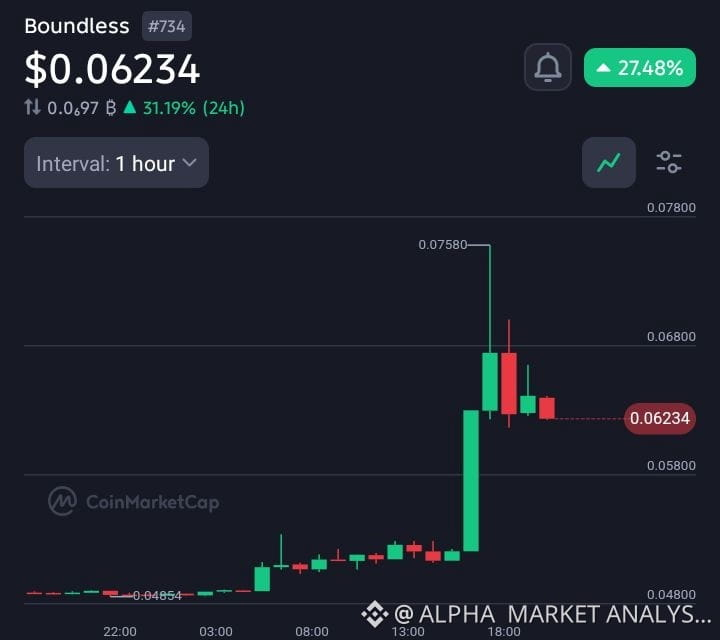
🚀 $ZKC (Boundless) Skyrockets! Volume Flips Market Cap by 4.6X! 🚀

Boundless ($ZKC ) has gone parabolic on the hourly chart, unleashing an explosive liquidity surge:

The Price Pump: Blasted up +27.48% in 24h, peaking at $0.0757 before stabilizing around $0.0623. 📈

The Volume Shock: 24h volume hit an astronomical $89.40M against a tiny $19.33M Market Cap—whales are aggressively churning this asset! 🐋

📈 What's Next? (Price Action)

Bull Target: Breaking past $0.0680 reopens the runway for a violent retest of the $0.0757 local peak.

Support Floor: Immediate defense is locked at $0.0580. Holding this shelf keeps the breakout structure fully intact. 🧱

Riding this vertical rocket or waiting out the volatility? Let's discuss below! 👇

#Boundless #ZKC
Boundless's recent market performance is definitely worth keeping an eye on, with its unique community incentive mechanism driving the action. The project team has set up a $10,000 airdrop reward for early community contributors, and more importantly, the clever design of its Discord role airdrop mechanism has attracted a ton of zero-cost participants. This low-barrier entry method has directly boosted ecosystem activity, and community anticipation is on the rise. Currently, ZKC is priced around $0.06288, with a 24-hour trading volume of $4.37 million, a market cap of $18.87 million, and a relatively small circulating supply. The success of the airdrop mechanism lies in the fact that it not only lowers the entry threshold for users but also enhances community stickiness through its role system. As a flood of new users join Discord, interactions within the ecosystem naturally increase, creating a positive feedback loop that is expected to provide fundamental support for the token's value. #Boundless #ZKC
Boundless's recent market performance is definitely worth keeping an eye on, with its unique community incentive mechanism driving the action. The project team has set up a $10,000 airdrop reward for early community contributors, and more importantly, the clever design of its Discord role airdrop mechanism has attracted a ton of zero-cost participants.

This low-barrier entry method has directly boosted ecosystem activity, and community anticipation is on the rise. Currently, ZKC is priced around $0.06288, with a 24-hour trading volume of $4.37 million, a market cap of $18.87 million, and a relatively small circulating supply.

The success of the airdrop mechanism lies in the fact that it not only lowers the entry threshold for users but also enhances community stickiness through its role system. As a flood of new users join Discord, interactions within the ecosystem naturally increase, creating a positive feedback loop that is expected to provide fundamental support for the token's value.

#Boundless #ZKC
Boundless ($ZKC) hasn't made it to the top 5 in funding flow or hype recently, indicating that short-term market interest is still pretty low. The current price is about $0.05052, with a 24h trading volume of $12.14M and a market cap of approximately $15.26 million. The charts are currently lacking clear bullish signals from major exchanges, and it may remain under pressure in the short term. I'll be keeping an eye on two key points: whether the trading volume can continue to ramp up and if it can re-enter the hype leaderboard. If neither improves, chasing after it won't offer much value, so it’s best to keep it on the watchlist for now. Not investment advice. #Boundless #ZKC
Boundless ($ZKC ) hasn't made it to the top 5 in funding flow or hype recently, indicating that short-term market interest is still pretty low. The current price is about $0.05052, with a 24h trading volume of $12.14M and a market cap of approximately $15.26 million. The charts are currently lacking clear bullish signals from major exchanges, and it may remain under pressure in the short term.

I'll be keeping an eye on two key points: whether the trading volume can continue to ramp up and if it can re-enter the hype leaderboard. If neither improves, chasing after it won't offer much value, so it’s best to keep it on the watchlist for now. Not investment advice. #Boundless #ZKC
Boundless ($ZKC) hasn't made it into the top 5 for capital flow/attention recently, indicating a weak short-term market sentiment. Current price is around 0.05052 USDT, with a 24h trading volume of about 12.14 million USD and a market cap of approximately 15.26 million USD. My observation: It's not just about 'if it dips, go short'; it's more about the lack of clear bullish signals from major exchanges and funding, which makes the price more susceptible to emotional swings. Watch closely for any spikes in trading volume and a rebound in interest; if the volume continues to dwindle, chasing higher prices might not be worth it. This is just a market observation and not investment advice. #ZKC #Boundless
Boundless ($ZKC ) hasn't made it into the top 5 for capital flow/attention recently, indicating a weak short-term market sentiment. Current price is around 0.05052 USDT, with a 24h trading volume of about 12.14 million USD and a market cap of approximately 15.26 million USD.

My observation: It's not just about 'if it dips, go short'; it's more about the lack of clear bullish signals from major exchanges and funding, which makes the price more susceptible to emotional swings. Watch closely for any spikes in trading volume and a rebound in interest; if the volume continues to dwindle, chasing higher prices might not be worth it.

This is just a market observation and not investment advice. #ZKC #Boundless
The recent market performance of Boundless is definitely worth watching. The project launched a $10,000 airdrop reward for early community contributors, which could potentially pump the token price. Their Discord role airdrop mechanism has attracted a ton of zero-cost participants, effectively boosting ecosystem activity and market sentiment. Current data: Price is around $0.06288, 24-hour trading volume is $4.37 million, and market cap is approximately $18.87 million. Can this community-driven growth model sustain itself? Let's wait and see. #Boundless #crypto
The recent market performance of Boundless is definitely worth watching. The project launched a $10,000 airdrop reward for early community contributors, which could potentially pump the token price. Their Discord role airdrop mechanism has attracted a ton of zero-cost participants, effectively boosting ecosystem activity and market sentiment.

Current data: Price is around $0.06288, 24-hour trading volume is $4.37 million, and market cap is approximately $18.87 million. Can this community-driven growth model sustain itself? Let's wait and see.

#Boundless #crypto
Verified
🚀 Boundless (ZKC): Scaling Blockchain with Universal Zero-Knowledge Proofs Boundless ($ZKC) is building a universal ZK protocol designed to make blockchains internet-scale. By enabling verifiable computation across networks, Boundless aims to deliver greater scalability, interoperability, and efficiency without compromising security. ⚡🔐 As demand for decentralized applications grows, universal ZK infrastructure could become a key foundation for the next generation of Web3. 🌐$ZKC #Boundless #ZKC #ZeroKnowledge #ZKProofs #Blockchain #Web3 #Crypto #DeFi 🚀$ {spot}(ZKCUSDT)
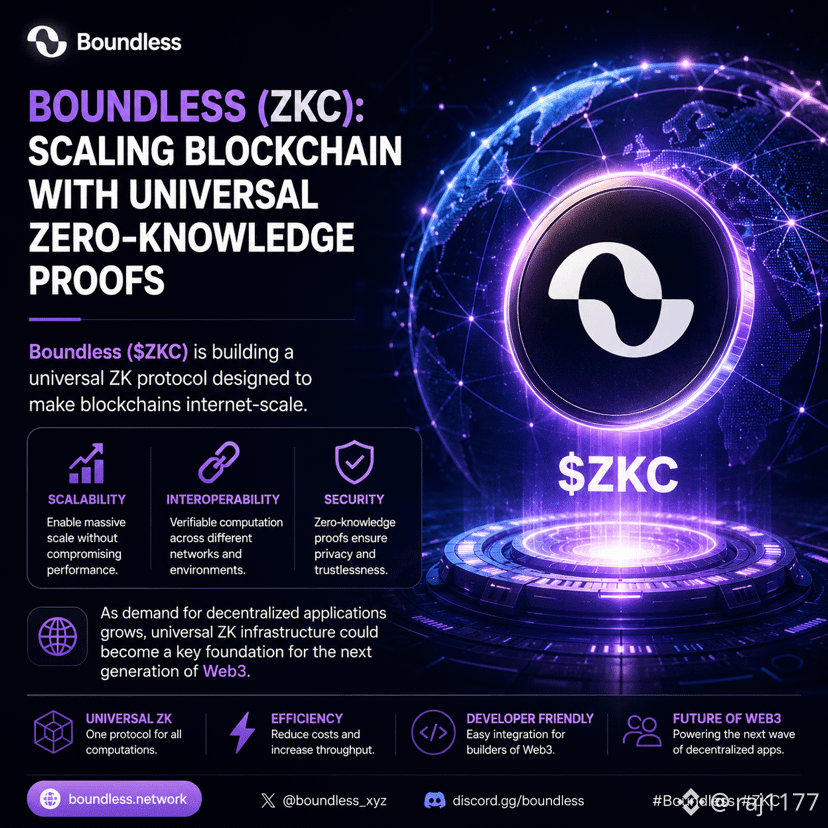
🚀 Boundless (ZKC): Scaling Blockchain with Universal Zero-Knowledge Proofs

Boundless ($ZKC ) is building a universal ZK protocol designed to make blockchains internet-scale. By enabling verifiable computation across networks, Boundless aims to deliver greater scalability, interoperability, and efficiency without compromising security. ⚡🔐

As demand for decentralized applications grows, universal ZK infrastructure could become a key foundation for the next generation of Web3. 🌐$ZKC

#Boundless #ZKC #ZeroKnowledge #ZKProofs #Blockchain #Web3 #Crypto #DeFi 🚀$
Boundless' recent market performance is definitely worth keeping an eye on. The project has set aside a $10,000 airdrop for early community contributors, which could act as a significant price catalyst. Their Discord role airdrop mechanism is particularly clever, drawing in a ton of zero-cost users with its low-entry barrier, effectively boosting overall ecosystem activity and raising market expectations for its future hype. Currently, ZKC is trading at $0.06288, with a 24-hour trading volume of $4.37 million and a market cap of $18.87 million. The core competitive edge of community-driven projects lies in sustained user engagement, and current data shows that early incentive measures are already showing results. For mid to small-cap projects like this, whether community hype can persist will be a key variable in determining their future market performance. #Boundless #crypto community
Boundless' recent market performance is definitely worth keeping an eye on. The project has set aside a $10,000 airdrop for early community contributors, which could act as a significant price catalyst.

Their Discord role airdrop mechanism is particularly clever, drawing in a ton of zero-cost users with its low-entry barrier, effectively boosting overall ecosystem activity and raising market expectations for its future hype.

Currently, ZKC is trading at $0.06288, with a 24-hour trading volume of $4.37 million and a market cap of $18.87 million. The core competitive edge of community-driven projects lies in sustained user engagement, and current data shows that early incentive measures are already showing results. For mid to small-cap projects like this, whether community hype can persist will be a key variable in determining their future market performance.

#Boundless #crypto community
Boundless is clearly losing steam lately, with $ZKC not making it into the recent top 5 capital flows, which indicates that short-term market interest hasn't really consolidated yet. The current price is around $0.04882, with a 24H trading volume of about $7.39M and a market cap of approximately $14.74 million. The market cap isn't huge, but that also means volatility can be amplified by emotions. I'm focusing on two key points: first, whether major exchanges show clearer signs of volume and buy pressure; second, if there are any updates from the project side that could drive the narrative. Without these catalysts, it's more suitable to sit back and observe in the short term rather than rushing in. #Boundless #ZKC
Boundless is clearly losing steam lately, with $ZKC not making it into the recent top 5 capital flows, which indicates that short-term market interest hasn't really consolidated yet. The current price is around $0.04882, with a 24H trading volume of about $7.39M and a market cap of approximately $14.74 million. The market cap isn't huge, but that also means volatility can be amplified by emotions.

I'm focusing on two key points: first, whether major exchanges show clearer signs of volume and buy pressure; second, if there are any updates from the project side that could drive the narrative. Without these catalysts, it's more suitable to sit back and observe in the short term rather than rushing in. #Boundless #ZKC
Boundless ($ZKC) hasn't made it into the top 5 for capital inflow/attention lately, and the short-term sentiment is looking weak. Current price is around $0.04882, with a 24-hour trading volume of about $7.39 million and a market cap of approximately $14.74 million. My focus isn't just on the daily fluctuations but on the lack of clear upward momentum on major exchanges and low market chatter, which means any potential rebound will rely more on unexpected catalysts. For the short term, we should watch if trading volume can continue to increase; otherwise, it might be better to wait for confirmation signals. #Boundless #ZKC #crypto market
Boundless ($ZKC ) hasn't made it into the top 5 for capital inflow/attention lately, and the short-term sentiment is looking weak. Current price is around $0.04882, with a 24-hour trading volume of about $7.39 million and a market cap of approximately $14.74 million. My focus isn't just on the daily fluctuations but on the lack of clear upward momentum on major exchanges and low market chatter, which means any potential rebound will rely more on unexpected catalysts. For the short term, we should watch if trading volume can continue to increase; otherwise, it might be better to wait for confirmation signals. #Boundless #ZKC #crypto market
Article
Can Boundless turn 'recomputational power' into an easily accessible toolbox?To put it bluntly, Boundless is more like a power backup for blockchain that is available on demand: when needed, just throw an order in, and the provers in the network will recalculate, eventually returning a 'receipt' that can be quickly verified on the chain. For developers, this means no longer having to reinvent the wheel for each project — you leave the complex computational tasks to others and focus on business logic and user experience. Don't just look at the concept; how usable it is depends on several real-world metrics: how many paid proof requests are there each day? What is the percentage of actual paying customers? What is the average time taken and success rate for generating proofs? And how many different nodes are reliably providing computational power — the more decentralized, the more reliable.

Can Boundless turn 'recomputational power' into an easily accessible toolbox?

To put it bluntly, Boundless is more like a power backup for blockchain that is available on demand: when needed, just throw an order in, and the provers in the network will recalculate, eventually returning a 'receipt' that can be quickly verified on the chain.
For developers, this means no longer having to reinvent the wheel for each project — you leave the complex computational tasks to others and focus on business logic and user experience.
Don't just look at the concept; how usable it is depends on several real-world metrics: how many paid proof requests are there each day? What is the percentage of actual paying customers? What is the average time taken and success rate for generating proofs? And how many different nodes are reliably providing computational power — the more decentralized, the more reliable.
Building Trust at the Speed of ComputationEvery few years technology takes a leap that changes the way we think about trust. The internet gave us access to unlimited information but also created a flood of misinformation. Blockchain gave us immutable records but also introduced scalability challenges. Artificial intelligence now processes data at speeds no human can match yet we often have no way to verify that what it produces is accurate or fair. Somewhere between these worlds lies the next evolution of digital infrastructure the ability to compute at scale without sacrificing verifiability. That is exactly the frontier Boundless Network is exploring. It is not another blockchain or an AI platform but something deeper a foundation where computation itself can prove it is telling the truth. The Problem Behind Speed Modern decentralized systems and AI models are faster than ever. Blockchains settle millions of transactions data networks train complex models and financial rollups execute trades automatically. But the faster these systems go the harder it becomes to check whether they are right. In traditional networks verification depends on trust. We trust auditors service providers or centralized validators to confirm results. In decentralized systems this trust becomes costly. Every node repeats the same computation to confirm correctness leading to redundancy and inefficiency. As workloads grow verification becomes the true bottleneck. Boundless was born from that tension. It asks a simple question what if systems could prove their own honesty mathematically instead of relying on repetition or reputation Rethinking the Proving Layer Boundless Network is designed as a scalable proving environment built on zero knowledge cryptography. It turns verification from a heavy process into a distributed service that grows with computation instead of against it. At its core Boundless transforms the proving layer itself. Instead of each application building its own isolated proof system Boundless offers a shared infrastructure where verification is composable and decentralized. It does not centralize validation or replicate workloads unnecessarily it distributes them intelligently across a global network of provers. How Boundless Works Boundless operates like a universal verification engine. When a blockchain or decentralized application needs to confirm that a computation was executed correctly it sends that task to the Boundless network. The network divides it into smaller parts delegates them to multiple provers and collects partial proofs. Each prover executes its assigned module generates a cryptographic proof and sends it back. The system then combines those smaller proofs recursively into one succinct final proof that can be verified on chain. The beauty of this model is that no matter how large the original task was the cost of final verification remains constant. Whether verifying a thousand transactions or a billion the blockchain only needs to check one compact proof. Recursive Proofs The Heart of Scalability Recursive proof technology is the backbone of Boundless. In simple terms recursion means using proofs to verify other proofs. Imagine breaking a large computation into many smaller ones. Each produces its own proof of correctness. Those smaller proofs are then bundled together and verified again producing a single compact result. This process can continue infinitely stacking proofs like layers until one final layer remains. That last proof is small enough to verify quickly but it represents the correctness of the entire chain of computations beneath it. With recursion Boundless achieves what traditional verification never could scalability without compromise. Large tasks no longer overwhelm the network because they are verified in modular pieces and assembled mathematically. Accountability Through Proof of Space Scaling verification is one challenge but ensuring honesty is another. In decentralized systems some participants may attempt to cheat or manipulate results for profit. To prevent that Boundless introduces a proof of space commitment layer. Each prover must reserve verifiable storage space on the network before participating. This storage acts as a tangible resource commitment like collateral. The more space a prover allocates the more responsibility it can take on. This approach replaces pure token based staking with physical accountability. It ties participation to real resources making it difficult for malicious actors to manipulate results without consequence. Proof of space commitments serve another purpose they create a direct link between computational performance and network reliability. A prover cannot simply rent computing power temporarily it must maintain consistent storage commitments that anchor its reputation in the network. Delegation for Performance Boundless is built to adapt dynamically to demand. When a user or protocol submits a task the system automatically divides it into subtasks and delegates them based on prover availability reliability and resource capacity. If one node slows down or goes offline others can immediately take over. This ensures consistent throughput without bottlenecks. Each sub proof remains connected to its prover’s storage commitment so accountability is preserved across the entire process. Delegated aggregation then merges the partial results into a single recursive structure. The user receives one final proof representing the work of dozens or even hundreds of distributed provers each verified independently and collectively. Why It Matters The combination of recursion proof of space and delegated aggregation turns verification into a living ecosystem. Instead of a single computer or chain handling all the work Boundless creates a network of participants collaborating to maintain truth. For developers it means verification is no longer a barrier. Building complex decentralized applications artificial intelligence systems or cross chain protocols no longer requires setting up expensive in house validation infrastructure. Proofs become a service accessible through Boundless. For users it means trust is no longer abstract. Every output is backed by a mathematical guarantee that it was computed correctly. You do not have to believe a provider you can verify the proof yourself. The Architecture in Motion Let us imagine how this looks in practice. A decentralized finance protocol wants to calculate risk exposure across multiple liquidity pools in real time. Doing this on chain would be too expensive. Instead the protocol submits the computation to Boundless. Boundless divides the workload into smaller modules each handled by different provers. As results come in proofs are generated and chained together recursively. The final proof is posted on chain confirming that every calculation followed the rules without re executing anything. The same model applies to artificial intelligence pipelines. A developer can run complex inference tasks off chain while using Boundless to prove that the results are genuine. Whether training models validating datasets or executing predictions every step can carry a verifiable proof of integrity. Shared Verification Across Networks Boundless also enables something revolutionary shared proofs. Imagine two separate blockchains running similar computations such as pricing algorithms or financial settlements. Instead of each one repeating the process both can rely on a single proof produced within Boundless. This shared verification reduces redundancy and builds implicit trust bridges between ecosystems. A proof valid on one chain can be recognized on another because it is mathematically grounded in the same verification process. In effect Boundless turns isolated ecosystems into interconnected systems of trust where computation and verification are universally portable. Economics of Proof Boundless introduces a new economic model for decentralized verification. Provers earn rewards for generating valid proofs but only when their results are verified. There are no payments for failed or incorrect computations. This aligns incentives toward accuracy and efficiency rather than raw power consumption. Provers who consistently deliver correct proofs build stronger reputations and gain access to more tasks and rewards. The proof of space layer further reinforces this economic fairness. Since participation requires resource commitments provers cannot simply spin up temporary nodes to exploit short term opportunities. The system favors stability and accountability over speculation. Sustainability and Cost Efficiency Traditional scaling solutions often rely on increasing computational throughput which can lead to escalating energy costs and centralization around powerful hardware. Boundless takes a different approach by emphasizing storage scalability. Expanding storage capacity across distributed participants is cheaper and more energy efficient than continuously upgrading compute power. It allows the network to grow organically without pricing out smaller participants. This design ensures long term sustainability. As the demand for verification increases Boundless can scale horizontally by adding more provers rather than vertically by requiring more powerful machines. Developer Experience and Accessibility For developers the Boundless framework simplifies one of the hardest parts of decentralized architecture. Instead of manually building proof circuits or managing validation nodes developers can plug into Boundless through APIs and SDKs. When a computation completes the system automatically returns a proof that can be verified on any supported blockchain. This lowers the barrier to entry for projects ranging from decentralized AI inference to data verification and financial modeling. Boundless essentially turns proof generation into a plug and play service accessible to anyone building on Web3. Proof as a Utility In traditional computing trust is based on service agreements. You trust a provider because they promise reliability. Boundless replaces that model with proof based assurance. You do not have to rely on contracts or audits you rely on mathematics. This shift turns verification into a utility something you can call upon whenever you need certainty. It is as fundamental as electricity in the digital economy. The more systems depend on computation the more they will depend on verifiable computation. Adaptive Learning Network As Boundless grows it becomes smarter. The system tracks how provers perform which ones are consistent and which proof templates are reused frequently. Over time it learns how to allocate tasks more efficiently optimizing recursion depth and delegation patterns. This creates a form of self optimization. The longer the network runs the leaner and more effective it becomes. Verification times shrink resource allocation improves and participants earn higher efficiency rewards. A Foundation for the Next Internet What makes Boundless so compelling is that it is not limited to one use case. It is an infrastructure for digital truth itself. From cross chain financial systems to AI verifiability Boundless provides the assurance layer that can keep up with modern computation. In a future where algorithms make decisions faster than humans can audit them Boundless ensures that those decisions can still be proven correct. It redefines accountability not as an afterthought but as an inherent property of computation. Real World Applications In finance Boundless can verify complex settlements across chains ensuring that every calculation aligns with contractual logic. In artificial intelligence it can certify that model predictions are genuine and free from manipulation without exposing the underlying data. In data networks it can confirm that information was processed according to predefined rules preventing tampering or hidden bias. Each of these examples demonstrates how Boundless transforms trust from a social construct into a verifiable protocol. The Human Element Even though Boundless deals in mathematics and proofs its implications are deeply human. In an era where misinformation automated decisions and opaque algorithms shape the world people need systems they can trust. Boundless offers a path to that trust not through control but through openness. By making verification transparent and decentralized it restores confidence in digital processes without sacrificing privacy or efficiency. Looking Ahead The journey of Boundless is just beginning. As more provers join the network and more developers integrate its verification layer the ecosystem will expand rapidly. The recursive proof structure ensures that scalability remains stable even under exponential growth. Future upgrades will likely introduce modular frameworks for AI specific verification and multi chain interoperability making Boundless the backbone of computational integrity across Web3 and beyond. Conclusion The digital world runs on computation and the value of that computation depends entirely on trust. Boundless Network is pioneering the architecture that lets both scale together. By combining recursive proofs proof of space commitments and delegated aggregation Boundless turns verification into a distributed public good. It makes proof not just a technical feature but a shared foundation for the next generation of digital systems. As computation continues to accelerate Boundless ensures that verifiability will not lag behind. It proves that in the age of intelligent machines and decentralized economies truth itself can be engineered. Boundless is not just scaling technology it is scaling trust and that may be the most important innovation of all. @boundless_network #boundless #Boundless $ZKC

Building Trust at the Speed of Computation

Every few years technology takes a leap that changes the way we think about trust. The internet gave us access to unlimited information but also created a flood of misinformation. Blockchain gave us immutable records but also introduced scalability challenges. Artificial intelligence now processes data at speeds no human can match yet we often have no way to verify that what it produces is accurate or fair.
Somewhere between these worlds lies the next evolution of digital infrastructure the ability to compute at scale without sacrificing verifiability. That is exactly the frontier Boundless Network is exploring. It is not another blockchain or an AI platform but something deeper a foundation where computation itself can prove it is telling the truth.
The Problem Behind Speed
Modern decentralized systems and AI models are faster than ever. Blockchains settle millions of transactions data networks train complex models and financial rollups execute trades automatically. But the faster these systems go the harder it becomes to check whether they are right.
In traditional networks verification depends on trust. We trust auditors service providers or centralized validators to confirm results. In decentralized systems this trust becomes costly. Every node repeats the same computation to confirm correctness leading to redundancy and inefficiency. As workloads grow verification becomes the true bottleneck.
Boundless was born from that tension. It asks a simple question what if systems could prove their own honesty mathematically instead of relying on repetition or reputation
Rethinking the Proving Layer
Boundless Network is designed as a scalable proving environment built on zero knowledge cryptography. It turns verification from a heavy process into a distributed service that grows with computation instead of against it.
At its core Boundless transforms the proving layer itself. Instead of each application building its own isolated proof system Boundless offers a shared infrastructure where verification is composable and decentralized. It does not centralize validation or replicate workloads unnecessarily it distributes them intelligently across a global network of provers.
How Boundless Works
Boundless operates like a universal verification engine. When a blockchain or decentralized application needs to confirm that a computation was executed correctly it sends that task to the Boundless network. The network divides it into smaller parts delegates them to multiple provers and collects partial proofs.
Each prover executes its assigned module generates a cryptographic proof and sends it back. The system then combines those smaller proofs recursively into one succinct final proof that can be verified on chain.
The beauty of this model is that no matter how large the original task was the cost of final verification remains constant. Whether verifying a thousand transactions or a billion the blockchain only needs to check one compact proof.
Recursive Proofs The Heart of Scalability
Recursive proof technology is the backbone of Boundless. In simple terms recursion means using proofs to verify other proofs. Imagine breaking a large computation into many smaller ones. Each produces its own proof of correctness. Those smaller proofs are then bundled together and verified again producing a single compact result.
This process can continue infinitely stacking proofs like layers until one final layer remains. That last proof is small enough to verify quickly but it represents the correctness of the entire chain of computations beneath it.
With recursion Boundless achieves what traditional verification never could scalability without compromise. Large tasks no longer overwhelm the network because they are verified in modular pieces and assembled mathematically.
Accountability Through Proof of Space
Scaling verification is one challenge but ensuring honesty is another. In decentralized systems some participants may attempt to cheat or manipulate results for profit. To prevent that Boundless introduces a proof of space commitment layer.
Each prover must reserve verifiable storage space on the network before participating. This storage acts as a tangible resource commitment like collateral. The more space a prover allocates the more responsibility it can take on.
This approach replaces pure token based staking with physical accountability. It ties participation to real resources making it difficult for malicious actors to manipulate results without consequence.
Proof of space commitments serve another purpose they create a direct link between computational performance and network reliability. A prover cannot simply rent computing power temporarily it must maintain consistent storage commitments that anchor its reputation in the network.
Delegation for Performance
Boundless is built to adapt dynamically to demand. When a user or protocol submits a task the system automatically divides it into subtasks and delegates them based on prover availability reliability and resource capacity.
If one node slows down or goes offline others can immediately take over. This ensures consistent throughput without bottlenecks. Each sub proof remains connected to its prover’s storage commitment so accountability is preserved across the entire process.
Delegated aggregation then merges the partial results into a single recursive structure. The user receives one final proof representing the work of dozens or even hundreds of distributed provers each verified independently and collectively.
Why It Matters
The combination of recursion proof of space and delegated aggregation turns verification into a living ecosystem. Instead of a single computer or chain handling all the work Boundless creates a network of participants collaborating to maintain truth.
For developers it means verification is no longer a barrier. Building complex decentralized applications artificial intelligence systems or cross chain protocols no longer requires setting up expensive in house validation infrastructure. Proofs become a service accessible through Boundless.
For users it means trust is no longer abstract. Every output is backed by a mathematical guarantee that it was computed correctly. You do not have to believe a provider you can verify the proof yourself.
The Architecture in Motion
Let us imagine how this looks in practice. A decentralized finance protocol wants to calculate risk exposure across multiple liquidity pools in real time. Doing this on chain would be too expensive. Instead the protocol submits the computation to Boundless.
Boundless divides the workload into smaller modules each handled by different provers. As results come in proofs are generated and chained together recursively. The final proof is posted on chain confirming that every calculation followed the rules without re executing anything.
The same model applies to artificial intelligence pipelines. A developer can run complex inference tasks off chain while using Boundless to prove that the results are genuine. Whether training models validating datasets or executing predictions every step can carry a verifiable proof of integrity.
Shared Verification Across Networks
Boundless also enables something revolutionary shared proofs. Imagine two separate blockchains running similar computations such as pricing algorithms or financial settlements. Instead of each one repeating the process both can rely on a single proof produced within Boundless.
This shared verification reduces redundancy and builds implicit trust bridges between ecosystems. A proof valid on one chain can be recognized on another because it is mathematically grounded in the same verification process.
In effect Boundless turns isolated ecosystems into interconnected systems of trust where computation and verification are universally portable.
Economics of Proof
Boundless introduces a new economic model for decentralized verification. Provers earn rewards for generating valid proofs but only when their results are verified. There are no payments for failed or incorrect computations.
This aligns incentives toward accuracy and efficiency rather than raw power consumption. Provers who consistently deliver correct proofs build stronger reputations and gain access to more tasks and rewards.
The proof of space layer further reinforces this economic fairness. Since participation requires resource commitments provers cannot simply spin up temporary nodes to exploit short term opportunities. The system favors stability and accountability over speculation.
Sustainability and Cost Efficiency
Traditional scaling solutions often rely on increasing computational throughput which can lead to escalating energy costs and centralization around powerful hardware. Boundless takes a different approach by emphasizing storage scalability.
Expanding storage capacity across distributed participants is cheaper and more energy efficient than continuously upgrading compute power. It allows the network to grow organically without pricing out smaller participants.
This design ensures long term sustainability. As the demand for verification increases Boundless can scale horizontally by adding more provers rather than vertically by requiring more powerful machines.
Developer Experience and Accessibility
For developers the Boundless framework simplifies one of the hardest parts of decentralized architecture. Instead of manually building proof circuits or managing validation nodes developers can plug into Boundless through APIs and SDKs.
When a computation completes the system automatically returns a proof that can be verified on any supported blockchain. This lowers the barrier to entry for projects ranging from decentralized AI inference to data verification and financial modeling.
Boundless essentially turns proof generation into a plug and play service accessible to anyone building on Web3.
Proof as a Utility
In traditional computing trust is based on service agreements. You trust a provider because they promise reliability. Boundless replaces that model with proof based assurance. You do not have to rely on contracts or audits you rely on mathematics.
This shift turns verification into a utility something you can call upon whenever you need certainty. It is as fundamental as electricity in the digital economy. The more systems depend on computation the more they will depend on verifiable computation.
Adaptive Learning Network
As Boundless grows it becomes smarter. The system tracks how provers perform which ones are consistent and which proof templates are reused frequently. Over time it learns how to allocate tasks more efficiently optimizing recursion depth and delegation patterns.
This creates a form of self optimization. The longer the network runs the leaner and more effective it becomes. Verification times shrink resource allocation improves and participants earn higher efficiency rewards.
A Foundation for the Next Internet
What makes Boundless so compelling is that it is not limited to one use case. It is an infrastructure for digital truth itself. From cross chain financial systems to AI verifiability Boundless provides the assurance layer that can keep up with modern computation.
In a future where algorithms make decisions faster than humans can audit them Boundless ensures that those decisions can still be proven correct. It redefines accountability not as an afterthought but as an inherent property of computation.
Real World Applications
In finance Boundless can verify complex settlements across chains ensuring that every calculation aligns with contractual logic.
In artificial intelligence it can certify that model predictions are genuine and free from manipulation without exposing the underlying data.
In data networks it can confirm that information was processed according to predefined rules preventing tampering or hidden bias.
Each of these examples demonstrates how Boundless transforms trust from a social construct into a verifiable protocol.
The Human Element
Even though Boundless deals in mathematics and proofs its implications are deeply human. In an era where misinformation automated decisions and opaque algorithms shape the world people need systems they can trust.
Boundless offers a path to that trust not through control but through openness. By making verification transparent and decentralized it restores confidence in digital processes without sacrificing privacy or efficiency.
Looking Ahead
The journey of Boundless is just beginning. As more provers join the network and more developers integrate its verification layer the ecosystem will expand rapidly. The recursive proof structure ensures that scalability remains stable even under exponential growth.
Future upgrades will likely introduce modular frameworks for AI specific verification and multi chain interoperability making Boundless the backbone of computational integrity across Web3 and beyond.
Conclusion
The digital world runs on computation and the value of that computation depends entirely on trust. Boundless Network is pioneering the architecture that lets both scale together.
By combining recursive proofs proof of space commitments and delegated aggregation Boundless turns verification into a distributed public good. It makes proof not just a technical feature but a shared foundation for the next generation of digital systems.
As computation continues to accelerate Boundless ensures that verifiability will not lag behind. It proves that in the age of intelligent machines and decentralized economies truth itself can be engineered.
Boundless is not just scaling technology it is scaling trust and that may be the most important innovation of all.
@boundless_network #boundless #Boundless $ZKC
Boundless Digital IntegrityThe internet has spent three decades perfecting how fast we can share information — but very little time ensuring that information can be trusted. We have networks that can transmit data at the speed of light, but no universal system to verify whether that data is accurate, untampered, or even real. That’s the fracture at the heart of the digital age. In this space between truth and transmission, Boundless finds its purpose. It isn’t here to accelerate the internet; it’s here to stabilize it. Boundless represents the quiet evolution of digital infrastructure. It doesn’t promise wealth, virality, or spectacle. It delivers something far more profound — a verifiable record of reality that holds firm even as systems evolve and data shifts. In a world where blockchains, AI, and decentralized computation constantly reshape how we build, Boundless ensures those creations don’t lose their integrity. It’s not trying to change how the internet works; it’s perfecting how it remembers. The Foundation of Verifiable Existence The problem Boundless solves is subtle but universal. The modern web is built on assumption. We assume a record is true because it exists in a database. We assume a transaction occurred because a server says so. We assume data is accurate because it appears consistent across systems. But assumption is fragile. One exploit, one bad actor, or one corrupted node can rewrite those truths. Boundless replaces assumption with verifiable evidence. Every action that takes place through its architecture is recorded as a cryptographic proof — immutable, timestamped, and transparent. This proof isn’t merely a hash on a ledger; it’s a complete validation that something happened exactly as claimed. It verifies the computation, the data, and the order of events, creating a digital environment where existence is no longer subjective. When the internet began, trust was manual — based on credentials, signatures, and reputation. In Web3, trust became programmable. Boundless takes the next step, making trust autonomous. It doesn’t need witnesses or guarantees; it runs on mathematics. Every byte of truth it generates becomes a permanent part of the network’s shared memory. A Quiet Revolution in How the Internet Works Boundless is not designed to compete with other protocols; it is designed to sit beneath them. It functions like the unseen electrical grid that powers the visible city. Projects, enterprises, and decentralized networks can plug into it to verify their own processes. Whether it’s confirming an AI model’s output, validating a financial settlement, or proving that a data packet hasn’t been altered, Boundless supplies the cryptographic backbone that turns information into verified truth. The key lies in its Proof of Verifiable Work mechanism — a model that rewards computational accuracy, not energy waste. Every prover within the Boundless network performs tasks that contribute to this verification layer, and their outputs are cross-validated by the system. This makes Boundless one of the first infrastructures where work isn’t rewarded for effort alone, but for correctness. It’s a shift from productivity to provability. In time, this could become as essential as HTTPS was for web security — invisible but indispensable. Websites, protocols, and entire economies will rely on Boundless to confirm that the data they depend on is real. The internet will evolve from being fast to being factual. The Architecture of Boundless At its core, Boundless is an ecosystem of provers, stakers, and validators — each contributing to a self-sustaining cycle of verification. Provers perform the computational tasks required to validate digital actions. Stakers secure the system by locking ZKC tokens, aligning their incentives with network reliability. Validators ensure that the proofs generated are mathematically sound and consistent across nodes. Together, these components form an autonomous engine of integrity. There is no single point of failure, no central authority, and no dependency on external validators. The system’s design ensures that truth emerges from consensus, not control. Boundless transforms the very act of computing into a process of accountability. The use of NFTs for governance adds another layer of sophistication. Unlike transferable governance tokens that can be accumulated or manipulated, Boundless employs non-transferable, soul-bound NFTs to represent voting power. This ensures that decision-making remains in the hands of those genuinely committed to the network rather than those seeking influence for profit. It’s a governance model designed for permanence, not speculation. Boundless and the Machine Era As artificial intelligence and automation accelerate, a new question arises: who verifies the machines? AI models can now generate text, code, art, and financial predictions — but there’s no way to confirm the authenticity of their output or trace the reasoning behind it. Boundless brings order to this growing complexity by embedding verifiability directly into computational logic. When an AI model trains on data, Boundless can generate proofs that confirm the dataset’s integrity and record each learning cycle’s parameters. When the model produces results, those too can be validated, ensuring that outcomes are transparent and reproducible. In other words, Boundless doesn’t make AI smarter — it makes it trustworthy. This is the missing piece of the AI revolution. As models grow larger and their decisions more impactful, societies will demand accountability. Boundless provides that without interfering with innovation. It turns opacity into traceability and assumption into proof. The result is an AI ecosystem that isn’t just powerful but ethically verifiable. The Boundless Economy of Verification Every major shift in internet architecture introduces a new form of value. The web gave us information economies. Blockchain gave us ownership economies. Boundless introduces the verification economy — where integrity itself becomes a measurable resource. The ZKC token is at the center of this system. It represents participation, collateral, and reward all in one. Stakers earn emissions every 48 hours for securing the network’s temporal consistency. Provers earn ZKC for contributing computational verification. The more verifications demanded across the digital ecosystem, the more the Boundless economy expands. Unlike speculative ecosystems driven by hype, Boundless grows through necessity. As industries adopt automation, decentralized identity, and AI-driven processes, their dependency on verifiable truth rises. Boundless sits at that intersection, monetizing authenticity itself. This isn’t just tokenomics — it’s the creation of a digital marketplace where credibility is currency. Use Cases Across the Digital World The versatility of Boundless extends across sectors. In finance, it verifies off-chain data, risk models, and algorithmic transactions without exposing private information. In supply chains, it validates every logistical checkpoint, ensuring that goods move transparently from origin to destination. In AI, it creates proof trails for models and datasets, bringing accountability to an industry that often operates behind closed algorithms. Healthcare providers can use Boundless to authenticate patient records while preserving privacy. Governments can apply its infrastructure to validate voting systems or public budgets without central oversight. Even creative industries can benefit — musicians, artists, and writers can anchor their works to immutable proofs of origin, safeguarding their intellectual property forever. Each of these use cases points to the same outcome: Boundless transforms verification from a service into an infrastructure. It doesn’t need to market itself; its relevance is self-evident wherever integrity matters. Governance and Decentralized Direction Boundless governance operates on a simple principle — those who secure the network should shape its future. Through its NFT-based voting mechanism, stakeholders participate in protocol upgrades, emission policies, and resource allocation. But unlike traditional decentralized systems where voting can be dominated by large holders, Boundless ensures one fundamental truth: influence cannot be bought, only earned. This creates a culture of stewardship rather than speculation. Every vote, every proposal, and every update carries the legitimacy of verifiable participation. Governance here is not just decentralized — it’s verifiably democratic. Cultural Permanence in a Forgetful Age We live in a time when the internet forgets too easily. Posts are deleted, data disappears, and histories are rewritten. Boundless introduces cultural permanence. It allows societies to preserve their digital heritage with cryptographic certainty. A document timestamped in Boundless can outlive its authors. A transaction verified through it can never be falsified. A record of truth can endure even as the systems around it fade. This permanence carries moral weight. It’s not just about preserving information but about protecting memory. In an era where truth is often fluid, Boundless anchors civilization to evidence that cannot be erased. The Invisible Backbone of Tomorrow Boundless doesn’t need to be visible to be revolutionary. Like the internet protocols that shaped the modern world, it will exist quietly beneath the surface, ensuring everything above it operates with integrity. As adoption grows, the Boundless layer will disappear from conversation but remain present in every digital interaction that depends on verification. In the years ahead, when proof becomes a default expectation rather than an optional feature, Boundless will be recognized not as a disruptor, but as a necessity. It will have fulfilled its purpose — turning digital trust from a promise into an architecture. And that’s the future of Boundless: a world where truth is no longer negotiated, because proof is built in. #Boundless @boundless_network $ZKC

Boundless Digital Integrity

The internet has spent three decades perfecting how fast we can share information — but very little time ensuring that information can be trusted. We have networks that can transmit data at the speed of light, but no universal system to verify whether that data is accurate, untampered, or even real. That’s the fracture at the heart of the digital age. In this space between truth and transmission, Boundless finds its purpose. It isn’t here to accelerate the internet; it’s here to stabilize it.
Boundless represents the quiet evolution of digital infrastructure. It doesn’t promise wealth, virality, or spectacle. It delivers something far more profound — a verifiable record of reality that holds firm even as systems evolve and data shifts. In a world where blockchains, AI, and decentralized computation constantly reshape how we build, Boundless ensures those creations don’t lose their integrity. It’s not trying to change how the internet works; it’s perfecting how it remembers.
The Foundation of Verifiable Existence
The problem Boundless solves is subtle but universal. The modern web is built on assumption. We assume a record is true because it exists in a database. We assume a transaction occurred because a server says so. We assume data is accurate because it appears consistent across systems. But assumption is fragile. One exploit, one bad actor, or one corrupted node can rewrite those truths.
Boundless replaces assumption with verifiable evidence. Every action that takes place through its architecture is recorded as a cryptographic proof — immutable, timestamped, and transparent. This proof isn’t merely a hash on a ledger; it’s a complete validation that something happened exactly as claimed. It verifies the computation, the data, and the order of events, creating a digital environment where existence is no longer subjective.
When the internet began, trust was manual — based on credentials, signatures, and reputation. In Web3, trust became programmable. Boundless takes the next step, making trust autonomous. It doesn’t need witnesses or guarantees; it runs on mathematics. Every byte of truth it generates becomes a permanent part of the network’s shared memory.
A Quiet Revolution in How the Internet Works
Boundless is not designed to compete with other protocols; it is designed to sit beneath them. It functions like the unseen electrical grid that powers the visible city. Projects, enterprises, and decentralized networks can plug into it to verify their own processes. Whether it’s confirming an AI model’s output, validating a financial settlement, or proving that a data packet hasn’t been altered, Boundless supplies the cryptographic backbone that turns information into verified truth.
The key lies in its Proof of Verifiable Work mechanism — a model that rewards computational accuracy, not energy waste. Every prover within the Boundless network performs tasks that contribute to this verification layer, and their outputs are cross-validated by the system. This makes Boundless one of the first infrastructures where work isn’t rewarded for effort alone, but for correctness. It’s a shift from productivity to provability.
In time, this could become as essential as HTTPS was for web security — invisible but indispensable. Websites, protocols, and entire economies will rely on Boundless to confirm that the data they depend on is real. The internet will evolve from being fast to being factual.
The Architecture of Boundless
At its core, Boundless is an ecosystem of provers, stakers, and validators — each contributing to a self-sustaining cycle of verification. Provers perform the computational tasks required to validate digital actions. Stakers secure the system by locking ZKC tokens, aligning their incentives with network reliability. Validators ensure that the proofs generated are mathematically sound and consistent across nodes.
Together, these components form an autonomous engine of integrity. There is no single point of failure, no central authority, and no dependency on external validators.
The system’s design ensures that truth emerges from consensus, not control. Boundless transforms the very act of computing into a process of accountability.
The use of NFTs for governance adds another layer of sophistication. Unlike transferable governance tokens that can be accumulated or manipulated, Boundless employs non-transferable, soul-bound NFTs to represent voting power. This ensures that decision-making remains in the hands of those genuinely committed to the network rather than those seeking influence for profit. It’s a governance model designed for permanence, not speculation.
Boundless and the Machine Era
As artificial intelligence and automation accelerate, a new question arises: who verifies the machines? AI models can now generate text, code, art, and financial predictions — but there’s no way to confirm the authenticity of their output or trace the reasoning behind it. Boundless brings order to this growing complexity by embedding verifiability directly into computational logic.
When an AI model trains on data, Boundless can generate proofs that confirm the dataset’s integrity and record each learning cycle’s parameters. When the model produces results, those too can be validated, ensuring that outcomes are transparent and reproducible. In other words, Boundless doesn’t make AI smarter — it makes it trustworthy.
This is the missing piece of the AI revolution. As models grow larger and their decisions more impactful, societies will demand accountability. Boundless provides that without interfering with innovation. It turns opacity into traceability and assumption into proof. The result is an AI ecosystem that isn’t just powerful but ethically verifiable.
The Boundless Economy of Verification
Every major shift in internet architecture introduces a new form of value. The web gave us information economies. Blockchain gave us ownership economies. Boundless introduces the verification economy — where integrity itself becomes a measurable resource.
The ZKC token is at the center of this system. It represents participation, collateral, and reward all in one. Stakers earn emissions every 48 hours for securing the network’s temporal consistency. Provers earn ZKC for contributing computational verification. The more verifications demanded across the digital ecosystem, the more the Boundless economy expands.
Unlike speculative ecosystems driven by hype, Boundless grows through necessity. As industries adopt automation, decentralized identity, and AI-driven processes, their dependency on verifiable truth rises. Boundless sits at that intersection, monetizing authenticity itself. This isn’t just tokenomics — it’s the creation of a digital marketplace where credibility is currency.
Use Cases Across the Digital World
The versatility of Boundless extends across sectors. In finance, it verifies off-chain data, risk models, and algorithmic transactions without exposing private information. In supply chains, it validates every logistical checkpoint, ensuring that goods move transparently from origin to destination. In AI, it creates proof trails for models and datasets, bringing accountability to an industry that often operates behind closed algorithms.
Healthcare providers can use Boundless to authenticate patient records while preserving privacy. Governments can apply its infrastructure to validate voting systems or public budgets without central oversight. Even creative industries can benefit — musicians, artists, and writers can anchor their works to immutable proofs of origin, safeguarding their intellectual property forever.
Each of these use cases points to the same outcome: Boundless transforms verification from a service into an infrastructure. It doesn’t need to market itself; its relevance is self-evident wherever integrity matters.
Governance and Decentralized Direction
Boundless governance operates on a simple principle — those who secure the network should shape its future.
Through its NFT-based voting mechanism, stakeholders participate in protocol upgrades, emission policies, and resource allocation. But unlike traditional decentralized systems where voting can be dominated by large holders, Boundless ensures one fundamental truth: influence cannot be bought, only earned.
This creates a culture of stewardship rather than speculation. Every vote, every proposal, and every update carries the legitimacy of verifiable participation. Governance here is not just decentralized — it’s verifiably democratic.
Cultural Permanence in a Forgetful Age
We live in a time when the internet forgets too easily. Posts are deleted, data disappears, and histories are rewritten. Boundless introduces cultural permanence. It allows societies to preserve their digital heritage with cryptographic certainty. A document timestamped in Boundless can outlive its authors. A transaction verified through it can never be falsified. A record of truth can endure even as the systems around it fade.
This permanence carries moral weight. It’s not just about preserving information but about protecting memory. In an era where truth is often fluid, Boundless anchors civilization to evidence that cannot be erased.
The Invisible Backbone of Tomorrow
Boundless doesn’t need to be visible to be revolutionary. Like the internet protocols that shaped the modern world, it will exist quietly beneath the surface, ensuring everything above it operates with integrity. As adoption grows, the Boundless layer will disappear from conversation but remain present in every digital interaction that depends on verification.
In the years ahead, when proof becomes a default expectation rather than an optional feature, Boundless will be recognized not as a disruptor, but as a necessity. It will have fulfilled its purpose — turning digital trust from a promise into an architecture.
And that’s the future of Boundless: a world where truth is no longer negotiated, because proof is built in.
#Boundless @boundless_network
$ZKC
Boundless: Redefining Digital Connectivity Through Web3 Innovation Boundless is an emerging Web3 project designed to push the limits of how people connect, create, and interact in the digital world. It blends blockchain, artificial intelligence, and immersive technologies to build an open and limitless digital ecosystem — one where creativity, ownership, and collaboration have no boundaries. At its heart, Boundless focuses on decentralized connectivity. It aims to remove the traditional barriers that separate users, developers, and platforms. By integrating blockchain infrastructure, Boundless ensures that every user has ownership over their data, identity, and digital assets. This approach aligns with the growing movement toward user sovereignty in the Web3 era. One of the defining aspects of Boundless is its interoperable design. Instead of existing as a closed system, Boundless connects multiple blockchains, digital platforms, and metaverse environments. This interoperability allows users to move their assets and identities seamlessly across various ecosystems, creating a truly borderless digital experience. Boundless also integrates AI-driven personalization, ensuring that every interaction feels intelligent and tailored. From content recommendations to virtual experiences, AI helps make the ecosystem adaptive and dynamic. This combination of blockchain transparency and AI intelligence is what sets Boundless apart from traditional digital platforms. The project envisions a creator-powered economy, where artists, developers, and innovators can build and monetize their work without relying on centralized intermediaries. Through NFTs and smart contracts, Boundless enables creators to retain full control and receive fair compensation for their digital assets. In addition to supporting creators, Boundless also focuses on building a strong foundation for digital communities. Using decentralized tools and governance models, users can collaborate, vote on platform decisions, and shape the future of the ecosystem together. This democratic structure encourages collective growth and transparency. The Boundless platform supports a range of applications — from social hubs and gaming environments to digital learning and enterprise solutions. Each of these applications benefits from the same principles of decentralization, security, and user empowerment. By offering flexible tools and APIs, Boundless makes it easy for developers to build innovative Web3 experiences. Security and data privacy are also at the core of Boundless’s mission. Blockchain technology ensures that all transactions, identities, and interactions remain verifiable and tamper-proof. Users maintain full ownership of their personal information, giving them control over how and where it is used. Another major goal of Boundless is to create a unified digital identity system. This allows users to maintain a single, secure identity that can be used across multiple platforms, applications, and metaverse worlds. With decentralized identity (DID) protocols, Boundless helps solve one of the biggest challenges in Web3 — fragmented user access. The project’s forward-looking vision extends beyond just technology. Boundless wants to redefine how digital economies work, emphasizing inclusion and accessibility. By removing entry barriers and empowering global participation, it hopes to make Web3 more approachable for both individuals and enterprises. Boundless is also exploring integration with spatial computing and XR (extended reality) technologies. This will enable immersive environments where users can work, play, and socialize in 3D spaces powered by AI and blockchain. It’s a step toward building an open metaverse — one that is not controlled by a single corporation but shaped collectively by its community. The ecosystem’s growth is supported by partnerships with innovators across Web3, DeFi, and digital media. These collaborations are expanding the Boundless network and introducing new utilities for its native assets and applications. Ultimately, Boundless stands as a vision for the next evolution of the internet — an internet without limits, centralized control, or data monopolies. Its blend of blockchain security, AI intelligence, and decentralized governance makes it a foundation for a more open, equitable, and connected digital future. In summary, Boundless represents a major shift in how people interact online. By creating a borderless ecosystem where users own their identity, assets, and creativity, it redefines what freedom and connection mean in the Web3 world.@boundless_network #Boundless $ZKC

Boundless: Redefining Digital Connectivity Through Web3 Innovation


Boundless is an emerging Web3 project designed to push the limits of how people connect, create, and interact in the digital world. It blends blockchain, artificial intelligence, and immersive technologies to build an open and limitless digital ecosystem — one where creativity, ownership, and collaboration have no boundaries.
At its heart, Boundless focuses on decentralized connectivity. It aims to remove the traditional barriers that separate users, developers, and platforms. By integrating blockchain infrastructure, Boundless ensures that every user has ownership over their data, identity, and digital assets. This approach aligns with the growing movement toward user sovereignty in the Web3 era.
One of the defining aspects of Boundless is its interoperable design. Instead of existing as a closed system, Boundless connects multiple blockchains, digital platforms, and metaverse environments. This interoperability allows users to move their assets and identities seamlessly across various ecosystems, creating a truly borderless digital experience.
Boundless also integrates AI-driven personalization, ensuring that every interaction feels intelligent and tailored. From content recommendations to virtual experiences, AI helps make the ecosystem adaptive and dynamic. This combination of blockchain transparency and AI intelligence is what sets Boundless apart from traditional digital platforms.
The project envisions a creator-powered economy, where artists, developers, and innovators can build and monetize their work without relying on centralized intermediaries. Through NFTs and smart contracts, Boundless enables creators to retain full control and receive fair compensation for their digital assets.
In addition to supporting creators, Boundless also focuses on building a strong foundation for digital communities. Using decentralized tools and governance models, users can collaborate, vote on platform decisions, and shape the future of the ecosystem together. This democratic structure encourages collective growth and transparency.
The Boundless platform supports a range of applications — from social hubs and gaming environments to digital learning and enterprise solutions. Each of these applications benefits from the same principles of decentralization, security, and user empowerment. By offering flexible tools and APIs, Boundless makes it easy for developers to build innovative Web3 experiences.
Security and data privacy are also at the core of Boundless’s mission. Blockchain technology ensures that all transactions, identities, and interactions remain verifiable and tamper-proof. Users maintain full ownership of their personal information, giving them control over how and where it is used.
Another major goal of Boundless is to create a unified digital identity system. This allows users to maintain a single, secure identity that can be used across multiple platforms, applications, and metaverse worlds. With decentralized identity (DID) protocols, Boundless helps solve one of the biggest challenges in Web3 — fragmented user access.
The project’s forward-looking vision extends beyond just technology. Boundless wants to redefine how digital economies work, emphasizing inclusion and accessibility. By removing entry barriers and empowering global participation, it hopes to make Web3 more approachable for both individuals and enterprises.
Boundless is also exploring integration with spatial computing and XR (extended reality) technologies. This will enable immersive environments where users can work, play, and socialize in 3D spaces powered by AI and blockchain. It’s a step toward building an open metaverse — one that is not controlled by a single corporation but shaped collectively by its community.
The ecosystem’s growth is supported by partnerships with innovators across Web3, DeFi, and digital media. These collaborations are expanding the Boundless network and introducing new utilities for its native assets and applications.
Ultimately, Boundless stands as a vision for the next evolution of the internet — an internet without limits, centralized control, or data monopolies. Its blend of blockchain security, AI intelligence, and decentralized governance makes it a foundation for a more open, equitable, and connected digital future.
In summary, Boundless represents a major shift in how people interact online. By creating a borderless ecosystem where users own their identity, assets, and creativity, it redefines what freedom and connection mean in the Web3 world.@boundless_network #Boundless $ZKC
Article
Boundless: Pioneering a Plug-and-Play Revolution in Zero-Knowledge Development@boundless_network The blockchain industry has long faced a paradox: as innovation accelerates, the technical barriers to entry grow ever steeper. Among the most promising technologies in this space, zero-knowledge proofs (ZKPs) offer transformative potential. From privacy-preserving financial transactions to cross-chain interoperability, ZKPs can redefine how decentralized systems operate. Yet, the adoption of ZK technology has remained limited due to high development thresholds, fragmented toolchains, and complex ecological dependencies. Developers are often confronted with months of learning specialized mathematics, designing circuits, and maintaining separate codebases for different chains. In 2024, there were fewer than 300 teams worldwide capable of building ZK applications, highlighting the severity of these bottlenecks. #boundless has emerged as a game-changing platform, breaking through these barriers by transforming ZK development into a plug-and-play experience. By combining toolchain standardization, community empowerment, and multi-ecosystem adaptability, Boundless is rewriting the rules of ZK technology, enabling developers to integrate privacy and verification solutions as seamlessly as calling an API. The Challenges of Traditional ZK Development Historically, integrating ZKPs required mastering complex concepts such as finite field arithmetic, circuit design, and cryptographic proof systems. Even experienced teams faced months of adaptation when deploying ZK solutions across multiple chains. For instance, a developer team aiming to implement privacy payments on Ethereum and Solana had to maintain two completely independent codebases, effectively doubling development costs and extending timelines. Moreover, ZK toolchains were siloed within individual ecosystems, making cross-chain deployment nearly impossible. Fragmented toolchains restricted collaboration, innovation, and adoption. Without a standardized framework, developers had to solve problems from scratch, inhibiting the growth of applications and slowing the expansion of Web3 infrastructure. @boundless_network addresses these challenges with a full-stack standardized tool matrix, enabling developers to integrate ZK capabilities seamlessly into existing workflows. This approach not only reduces complexity but also accelerates innovation, democratizing ZK development for small and medium-sized teams that previously lacked the expertise or resources to participate. Plug-and-Play ZK: The Steel Tool At the heart of @boundless_network innovation is the Steel tool, a ZK co-processor designed for the Ethereum Virtual Machine (EVM). Steel allows developers to migrate compute-intensive tasks off-chain to zkVM processing without rewriting their Solidity code. By providing a simple interface for integration, Steel can reduce Gas costs by up to 99.99%, offering a zero-cost migration path for ordinary developers. For Optimistic Rollups, Boundless has introduced OP Kailua, a hybrid ZK solution that compresses finalization periods from seven days to hours while retaining familiar architectural patterns. This feature reduces adaptation cycles from months to days, allowing teams to implement privacy, validation, and efficiency enhancements with minimal disruption. These tools collectively redefine the ZK developer experience: tasks that once required deep cryptographic expertise can now be accomplished by ordinary developers with hour-level entry, drastically reducing the time and effort required for implementation. Community-Driven Empowerment #boundless recognizes that tools alone are not sufficient to drive ZK adoption. Community engagement and localized operations are central to its strategy. In early 2025, Boundless partnered with TinTinLand to launch the "China Tour," a series of events spanning Hangzhou, Shanghai, Chengdu, and Shenzhen. Nearly a thousand developers participated in technical workshops, roundtables, and hands-on coding sessions, gaining practical skills and guidance directly from experts. The online community further amplifies this impact. Real-time technical support ensures core developer response times of under one hour, while code collaboration metrics indicate that over 60% of contributions are community-driven. The platform’s 100% open-source codebase and modular plugin system enable developers to freely customize functionality, optimize efficiency, and submit improvements. For example, a developer team enhanced memory management within Steel, increasing proof generation efficiency by 30% in specific scenarios, and quickly integrated their contributions into the official toolchain. Through these initiatives, Boundless transforms ZK development from an isolated, expert-driven domain into a vibrant, collaborative ecosystem, where knowledge sharing, innovation, and technical growth happen organically. Multi-Ecosystem Integration Boundless’s toolchain is designed for multi-chain adaptability, bridging the gap between isolated ecosystems. By providing a unified interface for Ethereum, Base, Stellar, and other networks, developers can build once and deploy across multiple platforms. This "develop-once, deploy-everywhere" approach reduces redundancy and accelerates innovation. Several projects have already leveraged Boundless’s tools to achieve groundbreaking results. BOB, a hybrid Bitcoin Rollup, integrated Boundless to enable interoperability between Bitcoin and EVM-based applications. Wormhole incorporated Boundless for zero-knowledge verification in cross-chain messaging, improving security while streamlining operations. This model of tool standardization combined with ecological diversification transforms ZK development from a highly customized process into a modular assembly line, enabling rapid experimentation and deployment. Democratizing ZK Knowledge @boundless_network also prioritizes knowledge dissemination. By offering open-source documentation, tutorials, and modular components, the platform lowers barriers for teams that lack deep cryptography expertise. Developers can now engage with ZK proofs through a plug-and-play interface, focusing on creative application rather than technical intricacies. The four-city developer tour exemplifies how Boundless bridges the gap between theory and practice. Workshops provide live demonstrations, code reviews, and interactive Q&A sessions, enabling participants to achieve practical mastery in hours rather than months. This hands-on approach accelerates the spread of ZK capabilities, fostering a new generation of developers ready to implement privacy-preserving and efficient blockchain solutions. Driving Innovation Through Governance Boundless also integrates token-driven governance to incentivize contribution and align ecosystem growth. Its native token, ZKC, serves as both a settlement medium for proof services and a governance tool. Verifiers earn rewards based on provable work (PoVW), encouraging efficient computation across modules. Token holders participate in protocol upgrades, fee adjustments, and other critical decisions, ensuring that development priorities reflect community consensus. A substantial portion of the ZKC supply is allocated to an ecological growth pool, funding modular component integration, tool development, and community initiatives. This ensures that innovation is continuously incentivized, and the ecosystem remains dynamic, adaptable, and self-sustaining. Expanding the Boundaries of Web3 The implications of Boundless extend far beyond ZK development itself. By reducing technical thresholds and promoting multi-chain integration, the platform opens new avenues for Web3 innovation. Applications in decentralized finance (DeFi), privacy-preserving identity systems, cross-chain gaming, and supply chain verification can now leverage ZK proofs efficiently. Projects can scale faster, reduce operational costs, and maintain security standards without needing specialized teams. Boundless effectively acts as a technical ferry, transporting developers across the previously prohibitive divide of ZK complexity. By making zero-knowledge proofs accessible, standardized, and modular, it enables a wave of innovation that will reshape how decentralized applications are conceived, built, and deployed. Case Studies: Real-World Impact BOB Hybrid Bitcoin Rollup: By integrating Boundless, BOB achieved interoperability between Bitcoin and EVM applications, opening new possibilities for hybrid DeFi ecosystems.Wormhole Cross-Chain Bridge: Boundless enabled zero-knowledge verification for cross-chain messaging, improving security and reducing adaptation cycles. EVM DEX Enhancements: Using Steel, multiple decentralized exchanges implemented off-chain proof processing, reducing Gas costs and improving transaction throughput.Optimistic Rollup Acceleration: OP Kailua compressed finalization timelines from days to hours, enabling faster deployment and more responsive blockchain networks. These examples illustrate Boundless’s ability to accelerate adoption, reduce complexity, and foster cross-chain innovation, transforming ZK proofs from a niche technology into a foundational capability for Web3. A New Paradigm in Developer Experience Perhaps the most profound impact of Boundless is on the developer experience. Traditional ZK development was labor-intensive, knowledge-heavy, and fragmented. Boundless converts this into a modular, plug-and-play workflow, where developers can focus on creative problem-solving rather than technical minutiae. The combination of standardized tools, community support, multi-chain adaptability, and governance incentives redefines what it means to develop in the ZK era. By lowering barriers, Boundless expands the pool of developers capable of implementing advanced ZK features. This democratization of ZK knowledge is likely to accelerate Web3 innovation, enabling smaller teams, startups, and individual developers to contribute meaningfully to a previously exclusive domain. The Future of ZK Development As blockchain ecosystems continue to modularize, the need for standardized, accessible, and interoperable ZK solutions will only grow. Boundless’s plug-and-play approach, reinforced by community engagement, multi-chain compatibility, and token-driven governance, positions it as the definitive enabler of the next generation of decentralized applications. From standardized tools to community empowerment, from local operations to ecological collaboration, Boundless is rewriting the underlying logic of ZK development. It is creating an ecosystem where every developer, regardless of background, can implement ZK capabilities, driving a wave of innovation that will define the future of Web3. Boundless is more than a technology platform it is a movement, democratizing ZK development, accelerating multi-chain adoption, and transforming modular blockchain from a fragmented collection of tools into a cohesive, collaborative, and highly efficient ecosystem. As Web3 applications scale and diversify, Boundless stands as the technical bridge, the modular unifier, and the innovation catalyst that will shape the decentralized future. $ZKC {spot}(ZKCUSDT)

Boundless: Pioneering a Plug-and-Play Revolution in Zero-Knowledge Development

@boundless_network
The blockchain industry has long faced a paradox: as innovation accelerates, the technical barriers to entry grow ever steeper. Among the most promising technologies in this space, zero-knowledge proofs (ZKPs) offer transformative potential. From privacy-preserving financial transactions to cross-chain interoperability, ZKPs can redefine how decentralized systems operate. Yet, the adoption of ZK technology has remained limited due to high development thresholds, fragmented toolchains, and complex ecological dependencies. Developers are often confronted with months of learning specialized mathematics, designing circuits, and maintaining separate codebases for different chains. In 2024, there were fewer than 300 teams worldwide capable of building ZK applications, highlighting the severity of these bottlenecks.
#boundless has emerged as a game-changing platform, breaking through these barriers by transforming ZK development into a plug-and-play experience. By combining toolchain standardization, community empowerment, and multi-ecosystem adaptability, Boundless is rewriting the rules of ZK technology, enabling developers to integrate privacy and verification solutions as seamlessly as calling an API.
The Challenges of Traditional ZK Development
Historically, integrating ZKPs required mastering complex concepts such as finite field arithmetic, circuit design, and cryptographic proof systems. Even experienced teams faced months of adaptation when deploying ZK solutions across multiple chains. For instance, a developer team aiming to implement privacy payments on Ethereum and Solana had to maintain two completely independent codebases, effectively doubling development costs and extending timelines.
Moreover, ZK toolchains were siloed within individual ecosystems, making cross-chain deployment nearly impossible. Fragmented toolchains restricted collaboration, innovation, and adoption. Without a standardized framework, developers had to solve problems from scratch, inhibiting the growth of applications and slowing the expansion of Web3 infrastructure.
@boundless_network addresses these challenges with a full-stack standardized tool matrix, enabling developers to integrate ZK capabilities seamlessly into existing workflows. This approach not only reduces complexity but also accelerates innovation, democratizing ZK development for small and medium-sized teams that previously lacked the expertise or resources to participate.
Plug-and-Play ZK: The Steel Tool
At the heart of @boundless_network innovation is the Steel tool, a ZK co-processor designed for the Ethereum Virtual Machine (EVM). Steel allows developers to migrate compute-intensive tasks off-chain to zkVM processing without rewriting their Solidity code. By providing a simple interface for integration, Steel can reduce Gas costs by up to 99.99%, offering a zero-cost migration path for ordinary developers.
For Optimistic Rollups, Boundless has introduced OP Kailua, a hybrid ZK solution that compresses finalization periods from seven days to hours while retaining familiar architectural patterns. This feature reduces adaptation cycles from months to days, allowing teams to implement privacy, validation, and efficiency enhancements with minimal disruption.
These tools collectively redefine the ZK developer experience: tasks that once required deep cryptographic expertise can now be accomplished by ordinary developers with hour-level entry, drastically reducing the time and effort required for implementation.
Community-Driven Empowerment
#boundless recognizes that tools alone are not sufficient to drive ZK adoption. Community engagement and localized operations are central to its strategy. In early 2025, Boundless partnered with TinTinLand to launch the "China Tour," a series of events spanning Hangzhou, Shanghai, Chengdu, and Shenzhen. Nearly a thousand developers participated in technical workshops, roundtables, and hands-on coding sessions, gaining practical skills and guidance directly from experts.
The online community further amplifies this impact. Real-time technical support ensures core developer response times of under one hour, while code collaboration metrics indicate that over 60% of contributions are community-driven. The platform’s 100% open-source codebase and modular plugin system enable developers to freely customize functionality, optimize efficiency, and submit improvements. For example, a developer team enhanced memory management within Steel, increasing proof generation efficiency by 30% in specific scenarios, and quickly integrated their contributions into the official toolchain.
Through these initiatives, Boundless transforms ZK development from an isolated, expert-driven domain into a vibrant, collaborative ecosystem, where knowledge sharing, innovation, and technical growth happen organically.
Multi-Ecosystem Integration
Boundless’s toolchain is designed for multi-chain adaptability, bridging the gap between isolated ecosystems. By providing a unified interface for Ethereum, Base, Stellar, and other networks, developers can build once and deploy across multiple platforms. This "develop-once, deploy-everywhere" approach reduces redundancy and accelerates innovation.
Several projects have already leveraged Boundless’s tools to achieve groundbreaking results. BOB, a hybrid Bitcoin Rollup, integrated Boundless to enable interoperability between Bitcoin and EVM-based applications. Wormhole incorporated Boundless for zero-knowledge verification in cross-chain messaging, improving security while streamlining operations. This model of tool standardization combined with ecological diversification transforms ZK development from a highly customized process into a modular assembly line, enabling rapid experimentation and deployment.
Democratizing ZK Knowledge
@boundless_network also prioritizes knowledge dissemination. By offering open-source documentation, tutorials, and modular components, the platform lowers barriers for teams that lack deep cryptography expertise. Developers can now engage with ZK proofs through a plug-and-play interface, focusing on creative application rather than technical intricacies.
The four-city developer tour exemplifies how Boundless bridges the gap between theory and practice. Workshops provide live demonstrations, code reviews, and interactive Q&A sessions, enabling participants to achieve practical mastery in hours rather than months. This hands-on approach accelerates the spread of ZK capabilities, fostering a new generation of developers ready to implement privacy-preserving and efficient blockchain solutions.
Driving Innovation Through Governance
Boundless also integrates token-driven governance to incentivize contribution and align ecosystem growth. Its native token, ZKC, serves as both a settlement medium for proof services and a governance tool. Verifiers earn rewards based on provable work (PoVW), encouraging efficient computation across modules. Token holders participate in protocol upgrades, fee adjustments, and other critical decisions, ensuring that development priorities reflect community consensus.
A substantial portion of the ZKC supply is allocated to an ecological growth pool, funding modular component integration, tool development, and community initiatives. This ensures that innovation is continuously incentivized, and the ecosystem remains dynamic, adaptable, and self-sustaining.
Expanding the Boundaries of Web3
The implications of Boundless extend far beyond ZK development itself. By reducing technical thresholds and promoting multi-chain integration, the platform opens new avenues for Web3 innovation. Applications in decentralized finance (DeFi), privacy-preserving identity systems, cross-chain gaming, and supply chain verification can now leverage ZK proofs efficiently. Projects can scale faster, reduce operational costs, and maintain security standards without needing specialized teams.
Boundless effectively acts as a technical ferry, transporting developers across the previously prohibitive divide of ZK complexity. By making zero-knowledge proofs accessible, standardized, and modular, it enables a wave of innovation that will reshape how decentralized applications are conceived, built, and deployed.
Case Studies: Real-World Impact
BOB Hybrid Bitcoin Rollup: By integrating Boundless, BOB achieved interoperability between Bitcoin and EVM applications, opening new possibilities for hybrid DeFi ecosystems.Wormhole Cross-Chain Bridge: Boundless enabled zero-knowledge verification for cross-chain messaging, improving security and reducing adaptation cycles.
EVM DEX Enhancements: Using Steel, multiple decentralized exchanges implemented off-chain proof processing, reducing Gas costs and improving transaction throughput.Optimistic Rollup Acceleration: OP Kailua compressed finalization timelines from days to hours, enabling faster deployment and more responsive blockchain networks.
These examples illustrate Boundless’s ability to accelerate adoption, reduce complexity, and foster cross-chain innovation, transforming ZK proofs from a niche technology into a foundational capability for Web3.
A New Paradigm in Developer Experience
Perhaps the most profound impact of Boundless is on the developer experience. Traditional ZK development was labor-intensive, knowledge-heavy, and fragmented. Boundless converts this into a modular, plug-and-play workflow, where developers can focus on creative problem-solving rather than technical minutiae. The combination of standardized tools, community support, multi-chain adaptability, and governance incentives redefines what it means to develop in the ZK era.
By lowering barriers, Boundless expands the pool of developers capable of implementing advanced ZK features. This democratization of ZK knowledge is likely to accelerate Web3 innovation, enabling smaller teams, startups, and individual developers to contribute meaningfully to a previously exclusive domain.
The Future of ZK Development
As blockchain ecosystems continue to modularize, the need for standardized, accessible, and interoperable ZK solutions will only grow. Boundless’s plug-and-play approach, reinforced by community engagement, multi-chain compatibility, and token-driven governance, positions it as the definitive enabler of the next generation of decentralized applications.
From standardized tools to community empowerment, from local operations to ecological collaboration, Boundless is rewriting the underlying logic of ZK development. It is creating an ecosystem where every developer, regardless of background, can implement ZK capabilities, driving a wave of innovation that will define the future of Web3.
Boundless is more than a technology platform it is a movement, democratizing ZK development, accelerating multi-chain adoption, and transforming modular blockchain from a fragmented collection of tools into a cohesive, collaborative, and highly efficient ecosystem. As Web3 applications scale and diversify, Boundless stands as the technical bridge, the modular unifier, and the innovation catalyst that will shape the decentralized future.
$ZKC
thanks for 1k follower thanks for everyone follow me Il love you all @boundless_network #boundless $BB
thanks for 1k follower thanks for everyone follow me Il love you all

@boundless_network
#boundless
$BB
Article
Proof of Verifiable Work — The Engine Behind BoundlessZK proofs are powerful — but what if you could prove how much work went into producing one? That’s the question Boundless answers with Proof of Verifiable Work (PoVW) — a revolutionary innovation by the RISC Zero team. Normally, blockchains can’t measure how “hard” it was to generate a ZK proof. Boundless fixes this by attaching verifiable metadata that measures computational effort. This creates a transparent, measurable, and fair reward system for ZK miners. Here’s how it works 👇 1️⃣ ZK Mining: Provers (miners) create ZK proofs. 2️⃣ Verification: The network verifies both the proof and its computational cost. 3️⃣ Reward: The system mints $ZKC tokens proportionally to the work done. This process not only secures the network but also decentralizes ZK computation — much like Bitcoin’s mining, but for zero-knowledge proofs. Why it matters: 🔒 Prevents fraudulent proofs and manipulation. ⚡ Enables fair reward distribution. 🌍 Incentivizes global prover participation. Boundless’ PoVW could soon become the standard model for decentralized ZK computation — and $ZKC will fuel that ecosystem. @boundless_network | #boundless | $ZKC

Proof of Verifiable Work — The Engine Behind Boundless

ZK proofs are powerful — but what if you could prove how much work went into producing one? That’s the question Boundless answers with Proof of Verifiable Work (PoVW) — a revolutionary innovation by the RISC Zero team.
Normally, blockchains can’t measure how “hard” it was to generate a ZK proof. Boundless fixes this by attaching verifiable metadata that measures computational effort. This creates a transparent, measurable, and fair reward system for ZK miners.
Here’s how it works 👇
1️⃣ ZK Mining: Provers (miners) create ZK proofs.
2️⃣ Verification: The network verifies both the proof and its computational cost.
3️⃣ Reward: The system mints $ZKC tokens proportionally to the work done.
This process not only secures the network but also decentralizes ZK computation — much like Bitcoin’s mining, but for zero-knowledge proofs.
Why it matters:
🔒 Prevents fraudulent proofs and manipulation.
⚡ Enables fair reward distribution.
🌍 Incentivizes global prover participation.
Boundless’ PoVW could soon become the standard model for decentralized ZK computation — and $ZKC will fuel that ecosystem.
@boundless_network | #boundless | $ZKC
When the Digital World Demands Us to Be More HumanThere was a time when technology was only about speed and efficiency. But now, we are starting to ask deeper questions: is there still room for humanity behind all the code and algorithms? The blockchain world—which once only talked about transactions and data—is now entering a new phase: searching for meaning. Here, the concept of 'without limits' is not just a slogan, but a mirror to rethink the relationship between technology, privacy, and identity. Between Data and Self We live in a highly connected world, yet we are losing control over our own digital footprints. Here lies the paradox: how to maintain transparency without losing privacy?

When the Digital World Demands Us to Be More Human

There was a time when technology was only about speed and efficiency. But now, we are starting to ask deeper questions: is there still room for humanity behind all the code and algorithms? The blockchain world—which once only talked about transactions and data—is now entering a new phase: searching for meaning. Here, the concept of 'without limits' is not just a slogan, but a mirror to rethink the relationship between technology, privacy, and identity.
Between Data and Self
We live in a highly connected world, yet we are losing control over our own digital footprints. Here lies the paradox: how to maintain transparency without losing privacy?
·
--
Boundless: Opening the Door to Web3 for the Next Billion Users For years, people have talked about how Web3 could create a fair and open digital economy for everyone. It promised borderless access, transparent finance, and equal opportunity. But for many people in developing countries, that dream has been hard to reach. Slow networks, high transaction fees, and complex systems have made blockchain technology feel distant and expensive. Boundless is changing that. It isn’t another tech buzzword or short-lived crypto trend. It’s real infrastructure built to make decentralized technology accessible to everyone, no matter where they live. By using powerful zero-knowledge technology, Boundless is lowering the cost of participation and helping users and developers in emerging markets finally join the digital economy on equal terms. The heart of Boundless is its zero-knowledge virtual machine, or zkVM. This system changes the way blockchains handle computation. Normally, every node in a blockchain repeats the same work to verify transactions, which wastes time and energy. Boundless fixes this by moving the heavy processing off-chain to specialized nodes that do the hard work once. These nodes then send a short mathematical proof back to the blockchain to confirm that everything was done correctly. It’s like having one expert solve a complex equation and everyone else simply checking the verified answer instead of doing the entire math again. This small change has huge effects it makes transactions faster, cheaper, and far more energy-efficient. For people in developing countries, that means affordable access to blockchain services and the chance to build businesses, trade, and create value online without high costs holding them back. In 2025, Boundless took a major step forward by launching its mainnet on Base, an Ethereum Layer-2 network. This wasn’t just a technical milestone; it was proof that Boundless’s technology works at scale. Before the launch, thousands of developers tested the system through months of experiments, fine-tuning the decentralized proving process. Now, the Boundless ecosystem runs on its own token, ZKC, which powers transactions, incentivizes computation, and keeps the network running smoothly. What makes Boundless truly special is its mission. It’s not only about making blockchain faster it’s about making it fairer. By using zero-knowledge computation, Boundless gives communities the ability to build and participate in decentralized applications without depending on expensive infrastructure or centralized companies. It opens new doors for digital payments, microfinance, education, and even AI systems that need low-cost computation. Boundless is quietly reshaping what inclusion in the digital age looks like. For the first time, people in emerging economies can access Web3 not as outsiders but as equal participants. The project proves that technology can be both advanced and human-centered that the future of blockchain isn’t just about power, but about people. With Boundless, the promise of Web3 is no longer a distant dream. It’s becoming a reality one that’s open, affordable, and built for everyone. @boundless_network #Boundless #boundless $ZKC {future}(ZKCUSDT)

Boundless: Opening the Door to Web3 for the Next Billion Users


For years, people have talked about how Web3 could create a fair and open digital economy for everyone. It promised borderless access, transparent finance, and equal opportunity. But for many people in developing countries, that dream has been hard to reach. Slow networks, high transaction fees, and complex systems have made blockchain technology feel distant and expensive.
Boundless is changing that. It isn’t another tech buzzword or short-lived crypto trend. It’s real infrastructure built to make decentralized technology accessible to everyone, no matter where they live. By using powerful zero-knowledge technology, Boundless is lowering the cost of participation and helping users and developers in emerging markets finally join the digital economy on equal terms.
The heart of Boundless is its zero-knowledge virtual machine, or zkVM. This system changes the way blockchains handle computation. Normally, every node in a blockchain repeats the same work to verify transactions, which wastes time and energy. Boundless fixes this by moving the heavy processing off-chain to specialized nodes that do the hard work once. These nodes then send a short mathematical proof back to the blockchain to confirm that everything was done correctly.
It’s like having one expert solve a complex equation and everyone else simply checking the verified answer instead of doing the entire math again. This small change has huge effects it makes transactions faster, cheaper, and far more energy-efficient. For people in developing countries, that means affordable access to blockchain services and the chance to build businesses, trade, and create value online without high costs holding them back.
In 2025, Boundless took a major step forward by launching its mainnet on Base, an Ethereum Layer-2 network. This wasn’t just a technical milestone; it was proof that Boundless’s technology works at scale. Before the launch, thousands of developers tested the system through months of experiments, fine-tuning the decentralized proving process. Now, the Boundless ecosystem runs on its own token, ZKC, which powers transactions, incentivizes computation, and keeps the network running smoothly.
What makes Boundless truly special is its mission. It’s not only about making blockchain faster it’s about making it fairer. By using zero-knowledge computation, Boundless gives communities the ability to build and participate in decentralized applications without depending on expensive infrastructure or centralized companies. It opens new doors for digital payments, microfinance, education, and even AI systems that need low-cost computation.
Boundless is quietly reshaping what inclusion in the digital age looks like. For the first time, people in emerging economies can access Web3 not as outsiders but as equal participants. The project proves that technology can be both advanced and human-centered that the future of blockchain isn’t just about power, but about people.
With Boundless, the promise of Web3 is no longer a distant dream. It’s becoming a reality one that’s open, affordable, and built for everyone.
@boundless_network #Boundless #boundless $ZKC
Article
Boundless: The Invisible Engine Powering Smarter Blockchains Blockchains are growing faster every day, but speed and trust often seem like opposing forces. Every network dreams of scaling without losing reliability, yet building separate zero-knowledge systems is slow, expensive, and exhausting. Boundless changes the game. It introduces a shared proving network that allows blockchains, rollups, and applications to access a powerful zero-knowledge engine without reinventing the wheel. Boundless is not just a tool. It is the force that makes blockchains faster, stronger, and more connected than ever before. Bringing Zero-Knowledge to Everyone Boundless was born from one simple belief: zero-knowledge technology should be practical and accessible for all. Instead of requiring every project to create its own proving pipeline, Boundless builds a global marketplace of prover nodes that compete to generate proofs. This approach turns complexity into collaboration and inefficiency into opportunity. Using zkVM technology, Boundless moves heavy computations off-chain while keeping verification on-chain. The result is smoother, faster, and more affordable blockchain operations. How Boundless Works Submit Your Program Developers package their code and inputs as a zkVM program and send it to the Boundless network. Provers Take the Challenge Decentralized nodes review requests, bid to handle them, and take on the computational work. Proof Generation Happens Off-Chain Provers execute the program securely, generate proofs, and return them without slowing down the main network. Verification is Fast and Secure The blockchain receives the proof and verifies it instantly, maintaining full trust and transparency. This system creates a seamless experience where computation is powerful, verification is light, and trust is never compromised. The Power of the Marketplace At the heart of Boundless is a new economy called Proof of Verifiable Work. Provers earn rewards by performing real computation and generating correct proofs. Staking ensures honesty, and only nodes that do their work correctly get rewarded. This is more than a market. It is a thriving ecosystem where computation becomes a valuable, trusted service. Why It Matters Blockchains struggle to balance speed with security. On-chain operations are safe but slow. Off-chain computation is fast but hard to trust. Boundless solves this by separating heavy computation from lightweight verification. Developers get faster execution, lower costs, and the ability to build applications that were once impossible to verify on-chain. It opens the door for innovation across games, finance, AI, and more. Boundless gives blockchains the power to dream bigger. Designed for Builders Boundless is built for everyone. Developers can access: SDKs that integrate proof generation into apps easily Steel, a ZK coprocessor that shifts heavy logic off-chain while keeping results provably correct Templates and quickstart tools that make adoption effortless This accessibility allows builders to focus on creating value instead of wrestling with complex cryptography. A Glimpse Into the Future Boundless is poised to become the shared proving backbone of the decentralized world. Its vision is bold: a future where blockchains can scale without compromise, where computation is verifiable, and where innovation is unbounded. Boundless is more than a project. It is the invisible engine that could redefine the way the decentralized world computes, connects, and grows. Boundless transforms trust into speed and potential into reality. $BOT @boundless_network #boundless

Boundless: The Invisible Engine Powering Smarter Blockchains


Blockchains are growing faster every day, but speed and trust often seem like opposing forces. Every network dreams of scaling without losing reliability, yet building separate zero-knowledge systems is slow, expensive, and exhausting.
Boundless changes the game. It introduces a shared proving network that allows blockchains, rollups, and applications to access a powerful zero-knowledge engine without reinventing the wheel. Boundless is not just a tool. It is the force that makes blockchains faster, stronger, and more connected than ever before.
Bringing Zero-Knowledge to Everyone
Boundless was born from one simple belief: zero-knowledge technology should be practical and accessible for all.
Instead of requiring every project to create its own proving pipeline, Boundless builds a global marketplace of prover nodes that compete to generate proofs. This approach turns complexity into collaboration and inefficiency into opportunity.
Using zkVM technology, Boundless moves heavy computations off-chain while keeping verification on-chain. The result is smoother, faster, and more affordable blockchain operations.
How Boundless Works
Submit Your Program
Developers package their code and inputs as a zkVM program and send it to the Boundless network.
Provers Take the Challenge
Decentralized nodes review requests, bid to handle them, and take on the computational work.
Proof Generation Happens Off-Chain
Provers execute the program securely, generate proofs, and return them without slowing down the main network.
Verification is Fast and Secure
The blockchain receives the proof and verifies it instantly, maintaining full trust and transparency.
This system creates a seamless experience where computation is powerful, verification is light, and trust is never compromised.
The Power of the Marketplace
At the heart of Boundless is a new economy called Proof of Verifiable Work. Provers earn rewards by performing real computation and generating correct proofs. Staking ensures honesty, and only nodes that do their work correctly get rewarded.
This is more than a market. It is a thriving ecosystem where computation becomes a valuable, trusted service.
Why It Matters
Blockchains struggle to balance speed with security. On-chain operations are safe but slow. Off-chain computation is fast but hard to trust. Boundless solves this by separating heavy computation from lightweight verification.
Developers get faster execution, lower costs, and the ability to build applications that were once impossible to verify on-chain. It opens the door for innovation across games, finance, AI, and more. Boundless gives blockchains the power to dream bigger.
Designed for Builders
Boundless is built for everyone. Developers can access:
SDKs that integrate proof generation into apps easily
Steel, a ZK coprocessor that shifts heavy logic off-chain while keeping results provably correct
Templates and quickstart tools that make adoption effortless
This accessibility allows builders to focus on creating value instead of wrestling with complex cryptography.
A Glimpse Into the Future
Boundless is poised to become the shared proving backbone of the decentralized world. Its vision is bold: a future where blockchains can scale without compromise, where computation is verifiable, and where innovation is unbounded.
Boundless is more than a project. It is the invisible engine that could redefine the way the decentralized world computes, connects, and grows.
Boundless transforms trust into speed and potential into reality.
$BOT @boundless_network #boundless
Log in to explore more content
Join global crypto users on Binance Square
⚡️ Get latest and useful information about crypto.
💬 Trusted by the world’s largest crypto exchange.
👍 Discover real insights from verified creators.
Email / Phone number