

#mev
mev
173,366 views
417 Discussing
Hot
Latest

Solana's latest attempt to solve MEV and trading fairness has hit a major roadblock. While proposals like SIMD-0649 aim to organize transaction priority within batches, block producers still hold ultimate power over inclusion. This structural bottleneck proves that decentralizing order flow is far harder than just pushing protocol updates. Until validators give up selective control, unfair execution will remain a persistent headache for everyday traders on the network. $SOL #Solana #MEV #CryptoTrading
Solana's latest attempt to solve MEV and trading fairness has hit a major roadblock. While proposals like SIMD-0649 aim to organize transaction priority within batches, block producers still hold ultimate power over inclusion. This structural bottleneck proves that decentralizing order flow is far harder than just pushing protocol updates. Until validators give up selective control, unfair execution will remain a persistent headache for everyday traders on the network. $SOL #Solana #MEV #CryptoTrading
25

·
--
⚡️ Web3 Sweeper Engine: Sub-Second Latency & Zero Dust
In Web3 infrastructure and treasury management, manual transfers are too slow. Here is how an autonomous sweeper bot clears wallet balances in under 1 second:
WS / gRPC Mempool Monitoring:
Tracks pending deposit transactions in real-time to pre-build sweep transactions before block inclusion.
Dynamic EIP-1559 Gas Math:
Calculates exact net balance to send:
Net = Total Balance - (Gas Limit * Gas Price)
This guarantees 100% balance extraction with $0.00 dust left behind.
Sub-Millisecond Execution:
Local transaction signing and private relay submission (Flashbots) to eliminate race conditions.
💡 Use Cases: Exchange deposit routing, whitehat asset rescue, and hot wallet risk mitigation.
💬 What gas strategies do you use for automated treasury sweeps? Let's discuss below! 👇
#BinanceSquare #Web3 #CryptoSecurity #Ethereum m #MEV
⚡️ Web3 Sweeper Engine: Sub-Second Latency & Zero Dust
In Web3 infrastructure and treasury management, manual transfers are too slow. Here is how an autonomous sweeper bot clears wallet balances in under 1 second:
WS / gRPC Mempool Monitoring:
Tracks pending deposit transactions in real-time to pre-build sweep transactions before block inclusion.
Dynamic EIP-1559 Gas Math:
Calculates exact net balance to send:
Net = Total Balance - (Gas Limit * Gas Price)
This guarantees 100% balance extraction with $0.00 dust left behind.
Sub-Millisecond Execution:
Local transaction signing and private relay submission (Flashbots) to eliminate race conditions.
💡 Use Cases: Exchange deposit routing, whitehat asset rescue, and hot wallet risk mitigation.
💬 What gas strategies do you use for automated treasury sweeps? Let's discuss below! 👇
#BinanceSquare #Web3 #CryptoSecurity #Ethereum m #MEV
In Web3 infrastructure and treasury management, manual transfers are too slow. Here is how an autonomous sweeper bot clears wallet balances in under 1 second:
WS / gRPC Mempool Monitoring:
Tracks pending deposit transactions in real-time to pre-build sweep transactions before block inclusion.
Dynamic EIP-1559 Gas Math:
Calculates exact net balance to send:
Net = Total Balance - (Gas Limit * Gas Price)
This guarantees 100% balance extraction with $0.00 dust left behind.
Sub-Millisecond Execution:
Local transaction signing and private relay submission (Flashbots) to eliminate race conditions.
💡 Use Cases: Exchange deposit routing, whitehat asset rescue, and hot wallet risk mitigation.
💬 What gas strategies do you use for automated treasury sweeps? Let's discuss below! 👇
#BinanceSquare #Web3 #CryptoSecurity #Ethereum m #MEV
71

·
--
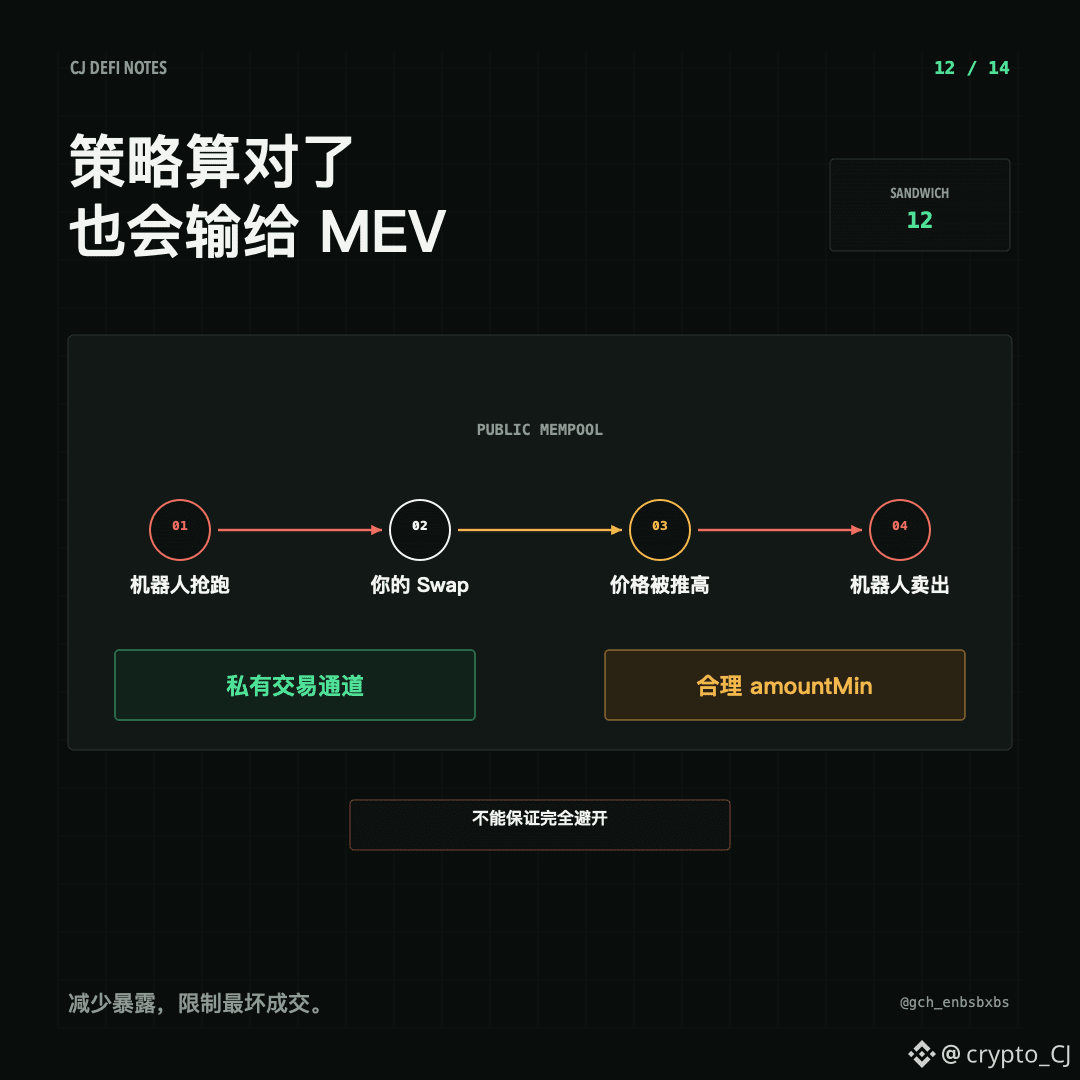
【CJ market-making notes 12/14】
In on-chain execution, some losses have nothing to do with directional judgment. Even if the strategy is correct, the moment of Swap execution can still hand the profit to an MEV bot.
Once a transaction enters the public mempool, the bot can see the direction, amount, and slippage tolerance in advance. It may buy in front of you, pushing the price higher; your trade then executes at a worse price; and the bot sells after you, pocketing the price difference. This is a common sandwich attack. The larger the amount, the thinner the liquidity, and the wider the allowed slippage tolerance—typically the more obvious the exposure.
To reduce risk, there are at least two layers. First, use appropriate private transaction channels for sensitive trades to reduce early exposure of orders in the public mempool. Second, set a reasonable minimum amount to receive—`amountMin`—to limit the worst execution you’re willing to accept. If the parameters are too loose, you give the bot room; if they’re too tight, the trade may fail frequently.
Neither private channels nor `amountMin` can guarantee a complete escape from MEV; they only reduce exposure and constrain the worst outcome. When doing on-chain strategies, your return model must leave room for execution frictions.
Next post: If technical risks can be handled, what do you do about the human attention limit?
#DeFi #MEV
【CJ market-making notes 12/14】
In on-chain execution, some losses have nothing to do with directional judgment. Even if the strategy is correct, the moment of Swap execution can still hand the profit to an MEV bot.
Once a transaction enters the public mempool, the bot can see the direction, amount, and slippage tolerance in advance. It may buy in front of you, pushing the price higher; your trade then executes at a worse price; and the bot sells after you, pocketing the price difference. This is a common sandwich attack. The larger the amount, the thinner the liquidity, and the wider the allowed slippage tolerance—typically the more obvious the exposure.
To reduce risk, there are at least two layers. First, use appropriate private transaction channels for sensitive trades to reduce early exposure of orders in the public mempool. Second, set a reasonable minimum amount to receive—`amountMin`—to limit the worst execution you’re willing to accept. If the parameters are too loose, you give the bot room; if they’re too tight, the trade may fail frequently.
Neither private channels nor `amountMin` can guarantee a complete escape from MEV; they only reduce exposure and constrain the worst outcome. When doing on-chain strategies, your return model must leave room for execution frictions.
Next post: If technical risks can be handled, what do you do about the human attention limit?
#DeFi #MEV
In on-chain execution, some losses have nothing to do with directional judgment. Even if the strategy is correct, the moment of Swap execution can still hand the profit to an MEV bot.
Once a transaction enters the public mempool, the bot can see the direction, amount, and slippage tolerance in advance. It may buy in front of you, pushing the price higher; your trade then executes at a worse price; and the bot sells after you, pocketing the price difference. This is a common sandwich attack. The larger the amount, the thinner the liquidity, and the wider the allowed slippage tolerance—typically the more obvious the exposure.
To reduce risk, there are at least two layers. First, use appropriate private transaction channels for sensitive trades to reduce early exposure of orders in the public mempool. Second, set a reasonable minimum amount to receive—`amountMin`—to limit the worst execution you’re willing to accept. If the parameters are too loose, you give the bot room; if they’re too tight, the trade may fail frequently.
Neither private channels nor `amountMin` can guarantee a complete escape from MEV; they only reduce exposure and constrain the worst outcome. When doing on-chain strategies, your return model must leave room for execution frictions.
Next post: If technical risks can be handled, what do you do about the human attention limit?
#DeFi #MEV
90

·
--
Every transaction on a public blockchain has two prices: the one you see, and the one embedded in its position.
That second price is MEV — maximal extractable value, the profit earned by whoever controls transaction ordering. Front-running is just the crudest form. The refined forms are everywhere: arbitrage bots capturing cross-venue spreads, sandwich attacks taxing large swaps, liquidation races paying priority fees to be first in line.
Traders treat MEV as a nuisance. Better to treat it as a structural market force — a hidden tax, and simultaneously the most honest indicator of where blockspace value actually flows.
This is why Layer 1 comparisons that stop at transactions per second miss the real economic question: who captures ordering value? Ethereum formalized the answer — builders bid, proposers collect, users pay extra for privacy through private order flow. Solana industrialized it — priority fees and MEV tips became a market of their own. Each design distributes ordering value differently, and that distribution decides which users and liquidity providers stay.
The chains that win will not be the ones that eliminate MEV — impossible in any market with public ordering. They will be the ones that return it: order flow auctions, MEV sharing with users, intent-based routing that makes transaction position something you own rather than something taken from you.
Blockspace is a market. The next phase of L1 competition is about who gets to keep its rent.
$ETH $SOL $BNB
#MEV #Ethereum #DeFi #Layer1 #CryptoInsights
Every transaction on a public blockchain has two prices: the one you see, and the one embedded in its position.
That second price is MEV — maximal extractable value, the profit earned by whoever controls transaction ordering. Front-running is just the crudest form. The refined forms are everywhere: arbitrage bots capturing cross-venue spreads, sandwich attacks taxing large swaps, liquidation races paying priority fees to be first in line.
Traders treat MEV as a nuisance. Better to treat it as a structural market force — a hidden tax, and simultaneously the most honest indicator of where blockspace value actually flows.
This is why Layer 1 comparisons that stop at transactions per second miss the real economic question: who captures ordering value? Ethereum formalized the answer — builders bid, proposers collect, users pay extra for privacy through private order flow. Solana industrialized it — priority fees and MEV tips became a market of their own. Each design distributes ordering value differently, and that distribution decides which users and liquidity providers stay.
The chains that win will not be the ones that eliminate MEV — impossible in any market with public ordering. They will be the ones that return it: order flow auctions, MEV sharing with users, intent-based routing that makes transaction position something you own rather than something taken from you.
Blockspace is a market. The next phase of L1 competition is about who gets to keep its rent.
$ETH $SOL $BNB
#MEV #Ethereum #DeFi #Layer1 #CryptoInsights
That second price is MEV — maximal extractable value, the profit earned by whoever controls transaction ordering. Front-running is just the crudest form. The refined forms are everywhere: arbitrage bots capturing cross-venue spreads, sandwich attacks taxing large swaps, liquidation races paying priority fees to be first in line.
Traders treat MEV as a nuisance. Better to treat it as a structural market force — a hidden tax, and simultaneously the most honest indicator of where blockspace value actually flows.
This is why Layer 1 comparisons that stop at transactions per second miss the real economic question: who captures ordering value? Ethereum formalized the answer — builders bid, proposers collect, users pay extra for privacy through private order flow. Solana industrialized it — priority fees and MEV tips became a market of their own. Each design distributes ordering value differently, and that distribution decides which users and liquidity providers stay.
The chains that win will not be the ones that eliminate MEV — impossible in any market with public ordering. They will be the ones that return it: order flow auctions, MEV sharing with users, intent-based routing that makes transaction position something you own rather than something taken from you.
Blockspace is a market. The next phase of L1 competition is about who gets to keep its rent.
$ETH $SOL $BNB
#MEV #Ethereum #DeFi #Layer1 #CryptoInsights
206 Atlas:
MEV is real, but framing it as the primary L1 differentiator ignores that most users just want cheap, reliable execution.
2
1
1.8k

·
--
Traders are watching whether $MEV can turn this retest into continuation.
$MEV – Momentum remains strong, and price is holding above the local range with buyers still active.
Trading Plan LONG $MEV (max 10x)
🎯 Entry: 0.006426 - 0.006478
🛑 SL: 0.002056
✅ TP1: 0.006542
✅ TP2: 0.006626
✅ TP3: 0.006723
• Fresh 24h volatility is creating a cleaner setup
• Relative volume is keeping this chart active on watchlists
Would you long the retest on $MEV, or wait for a reclaim first?
Trade $MEV here 👇
#MEV #Crypto #PriceAction
Traders are watching whether $MEV can turn this retest into continuation.
$MEV – Momentum remains strong, and price is holding above the local range with buyers still active.
Trading Plan LONG $MEV (max 10x)
🎯 Entry: 0.006426 - 0.006478
🛑 SL: 0.002056
✅ TP1: 0.006542
✅ TP2: 0.006626
✅ TP3: 0.006723
• Fresh 24h volatility is creating a cleaner setup
• Relative volume is keeping this chart active on watchlists
Would you long the retest on $MEV, or wait for a reclaim first?
Trade $MEV here 👇
#MEV #Crypto #PriceAction
$MEV – Momentum remains strong, and price is holding above the local range with buyers still active.
Trading Plan LONG $MEV (max 10x)
🎯 Entry: 0.006426 - 0.006478
🛑 SL: 0.002056
✅ TP1: 0.006542
✅ TP2: 0.006626
✅ TP3: 0.006723
• Fresh 24h volatility is creating a cleaner setup
• Relative volume is keeping this chart active on watchlists
Would you long the retest on $MEV, or wait for a reclaim first?
Trade $MEV here 👇
#MEV #Crypto #PriceAction
67


MEV BOT JUST FRONT-RAN A $7.8M EXPLOIT. 💀
A MEV bot on Ethereum named Yoink discovered and front-ran an exploit targeting Safe, involving 2,900 rsETH (~$7.8M).
Yoink spent nearly 19 ETH to secure the first position in block 25,980,525.
Result:
🎯 2,900 rsETH were taken by Yoink ahead of time
💸 ~18.95 ETH was returned to Yoink’s contract by the Pool Manager
⛓️ ~18.93 ETH was then transferred to the block builder
🚫 The original exploit transaction was executed afterward and reverted
BlockSec believes the cause was an incorrect authorization check in the execution contract of a Safe module. Blockaid said the exploit used a public multicall keeper + a malicious Uniswap v4 pool hook.
THE HACKER BROUGHT A KNIFE. YOIK BROUGHT A FASTER KNIFE. 💀
Is the MEV bot becoming an unintended “protector” layer for DeFi, or is this just another extraction game?
#Ethereum #MEV #defi #safeWallet
$ETH
{future}(ETHUSDT)
MEV BOT JUST FRONT-RAN A $7.8M EXPLOIT. 💀
A MEV bot on Ethereum named Yoink discovered and front-ran an exploit targeting Safe, involving 2,900 rsETH (~$7.8M).
Yoink spent nearly 19 ETH to secure the first position in block 25,980,525.
Result:
🎯 2,900 rsETH were taken by Yoink ahead of time
💸 ~18.95 ETH was returned to Yoink’s contract by the Pool Manager
⛓️ ~18.93 ETH was then transferred to the block builder
🚫 The original exploit transaction was executed afterward and reverted
BlockSec believes the cause was an incorrect authorization check in the execution contract of a Safe module. Blockaid said the exploit used a public multicall keeper + a malicious Uniswap v4 pool hook.
THE HACKER BROUGHT A KNIFE. YOIK BROUGHT A FASTER KNIFE. 💀
Is the MEV bot becoming an unintended “protector” layer for DeFi, or is this just another extraction game?
#Ethereum #MEV #defi #safeWallet
$ETH
A MEV bot on Ethereum named Yoink discovered and front-ran an exploit targeting Safe, involving 2,900 rsETH (~$7.8M).
Yoink spent nearly 19 ETH to secure the first position in block 25,980,525.
Result:
🎯 2,900 rsETH were taken by Yoink ahead of time
💸 ~18.95 ETH was returned to Yoink’s contract by the Pool Manager
⛓️ ~18.93 ETH was then transferred to the block builder
🚫 The original exploit transaction was executed afterward and reverted
BlockSec believes the cause was an incorrect authorization check in the execution contract of a Safe module. Blockaid said the exploit used a public multicall keeper + a malicious Uniswap v4 pool hook.
THE HACKER BROUGHT A KNIFE. YOIK BROUGHT A FASTER KNIFE. 💀
Is the MEV bot becoming an unintended “protector” layer for DeFi, or is this just another extraction game?
#Ethereum #MEV #defi #safeWallet
$ETH
53

·
--
Bullish
With <c-1/> Swap, I’m interested in not only the price I see on the screen.
There’s another part of the deal that’s easy to overlook — execution.
Between the expected price and the actual outcome, slippage can occur, liquidity can change, or other features of the DEX route can come into play.
For bStocks, this is especially interesting because the tokenized financial asset ends up in a different environment — TradFi × Web3. Here, the outcome of a trade is influenced not only by the asset’s own characteristics, but also by the mechanics of the blockchain market.
Another factor is MEV. On a public blockchain, transactions can be visible before they’re executed, so certain strategies may try to gain an advantage from the order in which trades are processed. This creates an additional risk for DEX Swap.
That’s why I wouldn’t judge Swap using just two numbers — the price and slippage.
Execution quality is also a matter of routing, liquidity, execution order, and protection against unwanted MEV.
To me, this is a good example of how tokenization changes not only the form of a financial asset, but also the environment in which that asset is traded.
#bStocks #Swap #MEV
With <c-1/> Swap, I’m interested in not only the price I see on the screen.
There’s another part of the deal that’s easy to overlook — execution.
Between the expected price and the actual outcome, slippage can occur, liquidity can change, or other features of the DEX route can come into play.
For bStocks, this is especially interesting because the tokenized financial asset ends up in a different environment — TradFi × Web3. Here, the outcome of a trade is influenced not only by the asset’s own characteristics, but also by the mechanics of the blockchain market.
Another factor is MEV. On a public blockchain, transactions can be visible before they’re executed, so certain strategies may try to gain an advantage from the order in which trades are processed. This creates an additional risk for DEX Swap.
That’s why I wouldn’t judge Swap using just two numbers — the price and slippage.
Execution quality is also a matter of routing, liquidity, execution order, and protection against unwanted MEV.
To me, this is a good example of how tokenization changes not only the form of a financial asset, but also the environment in which that asset is traded.
#bStocks #Swap #MEV
There’s another part of the deal that’s easy to overlook — execution.
Between the expected price and the actual outcome, slippage can occur, liquidity can change, or other features of the DEX route can come into play.
For bStocks, this is especially interesting because the tokenized financial asset ends up in a different environment — TradFi × Web3. Here, the outcome of a trade is influenced not only by the asset’s own characteristics, but also by the mechanics of the blockchain market.
Another factor is MEV. On a public blockchain, transactions can be visible before they’re executed, so certain strategies may try to gain an advantage from the order in which trades are processed. This creates an additional risk for DEX Swap.
That’s why I wouldn’t judge Swap using just two numbers — the price and slippage.
Execution quality is also a matter of routing, liquidity, execution order, and protection against unwanted MEV.
To me, this is a good example of how tokenization changes not only the form of a financial asset, but also the environment in which that asset is traded.
#bStocks #Swap #MEV
160

·
--
Article
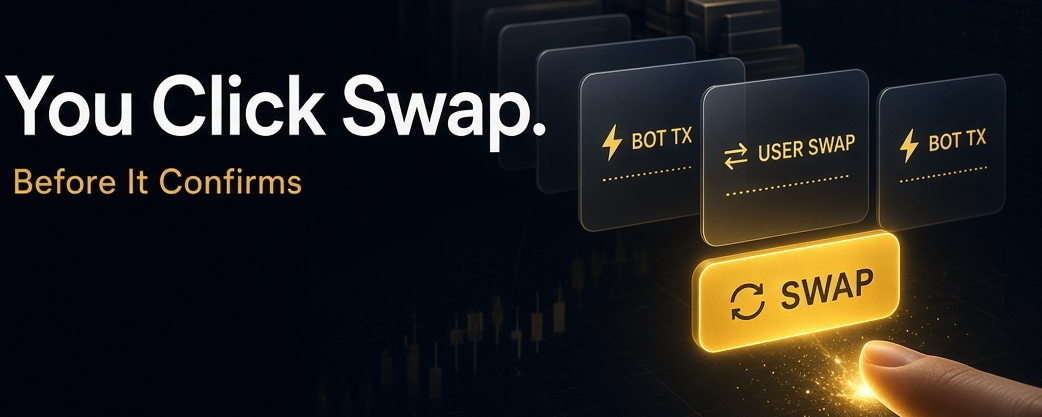
You Click Swap. What Happens Before It Confirms?Your Crypto Transaction Isn’t Always First Come, First Served
You make a swap.
You confirm it, pay the fee, and wait for the transaction to land on-chain.
Most people think the process is basically a queue:
I submitted first, so I should be processed first.
That assumption breaks down on some blockchains.
The interesting part is what happens before your transaction is confirmed.
Where MEV enters 🤔
MEV, or Maximal Extractable Value, is about the value that can be captured by controlling which transactions are included in a block and, importantly, the order they appear in.
That sounds technical, but the idea is fairly simple.
Say you are making a large swap on a decentralized exchange. Your transaction is sitting pending, and its execution could move the price of the token.
Automated traders are watching the same market.
If your trade creates an opportunity, they may try to get their own transaction positioned around yours.
That's where one of the most talked about MEV strategies comes in: the sandwich attack.
A trade can become the opportunity
Imagine you submit a large buy.
A bot gets its transaction in before yours.
Your trade pushes the token price higher.
The bot then sells after your transaction executes.
The exact mechanics depend on the blockchain and trading venue, but the basic idea is that your order creates a price movement that someone else tries to trade around.
And this is why transaction ordering matters.
It's not simply about who arrived first.
But calling all MEV “bad” misses the point
Arbitrage is another example.
If a token is trading at $100 on one decentralized exchange and $101 on another, a trader can buy on the cheaper venue and sell on the more expensive one.
That trade can capture MEV, but it can also help push the two prices closer together.
So there are two different conversations here.
Some MEV strategies can extract value from ordinary users.
Others are part of the competitive process that keeps fragmented markets more efficient.
The important thing is understanding who is getting the value and why.
Why should a normal user care?
Because MEV can turn something that looks like a simple swap into a more complicated execution problem.
Your final execution price can depend on liquidity, slippage, transaction ordering and what other participants are doing at the same time.
This becomes more noticeable with large trades or thin liquidity.
There isn't a magic button that makes MEV disappear.
But basic precautions help.
Keep slippage as tight as reasonably possible. Check whether your wallet or trading route provides MEV protection. And don't treat a fast confirmation as automatically meaning a better execution.
The bigger lesson for me is simple:
On-chain, your transaction isn't operating in isolation.
There are other traders, bots, validators, block builders and liquidity providers reacting to the same information.
Once you understand that, “I clicked swap” stops being the whole story.
The transaction still has to find its place in the block.
And that place can have a price.
Have you ever checked how your swap was actually executed after confirmation?
#MEV #defi #blockchain
$ETH
You Click Swap. What Happens Before It Confirms?
Your Crypto Transaction Isn’t Always First Come, First Served
You make a swap.
You confirm it, pay the fee, and wait for the transaction to land on-chain.
Most people think the process is basically a queue:
I submitted first, so I should be processed first.
That assumption breaks down on some blockchains.
The interesting part is what happens before your transaction is confirmed.
Where MEV enters 🤔
MEV, or Maximal Extractable Value, is about the value that can be captured by controlling which transactions are included in a block and, importantly, the order they appear in.
That sounds technical, but the idea is fairly simple.
Say you are making a large swap on a decentralized exchange. Your transaction is sitting pending, and its execution could move the price of the token.
Automated traders are watching the same market.
If your trade creates an opportunity, they may try to get their own transaction positioned around yours.
That's where one of the most talked about MEV strategies comes in: the sandwich attack.
A trade can become the opportunity
Imagine you submit a large buy.
A bot gets its transaction in before yours.
Your trade pushes the token price higher.
The bot then sells after your transaction executes.
The exact mechanics depend on the blockchain and trading venue, but the basic idea is that your order creates a price movement that someone else tries to trade around.
And this is why transaction ordering matters.
It's not simply about who arrived first.
But calling all MEV “bad” misses the point
Arbitrage is another example.
If a token is trading at $100 on one decentralized exchange and $101 on another, a trader can buy on the cheaper venue and sell on the more expensive one.
That trade can capture MEV, but it can also help push the two prices closer together.
So there are two different conversations here.
Some MEV strategies can extract value from ordinary users.
Others are part of the competitive process that keeps fragmented markets more efficient.
The important thing is understanding who is getting the value and why.
Why should a normal user care?
Because MEV can turn something that looks like a simple swap into a more complicated execution problem.
Your final execution price can depend on liquidity, slippage, transaction ordering and what other participants are doing at the same time.
This becomes more noticeable with large trades or thin liquidity.
There isn't a magic button that makes MEV disappear.
But basic precautions help.
Keep slippage as tight as reasonably possible. Check whether your wallet or trading route provides MEV protection. And don't treat a fast confirmation as automatically meaning a better execution.
The bigger lesson for me is simple:
On-chain, your transaction isn't operating in isolation.
There are other traders, bots, validators, block builders and liquidity providers reacting to the same information.
Once you understand that, “I clicked swap” stops being the whole story.
The transaction still has to find its place in the block.
And that place can have a price.
Have you ever checked how your swap was actually executed after confirmation?
#MEV #defi #blockchain
$ETH
You make a swap.
You confirm it, pay the fee, and wait for the transaction to land on-chain.
Most people think the process is basically a queue:
I submitted first, so I should be processed first.
That assumption breaks down on some blockchains.
The interesting part is what happens before your transaction is confirmed.
Where MEV enters 🤔
MEV, or Maximal Extractable Value, is about the value that can be captured by controlling which transactions are included in a block and, importantly, the order they appear in.
That sounds technical, but the idea is fairly simple.
Say you are making a large swap on a decentralized exchange. Your transaction is sitting pending, and its execution could move the price of the token.
Automated traders are watching the same market.
If your trade creates an opportunity, they may try to get their own transaction positioned around yours.
That's where one of the most talked about MEV strategies comes in: the sandwich attack.
A trade can become the opportunity
Imagine you submit a large buy.
A bot gets its transaction in before yours.
Your trade pushes the token price higher.
The bot then sells after your transaction executes.
The exact mechanics depend on the blockchain and trading venue, but the basic idea is that your order creates a price movement that someone else tries to trade around.
And this is why transaction ordering matters.
It's not simply about who arrived first.
But calling all MEV “bad” misses the point
Arbitrage is another example.
If a token is trading at $100 on one decentralized exchange and $101 on another, a trader can buy on the cheaper venue and sell on the more expensive one.
That trade can capture MEV, but it can also help push the two prices closer together.
So there are two different conversations here.
Some MEV strategies can extract value from ordinary users.
Others are part of the competitive process that keeps fragmented markets more efficient.
The important thing is understanding who is getting the value and why.
Why should a normal user care?
Because MEV can turn something that looks like a simple swap into a more complicated execution problem.
Your final execution price can depend on liquidity, slippage, transaction ordering and what other participants are doing at the same time.
This becomes more noticeable with large trades or thin liquidity.
There isn't a magic button that makes MEV disappear.
But basic precautions help.
Keep slippage as tight as reasonably possible. Check whether your wallet or trading route provides MEV protection. And don't treat a fast confirmation as automatically meaning a better execution.
The bigger lesson for me is simple:
On-chain, your transaction isn't operating in isolation.
There are other traders, bots, validators, block builders and liquidity providers reacting to the same information.
Once you understand that, “I clicked swap” stops being the whole story.
The transaction still has to find its place in the block.
And that place can have a price.
Have you ever checked how your swap was actually executed after confirmation?
#MEV #defi #blockchain
$ETH
2
144

·
--
📰 Solana co-founder Toly is at it again with Arbitrum co-founder Steven Goldfeder, and this time they’re arguing over the same old point: don’t just look at the headline fee.
Toly’s point is very straightforward: Arbitrum currently has a wider bid-ask spread and higher fees; if you only calculate the 10% cut taken from fees, the cost is already higher than the sandwich trading fee rate, and once you factor in the worse spread, he estimates the overall cost could be about 10 times higher.
💡 Steven’s take isn’t without merit either. He stresses that both Arbitrum One and Robinhood Chain are designed to prevent front-running and harmful MEV. A lot of people like to bring up “low fees,” but retail users may end up being slowly drained by hidden costs like front-running and sandwich attacks.
Honestly, the core of this debate isn’t who’s louder, but what people care about more: the “visible fee” or the total amount spent on the trade. On the single-sequencer model, Toly flat-out says it can never beat permissionless market competition.
🤔 When looking at chains, you really can’t focus on just one number. Would you trust something that’s “cheap but may have hidden losses,” or “a bit more expensive but has a more stable mechanism”?
#Solana #Arbitrum #MEV #on-chain trading
📰 Solana co-founder Toly is at it again with Arbitrum co-founder Steven Goldfeder, and this time they’re arguing over the same old point: don’t just look at the headline fee.
Toly’s point is very straightforward: Arbitrum currently has a wider bid-ask spread and higher fees; if you only calculate the 10% cut taken from fees, the cost is already higher than the sandwich trading fee rate, and once you factor in the worse spread, he estimates the overall cost could be about 10 times higher.
💡 Steven’s take isn’t without merit either. He stresses that both Arbitrum One and Robinhood Chain are designed to prevent front-running and harmful MEV. A lot of people like to bring up “low fees,” but retail users may end up being slowly drained by hidden costs like front-running and sandwich attacks.
Honestly, the core of this debate isn’t who’s louder, but what people care about more: the “visible fee” or the total amount spent on the trade. On the single-sequencer model, Toly flat-out says it can never beat permissionless market competition.
🤔 When looking at chains, you really can’t focus on just one number. Would you trust something that’s “cheap but may have hidden losses,” or “a bit more expensive but has a more stable mechanism”?
#Solana #Arbitrum #MEV #on-chain trading
Toly’s point is very straightforward: Arbitrum currently has a wider bid-ask spread and higher fees; if you only calculate the 10% cut taken from fees, the cost is already higher than the sandwich trading fee rate, and once you factor in the worse spread, he estimates the overall cost could be about 10 times higher.
💡 Steven’s take isn’t without merit either. He stresses that both Arbitrum One and Robinhood Chain are designed to prevent front-running and harmful MEV. A lot of people like to bring up “low fees,” but retail users may end up being slowly drained by hidden costs like front-running and sandwich attacks.
Honestly, the core of this debate isn’t who’s louder, but what people care about more: the “visible fee” or the total amount spent on the trade. On the single-sequencer model, Toly flat-out says it can never beat permissionless market competition.
🤔 When looking at chains, you really can’t focus on just one number. Would you trust something that’s “cheap but may have hidden losses,” or “a bit more expensive but has a more stable mechanism”?
#Solana #Arbitrum #MEV #on-chain trading

222

·
--
LayerZero teams up with Oblivious Labs and Carnegie Mellon University to publish a paper, introducing a new AMM mechanism called OTTER that is resistant to MEV.
OTTER uses a batch settlement mechanism similar to a VCG auction, making it a dominant strategy for traders to truthfully report their valuations and budgets, while weakening block builders’ ability to profit through transaction ordering, sandwich attacks, or injecting false bids.
The residual value that might originally have been captured by MEV will be redistributed to liquidity providers, traders, liquidity pools, or underlying chain validators, reducing the impact of builders’ advantages on how ecosystem value is allocated.
#LayerZero #MEV #DeFi #AMM
LayerZero teams up with Oblivious Labs and Carnegie Mellon University to publish a paper, introducing a new AMM mechanism called OTTER that is resistant to MEV.
OTTER uses a batch settlement mechanism similar to a VCG auction, making it a dominant strategy for traders to truthfully report their valuations and budgets, while weakening block builders’ ability to profit through transaction ordering, sandwich attacks, or injecting false bids.
The residual value that might originally have been captured by MEV will be redistributed to liquidity providers, traders, liquidity pools, or underlying chain validators, reducing the impact of builders’ advantages on how ecosystem value is allocated.
#LayerZero #MEV #DeFi #AMM
OTTER uses a batch settlement mechanism similar to a VCG auction, making it a dominant strategy for traders to truthfully report their valuations and budgets, while weakening block builders’ ability to profit through transaction ordering, sandwich attacks, or injecting false bids.
The residual value that might originally have been captured by MEV will be redistributed to liquidity providers, traders, liquidity pools, or underlying chain validators, reducing the impact of builders’ advantages on how ecosystem value is allocated.
#LayerZero #MEV #DeFi #AMM
119

Article
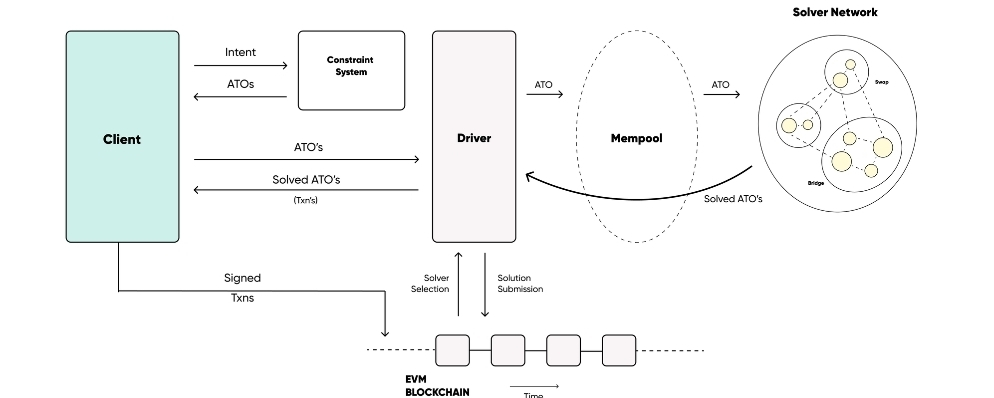
Intent-Based Architecture is Fixing UX, But What Is It Doing to Market Structure?We’ve all heard the narrative over the past year: Intents are the ultimate endgame for Web3 UX. You sign a message declaring what outcome you want, and off-chain solvers handle the routing, gas, and execution behind the scenes.
For the average user, it feels like magic. No more stuck transactions, no more manual multi-step bridging, and no need to micromanage gas fees across six different chains.
But if you look closely at how order flow is actually settling behind the curtain, a quiet trade-off is taking place that isn't getting nearly enough coverage.
When you route transactions through off-chain solvers rather than an open public mempool, you aren't eliminating MEV—you’re just shifting where it happens.
1. The "Dark Pool" Parallel
In traditional finance, dark pools were created to execute large orders without moving public order books. Over time, however, they led to market fragmentation where retail orders got internalized off-exchange while toxic flow was dumped onto lit venues. Intent-based architectures run a very similar risk: if solver networks become concentrated, price discovery starts moving off-chain into private auction spaces.
2. Capital Requirements & Solver Oligopolies
Running a competitive solver isn't cheap. It requires massive cross-chain liquidity, sophisticated inventory management, and ultra-low-latency infrastructure. Because of these barrier costs, the pool of winning solvers in any major protocol naturally trends toward a small cluster of well-capitalized market makers. When a handful of entities win 80%+ of execution bids, "optimal routing" is effectively defined by whoever holds the monopoly on liquidity.
3. Convenience vs. Execution Fairness
Hiding technical complexity from the end user is essential for mainstream adoption. But convenience shouldn't blind us to execution quality. If a solver executes your trade slightly worse than optimal market rate and absorbs the difference as margin, the user still gets a "smooth" experience—they just pay an invisible fee for it.
The Big Picture
Intent abstraction is undoubtedly one of the best UX upgrades Web3 has seen in years. But as traders, analysts, and builders, we need to track how these solver auctions mature.
The real test for the next phase of DeFi isn't just making transactions seamless—it's ensuring that solver competition stays decentralized enough so that execution value flows back to the user, rather than getting swallowed by off-chain intermediaries.
Keep an eye on solver auction designs, batch auction mechanics, and programmable privacy primitives over the coming months. That is where the real infrastructure battle is happening.
#defi #Web3 #CryptoAnalysis #MEV
Intent-Based Architecture is Fixing UX, But What Is It Doing to Market Structure?
We’ve all heard the narrative over the past year: Intents are the ultimate endgame for Web3 UX. You sign a message declaring what outcome you want, and off-chain solvers handle the routing, gas, and execution behind the scenes.
For the average user, it feels like magic. No more stuck transactions, no more manual multi-step bridging, and no need to micromanage gas fees across six different chains.
But if you look closely at how order flow is actually settling behind the curtain, a quiet trade-off is taking place that isn't getting nearly enough coverage.
When you route transactions through off-chain solvers rather than an open public mempool, you aren't eliminating MEV—you’re just shifting where it happens.
1. The "Dark Pool" Parallel
In traditional finance, dark pools were created to execute large orders without moving public order books. Over time, however, they led to market fragmentation where retail orders got internalized off-exchange while toxic flow was dumped onto lit venues. Intent-based architectures run a very similar risk: if solver networks become concentrated, price discovery starts moving off-chain into private auction spaces.
2. Capital Requirements & Solver Oligopolies
Running a competitive solver isn't cheap. It requires massive cross-chain liquidity, sophisticated inventory management, and ultra-low-latency infrastructure. Because of these barrier costs, the pool of winning solvers in any major protocol naturally trends toward a small cluster of well-capitalized market makers. When a handful of entities win 80%+ of execution bids, "optimal routing" is effectively defined by whoever holds the monopoly on liquidity.
3. Convenience vs. Execution Fairness
Hiding technical complexity from the end user is essential for mainstream adoption. But convenience shouldn't blind us to execution quality. If a solver executes your trade slightly worse than optimal market rate and absorbs the difference as margin, the user still gets a "smooth" experience—they just pay an invisible fee for it.
The Big Picture
Intent abstraction is undoubtedly one of the best UX upgrades Web3 has seen in years. But as traders, analysts, and builders, we need to track how these solver auctions mature.
The real test for the next phase of DeFi isn't just making transactions seamless—it's ensuring that solver competition stays decentralized enough so that execution value flows back to the user, rather than getting swallowed by off-chain intermediaries.
Keep an eye on solver auction designs, batch auction mechanics, and programmable privacy primitives over the coming months. That is where the real infrastructure battle is happening.
#defi #Web3 #CryptoAnalysis #MEV
For the average user, it feels like magic. No more stuck transactions, no more manual multi-step bridging, and no need to micromanage gas fees across six different chains.
But if you look closely at how order flow is actually settling behind the curtain, a quiet trade-off is taking place that isn't getting nearly enough coverage.
When you route transactions through off-chain solvers rather than an open public mempool, you aren't eliminating MEV—you’re just shifting where it happens.
1. The "Dark Pool" Parallel
In traditional finance, dark pools were created to execute large orders without moving public order books. Over time, however, they led to market fragmentation where retail orders got internalized off-exchange while toxic flow was dumped onto lit venues. Intent-based architectures run a very similar risk: if solver networks become concentrated, price discovery starts moving off-chain into private auction spaces.
2. Capital Requirements & Solver Oligopolies
Running a competitive solver isn't cheap. It requires massive cross-chain liquidity, sophisticated inventory management, and ultra-low-latency infrastructure. Because of these barrier costs, the pool of winning solvers in any major protocol naturally trends toward a small cluster of well-capitalized market makers. When a handful of entities win 80%+ of execution bids, "optimal routing" is effectively defined by whoever holds the monopoly on liquidity.
3. Convenience vs. Execution Fairness
Hiding technical complexity from the end user is essential for mainstream adoption. But convenience shouldn't blind us to execution quality. If a solver executes your trade slightly worse than optimal market rate and absorbs the difference as margin, the user still gets a "smooth" experience—they just pay an invisible fee for it.
The Big Picture
Intent abstraction is undoubtedly one of the best UX upgrades Web3 has seen in years. But as traders, analysts, and builders, we need to track how these solver auctions mature.
The real test for the next phase of DeFi isn't just making transactions seamless—it's ensuring that solver competition stays decentralized enough so that execution value flows back to the user, rather than getting swallowed by off-chain intermediaries.
Keep an eye on solver auction designs, batch auction mechanics, and programmable privacy primitives over the coming months. That is where the real infrastructure battle is happening.
#defi #Web3 #CryptoAnalysis #MEV
1
339
·
--
Ads, sources, and external links have been removed, and the format has been optimized for the following tweet:
🚨 JaredfromSubway.eth sandwich attack bot has cumulatively extracted about $295 million in ETH (117,007 ETH), but in June it was reverse-attacked and stole at least $7.5 million.
The attackers deployed 66 counterfeit token contract copies and used the bot’s automated trading logic to profit; the funds have been moved to Tornado Cash and have not been recovered yet.
Background: Sandwich attacks are a type of MEV. The bot monitors large transactions in Ethereum’s public mempool, front-runs by buying first, then sells after the price has been pushed up to profit from the price spread.
MEV-Boost centralization remains evident: relay.ultrasound.money, Titan Relay, bloXroute, and others forwarded about 85%-88% of the related blocks within 24 hours; Titan builders independently assembled 50.3% of blocks.
Monthly sandwich-attack extraction trend: it fell from about $10 million at the end of 2024 to about $2.5 million in October 2025.
#Ethereum #MEV #Crypto
Ads, sources, and external links have been removed, and the format has been optimized for the following tweet:
🚨 JaredfromSubway.eth sandwich attack bot has cumulatively extracted about $295 million in ETH (117,007 ETH), but in June it was reverse-attacked and stole at least $7.5 million.
The attackers deployed 66 counterfeit token contract copies and used the bot’s automated trading logic to profit; the funds have been moved to Tornado Cash and have not been recovered yet.
Background: Sandwich attacks are a type of MEV. The bot monitors large transactions in Ethereum’s public mempool, front-runs by buying first, then sells after the price has been pushed up to profit from the price spread.
MEV-Boost centralization remains evident: relay.ultrasound.money, Titan Relay, bloXroute, and others forwarded about 85%-88% of the related blocks within 24 hours; Titan builders independently assembled 50.3% of blocks.
Monthly sandwich-attack extraction trend: it fell from about $10 million at the end of 2024 to about $2.5 million in October 2025.
#Ethereum #MEV #Crypto
🚨 JaredfromSubway.eth sandwich attack bot has cumulatively extracted about $295 million in ETH (117,007 ETH), but in June it was reverse-attacked and stole at least $7.5 million.
The attackers deployed 66 counterfeit token contract copies and used the bot’s automated trading logic to profit; the funds have been moved to Tornado Cash and have not been recovered yet.
Background: Sandwich attacks are a type of MEV. The bot monitors large transactions in Ethereum’s public mempool, front-runs by buying first, then sells after the price has been pushed up to profit from the price spread.
MEV-Boost centralization remains evident: relay.ultrasound.money, Titan Relay, bloXroute, and others forwarded about 85%-88% of the related blocks within 24 hours; Titan builders independently assembled 50.3% of blocks.
Monthly sandwich-attack extraction trend: it fell from about $10 million at the end of 2024 to about $2.5 million in October 2025.
#Ethereum #MEV #Crypto
178

·
--
JaredfromSubway.eth-operated sandwich-attack bot has cumulatively extracted 117007 ETH since March 2023, which is equivalent to approximately $295 million at current prices. ETH is currently trading at about $2455.8 on Binance, with a 24-hour increase of 0.65%.
The bot suffered a backfire in June 2026. Anonymous attackers deployed 66 counterfeit token contracts, using its automated trading logic to steal at least $7.5 million worth of ETH and stablecoins. The funds have been moved to Tornado Cash and have not been recovered yet.
Sandwich attacks are a typical form of MEV: the bot monitors large transactions in the public mempool, buys in advance, and sells after the price is pushed up, extracting profit from the trade-price spread. On-chain data shows that block construction remains highly concentrated: the Titan Builder independently assembles 50.3% of blocks, and three regulatory relays together forward roughly 85% to 88% of the related blocks.
For market observation only and does not constitute investment advice.
#ETH #MEV #链上安全
JaredfromSubway.eth-operated sandwich-attack bot has cumulatively extracted 117007 ETH since March 2023, which is equivalent to approximately $295 million at current prices. ETH is currently trading at about $2455.8 on Binance, with a 24-hour increase of 0.65%.
The bot suffered a backfire in June 2026. Anonymous attackers deployed 66 counterfeit token contracts, using its automated trading logic to steal at least $7.5 million worth of ETH and stablecoins. The funds have been moved to Tornado Cash and have not been recovered yet.
Sandwich attacks are a typical form of MEV: the bot monitors large transactions in the public mempool, buys in advance, and sells after the price is pushed up, extracting profit from the trade-price spread. On-chain data shows that block construction remains highly concentrated: the Titan Builder independently assembles 50.3% of blocks, and three regulatory relays together forward roughly 85% to 88% of the related blocks.
For market observation only and does not constitute investment advice.
#ETH #MEV #链上安全
The bot suffered a backfire in June 2026. Anonymous attackers deployed 66 counterfeit token contracts, using its automated trading logic to steal at least $7.5 million worth of ETH and stablecoins. The funds have been moved to Tornado Cash and have not been recovered yet.
Sandwich attacks are a typical form of MEV: the bot monitors large transactions in the public mempool, buys in advance, and sells after the price is pushed up, extracting profit from the trade-price spread. On-chain data shows that block construction remains highly concentrated: the Titan Builder independently assembles 50.3% of blocks, and three regulatory relays together forward roughly 85% to 88% of the related blocks.
For market observation only and does not constitute investment advice.
#ETH #MEV #链上安全
57

·
--
Bullish
Transparency was supposed to be crypto's greatest feature. It became its most exploited vulnerability.@GeniusOfficial
For years, the market rewarded observers. Wallet trackers, on-chain analysts, smart money followers entire trading cultures built around the assumption that seeing clearly was the same as competing effectively. Visibility was treated as edge.
But that assumption contained a hidden flaw.#genius
In a fully transparent market, information equalizes faster than it can be monetized. The moment a whale moves, the signal propagates. The moment a signal propagates, it gets front-run, copied, or priced in. Observation without execution is just latency with a better dashboard.
This is where the nature of competition quietly shifts.#MEV
The real structural advantage is no longer upstream it is not in knowing what capital is doing. It is in controlling how capital moves once you decide to act. Routing quality, MEV protection, liquidity access, execution without footprint these are becoming the actual determinants of alpha in adversarial, fragmented markets.
Genius Terminal sits precisely at this inflection point. Not as a visibility tool, but as execution infrastructure built for an environment where revealing your intent is the same as surrendering your position.
The implication extends beyond any single platform.#GeniusTerminal
Markets evolve toward making their most exploitable advantages obsolete. Information edges compress. Behavioral edges get modeled. What survives is structural the ability to operate efficiently inside a system that is actively working against you.
The question was never just "what are the whales doing?"
It was always "why do some of them keep winning even after everyone is watching?"
@GeniusOfficial #genius $GENIUS
{spot}(GENIUSUSDT)
Transparency was supposed to be crypto's greatest feature. It became its most exploited vulnerability.@GeniusOfficial
For years, the market rewarded observers. Wallet trackers, on-chain analysts, smart money followers entire trading cultures built around the assumption that seeing clearly was the same as competing effectively. Visibility was treated as edge.
But that assumption contained a hidden flaw.#genius
In a fully transparent market, information equalizes faster than it can be monetized. The moment a whale moves, the signal propagates. The moment a signal propagates, it gets front-run, copied, or priced in. Observation without execution is just latency with a better dashboard.
This is where the nature of competition quietly shifts.#MEV
The real structural advantage is no longer upstream it is not in knowing what capital is doing. It is in controlling how capital moves once you decide to act. Routing quality, MEV protection, liquidity access, execution without footprint these are becoming the actual determinants of alpha in adversarial, fragmented markets.
Genius Terminal sits precisely at this inflection point. Not as a visibility tool, but as execution infrastructure built for an environment where revealing your intent is the same as surrendering your position.
The implication extends beyond any single platform.#GeniusTerminal
Markets evolve toward making their most exploitable advantages obsolete. Information edges compress. Behavioral edges get modeled. What survives is structural the ability to operate efficiently inside a system that is actively working against you.
The question was never just "what are the whales doing?"
It was always "why do some of them keep winning even after everyone is watching?"
@GeniusOfficial #genius $GENIUS
For years, the market rewarded observers. Wallet trackers, on-chain analysts, smart money followers entire trading cultures built around the assumption that seeing clearly was the same as competing effectively. Visibility was treated as edge.
But that assumption contained a hidden flaw.#genius
In a fully transparent market, information equalizes faster than it can be monetized. The moment a whale moves, the signal propagates. The moment a signal propagates, it gets front-run, copied, or priced in. Observation without execution is just latency with a better dashboard.
This is where the nature of competition quietly shifts.#MEV
The real structural advantage is no longer upstream it is not in knowing what capital is doing. It is in controlling how capital moves once you decide to act. Routing quality, MEV protection, liquidity access, execution without footprint these are becoming the actual determinants of alpha in adversarial, fragmented markets.
Genius Terminal sits precisely at this inflection point. Not as a visibility tool, but as execution infrastructure built for an environment where revealing your intent is the same as surrendering your position.
The implication extends beyond any single platform.#GeniusTerminal
Markets evolve toward making their most exploitable advantages obsolete. Information edges compress. Behavioral edges get modeled. What survives is structural the ability to operate efficiently inside a system that is actively working against you.
The question was never just "what are the whales doing?"
It was always "why do some of them keep winning even after everyone is watching?"
@GeniusOfficial #genius $GENIUS

4
8
154

·
--
The most notorious sniping bot on Ethereum just got sniped for $7.5 million yesterday.
If you’re into DeFi, you’ve probably heard of jaredfromsubway.eth. For over two years, this bot has been behind 70% of sniping attacks on Ethereum. Even Vitalik got caught in its sniping net over a $2 token. It uses algorithms to automatically monitor pending transactions, buying in front of you and selling behind you to cash in on the price spread. Simple and brutal, yet extremely profitable.
But yesterday, this bot, which usually feasts on others, became the prey.
A hacker spent weeks deploying 66 fake token contracts and fake liquidity pools. These bogus contracts mimicked the trading patterns of WETH, USDC, and USDT, creating seemingly profitable trading opportunities. The jaredfromsubway bot saw this as a chance to feast and jumped in without hesitation. What it didn’t realize was that each "profitable trade" authorized a malicious contract. In the final transaction, the hacker triggered all backdoors and drained the bot's wallet of ETH, USDC, and USDT.
This tactic is called a "reverse MEV honeypot," specifically tailored to exploit the decision-making logic of bots. It’s not about breaking contracts or phishing signatures; it’s about leveraging the bot's weakness of "only looking at profits and not at the opponent."
I keep pondering one question: MEV bots rely on algorithms to automatically determine whether a trade is worth executing, but the algorithm can’t tell if an opponent is a real user or a hunter. When your business model is built on "sniping others," your Achilles' heel is pretty obvious — just create a fake target that looks snipable, and the bot will walk right into the trap.
What does this mean for regular retail traders? A lot. It shows that the on-chain environment is far more dangerous than you might think. Did you think getting sniped is just a nuisance for small traders? Even the most aggressive bots can get sniped. In DeFi, every trade could face a hidden trap.
Ironically, on the same day, the Wall Street Journal exposed Polymarket. The investigation found that a lot of "instant profit" videos on TikTok and Instagram are fake, with some created by paid influencers and some profit screenshots outright forged. Polymarket even hired a marketing firm called Virality specifically to promote to US users. A prediction market platform that is fabricating its own credibility — what can you even trust?
These two events point to the same reality: there is no safe zone in the on-chain world. From MEV bots to prediction platforms, from algorithms to marketing, there are setups at every stage.
You think you’re playing a game, but in reality, you are the game itself.
$ETH #MEV #DeFi #Polymarket #BinanceSquare
The most notorious sniping bot on Ethereum just got sniped for $7.5 million yesterday.
If you’re into DeFi, you’ve probably heard of jaredfromsubway.eth. For over two years, this bot has been behind 70% of sniping attacks on Ethereum. Even Vitalik got caught in its sniping net over a $2 token. It uses algorithms to automatically monitor pending transactions, buying in front of you and selling behind you to cash in on the price spread. Simple and brutal, yet extremely profitable.
But yesterday, this bot, which usually feasts on others, became the prey.
A hacker spent weeks deploying 66 fake token contracts and fake liquidity pools. These bogus contracts mimicked the trading patterns of WETH, USDC, and USDT, creating seemingly profitable trading opportunities. The jaredfromsubway bot saw this as a chance to feast and jumped in without hesitation. What it didn’t realize was that each "profitable trade" authorized a malicious contract. In the final transaction, the hacker triggered all backdoors and drained the bot's wallet of ETH, USDC, and USDT.
This tactic is called a "reverse MEV honeypot," specifically tailored to exploit the decision-making logic of bots. It’s not about breaking contracts or phishing signatures; it’s about leveraging the bot's weakness of "only looking at profits and not at the opponent."
I keep pondering one question: MEV bots rely on algorithms to automatically determine whether a trade is worth executing, but the algorithm can’t tell if an opponent is a real user or a hunter. When your business model is built on "sniping others," your Achilles' heel is pretty obvious — just create a fake target that looks snipable, and the bot will walk right into the trap.
What does this mean for regular retail traders? A lot. It shows that the on-chain environment is far more dangerous than you might think. Did you think getting sniped is just a nuisance for small traders? Even the most aggressive bots can get sniped. In DeFi, every trade could face a hidden trap.
Ironically, on the same day, the Wall Street Journal exposed Polymarket. The investigation found that a lot of "instant profit" videos on TikTok and Instagram are fake, with some created by paid influencers and some profit screenshots outright forged. Polymarket even hired a marketing firm called Virality specifically to promote to US users. A prediction market platform that is fabricating its own credibility — what can you even trust?
These two events point to the same reality: there is no safe zone in the on-chain world. From MEV bots to prediction platforms, from algorithms to marketing, there are setups at every stage.
You think you’re playing a game, but in reality, you are the game itself.
$ETH #MEV #DeFi #Polymarket #BinanceSquare
If you’re into DeFi, you’ve probably heard of jaredfromsubway.eth. For over two years, this bot has been behind 70% of sniping attacks on Ethereum. Even Vitalik got caught in its sniping net over a $2 token. It uses algorithms to automatically monitor pending transactions, buying in front of you and selling behind you to cash in on the price spread. Simple and brutal, yet extremely profitable.
But yesterday, this bot, which usually feasts on others, became the prey.
A hacker spent weeks deploying 66 fake token contracts and fake liquidity pools. These bogus contracts mimicked the trading patterns of WETH, USDC, and USDT, creating seemingly profitable trading opportunities. The jaredfromsubway bot saw this as a chance to feast and jumped in without hesitation. What it didn’t realize was that each "profitable trade" authorized a malicious contract. In the final transaction, the hacker triggered all backdoors and drained the bot's wallet of ETH, USDC, and USDT.
This tactic is called a "reverse MEV honeypot," specifically tailored to exploit the decision-making logic of bots. It’s not about breaking contracts or phishing signatures; it’s about leveraging the bot's weakness of "only looking at profits and not at the opponent."
I keep pondering one question: MEV bots rely on algorithms to automatically determine whether a trade is worth executing, but the algorithm can’t tell if an opponent is a real user or a hunter. When your business model is built on "sniping others," your Achilles' heel is pretty obvious — just create a fake target that looks snipable, and the bot will walk right into the trap.
What does this mean for regular retail traders? A lot. It shows that the on-chain environment is far more dangerous than you might think. Did you think getting sniped is just a nuisance for small traders? Even the most aggressive bots can get sniped. In DeFi, every trade could face a hidden trap.
Ironically, on the same day, the Wall Street Journal exposed Polymarket. The investigation found that a lot of "instant profit" videos on TikTok and Instagram are fake, with some created by paid influencers and some profit screenshots outright forged. Polymarket even hired a marketing firm called Virality specifically to promote to US users. A prediction market platform that is fabricating its own credibility — what can you even trust?
These two events point to the same reality: there is no safe zone in the on-chain world. From MEV bots to prediction platforms, from algorithms to marketing, there are setups at every stage.
You think you’re playing a game, but in reality, you are the game itself.
$ETH #MEV #DeFi #Polymarket #BinanceSquare
165

An MEV bot that was once considered a money printer on Ethereum just got "played" and lost a whopping $7.5 million in just a few hours. This wasn’t due to a bridge exploit or a smart contract hack; instead, the attacker exploited the very trading logic of the bot JaredFromSubway — reading the algorithm through test transactions and then setting a trap.
This incident reveals a harsh truth: the more sophisticated the bot, the larger the attack surface. Once the trading logic is exposed, the bot is no different than a moving target. The operations team threatens legal action, but responsibility in the layers of DeFi is often very murky.
For traders, this is a wake-up call about the risks of automation. You shouldn’t put all your trust in a bot, even if it was running smoothly before. Regular security checks and logic testing are the real shields.
DYOR and manage your risk.
#Ethereum #MEV #BảoMật #CryptoRisks #DeFi
An MEV bot that was once considered a money printer on Ethereum just got "played" and lost a whopping $7.5 million in just a few hours. This wasn’t due to a bridge exploit or a smart contract hack; instead, the attacker exploited the very trading logic of the bot JaredFromSubway — reading the algorithm through test transactions and then setting a trap.
This incident reveals a harsh truth: the more sophisticated the bot, the larger the attack surface. Once the trading logic is exposed, the bot is no different than a moving target. The operations team threatens legal action, but responsibility in the layers of DeFi is often very murky.
For traders, this is a wake-up call about the risks of automation. You shouldn’t put all your trust in a bot, even if it was running smoothly before. Regular security checks and logic testing are the real shields.
DYOR and manage your risk.
#Ethereum #MEV #BảoMật #CryptoRisks #DeFi
This incident reveals a harsh truth: the more sophisticated the bot, the larger the attack surface. Once the trading logic is exposed, the bot is no different than a moving target. The operations team threatens legal action, but responsibility in the layers of DeFi is often very murky.
For traders, this is a wake-up call about the risks of automation. You shouldn’t put all your trust in a bot, even if it was running smoothly before. Regular security checks and logic testing are the real shields.
DYOR and manage your risk.
#Ethereum #MEV #BảoMật #CryptoRisks #DeFi

53

SUPER PROFITS FOR YOUR ACCOUNT: HOW SOLANA VALIDATORS STEAL CENTS FROM EVERY TRADE YOU MAKE 🤖🧬
Are you trading on Solana through Phantom or Telegram bots, setting the maximum priority fee to get your order through faster, but still buying the asset at a worse price? Meet the MEV infrastructure of validators (Jito).
• How you’re getting robbed: Network validators see your order in the queue. They use special software to reposition their transactions right before yours and immediately after it.
• The result: They artificially inflate the price for you by a fraction of a percent, pocketing that difference and bailing out instantly. This is legal robbery within the blockchain that bloggers stay silent about.
👇 Open the SOL widget. Did you know that blockchain technologies can work against you too?
#Solana $SOL #MEV #Jito #CryptoFREEMEN
SUPER PROFITS FOR YOUR ACCOUNT: HOW SOLANA VALIDATORS STEAL CENTS FROM EVERY TRADE YOU MAKE 🤖🧬
Are you trading on Solana through Phantom or Telegram bots, setting the maximum priority fee to get your order through faster, but still buying the asset at a worse price? Meet the MEV infrastructure of validators (Jito).
• How you’re getting robbed: Network validators see your order in the queue. They use special software to reposition their transactions right before yours and immediately after it.
• The result: They artificially inflate the price for you by a fraction of a percent, pocketing that difference and bailing out instantly. This is legal robbery within the blockchain that bloggers stay silent about.
👇 Open the SOL widget. Did you know that blockchain technologies can work against you too?
#Solana $SOL #MEV #Jito #CryptoFREEMEN
Are you trading on Solana through Phantom or Telegram bots, setting the maximum priority fee to get your order through faster, but still buying the asset at a worse price? Meet the MEV infrastructure of validators (Jito).
• How you’re getting robbed: Network validators see your order in the queue. They use special software to reposition their transactions right before yours and immediately after it.
• The result: They artificially inflate the price for you by a fraction of a percent, pocketing that difference and bailing out instantly. This is legal robbery within the blockchain that bloggers stay silent about.
👇 Open the SOL widget. Did you know that blockchain technologies can work against you too?
#Solana $SOL #MEV #Jito #CryptoFREEMEN
143

·
--
The famous Ethereum MEV bot known as "JaredFromSubway" just lost $7.5 million in a weekend attack — and it's sending shockwaves through DeFi.
The bot, which perfected the sandwich attack strategy, was exploited when fake tokens and fraudulent smart contracts exposed a flaw in its logic. The attacker presented misleading opportunities that allowed them to drain legitimate funds. Security firm Blockaid confirmed the exploit involved transactions that didn't properly revoke spending permissions.
In an on-chain message, the bot operator offered a 50% white hat bounty for the return of 2,150 ETH (~$3.7M) within 48 hours. But the attacker had already begun moving stolen funds through Tornado Cash to obscure the trail.
Key takeaway for DeFi traders: Even the most sophisticated automated strategies carry smart contract risk. MEV bots that scan for profit opportunities can be turned against themselves. Always verify token contracts before approving spending permissions.
Have you ever interacted with MEV protection tools on $ETH? What's your strategy for staying safe on-chain?
#MEV #Ethereum #DeFiSecurity #SandwichAttack #Crypto
The famous Ethereum MEV bot known as "JaredFromSubway" just lost $7.5 million in a weekend attack — and it's sending shockwaves through DeFi.
The bot, which perfected the sandwich attack strategy, was exploited when fake tokens and fraudulent smart contracts exposed a flaw in its logic. The attacker presented misleading opportunities that allowed them to drain legitimate funds. Security firm Blockaid confirmed the exploit involved transactions that didn't properly revoke spending permissions.
In an on-chain message, the bot operator offered a 50% white hat bounty for the return of 2,150 ETH (~$3.7M) within 48 hours. But the attacker had already begun moving stolen funds through Tornado Cash to obscure the trail.
Key takeaway for DeFi traders: Even the most sophisticated automated strategies carry smart contract risk. MEV bots that scan for profit opportunities can be turned against themselves. Always verify token contracts before approving spending permissions.
Have you ever interacted with MEV protection tools on $ETH ? What's your strategy for staying safe on-chain?
#MEV #Ethereum #DeFiSecurity #SandwichAttack #Crypto
The bot, which perfected the sandwich attack strategy, was exploited when fake tokens and fraudulent smart contracts exposed a flaw in its logic. The attacker presented misleading opportunities that allowed them to drain legitimate funds. Security firm Blockaid confirmed the exploit involved transactions that didn't properly revoke spending permissions.
In an on-chain message, the bot operator offered a 50% white hat bounty for the return of 2,150 ETH (~$3.7M) within 48 hours. But the attacker had already begun moving stolen funds through Tornado Cash to obscure the trail.
Key takeaway for DeFi traders: Even the most sophisticated automated strategies carry smart contract risk. MEV bots that scan for profit opportunities can be turned against themselves. Always verify token contracts before approving spending permissions.
Have you ever interacted with MEV protection tools on $ETH ? What's your strategy for staying safe on-chain?
#MEV #Ethereum #DeFiSecurity #SandwichAttack #Crypto
14

Article
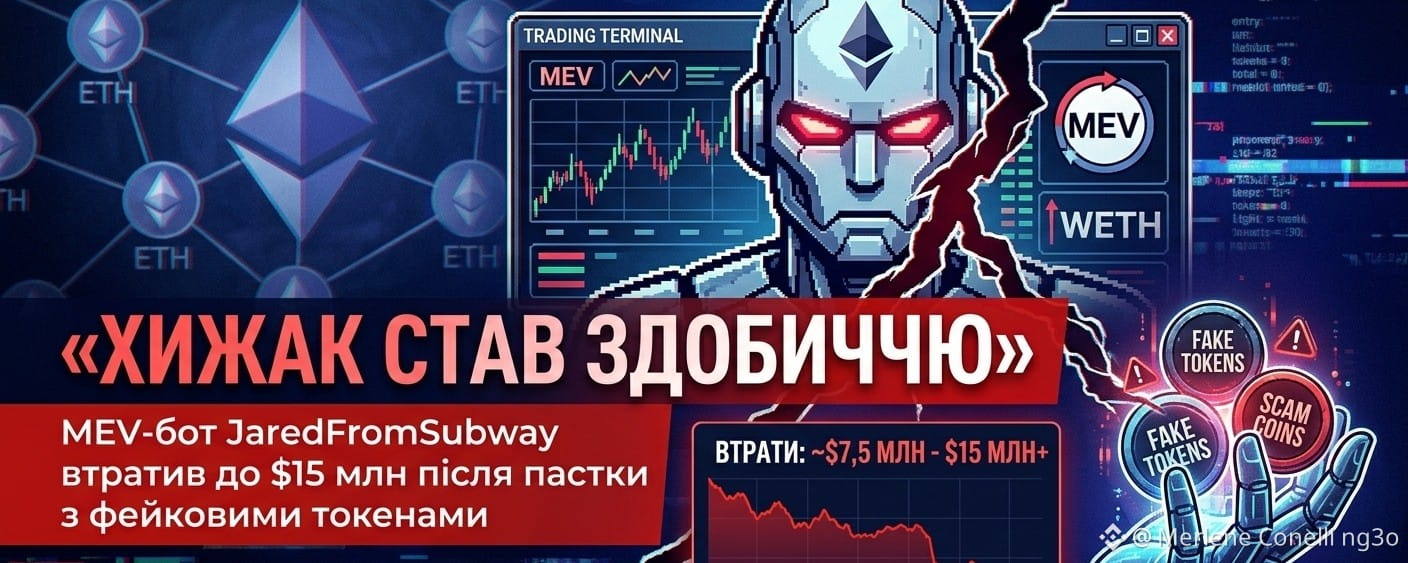
"The Predator Became Prey": Analysis of the Weekend's Loudest DeFi Scandal. JaredFromSubway lost up to $15 millionWhile the crypto market was taking a breather over the weekend, a real drama unfolded in the Ethereum ecosystem. One of the most infamous and aggressive sandwich bots — jaredfromsubway.eth — became a victim of a masterfully laid trap.
Today, as the initial emotions settled, analysts from Blockaid and on-chain researchers thoroughly dissected the mechanics of this sophisticated exploit, which cost the bot between $7.5 million and over $15 million.
"The Predator Became Prey": Analysis of the Weekend's Loudest DeFi Scandal. JaredFromSubway lost up to $15 million
While the crypto market was taking a breather over the weekend, a real drama unfolded in the Ethereum ecosystem. One of the most infamous and aggressive sandwich bots — jaredfromsubway.eth — became a victim of a masterfully laid trap.
Today, as the initial emotions settled, analysts from Blockaid and on-chain researchers thoroughly dissected the mechanics of this sophisticated exploit, which cost the bot between $7.5 million and over $15 million.
Today, as the initial emotions settled, analysts from Blockaid and on-chain researchers thoroughly dissected the mechanics of this sophisticated exploit, which cost the bot between $7.5 million and over $15 million.
8
97

·
--
Bullish
What is Front-Running in Crypto?
Front-running happens when someone sees a pending transaction and attempts to trade before it is confirmed.
The goal is usually to profit from the price movement that the original transaction may create.
It is closely connected to MEV and transaction ordering.
#FrontRunning #MEV #crypto #defi
What is Front-Running in Crypto?
Front-running happens when someone sees a pending transaction and attempts to trade before it is confirmed.
The goal is usually to profit from the price movement that the original transaction may create.
It is closely connected to MEV and transaction ordering.
#FrontRunning #MEV #crypto #defi
Front-running happens when someone sees a pending transaction and attempts to trade before it is confirmed.
The goal is usually to profit from the price movement that the original transaction may create.
It is closely connected to MEV and transaction ordering.
#FrontRunning #MEV #crypto #defi

136
Log in to explore more content
Join global crypto users on Binance Square
⚡️ Get latest and useful information about crypto.
💬 Trusted by the world’s largest crypto exchange.
👍 Discover real insights from verified creators.
Email / Phone number
Trending Topics
1
#BitcoinClears$85200
3,043 views
115 Discussing
2
#AltcoinSeasonIndexHoldsAbove60For5Days
20,399 views
734 Discussing
3
#USADPAdds90000JobsInSeptember
7,430 views
406 Discussing
4
#USCorePCEEasesTo3%InAugust
6,367 views
339 Discussing
5
#KospiPostsWorstQuarterSince2020
5,559 views
361 Discussing
6
#SECToClarifyOnChainFundraisingRules
14,111 views
536 Discussing
7
#UKFCAOpensCryptoFirmAuthorization
16,840 views
474 Discussing
8
#JapanMOFStudyGroupOnTokenizedGovtBonds
14,502 views
382 Discussing
9
#QNTRises287%
64,825 views
806 Discussing
10
#TrumpRejectsAIRulesForVoluntaryAudits
39,986 views
717 Discussing