
#layerzero
layerzero
1.4M views
3,132 Discussing
Hot
Latest


·
--
Article
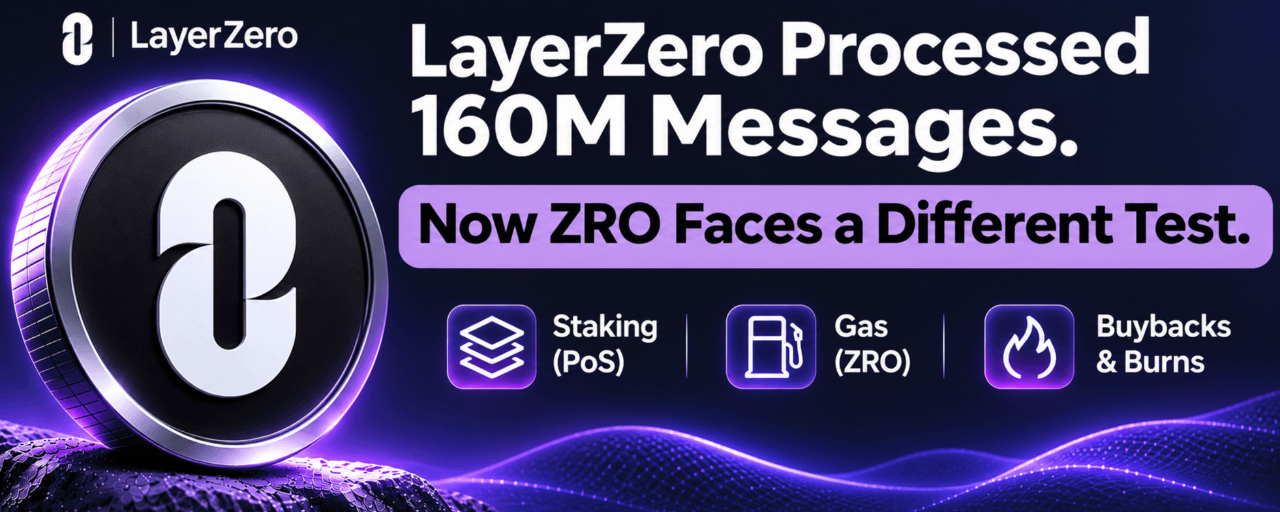
LayerZero Has Processed 160 Million Messages. Now ZRO Faces a Different TestLayerZero has spent years helping assets move between blockchains.
But November 2026 marks a change in what investors are actually buying when they hold ZRO.
The token is about to become part of a new blockchain's security and fee system.
And that makes its economics considerably more interesting.
On November 23, LayerZero opened staking for Zero, its upcoming Layer 1 blockchain.
Zero is scheduled to launch on November 30.
Unlike the original LayerZero messaging protocol, Zero will use ZRO as its native gas token and as the asset securing its proof-of-stake network.
That's a meaningful change.
Previously, someone could use an application powered by LayerZero without needing to purchase ZRO.
Messaging fees generally went toward the infrastructure providers verifying and executing cross-chain transactions.
And LayerZero's separate protocol fee switch has not been activated.
So even though the protocol handles substantial activity, those messaging fees don't automatically flow to ZRO holders.
The situation is different with Zero.
Users will need gas for transactions, validators will rely on staked ZRO, and the network plans to direct certain fees toward token buybacks and burns.
That creates a clearer connection between network usage and the token.
But there's a detail I think investors should examine before getting too excited.
Staking rewards will introduce new ZRO supply.
According to LayerZero's official staking documentation, Zero targets annual token issuance of 1%.
That's approximately 10 million ZRO per year, based on the initial 1 billion token supply.
The actual reward rate earned by each staker will depend on total participation and validator commission.
And these rewards come from new issuance, not necessarily profits earned by the network.
Staked ZRO will remain locked until March 31, 2027, under the initial program.
So staking can temporarily reduce liquid supply, but it also creates future rewards and a common unlock date.
That's worth remembering.
There's another source of token demand already operating.
LayerZero acquired Stargate in 2025 and began directing 100% of Stargate revenue toward ZRO purchases in April 2026.
In its June tokenomics update, LayerZero reported approximately 1.9 million ZRO purchased using Stargate revenue.
The purchases are real.
But they're not the same as a permanent supply reduction unless the acquired tokens are subsequently burned.
LayerZero's broader buyback figures also need careful interpretation.
The project reported $112.7 million deployed into ZRO purchases since September 2025.
Much of that total came from large strategic transactions, including purchasing 50 million ZRO from early investors.
Those transactions changed who held the tokens and their future unlock schedule.
They weren't all recurring purchases funded by protocol fees.
That's a significant distinction when valuing a revenue-backed token.
Meanwhile, the LayerZero messaging network continues to grow.
The company reported more than 160 million cumulative messages across its infrastructure.
It also highlighted adoption by stablecoin issuers and tokenized asset platforms.
That gives Zero a potential distribution advantage.
But messaging volume, bridge volume, and tokenholder revenue are three very different things.
A billion dollars moving through an interoperability protocol doesn't mean the protocol earned a billion dollars.
Nor does every message create a purchase of ZRO.
I'd also watch the next vesting event.
DeFiLlama estimates approximately 23.63 million ZRO will unlock on December 20, mainly for core contributors and strategic partners.
That's close to 5.9% of the current circulating supply.
The tokens won't necessarily be sold immediately.
But their availability matters, particularly as the new staking system starts attracting capital.
The most interesting part of Zero's design may be its planned trading infrastructure.
LayerZero says 75% of certain trading fees remaining after venue allocations on ATLAS will support ZRO buybacks and burns.
If Zero attracts meaningful trading activity, that could become a more direct source of token value.
But the network hasn't launched yet.
Revenue projections aren't the same as fees already collected.
For me, ZRO now has two investment stories.
One is an established interoperability network with real adoption but limited direct fee capture from messaging.
The other is a new blockchain designed to use ZRO for security, gas payments, and potential revenue-driven burns.
The first story has operating history.
The second still needs execution.
I'll be watching whether Zero generates enough recurring economic activity to outweigh staking issuance and upcoming token unlocks.
That's a more useful test than simply counting how many blockchains LayerZero connects.
#ZRO #LayerZero $ZRO
{future}(ZROUSDT)
LayerZero Has Processed 160 Million Messages. Now ZRO Faces a Different Test
LayerZero has spent years helping assets move between blockchains.
But November 2026 marks a change in what investors are actually buying when they hold ZRO.
The token is about to become part of a new blockchain's security and fee system.
And that makes its economics considerably more interesting.
On November 23, LayerZero opened staking for Zero, its upcoming Layer 1 blockchain.
Zero is scheduled to launch on November 30.
Unlike the original LayerZero messaging protocol, Zero will use ZRO as its native gas token and as the asset securing its proof-of-stake network.
That's a meaningful change.
Previously, someone could use an application powered by LayerZero without needing to purchase ZRO.
Messaging fees generally went toward the infrastructure providers verifying and executing cross-chain transactions.
And LayerZero's separate protocol fee switch has not been activated.
So even though the protocol handles substantial activity, those messaging fees don't automatically flow to ZRO holders.
The situation is different with Zero.
Users will need gas for transactions, validators will rely on staked ZRO, and the network plans to direct certain fees toward token buybacks and burns.
That creates a clearer connection between network usage and the token.
But there's a detail I think investors should examine before getting too excited.
Staking rewards will introduce new ZRO supply.
According to LayerZero's official staking documentation, Zero targets annual token issuance of 1%.
That's approximately 10 million ZRO per year, based on the initial 1 billion token supply.
The actual reward rate earned by each staker will depend on total participation and validator commission.
And these rewards come from new issuance, not necessarily profits earned by the network.
Staked ZRO will remain locked until March 31, 2027, under the initial program.
So staking can temporarily reduce liquid supply, but it also creates future rewards and a common unlock date.
That's worth remembering.
There's another source of token demand already operating.
LayerZero acquired Stargate in 2025 and began directing 100% of Stargate revenue toward ZRO purchases in April 2026.
In its June tokenomics update, LayerZero reported approximately 1.9 million ZRO purchased using Stargate revenue.
The purchases are real.
But they're not the same as a permanent supply reduction unless the acquired tokens are subsequently burned.
LayerZero's broader buyback figures also need careful interpretation.
The project reported $112.7 million deployed into ZRO purchases since September 2025.
Much of that total came from large strategic transactions, including purchasing 50 million ZRO from early investors.
Those transactions changed who held the tokens and their future unlock schedule.
They weren't all recurring purchases funded by protocol fees.
That's a significant distinction when valuing a revenue-backed token.
Meanwhile, the LayerZero messaging network continues to grow.
The company reported more than 160 million cumulative messages across its infrastructure.
It also highlighted adoption by stablecoin issuers and tokenized asset platforms.
That gives Zero a potential distribution advantage.
But messaging volume, bridge volume, and tokenholder revenue are three very different things.
A billion dollars moving through an interoperability protocol doesn't mean the protocol earned a billion dollars.
Nor does every message create a purchase of ZRO.
I'd also watch the next vesting event.
DeFiLlama estimates approximately 23.63 million ZRO will unlock on December 20, mainly for core contributors and strategic partners.
That's close to 5.9% of the current circulating supply.
The tokens won't necessarily be sold immediately.
But their availability matters, particularly as the new staking system starts attracting capital.
The most interesting part of Zero's design may be its planned trading infrastructure.
LayerZero says 75% of certain trading fees remaining after venue allocations on ATLAS will support ZRO buybacks and burns.
If Zero attracts meaningful trading activity, that could become a more direct source of token value.
But the network hasn't launched yet.
Revenue projections aren't the same as fees already collected.
For me, ZRO now has two investment stories.
One is an established interoperability network with real adoption but limited direct fee capture from messaging.
The other is a new blockchain designed to use ZRO for security, gas payments, and potential revenue-driven burns.
The first story has operating history.
The second still needs execution.
I'll be watching whether Zero generates enough recurring economic activity to outweigh staking issuance and upcoming token unlocks.
That's a more useful test than simply counting how many blockchains LayerZero connects.
#ZRO #LayerZero $ZRO
1
3
525
LayerZero opened staking for its new Zero chain on Monday — and ZRO fell 17% on the news. The level I'm watching is $1.00.
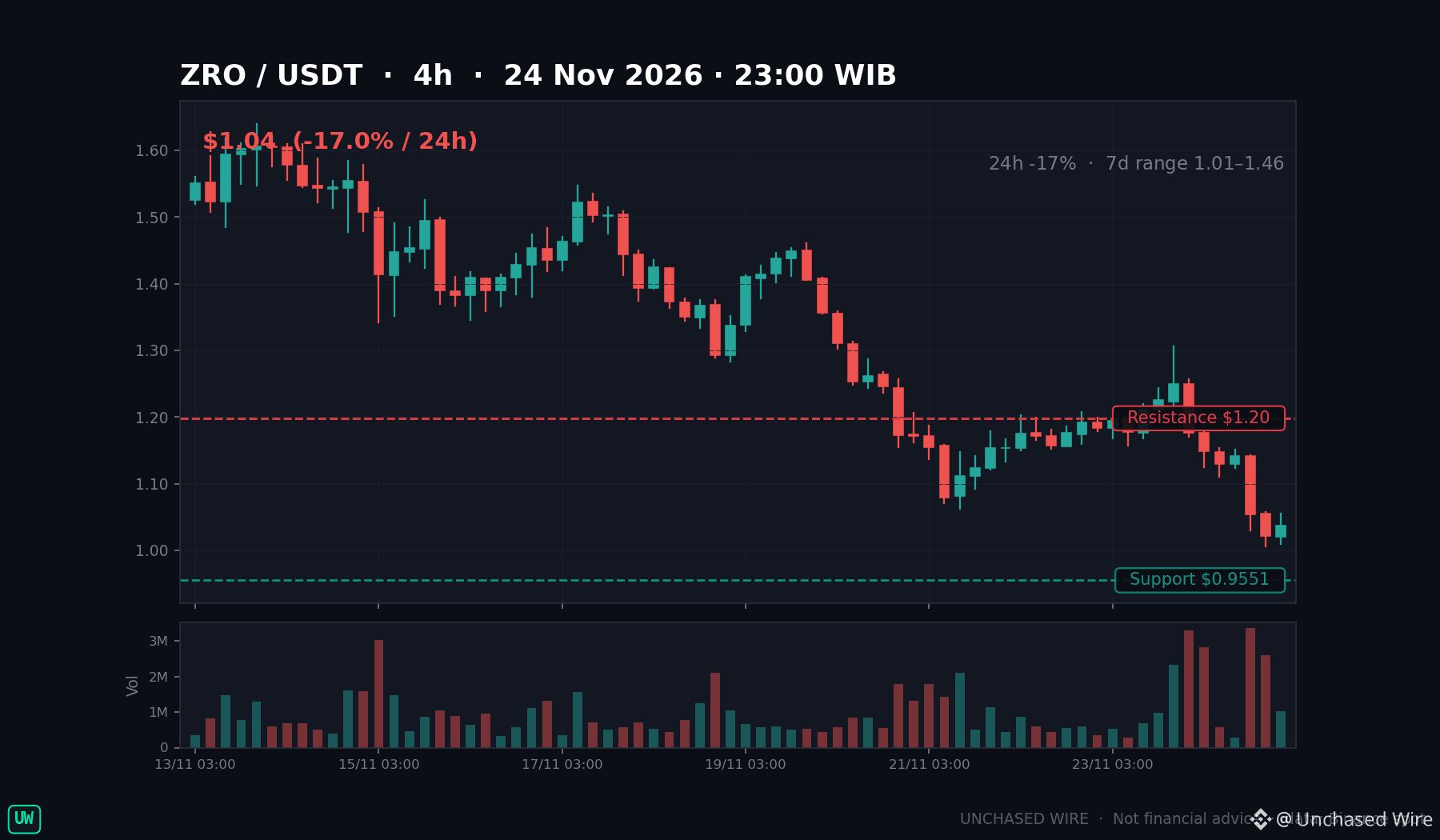
Three ways this reads. If $1.00 holds into tonight's PCE print, relief runs toward $1.20 — the ceiling that capped two rallies this week. If $1.00 breaks, $0.9551 is next, then $0.7660. The setup underneath is real: pre-genesis staking opened November 23, the Foundation staked 100 million ZRO locked until March 31, 2027, and 75% of Zero's fees are earmarked for buy-and-burn once mainnet launches November 30. But the tape sold the news anyway — $1.04 into the 23:00 WIB print, down 17.0% in 24 hours, 41% in a month, RSI near 27.
What kills this read: a daily close under $0.9551 — that is structure breaking, not a dip.
The floor to watch is $1.00, then $0.9551. Overhead: $1.20, then $1.28. A daily close under $0.9551 breaks the read.
What tells you the $1.00 buyers are real — a close back above $1.20, or volume picking up into November 30?
DYOR — not financial advice.
$ZRO #CryptoNews #LayerZero #Staking #PCE
1
172

ZRO Staking Opens as ZRO Falls 15% Toward $1 on Binance
ZRO staking opened on Nov 23 and ZRO fell about 15% to $1.05 on Binance. The LayerZero Foundation supplied 100M of the 102.96M ZRO staked on the portal.
Full article: https://www.cryptonewslive.org/article/zro-staking-opens-zro-falls-15-percent/
#Binance #LayerZero #Staking #ZeroMainnet #ZRO
ZRO staking opened on Nov 23 and ZRO fell about 15% to $1.05 on Binance. The LayerZero Foundation supplied 100M of the 102.96M ZRO staked on the portal.
Full article: https://www.cryptonewslive.org/article/zro-staking-opens-zro-falls-15-percent/
#Binance #LayerZero #Staking #ZeroMainnet #ZRO
71

🚨 $ZRO IS SHIFTING FROM MESSAGING PROTOCOL TO NATIVE L1 GAS TOKEN! ⚡
The upcoming Zero chain launch changes the entire economic architecture for $ZRO . Instead of relying purely on bridge volume that historically bypassed tokenholders, the new network ties directly into staking, gas fees, and potential buyback-and-burn mechanisms from trading revenue. 📊
Yet smart participants always look at the other side of the ledger. Staking issuance targets one percent annually, and a notable token unlock is looming in December. 💡 While buybacks from Stargate revenue and future trading venues provide underlying bid support, liquid supply dynamics will dictate near-term price action. 🌊
Are you positioning for the utility upgrade or waiting to see how the market absorbs those incoming unlocks? 👇
⚠️ Not financial advice. Always manage your risk. 🛡️
🏷️ #ZRO #LayerZero #Tokenomics #Crypto
🦈 💎
5

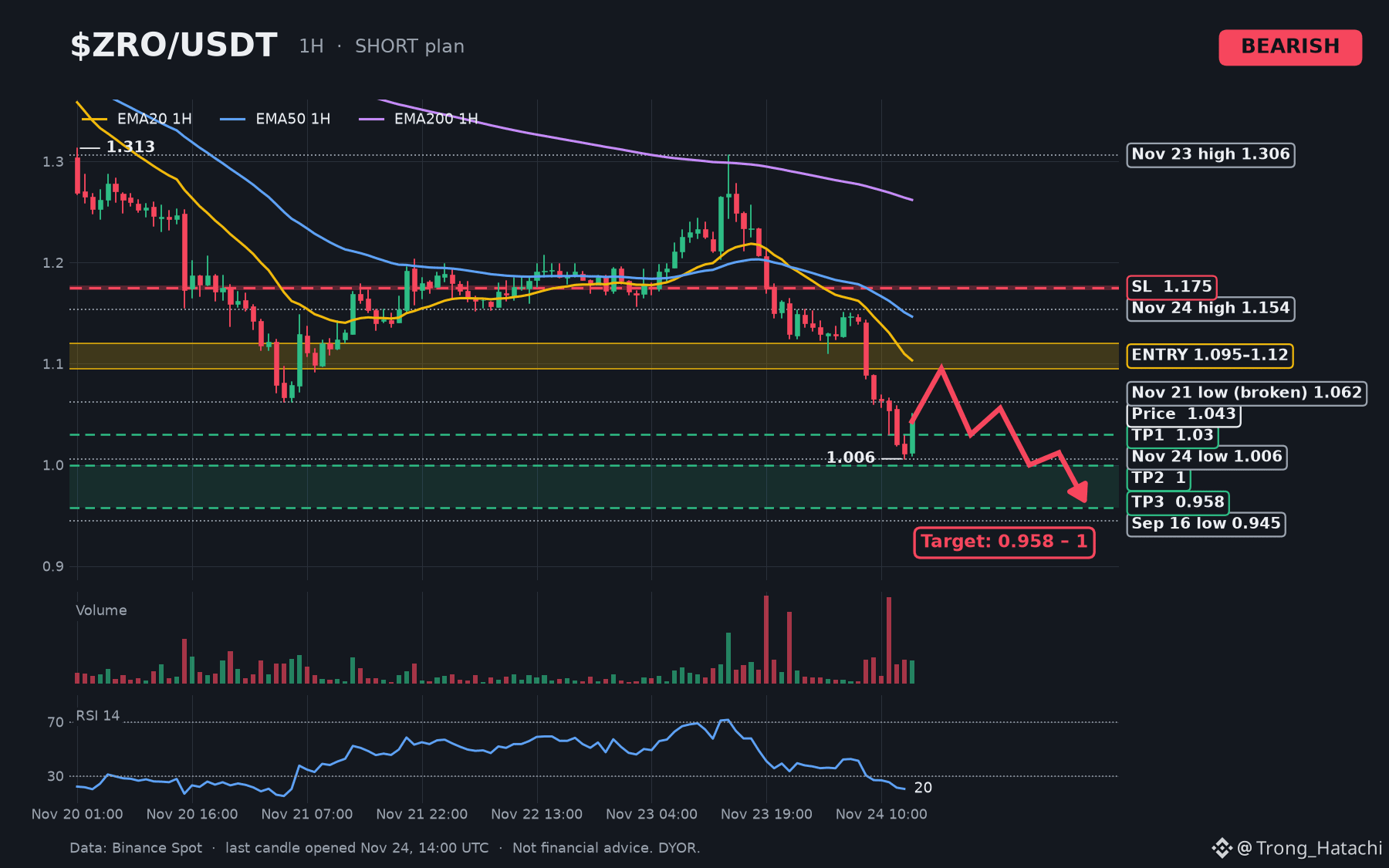
$ZRO ran from 0.918 (Sep 15) to 2.483 (Oct 12). Now 1.042 after a 1.006 low.
~92% of that rally is gone, and the Nov 21 low (1.062) just broke.
Trend: Bearish (4H, 1H)
🎯 Entry short: 1.095 – 1.120 (on a bounce only; valid to Nov 25, 12:00 UTC)
✅ TP1: 1.030
✅ TP2: 1.000 (under today's 1.006 low)
✅ TP3: 0.958 (above the Sep 16 low 0.945)
🛑 SL: 1.175 (above today's 1.154 high)
📊 Logic:
• 1.11-1.15 held most of Nov 24 until the 08:00 UTC 4H candle broke it. 1H EMA20 (~1.11) sits in the zone.
• 4H under EMA50 (1.27). OI down 9.8% in 24h, funding slightly negative.
• LayerZero pre-staking opened Nov 23; CoinMarketCap ties the drop to profit-taking, no exploit reported.
• $BTC ~60.3K, 4H downtrend. Fear & Greed 11.
• Risk: 1H RSI 20 (oversold): bounces are fast. 1D ATR 15%: size small.
⚠️ Invalidation: any trade above 1.175. If 1.030 trades before a fill, skip.
$ZRO after the staking dump: SHORT the bounce or WAIT? 👇
#ZRO #LayerZero #AltcoinAnalysis
Not financial advice. DYOR.
270
·
--
Bearish
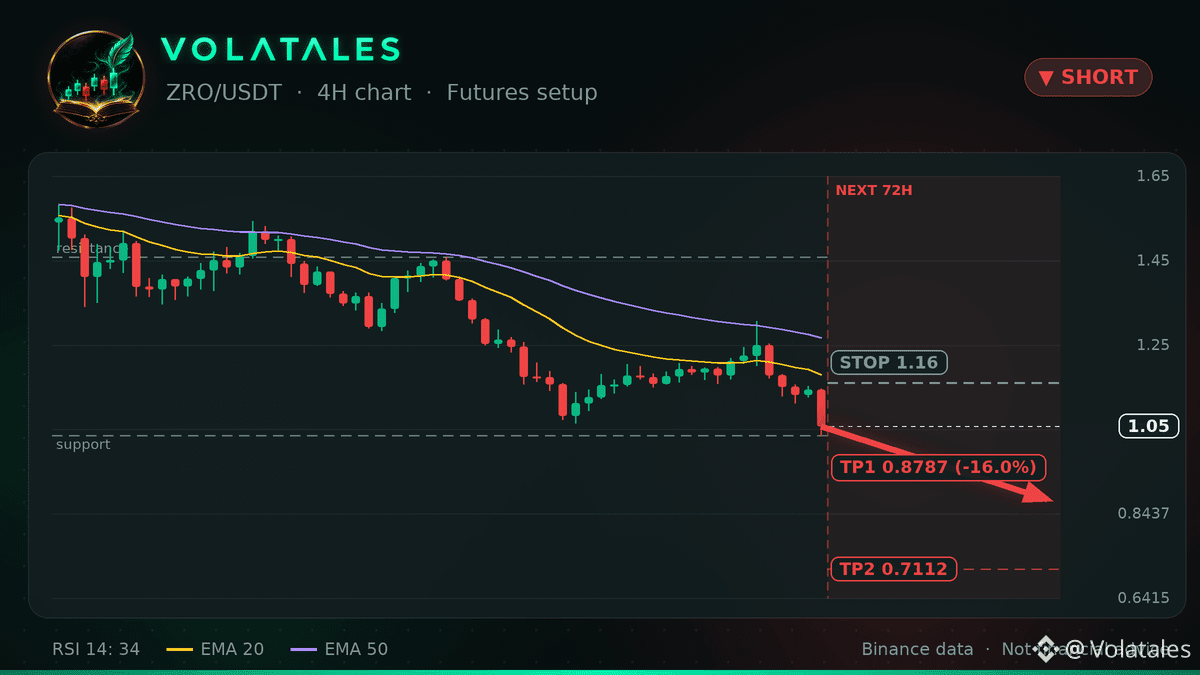
📉 $ZRO breaks its 8-day low on 2.2x volume → 0.8787 next?
📐 Strategy: Breakout on the 4h chart
🧪 Backtest since 2019: 1,552 setups like this, TP1 hit 37%, avg +0.15R per trade after fees
📊 The break came on 2.2x normal volume, and price is under its 4h trend, so sellers have the edge.
₿ Bitcoin is also below its 4h trend line, and ZRO is down 24.2% over 50 candles, adding pressure.
🔴 SHORT setup · up to 72h
Entry: 1.05
🎯 TP1: 0.8787 (−16.0%) · take half, stop to entry
🎯 TP2: 0.7112 (−32.0%)
❌ Stop: 1.16 (+10.7%)
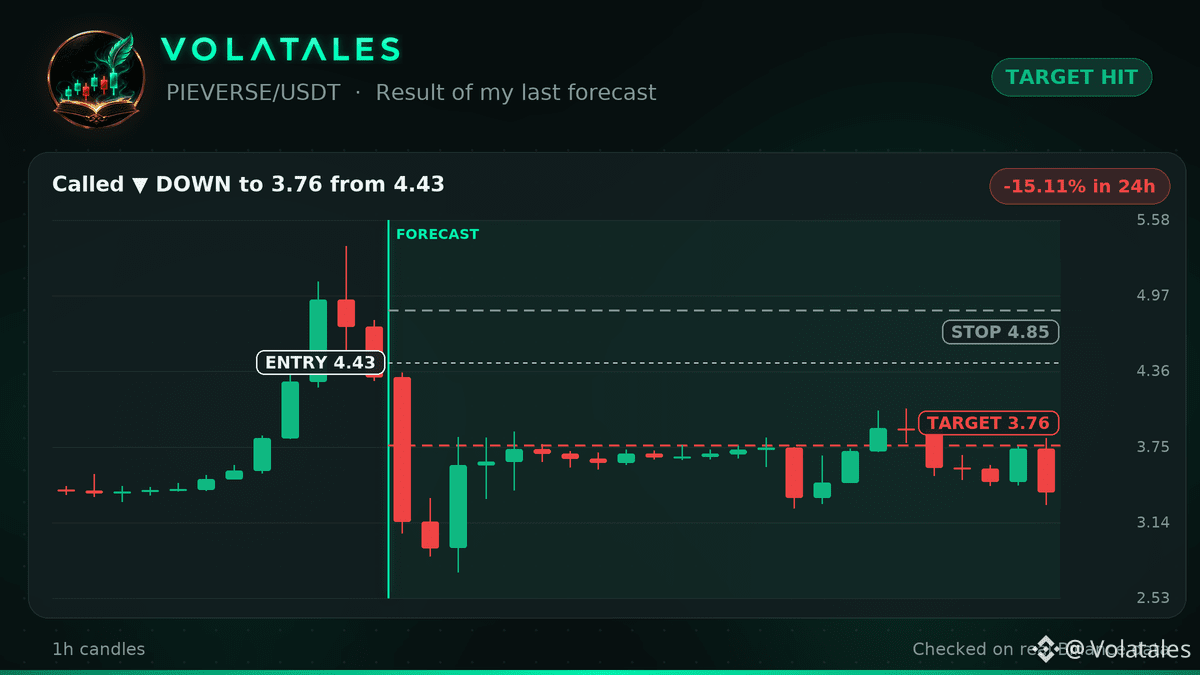
📋 How did my last call do?
I said $PIEVERSE would drop from 4.43 to 3.76.
✅ It reached the target (-15.11%).
🔗 The original call: https://app.binance.com/uni-qr/cpos/390987788438021?r=HVTQDXNE&l=en
👇 The result chart is in the 2nd picture
Are you in this short, or waiting for a pullback to a better entry?
Futures setups are posted the moment they trigger. Follow me so you don't miss them 🔔
👉 Tap $ZRO to open futures and trade
Not financial advice. DYOR. Risk only what you can afford to lose.
#FuturesTrading #CryptoSignals #LayerZero
1
2
513

·
--
# ZRO at 1.141: Staking Is Live, the Price Is Still Falling — the Market Is Selling the News
$ZRO is new on the trending list today — and the story is the opposite of a celebration. LayerZero opened ZRO staking on 23 November, the Foundation is locking up 100M ZRO, and the price is still down 5.5% to 1.141.
DATA (24 Nov 2026, 07:48 UTC)
ZROUSDT at 1.141, down 5.55% in 24h; high 1.306, low 1.11; 24h quote volume $12.37M. RSI 14 at 26.2, oversold, below its 20-period average of 1.1766. H4 resistance 1.203–1.207 (2 touches); H4 support 1.062 (1 touch, thin). M30 trend DOWN 18.18%; channel 0.9709–1.2578. $BTC 60,458, down 1.74%; Fear and Greed 9–11.
CATALYST — VERIFIED, MARKET NOT BUYING IT
Staking opened 23 Nov; rewards start 30 Nov at the Zero mainnet launch, tokens locked until 31 Mar 2027, no early exit. The Foundation stakes 100M ZRO (10% of supply) on the same terms; target issuance 1% a year. The 30 Nov launch also brings lzATLAS, with 75% of fees after rebates buying and burning ZRO under the announced model. Yet ZRO is down 22% in seven days: a $34.69M unlock (5.82% of supply) was scheduled for 20 Nov, and 5.213M unbacked CYBER were minted after LayerZero exited the Cyber bridge (CEO attribution unverified).
Staking is live, 100M ZRO locks until March 2027, and the price still fell 5.5% to 1.141 with RSI 26.2 — the news is real, the selling is realer.
LEVELS
Resistance 1.203–1.207 | Support 1.062 (thin) | Sell-limit zone 1.142, invalidation 1.1435, WAITING | Channel 0.9709–1.2578
Below 1.203–1.207 the fade stays valid; losing 1.062 opens the lower channel toward 0.9709. An H4 close above 1.207 with volume is the first sign buyers control it; above that, the 24h high at 1.306.
Trending-desk coverage: ZRO is outside our 20-pair universe. Not financial advice; levels decay as new candles print.
Which level are you watching on $ZRO — 1.142 or 1.207 — and what is your evidence?
#LayerZero #ZRO #TechnicalAnalysis #Staking
179

·
--
Verified
$ZRO 🔥 LAYERZERO (ZRO) – BIG DEVELOPMENTS AHEAD!
Something interesting is coming for LayerZero!
Zero Mainnet and lzATLAS are targeted for launch on November 30, 2026.
🚀 Why Watch ZRO?
✅ Upcoming Zero Mainnet launch
✅ New blockchain infrastructure
✅ Cross-chain ecosystem development
✅ Growing attention around interoperability
⚠️ ZRO also has a scheduled token unlock, so traders should carefully monitor possible selling pressure.
📈 I'm watching ZRO's volume, support and resistance before making any trading decision.
Can ZRO surprise the market?
#zro #LayerZero #CryptoUpdate #Altcoins! #BinanceSquare
1
639

·
--
Bullish
⚠️ LAYERZERO IS FACING AN IMPORTANT SUPPLY AND ADOPTION TEST!
$ZRO is an interesting infrastructure token because LayerZero focuses on connecting applications and blockchain networks through cross-chain messaging technology.
Interoperability is becoming increasingly important as the blockchain industry expands across multiple ecosystems.
One key event for traders was the November 20 token unlock, which introduced additional supply into the market. The important question now is whether demand and liquidity can absorb that supply without creating further selling pressure.
I'm watching exchange flows, trading volume and market structure before forming a stronger outlook.
Supply events deserve attention, especially in volatile markets.
NFA. DYOR.
#LayerZero #ZRO #CrossChain #CryptoAnalysis #BinanceSquare
3

·
--
ZRO staking just launched, and the price has already dropped 10%
Let me start with the takeaway: I don’t see this drop as bad news, or as a signal to buy the dip.
The “sell the news” routine—good news comes out, then the price falls—is something we saw plenty of during the 2017 ICO boom.
$ZRO current data (CoinGecko, Beijing time, November 25 at 10:00):
• Current price: about $1.03, down about 9.9% over 24 hours
• 24-hour trading volume: about $71.9 million; 24-hour range: $1.01–$1.15
• Down about 26.7% over 7 days; 7-day range: about $1.01–$1.45
• OKX perpetual funding rate: about 0.005%, with no obvious signs of overheating
Why did it drop?
On November 23, LayerZero opened pre-genesis staking ahead of the Zero mainnet launch, and the foundation also announced that it would stake 100 million ZRO.
According to CoinMarketCap, the price retreated after climbing to around $1.29. This was interpreted as “profit-taking on the news,” while long liquidations also amplified volatility.
Several media outlets say there’s no confirmed single catalyst, so don’t read too much into any one explanation.
Risks:
• Staked tokens are locked until March 31, 2027, and cannot be withdrawn early
• The Zero mainnet launches on November 30, so there may still be another round of speculation beforehand
• According to reports, KelpDAO has filed a civil claim against it; LayerZero says the claim is baseless
My take:
Around $1.01 is this week’s low zone. If it breaks below that, be careful—it could look for support further down.
The $1.15–$1.29 range is resistance the price will face on a rebound. If it can’t break above that, don’t mistake a rebound for a reversal.
Do you think $ZRO will reclaim $1.15 before the November 30 mainnet launch, or drop below $1.0 first?
$ZRO
#LayerZero #Binance Square
This is not investment advice. DYOR

111

·
--
ATLAS Exchange launches, LayerZero takes on quantum encryption, and throughput doubles!
Word is that LayerZero is about to make a big move! On November 30, ATLAS Exchange officially launches—and it’s institutional-grade! Plus, Zero technology uses quantum encryption to keep things secure, while doubling throughput for smooth performance. Blockchain transactions can really take off! Come check it out!#LayerZero #ATLAS Exchange
Word is that LayerZero is about to make a big move! On November 30, ATLAS Exchange officially launches—and it’s institutional-grade! Plus, Zero technology uses quantum encryption to keep things secure, while doubling throughput for smooth performance. Blockchain transactions can really take off! Come check it out!#LayerZero #ATLAS Exchange
129

·
--
Major announcement: LayerZero unveils the ATLAS exchange and Zero technology
Breaking news! LayerZero is set to launch ATLAS, an institutional-grade on-chain exchange, on November 30, alongside its Zero technology, featuring quantum-resistant technology and high throughput to usher in a new chapter for blockchain technology.#LayerZero #区块链技术 #Cryptocurrency
Breaking news! LayerZero is set to launch ATLAS, an institutional-grade on-chain exchange, on November 30, alongside its Zero technology, featuring quantum-resistant technology and high throughput to usher in a new chapter for blockchain technology.#LayerZero #区块链技术 #Cryptocurrency
1
226

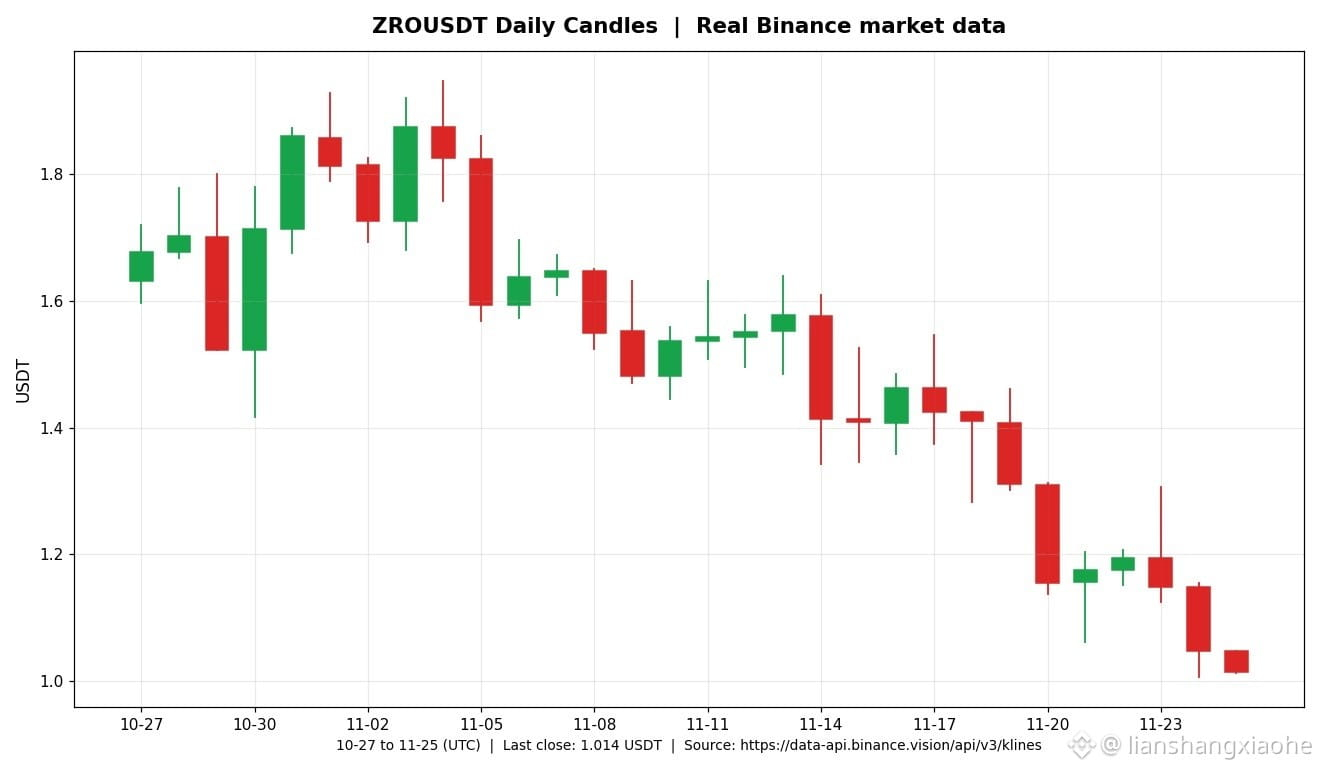
Today, it’s the worst performer in the entire market: down about 16% in 24 hours, sliding at one point from $1.29 to around $1.02. It’s fallen nearly 27% in 7 days, leaving a market cap of only about $410 million. The irony is that on the very same day, the LayerZero Foundation completed the staking and locking of 100 million ZRO tokens until March 31, 2027, and the Zero mainnet is set to launch on November 30—on the day the good news was realized, the token price crashed first. The broader market was already weak, with $BTC closing at $59,731 and the Fear and Greed Index at just 13. In this environment, even major staking news can’t prop up the market. Those who chased the price at $1.29 yesterday are down 20% on paper after just one day. If the $1 level is breached, there may be little support at the next stop. #LayerZero #ZRO
Today, it’s the worst performer in the entire market: down about 16% in 24 hours, sliding at one point from $1.29 to around $1.02. It’s fallen nearly 27% in 7 days, leaving a market cap of only about $410 million. The irony is that on the very same day, the LayerZero Foundation completed the staking and locking of 100 million ZRO tokens until March 31, 2027, and the Zero mainnet is set to launch on November 30—on the day the good news was realized, the token price crashed first. The broader market was already weak, with $BTC closing at $59,731 and the Fear and Greed Index at just 13. In this environment, even major staking news can’t prop up the market. Those who chased the price at $1.29 yesterday are down 20% on paper after just one day. If the $1 level is breached, there may be little support at the next stop. #LayerZero #ZRO
69

·
--
LayerZero ATLAS Exchange Sets Sail, Powered by Zero Technology for a New Era of Institutional-Grade Trading
The newly launched LayerZero ATLAS Exchange is ushering in a new wave of on-chain trading with institutional-grade standards. Zero technology adds quantum-resistant security and high throughput, helping safeguard institutional trading. Join us on November 30 to witness LayerZero’s technological innovation.#LayerZero #ATLAS Exchange
The newly launched LayerZero ATLAS Exchange is ushering in a new wave of on-chain trading with institutional-grade standards. Zero technology adds quantum-resistant security and high throughput, helping safeguard institutional trading. Join us on November 30 to witness LayerZero’s technological innovation.#LayerZero #ATLAS Exchange
42

·
--
LayerZero ATLAS Exchange Sets Sail, Powered by Zero Technology for a New Era of Institutional-Grade Trading
LayerZero’s newly launched ATLAS Exchange is leading a new wave of on-chain trading with institutional-grade specifications. The addition of Zero technology brings quantum-resistant security and high throughput, supporting institutional trading every step of the way. On November 30, witness LayerZero’s technological innovation journey.#LayerZero #ATLAS Exchange
LayerZero’s newly launched ATLAS Exchange is leading a new wave of on-chain trading with institutional-grade specifications. The addition of Zero technology brings quantum-resistant security and high throughput, supporting institutional trading every step of the way. On November 30, witness LayerZero’s technological innovation journey.#LayerZero #ATLAS Exchange
43

·
--
LayerZero ATLAS Exchange sets sail, with Zero technology ushering in a new era of institutional-grade trading
The newly launched ATLAS Exchange by LayerZero is leading a new wave of on-chain trading with institutional-grade standards. Zero technology adds quantum-resistant security and high throughput, safeguarding institutional trading. On November 30, witness LayerZero’s journey of technological innovation. #LayerZero #ATLASExchange
The newly launched ATLAS Exchange by LayerZero is leading a new wave of on-chain trading with institutional-grade standards. Zero technology adds quantum-resistant security and high throughput, safeguarding institutional trading. On November 30, witness LayerZero’s journey of technological innovation. #LayerZero #ATLASExchange
39

·
--
LayerZero ATLAS Exchange sets sail, with Zero technology ushering in a new era of institutional-grade trading
The newly launched LayerZero ATLAS Exchange is leading a new wave of on-chain trading with institutional-grade specifications. Zero technology adds quantum-resistant security and high throughput, safeguarding institutional trading. On November 30, witness LayerZero's technological breakthrough.#LayerZero #ATLAS Exchange
The newly launched LayerZero ATLAS Exchange is leading a new wave of on-chain trading with institutional-grade specifications. Zero technology adds quantum-resistant security and high throughput, safeguarding institutional trading. On November 30, witness LayerZero's technological breakthrough.#LayerZero #ATLAS Exchange
45

·
--
LayerZero ATLAS Exchange Makes Its Debut, Powered by Zero Technology for a New Era of Institutional-Grade Trading
LayerZero’s newly launched ATLAS Exchange is setting a new trend in on-chain trading with its institutional-grade specifications. The addition of Zero technology brings quantum-resistant security and high throughput, supporting institutional trading. On November 30, witness LayerZero’s journey of technological innovation.#LayerZero #ATLAS Exchange
LayerZero’s newly launched ATLAS Exchange is setting a new trend in on-chain trading with its institutional-grade specifications. The addition of Zero technology brings quantum-resistant security and high throughput, supporting institutional trading. On November 30, witness LayerZero’s journey of technological innovation.#LayerZero #ATLAS Exchange
44

·
--
LayerZero ATLAS Exchange sets sail, ushering in a new era of institutional-grade trading powered by Zero technology
The newly launched LayerZero ATLAS Exchange is leading a new wave of on-chain trading with institutional-grade standards. Powered by Zero technology, it also offers quantum-resistant security and high throughput to safeguard institutional trading. Join us on November 30 to witness LayerZero’s technological evolution.#LayerZero #ATLAS Exchange
The newly launched LayerZero ATLAS Exchange is leading a new wave of on-chain trading with institutional-grade standards. Powered by Zero technology, it also offers quantum-resistant security and high throughput to safeguard institutional trading. Join us on November 30 to witness LayerZero’s technological evolution.#LayerZero #ATLAS Exchange
41

·
--
LayerZero ATLAS Exchange makes its debut, with Zero technology ushering in a new era of institutional-grade trading
LayerZero’s newly launched ATLAS Exchange is leading a new trend in on-chain trading with its institutional-grade specifications. The addition of Zero technology brings quantum-resistant security and high throughput, supporting institutional trading. On November 30, witness LayerZero’s technological transformation.#LayerZero #ATLAS Exchange
LayerZero’s newly launched ATLAS Exchange is leading a new trend in on-chain trading with its institutional-grade specifications. The addition of Zero technology brings quantum-resistant security and high throughput, supporting institutional trading. On November 30, witness LayerZero’s technological transformation.#LayerZero #ATLAS Exchange
44
Log in to explore more content
Join global crypto users on Binance Square
⚡️ Get latest and useful information about crypto.
💬 Trusted by the world’s largest crypto exchange.
👍 Discover real insights from verified creators.
Email / Phone number
Trending Topics
1
#BitcoinAndStocksSlipAgainAmidTrump’sTariffPlans
9,790 views
201 Discussing
2
#JensenHuangSaysNvidiaDoesn’tNeedASuccessionPlan
9,262 views
150 Discussing
3
#AnthropicBreaksBelowIPOPriceAmidAISlump
100,610 views
907 Discussing
4
#FidelityCryptoAddsAAVELINKAndUNITrading
476 views
26 Discussing
5
#UKToBanExchangesMakingMarketsOnOwnPlatforms
481 views
21 Discussing
6
#CFTCApprovesTradeReportingRuleForPredictionMarkets
8,094 views
111 Discussing
7
#Bitcoin'sReboundFadesBelow$60K
158,122 views
439 Discussing
8
#WillMarketsStageAThanksgivingReliefRally?
691,054 views
3,737 Discussing
9
#EthereumFoundationPlansShiftToHashBasedSignaturesBy2028
7,395 views
147 Discussing
10
#ADPWeeklyPrivatePayrollsSlowTo21000
21,784 views
339 Discussing