

#defi
defi
57M views
299,389 Discussing
Hot
Latest

·
--
Verified
🚨 ASTER JUST MADE A REAL SUPPLY MOVE
Aster DEX has reportedly burned 3.109 million ASTER tokens, worth about $2.25 million at the time of the burn. The move reduces the token supply, although it does not guarantee any price impact.
There’s also an active Perpetual Grid 2.0 campaign running through October 25, with up to 140,000 ASTER in rewards for eligible activity.
So the latest ASTER story has two sides: supply reduction and continued product incentives.
The key question now is whether Aster can turn that ecosystem activity into sustained usage.
$ASTER
{future}(ASTERUSDT)
.
.
.
#Aster #DeFi #Write2Earn
Not financial advice. DYOR.
🚨 ASTER JUST MADE A REAL SUPPLY MOVE
Aster DEX has reportedly burned 3.109 million ASTER tokens, worth about $2.25 million at the time of the burn. The move reduces the token supply, although it does not guarantee any price impact.
There’s also an active Perpetual Grid 2.0 campaign running through October 25, with up to 140,000 ASTER in rewards for eligible activity.
So the latest ASTER story has two sides: supply reduction and continued product incentives.
The key question now is whether Aster can turn that ecosystem activity into sustained usage.
$ASTER
.
.
.
#Aster #DeFi #Write2Earn
Not financial advice. DYOR.
Aster DEX has reportedly burned 3.109 million ASTER tokens, worth about $2.25 million at the time of the burn. The move reduces the token supply, although it does not guarantee any price impact.
There’s also an active Perpetual Grid 2.0 campaign running through October 25, with up to 140,000 ASTER in rewards for eligible activity.
So the latest ASTER story has two sides: supply reduction and continued product incentives.
The key question now is whether Aster can turn that ecosystem activity into sustained usage.
$ASTER
.
.
.
#Aster #DeFi #Write2Earn
Not financial advice. DYOR.
1.4k
·
--
Article
DeFi 3.0: When Real-World Assets Become Programmable On-ChainDecentralized finance is undergoing a foundational evolution.
In its infancy, DeFi 1.0 laid the core primitives: automated market makers (AMMs), decentralized exchanges (DEXs), and collateralized lending protocols. DeFi 2.0 pushed boundaries by introducing liquidity management protocols and cross-application composability. Yet, both cycles suffered from the same core limitation: they remained purely crypto-native. The underlying collateral pool consisted almost entirely of volatile, speculative governance tokens and high-beta altcoins. When liquidity dried up, cascading liquidations and reflexive downward spirals were inevitable.
DeFi 3.0 fundamentally breaks that cycle. The next era of on-chain finance begins when real-world asset (RWA) classes—most notably traditional equities, treasuries, and indices—transform from passive synthetic tokens into fully programmable on-chain assets.
From Crypto-Native Speculation to Structural Health
The fundamental problem with previous decentralized lending and yield protocols was structural risk. Altcoins carry severe volatility and the persistent risk of going to zero. When high-risk assets serve as the core collateral of money markets, systemic solvency remains permanently fragile.
Tokenized real-world assets solve this dilemma. Equities and sovereign debt represent claims on tangible enterprise cash flows, legal rights, and mature macroeconomic production. They are perpetual, liquid, and fundamentally insulated from the existential tail risks common to micro-cap crypto tokens.
In DeFi 3.0, tokenized stocks and credit instruments do not merely sit idle in a Web3 wallet. They become dynamic collateral:
Programmable Liquidity: Investors can pledge tokenized blue-chip equities to mint overcollateralized stablecoins, hedge downside exposure via smart-contract options vaults, or route yield through automated liquidity strategies.Continuous Settlement: Unlike traditional equities constrained by legacy clearinghouses and rigid market hours, programmable RWAs operate 24/7 with instant on-chain finality.Institutional-Grade Solvency: Lending markets backed by diversified, productive capital offer transparent, auditable solvency ratios that mitigate systemic liquidation cascades.
This structural upgrade shifts on-chain capital from circular speculation toward real financial utility.
Defining the Standards: PAR and CAR
As institutional capital enters on-chain markets, industry benchmarks must evolve beyond generic metrics like Total Value Locked (TVL), which often counts double-leveraged or inflationary tokens.
Binance is actively shaping this institutional transition, formalizing the framework for the Programmable Asset Era by proposing rigorous quantitative indicators:
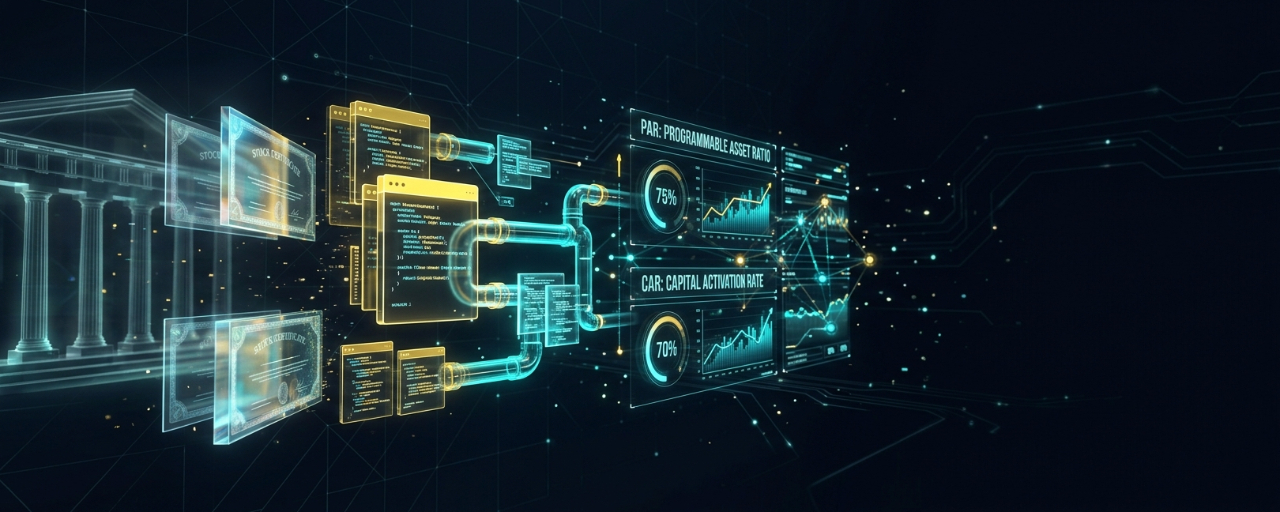
Programmable Asset Ratio (PAR): A metric tracking the proportion of total on-chain assets backed by productive, legal-wrapped real-world instruments versus purely speculative tokens. A rising PAR signals an ecosystem maturing into sustainable institutional utility.Capital Activation Rate (CAR): A performance indicator that measures how actively tokenized collateral is deployed across automated strategies, credit protocols, and liquidity pools, rather than sitting passive in cold custody.
By pioneering these benchmarks before broader market consensus crystallizes, Binance is positioning its ecosystem to serve as the structural gateway connecting global capital markets with Web3 liquidity.
The Programmable Asset Era
The convergence of real-world equity markets and decentralized smart contracts marks the end of isolated crypto liquidity. When Wall Street assets gain the programmability, composability, and fractional nature of blockchain tokens, finance becomes borderless and modular.
DeFi 3.0 is not about replacing traditional market discipline with algorithmic hype. It is about deploying battle-tested traditional value onto transparent, automated, and hyper-efficient rails. Through deep liquidity infrastructure, compliant gateways, and analytical benchmarks like PAR and CAR, the foundation for the on-chain economy is no longer theoretical—it is actively being constructed.
#defi #car #par #Tradefi
$BTC $NVDAB $AAPLB
{spot}(AAPLBUSDT)
{spot}(NVDABUSDT)
{spot}(BTCUSDT)
DeFi 3.0: When Real-World Assets Become Programmable On-Chain
Decentralized finance is undergoing a foundational evolution.
In its infancy, DeFi 1.0 laid the core primitives: automated market makers (AMMs), decentralized exchanges (DEXs), and collateralized lending protocols. DeFi 2.0 pushed boundaries by introducing liquidity management protocols and cross-application composability. Yet, both cycles suffered from the same core limitation: they remained purely crypto-native. The underlying collateral pool consisted almost entirely of volatile, speculative governance tokens and high-beta altcoins. When liquidity dried up, cascading liquidations and reflexive downward spirals were inevitable.
DeFi 3.0 fundamentally breaks that cycle. The next era of on-chain finance begins when real-world asset (RWA) classes—most notably traditional equities, treasuries, and indices—transform from passive synthetic tokens into fully programmable on-chain assets.
From Crypto-Native Speculation to Structural Health
The fundamental problem with previous decentralized lending and yield protocols was structural risk. Altcoins carry severe volatility and the persistent risk of going to zero. When high-risk assets serve as the core collateral of money markets, systemic solvency remains permanently fragile.
Tokenized real-world assets solve this dilemma. Equities and sovereign debt represent claims on tangible enterprise cash flows, legal rights, and mature macroeconomic production. They are perpetual, liquid, and fundamentally insulated from the existential tail risks common to micro-cap crypto tokens.
In DeFi 3.0, tokenized stocks and credit instruments do not merely sit idle in a Web3 wallet. They become dynamic collateral:
Programmable Liquidity: Investors can pledge tokenized blue-chip equities to mint overcollateralized stablecoins, hedge downside exposure via smart-contract options vaults, or route yield through automated liquidity strategies.Continuous Settlement: Unlike traditional equities constrained by legacy clearinghouses and rigid market hours, programmable RWAs operate 24/7 with instant on-chain finality.Institutional-Grade Solvency: Lending markets backed by diversified, productive capital offer transparent, auditable solvency ratios that mitigate systemic liquidation cascades.
This structural upgrade shifts on-chain capital from circular speculation toward real financial utility.
Defining the Standards: PAR and CAR
As institutional capital enters on-chain markets, industry benchmarks must evolve beyond generic metrics like Total Value Locked (TVL), which often counts double-leveraged or inflationary tokens.
Binance is actively shaping this institutional transition, formalizing the framework for the Programmable Asset Era by proposing rigorous quantitative indicators:
Programmable Asset Ratio (PAR): A metric tracking the proportion of total on-chain assets backed by productive, legal-wrapped real-world instruments versus purely speculative tokens. A rising PAR signals an ecosystem maturing into sustainable institutional utility.Capital Activation Rate (CAR): A performance indicator that measures how actively tokenized collateral is deployed across automated strategies, credit protocols, and liquidity pools, rather than sitting passive in cold custody.
By pioneering these benchmarks before broader market consensus crystallizes, Binance is positioning its ecosystem to serve as the structural gateway connecting global capital markets with Web3 liquidity.
The Programmable Asset Era
The convergence of real-world equity markets and decentralized smart contracts marks the end of isolated crypto liquidity. When Wall Street assets gain the programmability, composability, and fractional nature of blockchain tokens, finance becomes borderless and modular.
DeFi 3.0 is not about replacing traditional market discipline with algorithmic hype. It is about deploying battle-tested traditional value onto transparent, automated, and hyper-efficient rails. Through deep liquidity infrastructure, compliant gateways, and analytical benchmarks like PAR and CAR, the foundation for the on-chain economy is no longer theoretical—it is actively being constructed.
#defi #car #par #Tradefi
$BTC $NVDAB $AAPLB
In its infancy, DeFi 1.0 laid the core primitives: automated market makers (AMMs), decentralized exchanges (DEXs), and collateralized lending protocols. DeFi 2.0 pushed boundaries by introducing liquidity management protocols and cross-application composability. Yet, both cycles suffered from the same core limitation: they remained purely crypto-native. The underlying collateral pool consisted almost entirely of volatile, speculative governance tokens and high-beta altcoins. When liquidity dried up, cascading liquidations and reflexive downward spirals were inevitable.
DeFi 3.0 fundamentally breaks that cycle. The next era of on-chain finance begins when real-world asset (RWA) classes—most notably traditional equities, treasuries, and indices—transform from passive synthetic tokens into fully programmable on-chain assets.
From Crypto-Native Speculation to Structural Health
The fundamental problem with previous decentralized lending and yield protocols was structural risk. Altcoins carry severe volatility and the persistent risk of going to zero. When high-risk assets serve as the core collateral of money markets, systemic solvency remains permanently fragile.
Tokenized real-world assets solve this dilemma. Equities and sovereign debt represent claims on tangible enterprise cash flows, legal rights, and mature macroeconomic production. They are perpetual, liquid, and fundamentally insulated from the existential tail risks common to micro-cap crypto tokens.
In DeFi 3.0, tokenized stocks and credit instruments do not merely sit idle in a Web3 wallet. They become dynamic collateral:
Programmable Liquidity: Investors can pledge tokenized blue-chip equities to mint overcollateralized stablecoins, hedge downside exposure via smart-contract options vaults, or route yield through automated liquidity strategies.Continuous Settlement: Unlike traditional equities constrained by legacy clearinghouses and rigid market hours, programmable RWAs operate 24/7 with instant on-chain finality.Institutional-Grade Solvency: Lending markets backed by diversified, productive capital offer transparent, auditable solvency ratios that mitigate systemic liquidation cascades.
This structural upgrade shifts on-chain capital from circular speculation toward real financial utility.
Defining the Standards: PAR and CAR
As institutional capital enters on-chain markets, industry benchmarks must evolve beyond generic metrics like Total Value Locked (TVL), which often counts double-leveraged or inflationary tokens.
Binance is actively shaping this institutional transition, formalizing the framework for the Programmable Asset Era by proposing rigorous quantitative indicators:
Programmable Asset Ratio (PAR): A metric tracking the proportion of total on-chain assets backed by productive, legal-wrapped real-world instruments versus purely speculative tokens. A rising PAR signals an ecosystem maturing into sustainable institutional utility.Capital Activation Rate (CAR): A performance indicator that measures how actively tokenized collateral is deployed across automated strategies, credit protocols, and liquidity pools, rather than sitting passive in cold custody.
By pioneering these benchmarks before broader market consensus crystallizes, Binance is positioning its ecosystem to serve as the structural gateway connecting global capital markets with Web3 liquidity.
The Programmable Asset Era
The convergence of real-world equity markets and decentralized smart contracts marks the end of isolated crypto liquidity. When Wall Street assets gain the programmability, composability, and fractional nature of blockchain tokens, finance becomes borderless and modular.
DeFi 3.0 is not about replacing traditional market discipline with algorithmic hype. It is about deploying battle-tested traditional value onto transparent, automated, and hyper-efficient rails. Through deep liquidity infrastructure, compliant gateways, and analytical benchmarks like PAR and CAR, the foundation for the on-chain economy is no longer theoretical—it is actively being constructed.
#defi #car #par #Tradefi
$BTC $NVDAB $AAPLB
2
136

·
--
dYdX started as an Ethereum-based order book DEX but made a pivotal shift in 2023 — launching its own Cosmos-based Layer 1 chain, dYdX Chain, to escape gas costs and throughput limits. Today it operates as a fully decentralized perpetuals exchange where traders can long or short crypto assets with up to 20x leverage, all without KYC or centralized custody.
The protocol uses an off-chain order book with on-chain settlement, matching orders via a network of validators while keeping funds in user-controlled smart contracts. This hybrid model delivers CEX-like speed with DeFi transparency. The native DYDX token powers governance, staking rewards, and fee discounts — currently around $1.20 with a $380M market cap. Total Value Locked sits near $450M, and staking APY hovers around 12% for validators and delegators combined.
One risk often overlooked: validator centralization. While dYdX Chain has 60+ validators, the top 10 control over 40% of stake. A coordinated attack or collusion among major validators could censor trades or manipulate oracle prices during high volatility — a structural risk that pure on-chain order books avoid.
If you trade perps on dYdX, do you trust the validator set enough to hold sizeable positions overnight?
#Layer2 #StableCoin #DeFi #DeFiProtocol
dYdX started as an Ethereum-based order book DEX but made a pivotal shift in 2023 — launching its own Cosmos-based Layer 1 chain, dYdX Chain, to escape gas costs and throughput limits. Today it operates as a fully decentralized perpetuals exchange where traders can long or short crypto assets with up to 20x leverage, all without KYC or centralized custody.
The protocol uses an off-chain order book with on-chain settlement, matching orders via a network of validators while keeping funds in user-controlled smart contracts. This hybrid model delivers CEX-like speed with DeFi transparency. The native DYDX token powers governance, staking rewards, and fee discounts — currently around $1.20 with a $380M market cap. Total Value Locked sits near $450M, and staking APY hovers around 12% for validators and delegators combined.
One risk often overlooked: validator centralization. While dYdX Chain has 60+ validators, the top 10 control over 40% of stake. A coordinated attack or collusion among major validators could censor trades or manipulate oracle prices during high volatility — a structural risk that pure on-chain order books avoid.
If you trade perps on dYdX, do you trust the validator set enough to hold sizeable positions overnight?
#Layer2 #StableCoin #DeFi #DeFiProtocol
The protocol uses an off-chain order book with on-chain settlement, matching orders via a network of validators while keeping funds in user-controlled smart contracts. This hybrid model delivers CEX-like speed with DeFi transparency. The native DYDX token powers governance, staking rewards, and fee discounts — currently around $1.20 with a $380M market cap. Total Value Locked sits near $450M, and staking APY hovers around 12% for validators and delegators combined.
One risk often overlooked: validator centralization. While dYdX Chain has 60+ validators, the top 10 control over 40% of stake. A coordinated attack or collusion among major validators could censor trades or manipulate oracle prices during high volatility — a structural risk that pure on-chain order books avoid.
If you trade perps on dYdX, do you trust the validator set enough to hold sizeable positions overnight?
#Layer2 #StableCoin #DeFi #DeFiProtocol
96

·
--
Article
Orca Is Up 23% and Funding Rates Are Screaming: The Governance Bet Nobody Saw ComingOn a day when Bitcoin barely moved and most major coins drifted sideways, a mid-cap Solana DEX token quietly ripped through key resistance with volume that was twelve times its normal level.
That token is Orca. And the move is not just a random low-liquidity spike. There is a specific catalyst behind it, a structural shift in how the protocol plans to reward its holders, and a derivatives market that is now pricing in something unusual.
Here is what the data actually shows, and what traders should be watching next.
What triggered the move
On September 29, the Orca team posted a tokenholder proposal that would fundamentally change how protocol revenue flows back to the token. The proposal suggests sending 10% of protocol fees to open-market ORCA buybacks and another 10% to ORCA rewards for stakers, with a potential "fee switch" mechanism that would make the token directly capture a share of trading activity on the platform.
This matters because Orca is not some empty-shell protocol. It is one of the longest-running and most heavily used decentralized exchanges on Solana. Routing a portion of real trading fees into buybacks and staking rewards gives ORCA holders a tangible claim on protocol activity, rather than just governance rights over a treasury.
The market responded fast. Over the past 24 hours, ORCA surged more than 23% to roughly $2.48, with trading volume hitting twelve times its normal level. That volume multiple is the part that separates this from a typical altcoin pump. A move that big on thin volume is noise. A move that big with genuine follow-through in turnover suggests real capital is rotating in, not just a few market makers pushing a thin order book.
What the technical picture looks like
The rally pushed ORCA through the $2.40 resistance zone that had been capping price action, and the token is now trading well above its short-term moving averages. On the 4-hour chart, MA5 sits at $2.5626 with price pressing right up against it, while MA20 at $2.3805 is providing a secondary layer of support below.
The 21-day moving average had been acting as a ceiling for most of late September. That level is now behind price, which is a meaningful structural shift. When a coin reclaims a moving average it has been rejected from repeatedly, the next move tends to be an extension or a retest, not an immediate collapse.
The RSI picture is where things get interesting, and potentially dangerous. Multiple data points show ORCA's RSI pushing into the 74 to 80 range on shorter timeframes, with one reading hitting above 80. An RSI above 70 signals overbought conditions. Above 80, it signals that the short-term move has been so aggressive that a mean-reversion pullback becomes statistically more likely with each passing candle.
That does not mean the rally is over. In strong trending moves, RSI can stay overbought for days. But it does mean that chasing here carries elevated risk, especially with price sitting just below the upper Bollinger Band around $2.69.
Volume is confirming the price move, which is the bullish part of the technical setup. The $2.50 to $2.55 zone is the immediate resistance to watch. A clean break and hold above that level would open the door toward the $2.70 to $3.00 range. Failure to clear $2.55 keeps the risk of a retracement to the $2.20 to $2.22 area alive.
The derivatives market is flashing a warning sign
Here is where the setup gets genuinely unusual, and where traders need to pay close attention.
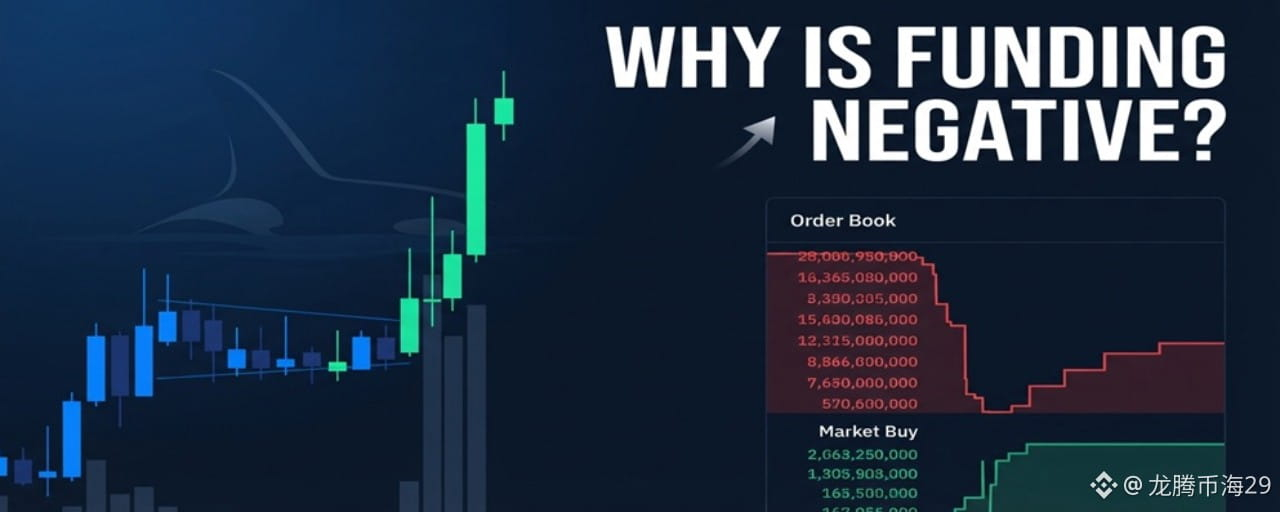
ORCA's funding rate has been deeply negative during this rally. One reading showed a funding rate of minus 0.0893% on a 24-hour surge of over 16%. Another more recent reading showed minus 0.2556% while price was around $3.10. Negative funding means short sellers are paying longs to keep their positions open. In a normal market, a price rally pushes funding positive as longs crowd in. Seeing price rip while funding stays negative tells you that the move is being driven by spot buying or short covering, not by leveraged longs piling in.
This creates a specific kind of squeeze dynamic. Shorts are underwater and paying to stay in. If price holds above key support, the pressure on those positions increases. Short liquidations would add fuel to the move. But there is a flip side that traders often ignore: negative funding can also reflect a market that has already priced in a sharp pullback, or that has become dangerously one-sided in the opposite direction. When everyone expects the same outcome (shorts getting squeezed), the move can exhaust itself faster than expected.
Open interest on ORCA futures sits around $10.2 million, which is relatively modest for a token with a market cap in the low nine figures. That low OI means the derivatives market is not the primary driver here. Spot activity is doing the heavy lifting. That is generally a healthier sign than a rally driven purely by leverage, but it also means that if spot buying dries up, there is less of a derivatives cushion to absorb selling pressure.
The fundamental case and the unresolved question
The governance proposal is real, and it has a clear deadline attached to it. Tokenholder votes on Orca governance proposals have historically moved the token, and this particular proposal touches the core tokenomics of the protocol.
What remains unverified is the exact timeline for implementation and whether the proposal will pass with the required threshold. Until those details are confirmed, any narrative about "buybacks beginning next week" or "stakers earning fees from next month" is speculation, not fact.
There is also a broader context worth noting. Orca operates in the Solana DEX landscape, which has become increasingly competitive. Jupiter, Raydium, and Meteora all compete for the same liquidity and trading volume. A fee switch that rewards ORCA holders is a strong incentive alignment tool, but it does not change the underlying competitive dynamics of the DEX market. If Orca's trading volume declines relative to competitors, the value of those fee distributions declines too.
The Cardano ecosystem has also been showing momentum recently, with NIGHT surging over 10% on the back of ecosystem upgrades and a 224% volume increase. That is a separate narrative, but it is worth mentioning because capital rotating between mid-cap altcoins tends to move in waves. If the broader small and mid-cap sector stays hot, ORCA has a better chance of sustaining its move.
What bulls need to prove next
For the bullish thesis to remain valid, three things need to happen.
First, ORCA needs to hold above the $2.40 to $2.50 zone on any pullback. That area was resistance on the way up, and it needs to act as support on the way down. If price loses that level and closes below $2.20, the breakout structure starts to break down.
Second, volume needs to stay elevated. A rally that fades on declining volume is a rally that gets sold. If turnover drops back toward pre-rally levels while price stays flat, that is a sign that buyers have stepped away.
Third, the governance proposal needs to move forward with clear implementation dates. Narrative alone can carry a token for a few days. Concrete tokenomics changes that put real value in holders' hands is what sustains a re-rating.
What could kill the move
The most obvious risk is an overbought reversal. With RSI readings in the high 70s and price pressing against the upper Bollinger Band, a sharp pullback is entirely possible without any fundamental catalyst. This is not a doom scenario; it is just what happens when a token gains 20% in a day.
A more structural risk is that the governance proposal gets delayed, diluted, or rejected. If tokenholders vote it down, or if the team signals that implementation will take months rather than weeks, the primary driver of the rally disappears.
Broader market conditions also matter. Bitcoin is struggling to break above $87,000 and has failed three times at that level. If BTC rolls over and drags the altcoin market with it, ORCA will not be immune. The correlation between BTC and mid-cap altcoins tends to tighten during selloffs, even if it loosens during rallies.
Finally, there is the liquidity risk that applies to all mid-cap tokens. ORCA's order books are thinner than those of larger coins. A sudden shift in sentiment can lead to slippage and sharp moves in both directions. Position sizing matters more here than it would with a top-10 asset.
The practical takeaway
ORCA is not a random pump. There is a governance proposal with real economic implications, volume expansion that suggests genuine buyer interest, and a derivatives market that is positioned in an unusual way. The negative funding rate combined with a rising spot price is a setup that can produce violent short squeezes, but it can also mean the move is closer to exhaustion than it looks.
The honest assessment is that this is a high-risk, high-reward setup. The catalyst is real but not yet confirmed. The technicals are strong but overbought. The derivatives positioning is intriguing but not conclusive. Traders who want exposure should define their risk clearly, identify the invalidation level (below $2.20 on a closing basis), and size positions accordingly. There is no guaranteed outcome here, only a set of probabilities that shift as new information arrives.
What makes ORCA worth watching over the next few days is not the percentage gain it just posted. It is whether the structural changes being proposed actually materialize, and whether the market's positioning ahead of those changes proves to be smart or crowded.
$ORCA
{future}(ORCAUSDT)
#ORCA #solana #defi #altcoins
Orca Is Up 23% and Funding Rates Are Screaming: The Governance Bet Nobody Saw Coming
On a day when Bitcoin barely moved and most major coins drifted sideways, a mid-cap Solana DEX token quietly ripped through key resistance with volume that was twelve times its normal level.
That token is Orca. And the move is not just a random low-liquidity spike. There is a specific catalyst behind it, a structural shift in how the protocol plans to reward its holders, and a derivatives market that is now pricing in something unusual.
Here is what the data actually shows, and what traders should be watching next.
What triggered the move
On September 29, the Orca team posted a tokenholder proposal that would fundamentally change how protocol revenue flows back to the token. The proposal suggests sending 10% of protocol fees to open-market ORCA buybacks and another 10% to ORCA rewards for stakers, with a potential "fee switch" mechanism that would make the token directly capture a share of trading activity on the platform.
This matters because Orca is not some empty-shell protocol. It is one of the longest-running and most heavily used decentralized exchanges on Solana. Routing a portion of real trading fees into buybacks and staking rewards gives ORCA holders a tangible claim on protocol activity, rather than just governance rights over a treasury.
The market responded fast. Over the past 24 hours, ORCA surged more than 23% to roughly $2.48, with trading volume hitting twelve times its normal level. That volume multiple is the part that separates this from a typical altcoin pump. A move that big on thin volume is noise. A move that big with genuine follow-through in turnover suggests real capital is rotating in, not just a few market makers pushing a thin order book.
What the technical picture looks like
The rally pushed ORCA through the $2.40 resistance zone that had been capping price action, and the token is now trading well above its short-term moving averages. On the 4-hour chart, MA5 sits at $2.5626 with price pressing right up against it, while MA20 at $2.3805 is providing a secondary layer of support below.
The 21-day moving average had been acting as a ceiling for most of late September. That level is now behind price, which is a meaningful structural shift. When a coin reclaims a moving average it has been rejected from repeatedly, the next move tends to be an extension or a retest, not an immediate collapse.
The RSI picture is where things get interesting, and potentially dangerous. Multiple data points show ORCA's RSI pushing into the 74 to 80 range on shorter timeframes, with one reading hitting above 80. An RSI above 70 signals overbought conditions. Above 80, it signals that the short-term move has been so aggressive that a mean-reversion pullback becomes statistically more likely with each passing candle.
That does not mean the rally is over. In strong trending moves, RSI can stay overbought for days. But it does mean that chasing here carries elevated risk, especially with price sitting just below the upper Bollinger Band around $2.69.
Volume is confirming the price move, which is the bullish part of the technical setup. The $2.50 to $2.55 zone is the immediate resistance to watch. A clean break and hold above that level would open the door toward the $2.70 to $3.00 range. Failure to clear $2.55 keeps the risk of a retracement to the $2.20 to $2.22 area alive.
The derivatives market is flashing a warning sign
Here is where the setup gets genuinely unusual, and where traders need to pay close attention.
ORCA's funding rate has been deeply negative during this rally. One reading showed a funding rate of minus 0.0893% on a 24-hour surge of over 16%. Another more recent reading showed minus 0.2556% while price was around $3.10. Negative funding means short sellers are paying longs to keep their positions open. In a normal market, a price rally pushes funding positive as longs crowd in. Seeing price rip while funding stays negative tells you that the move is being driven by spot buying or short covering, not by leveraged longs piling in.
This creates a specific kind of squeeze dynamic. Shorts are underwater and paying to stay in. If price holds above key support, the pressure on those positions increases. Short liquidations would add fuel to the move. But there is a flip side that traders often ignore: negative funding can also reflect a market that has already priced in a sharp pullback, or that has become dangerously one-sided in the opposite direction. When everyone expects the same outcome (shorts getting squeezed), the move can exhaust itself faster than expected.
Open interest on ORCA futures sits around $10.2 million, which is relatively modest for a token with a market cap in the low nine figures. That low OI means the derivatives market is not the primary driver here. Spot activity is doing the heavy lifting. That is generally a healthier sign than a rally driven purely by leverage, but it also means that if spot buying dries up, there is less of a derivatives cushion to absorb selling pressure.
The fundamental case and the unresolved question
The governance proposal is real, and it has a clear deadline attached to it. Tokenholder votes on Orca governance proposals have historically moved the token, and this particular proposal touches the core tokenomics of the protocol.
What remains unverified is the exact timeline for implementation and whether the proposal will pass with the required threshold. Until those details are confirmed, any narrative about "buybacks beginning next week" or "stakers earning fees from next month" is speculation, not fact.
There is also a broader context worth noting. Orca operates in the Solana DEX landscape, which has become increasingly competitive. Jupiter, Raydium, and Meteora all compete for the same liquidity and trading volume. A fee switch that rewards ORCA holders is a strong incentive alignment tool, but it does not change the underlying competitive dynamics of the DEX market. If Orca's trading volume declines relative to competitors, the value of those fee distributions declines too.
The Cardano ecosystem has also been showing momentum recently, with NIGHT surging over 10% on the back of ecosystem upgrades and a 224% volume increase. That is a separate narrative, but it is worth mentioning because capital rotating between mid-cap altcoins tends to move in waves. If the broader small and mid-cap sector stays hot, ORCA has a better chance of sustaining its move.
What bulls need to prove next
For the bullish thesis to remain valid, three things need to happen.
First, ORCA needs to hold above the $2.40 to $2.50 zone on any pullback. That area was resistance on the way up, and it needs to act as support on the way down. If price loses that level and closes below $2.20, the breakout structure starts to break down.
Second, volume needs to stay elevated. A rally that fades on declining volume is a rally that gets sold. If turnover drops back toward pre-rally levels while price stays flat, that is a sign that buyers have stepped away.
Third, the governance proposal needs to move forward with clear implementation dates. Narrative alone can carry a token for a few days. Concrete tokenomics changes that put real value in holders' hands is what sustains a re-rating.
What could kill the move
The most obvious risk is an overbought reversal. With RSI readings in the high 70s and price pressing against the upper Bollinger Band, a sharp pullback is entirely possible without any fundamental catalyst. This is not a doom scenario; it is just what happens when a token gains 20% in a day.
A more structural risk is that the governance proposal gets delayed, diluted, or rejected. If tokenholders vote it down, or if the team signals that implementation will take months rather than weeks, the primary driver of the rally disappears.
Broader market conditions also matter. Bitcoin is struggling to break above $87,000 and has failed three times at that level. If BTC rolls over and drags the altcoin market with it, ORCA will not be immune. The correlation between BTC and mid-cap altcoins tends to tighten during selloffs, even if it loosens during rallies.
Finally, there is the liquidity risk that applies to all mid-cap tokens. ORCA's order books are thinner than those of larger coins. A sudden shift in sentiment can lead to slippage and sharp moves in both directions. Position sizing matters more here than it would with a top-10 asset.
The practical takeaway
ORCA is not a random pump. There is a governance proposal with real economic implications, volume expansion that suggests genuine buyer interest, and a derivatives market that is positioned in an unusual way. The negative funding rate combined with a rising spot price is a setup that can produce violent short squeezes, but it can also mean the move is closer to exhaustion than it looks.
The honest assessment is that this is a high-risk, high-reward setup. The catalyst is real but not yet confirmed. The technicals are strong but overbought. The derivatives positioning is intriguing but not conclusive. Traders who want exposure should define their risk clearly, identify the invalidation level (below $2.20 on a closing basis), and size positions accordingly. There is no guaranteed outcome here, only a set of probabilities that shift as new information arrives.
What makes ORCA worth watching over the next few days is not the percentage gain it just posted. It is whether the structural changes being proposed actually materialize, and whether the market's positioning ahead of those changes proves to be smart or crowded.
$ORCA
#ORCA #solana #defi #altcoins
That token is Orca. And the move is not just a random low-liquidity spike. There is a specific catalyst behind it, a structural shift in how the protocol plans to reward its holders, and a derivatives market that is now pricing in something unusual.
Here is what the data actually shows, and what traders should be watching next.
What triggered the move
On September 29, the Orca team posted a tokenholder proposal that would fundamentally change how protocol revenue flows back to the token. The proposal suggests sending 10% of protocol fees to open-market ORCA buybacks and another 10% to ORCA rewards for stakers, with a potential "fee switch" mechanism that would make the token directly capture a share of trading activity on the platform.
This matters because Orca is not some empty-shell protocol. It is one of the longest-running and most heavily used decentralized exchanges on Solana. Routing a portion of real trading fees into buybacks and staking rewards gives ORCA holders a tangible claim on protocol activity, rather than just governance rights over a treasury.
The market responded fast. Over the past 24 hours, ORCA surged more than 23% to roughly $2.48, with trading volume hitting twelve times its normal level. That volume multiple is the part that separates this from a typical altcoin pump. A move that big on thin volume is noise. A move that big with genuine follow-through in turnover suggests real capital is rotating in, not just a few market makers pushing a thin order book.
What the technical picture looks like
The rally pushed ORCA through the $2.40 resistance zone that had been capping price action, and the token is now trading well above its short-term moving averages. On the 4-hour chart, MA5 sits at $2.5626 with price pressing right up against it, while MA20 at $2.3805 is providing a secondary layer of support below.
The 21-day moving average had been acting as a ceiling for most of late September. That level is now behind price, which is a meaningful structural shift. When a coin reclaims a moving average it has been rejected from repeatedly, the next move tends to be an extension or a retest, not an immediate collapse.
The RSI picture is where things get interesting, and potentially dangerous. Multiple data points show ORCA's RSI pushing into the 74 to 80 range on shorter timeframes, with one reading hitting above 80. An RSI above 70 signals overbought conditions. Above 80, it signals that the short-term move has been so aggressive that a mean-reversion pullback becomes statistically more likely with each passing candle.
That does not mean the rally is over. In strong trending moves, RSI can stay overbought for days. But it does mean that chasing here carries elevated risk, especially with price sitting just below the upper Bollinger Band around $2.69.
Volume is confirming the price move, which is the bullish part of the technical setup. The $2.50 to $2.55 zone is the immediate resistance to watch. A clean break and hold above that level would open the door toward the $2.70 to $3.00 range. Failure to clear $2.55 keeps the risk of a retracement to the $2.20 to $2.22 area alive.
The derivatives market is flashing a warning sign
Here is where the setup gets genuinely unusual, and where traders need to pay close attention.
ORCA's funding rate has been deeply negative during this rally. One reading showed a funding rate of minus 0.0893% on a 24-hour surge of over 16%. Another more recent reading showed minus 0.2556% while price was around $3.10. Negative funding means short sellers are paying longs to keep their positions open. In a normal market, a price rally pushes funding positive as longs crowd in. Seeing price rip while funding stays negative tells you that the move is being driven by spot buying or short covering, not by leveraged longs piling in.
This creates a specific kind of squeeze dynamic. Shorts are underwater and paying to stay in. If price holds above key support, the pressure on those positions increases. Short liquidations would add fuel to the move. But there is a flip side that traders often ignore: negative funding can also reflect a market that has already priced in a sharp pullback, or that has become dangerously one-sided in the opposite direction. When everyone expects the same outcome (shorts getting squeezed), the move can exhaust itself faster than expected.
Open interest on ORCA futures sits around $10.2 million, which is relatively modest for a token with a market cap in the low nine figures. That low OI means the derivatives market is not the primary driver here. Spot activity is doing the heavy lifting. That is generally a healthier sign than a rally driven purely by leverage, but it also means that if spot buying dries up, there is less of a derivatives cushion to absorb selling pressure.
The fundamental case and the unresolved question
The governance proposal is real, and it has a clear deadline attached to it. Tokenholder votes on Orca governance proposals have historically moved the token, and this particular proposal touches the core tokenomics of the protocol.
What remains unverified is the exact timeline for implementation and whether the proposal will pass with the required threshold. Until those details are confirmed, any narrative about "buybacks beginning next week" or "stakers earning fees from next month" is speculation, not fact.
There is also a broader context worth noting. Orca operates in the Solana DEX landscape, which has become increasingly competitive. Jupiter, Raydium, and Meteora all compete for the same liquidity and trading volume. A fee switch that rewards ORCA holders is a strong incentive alignment tool, but it does not change the underlying competitive dynamics of the DEX market. If Orca's trading volume declines relative to competitors, the value of those fee distributions declines too.
The Cardano ecosystem has also been showing momentum recently, with NIGHT surging over 10% on the back of ecosystem upgrades and a 224% volume increase. That is a separate narrative, but it is worth mentioning because capital rotating between mid-cap altcoins tends to move in waves. If the broader small and mid-cap sector stays hot, ORCA has a better chance of sustaining its move.
What bulls need to prove next
For the bullish thesis to remain valid, three things need to happen.
First, ORCA needs to hold above the $2.40 to $2.50 zone on any pullback. That area was resistance on the way up, and it needs to act as support on the way down. If price loses that level and closes below $2.20, the breakout structure starts to break down.
Second, volume needs to stay elevated. A rally that fades on declining volume is a rally that gets sold. If turnover drops back toward pre-rally levels while price stays flat, that is a sign that buyers have stepped away.
Third, the governance proposal needs to move forward with clear implementation dates. Narrative alone can carry a token for a few days. Concrete tokenomics changes that put real value in holders' hands is what sustains a re-rating.
What could kill the move
The most obvious risk is an overbought reversal. With RSI readings in the high 70s and price pressing against the upper Bollinger Band, a sharp pullback is entirely possible without any fundamental catalyst. This is not a doom scenario; it is just what happens when a token gains 20% in a day.
A more structural risk is that the governance proposal gets delayed, diluted, or rejected. If tokenholders vote it down, or if the team signals that implementation will take months rather than weeks, the primary driver of the rally disappears.
Broader market conditions also matter. Bitcoin is struggling to break above $87,000 and has failed three times at that level. If BTC rolls over and drags the altcoin market with it, ORCA will not be immune. The correlation between BTC and mid-cap altcoins tends to tighten during selloffs, even if it loosens during rallies.
Finally, there is the liquidity risk that applies to all mid-cap tokens. ORCA's order books are thinner than those of larger coins. A sudden shift in sentiment can lead to slippage and sharp moves in both directions. Position sizing matters more here than it would with a top-10 asset.
The practical takeaway
ORCA is not a random pump. There is a governance proposal with real economic implications, volume expansion that suggests genuine buyer interest, and a derivatives market that is positioned in an unusual way. The negative funding rate combined with a rising spot price is a setup that can produce violent short squeezes, but it can also mean the move is closer to exhaustion than it looks.
The honest assessment is that this is a high-risk, high-reward setup. The catalyst is real but not yet confirmed. The technicals are strong but overbought. The derivatives positioning is intriguing but not conclusive. Traders who want exposure should define their risk clearly, identify the invalidation level (below $2.20 on a closing basis), and size positions accordingly. There is no guaranteed outcome here, only a set of probabilities that shift as new information arrives.
What makes ORCA worth watching over the next few days is not the percentage gain it just posted. It is whether the structural changes being proposed actually materialize, and whether the market's positioning ahead of those changes proves to be smart or crowded.
$ORCA
#ORCA #solana #defi #altcoins
52

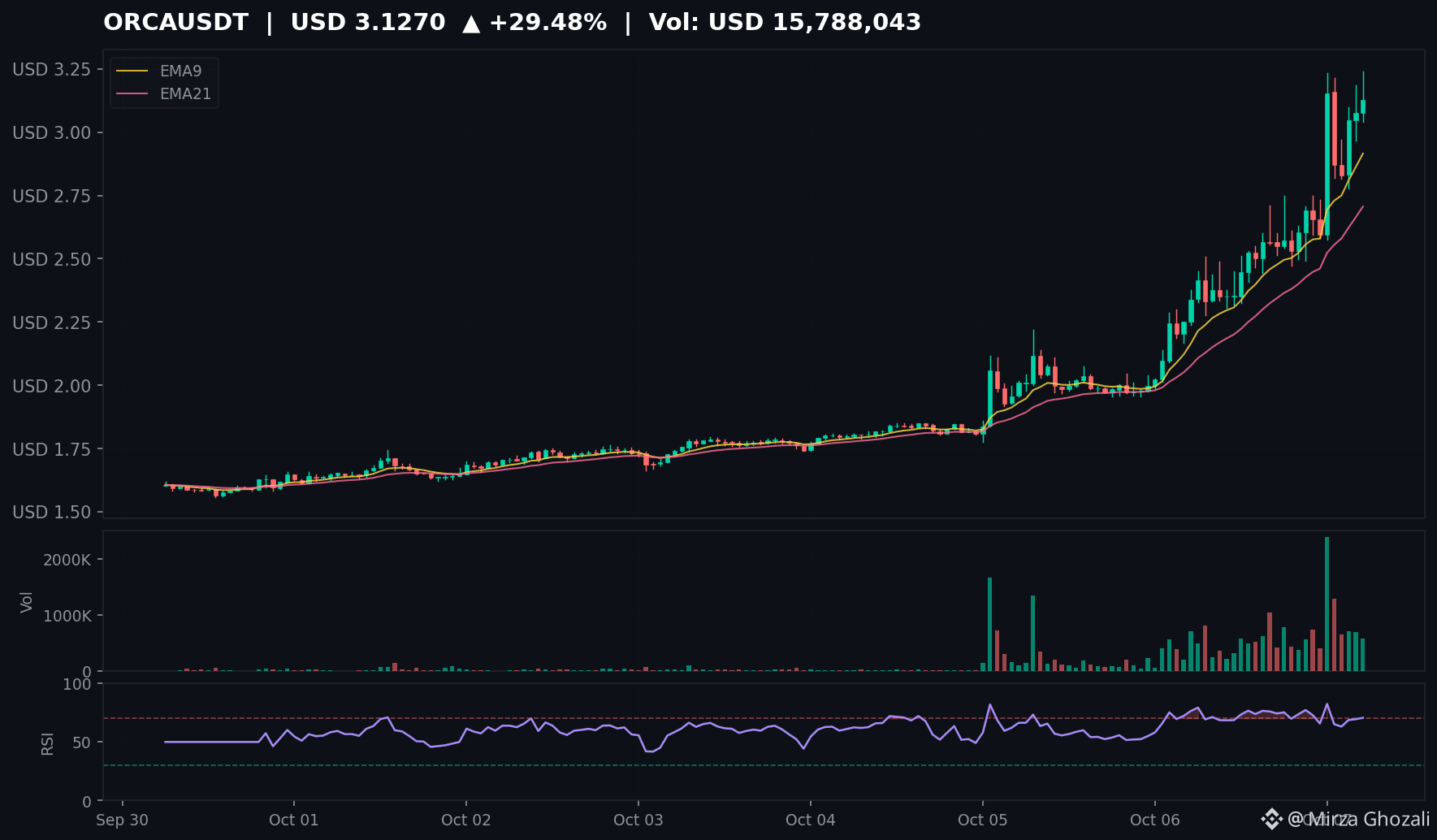
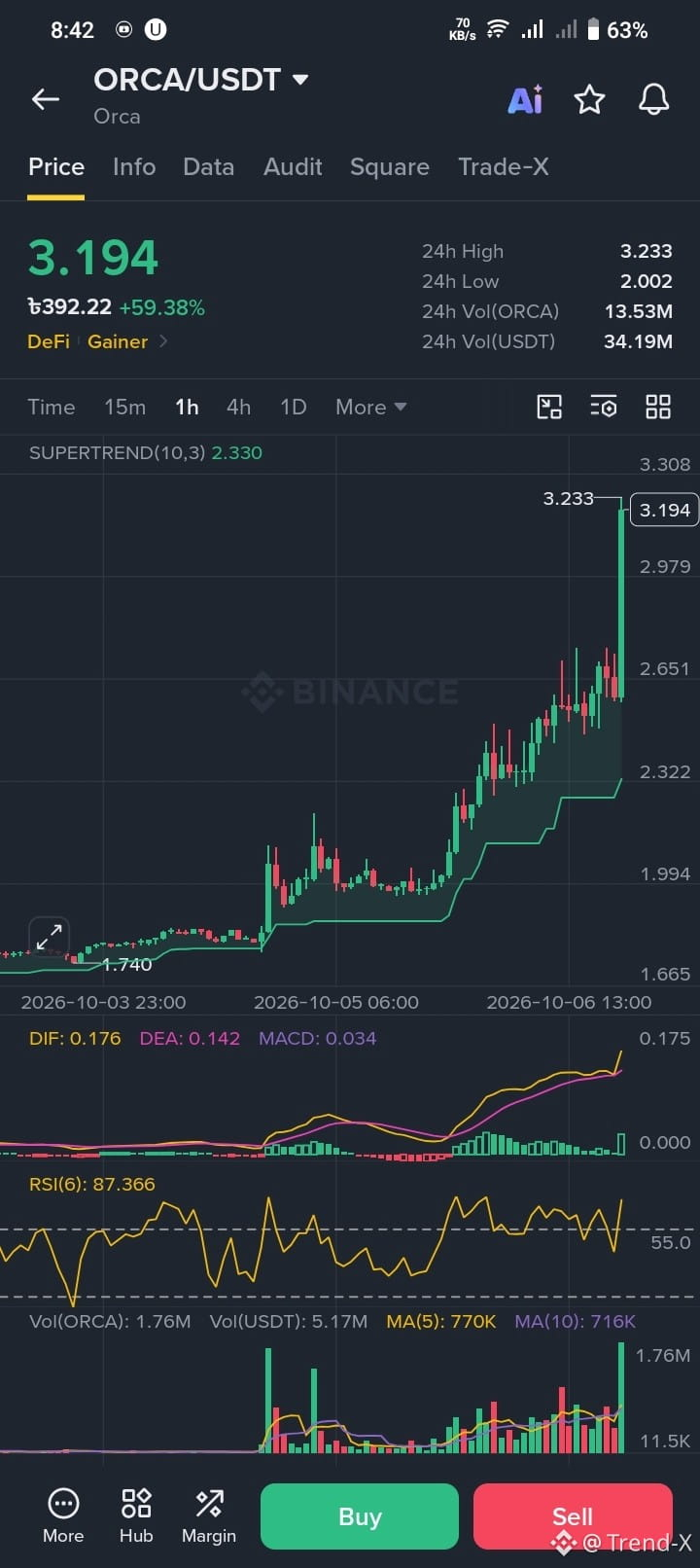
$ORCA surges +34.4% in 24h, hitting $3.12 on massive volume expansion ($43M+ USDT). Over 7 days, it's up +89.2%, leading the $SOL DeFi momentum.
Technical breakdown:
• Clean breakout past $2.50–$2.65 resistance with high volume confirmation
• EMA9 ($2.95) pulling firmly above EMA21 ($2.73)
• Immediate resistance sits at $3.24; flipped support holds around $2.75–$2.80
• 1H RSI is pushing into overbought territory (~75) — watch for brief consolidation before continuation
Are you taking profits here or eyeing the push toward $4.00?
#ORCA #Solana #CryptoAnalysis #DeFi
$ORCA surges +34.4% in 24h, hitting $3.12 on massive volume expansion ($43M+ USDT). Over 7 days, it's up +89.2%, leading the $SOL DeFi momentum.
Technical breakdown:
• Clean breakout past $2.50–$2.65 resistance with high volume confirmation
• EMA9 ($2.95) pulling firmly above EMA21 ($2.73)
• Immediate resistance sits at $3.24; flipped support holds around $2.75–$2.80
• 1H RSI is pushing into overbought territory (~75) — watch for brief consolidation before continuation
Are you taking profits here or eyeing the push toward $4.00?
#ORCA #Solana #CryptoAnalysis #DeFi
Technical breakdown:
• Clean breakout past $2.50–$2.65 resistance with high volume confirmation
• EMA9 ($2.95) pulling firmly above EMA21 ($2.73)
• Immediate resistance sits at $3.24; flipped support holds around $2.75–$2.80
• 1H RSI is pushing into overbought territory (~75) — watch for brief consolidation before continuation
Are you taking profits here or eyeing the push toward $4.00?
#ORCA #Solana #CryptoAnalysis #DeFi
218

·
--
Concentrated Liquidity Changed DeFi Forever — Most LPs Still Havent Adapted
When Uniswap v3 introduced concentrated liquidity in 2021, it rewrote the economics of market-making on-chain. Most retail LPs missed the memo and are still paying for it.
Here is what changed: instead of spreading capital across every possible price from zero to infinity, LPs can now focus liquidity within a custom price range. The capital efficiency gain is staggering — up to 4000x versus v2 in a tight range. Same fee revenue, a fraction of the capital deployed.
But the tradeoff is real. Concentrated positions require active management. When price moves outside your range, you stop earning fees entirely and hold 100% of the depreciating asset — amplified impermanent loss with no compensation. Passive LPs who set wide ranges underperform professional market-makers who rebalance dynamically.
Uniswap v4 pushes this further with hooks — programmable logic triggered on pool events. Think auto-rebalancing, dynamic fees that widen during volatility, and TWAP-linked ranges. It effectively brings custom AMM design to any developer without launching a new protocol.
$ETH $BNB $SOL are all building ecosystems where concentrated liquidity pools are the default infrastructure layer. The edge in DeFi is no longer which chain you use — it is how efficiently you deploy capital within pools.
Most retail LPs are still using v2-style thinking in a v3 world. That gap is an alpha edge for those paying attention.
#DeFi #Uniswap #LiquidityProvision #CryptoAlpha #Web3
Concentrated Liquidity Changed DeFi Forever — Most LPs Still Havent Adapted
When Uniswap v3 introduced concentrated liquidity in 2021, it rewrote the economics of market-making on-chain. Most retail LPs missed the memo and are still paying for it.
Here is what changed: instead of spreading capital across every possible price from zero to infinity, LPs can now focus liquidity within a custom price range. The capital efficiency gain is staggering — up to 4000x versus v2 in a tight range. Same fee revenue, a fraction of the capital deployed.
But the tradeoff is real. Concentrated positions require active management. When price moves outside your range, you stop earning fees entirely and hold 100% of the depreciating asset — amplified impermanent loss with no compensation. Passive LPs who set wide ranges underperform professional market-makers who rebalance dynamically.
Uniswap v4 pushes this further with hooks — programmable logic triggered on pool events. Think auto-rebalancing, dynamic fees that widen during volatility, and TWAP-linked ranges. It effectively brings custom AMM design to any developer without launching a new protocol.
$ETH $BNB $SOL are all building ecosystems where concentrated liquidity pools are the default infrastructure layer. The edge in DeFi is no longer which chain you use — it is how efficiently you deploy capital within pools.
Most retail LPs are still using v2-style thinking in a v3 world. That gap is an alpha edge for those paying attention.
#DeFi #Uniswap #LiquidityProvision #CryptoAlpha #Web3
When Uniswap v3 introduced concentrated liquidity in 2021, it rewrote the economics of market-making on-chain. Most retail LPs missed the memo and are still paying for it.
Here is what changed: instead of spreading capital across every possible price from zero to infinity, LPs can now focus liquidity within a custom price range. The capital efficiency gain is staggering — up to 4000x versus v2 in a tight range. Same fee revenue, a fraction of the capital deployed.
But the tradeoff is real. Concentrated positions require active management. When price moves outside your range, you stop earning fees entirely and hold 100% of the depreciating asset — amplified impermanent loss with no compensation. Passive LPs who set wide ranges underperform professional market-makers who rebalance dynamically.
Uniswap v4 pushes this further with hooks — programmable logic triggered on pool events. Think auto-rebalancing, dynamic fees that widen during volatility, and TWAP-linked ranges. It effectively brings custom AMM design to any developer without launching a new protocol.
$ETH $BNB $SOL are all building ecosystems where concentrated liquidity pools are the default infrastructure layer. The edge in DeFi is no longer which chain you use — it is how efficiently you deploy capital within pools.
Most retail LPs are still using v2-style thinking in a v3 world. That gap is an alpha edge for those paying attention.
#DeFi #Uniswap #LiquidityProvision #CryptoAlpha #Web3
36

While BTC keeps getting rejected at $87K, Aave is doing something real. 🚀
Aave's V4 lending markets crossed $1 BILLION in deposits in September, with $310 million in active loans. And on Base, its new Equities Hub lets users borrow USDC against tokenized Apple, Microsoft and Nvidia stock.
$AAVE is up 22% this week to around $183 — now knocking on the $184 resistance level. An analyst sees $200 as the next target if it holds above $184.
The sharp take: DeFi's blue chip is rallying on real deposits and real revenue, while the rest of the market waits on the Fed. Who wins October — DeFi or BTC? 👀
$AAVE
#DeFi #AAVE #CryptoNews
While BTC keeps getting rejected at $87K, Aave is doing something real. 🚀
Aave's V4 lending markets crossed $1 BILLION in deposits in September, with $310 million in active loans. And on Base, its new Equities Hub lets users borrow USDC against tokenized Apple, Microsoft and Nvidia stock.
$AAVE is up 22% this week to around $183 — now knocking on the $184 resistance level. An analyst sees $200 as the next target if it holds above $184.
The sharp take: DeFi's blue chip is rallying on real deposits and real revenue, while the rest of the market waits on the Fed. Who wins October — DeFi or BTC? 👀
$AAVE
#DeFi #AAVE #CryptoNews
Aave's V4 lending markets crossed $1 BILLION in deposits in September, with $310 million in active loans. And on Base, its new Equities Hub lets users borrow USDC against tokenized Apple, Microsoft and Nvidia stock.
$AAVE is up 22% this week to around $183 — now knocking on the $184 resistance level. An analyst sees $200 as the next target if it holds above $184.
The sharp take: DeFi's blue chip is rallying on real deposits and real revenue, while the rest of the market waits on the Fed. Who wins October — DeFi or BTC? 👀
$AAVE
#DeFi #AAVE #CryptoNews
56
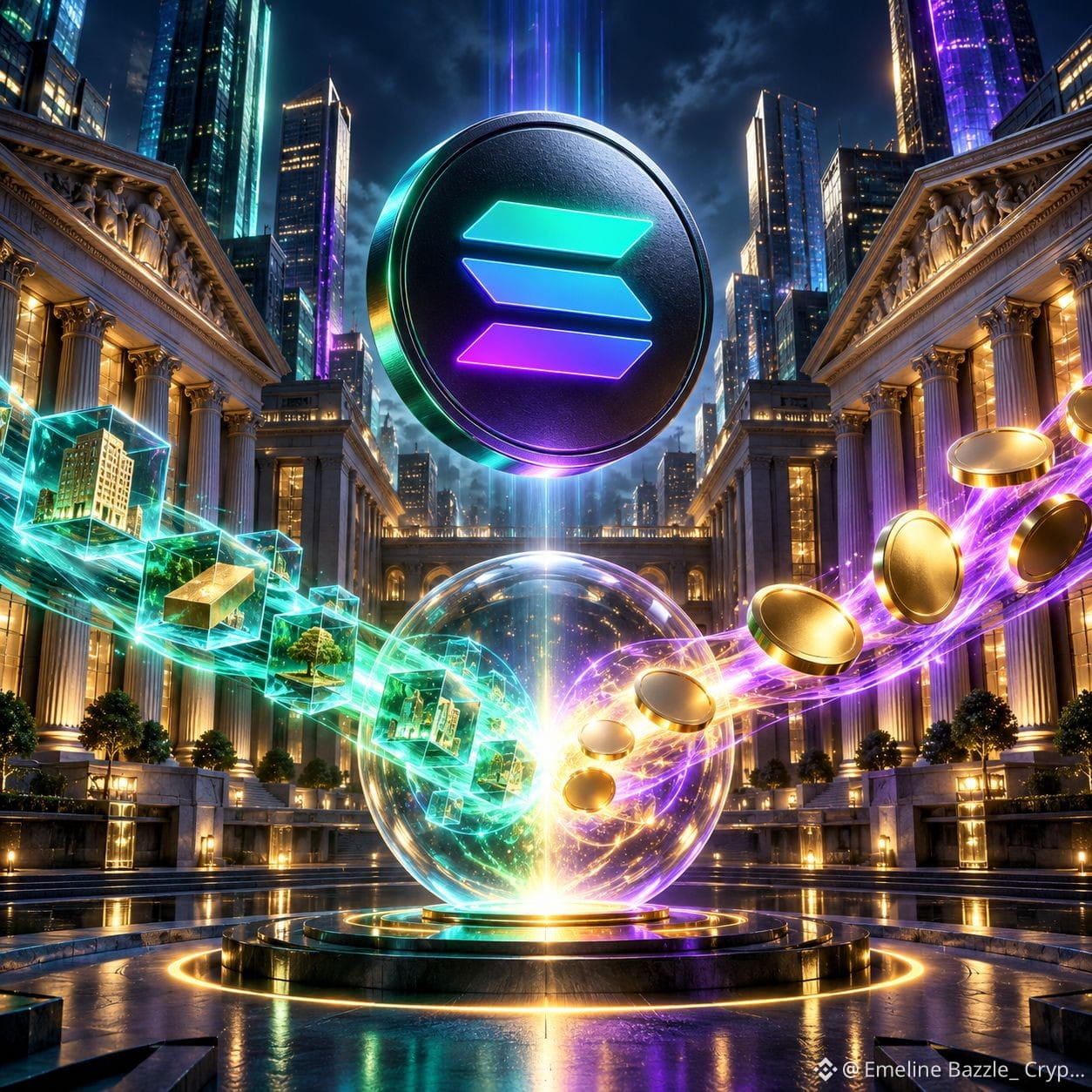
🚨🏦 SOLANA TAKES AIM AT WALL STREET — WITH INPUT FROM J.P. MORGAN ⚡🌐
An asset moves. The payment fails. 😬 That’s the settlement risk institutions want to avoid.
Solana’s new DvP program makes both sides settle together — or neither does. 🔄🤝🔐
The Solana Foundation says its open-source infrastructure brings delivery-versus-payment settlement on-chain, with finality in seconds instead of days. ⏱️🚀
Here’s why it matters 👇👀
⚡ Faster settlement: Less time waiting for trades to complete. ✅
💰 Capital efficiency: Potentially less money tied up between trade and settlement. 🔓
🛠️ Shared infrastructure: An MIT-licensed standard institutions can build on. 🧩
🏦 Institutional input: J.P. Morgan helped shape the design around institutional settlement practices. 🤝
🔒 Privacy planned: Confidential settlement features are on the roadmap. 🛡️
🌍 The bigger picture? Tokenized assets need reliable infrastructure to move from issuance to everyday trading. 📈🔗
Atomic settlement reduces the risk of delivering an asset without receiving payment. ✅ Technology, operational and compliance risks still matter. ⚙️⚖️
🔥 Could settlement infrastructure become Solana’s next major adoption driver? 🚀
👇💬 What matters more for $SOL: institutional usage 🏦, tokenized assets 🏠 or trading activity 📊?
#Tokenization #RWA #defi
$SOL
{spot}(SOLUSDT)
$XRP
{spot}(XRPUSDT)
$ONDO
{spot}(ONDOUSDT)
🚨🏦 SOLANA TAKES AIM AT WALL STREET — WITH INPUT FROM J.P. MORGAN ⚡🌐
An asset moves. The payment fails. 😬 That’s the settlement risk institutions want to avoid.
Solana’s new DvP program makes both sides settle together — or neither does. 🔄🤝🔐
The Solana Foundation says its open-source infrastructure brings delivery-versus-payment settlement on-chain, with finality in seconds instead of days. ⏱️🚀
Here’s why it matters 👇👀
⚡ Faster settlement: Less time waiting for trades to complete. ✅
💰 Capital efficiency: Potentially less money tied up between trade and settlement. 🔓
🛠️ Shared infrastructure: An MIT-licensed standard institutions can build on. 🧩
🏦 Institutional input: J.P. Morgan helped shape the design around institutional settlement practices. 🤝
🔒 Privacy planned: Confidential settlement features are on the roadmap. 🛡️
🌍 The bigger picture? Tokenized assets need reliable infrastructure to move from issuance to everyday trading. 📈🔗
Atomic settlement reduces the risk of delivering an asset without receiving payment. ✅ Technology, operational and compliance risks still matter. ⚙️⚖️
🔥 Could settlement infrastructure become Solana’s next major adoption driver? 🚀
👇💬 What matters more for $SOL : institutional usage 🏦, tokenized assets 🏠 or trading activity 📊?
#Tokenization #RWA #defi
$SOL
$XRP
$ONDO
An asset moves. The payment fails. 😬 That’s the settlement risk institutions want to avoid.
Solana’s new DvP program makes both sides settle together — or neither does. 🔄🤝🔐
The Solana Foundation says its open-source infrastructure brings delivery-versus-payment settlement on-chain, with finality in seconds instead of days. ⏱️🚀
Here’s why it matters 👇👀
⚡ Faster settlement: Less time waiting for trades to complete. ✅
💰 Capital efficiency: Potentially less money tied up between trade and settlement. 🔓
🛠️ Shared infrastructure: An MIT-licensed standard institutions can build on. 🧩
🏦 Institutional input: J.P. Morgan helped shape the design around institutional settlement practices. 🤝
🔒 Privacy planned: Confidential settlement features are on the roadmap. 🛡️
🌍 The bigger picture? Tokenized assets need reliable infrastructure to move from issuance to everyday trading. 📈🔗
Atomic settlement reduces the risk of delivering an asset without receiving payment. ✅ Technology, operational and compliance risks still matter. ⚙️⚖️
🔥 Could settlement infrastructure become Solana’s next major adoption driver? 🚀
👇💬 What matters more for $SOL : institutional usage 🏦, tokenized assets 🏠 or trading activity 📊?
#Tokenization #RWA #defi
$SOL
$XRP
$ONDO
177

·
--

Article
The Biggest Shift Nobody Noticed in 2026 🤖💵✨Everyone talks about AI making images and videos 📸
But the real shift is AI using money itself 🧠💸
AI agents can't open a bank account 🏦❌
They can't use cash 💵❌
But they CAN use stablecoins instantly 24/7 🌐⚡️
That is why October 2026 is not just Uptober 📈
It is the start of RWA + AI + DeFi merging 🔗🚀
What I am seeing 👀
1 Morpho and other protocols unlocking yield on tokenized assets 📊💰
2 $ETH scaling with Glamsterdam testing 🔧🌟
3 $BTC holding above 86k with ETF inflows back 💎📥
My take 💭
The future is not human OR AI 🙅
It is human strategy + AI execution 🤝🧠
The most profitable wallets this year are hybrid 🔄
Humans decide the direction 🧭
AI handles execution and risk management 🛡️🤖
Learning this now is like learning internet in 1999 💻🌍
👉 BTC is the base layer 🧱
👉 ETH is where AI agents will live and transact 🏠💳
Are you learning AI x Crypto or still only chasing candles? 🤔📉
#AIcrypto #RWA #DeFi #BinanceSquare
The Biggest Shift Nobody Noticed in 2026 🤖💵✨
Everyone talks about AI making images and videos 📸
But the real shift is AI using money itself 🧠💸
AI agents can't open a bank account 🏦❌
They can't use cash 💵❌
But they CAN use stablecoins instantly 24/7 🌐⚡️
That is why October 2026 is not just Uptober 📈
It is the start of RWA + AI + DeFi merging 🔗🚀
What I am seeing 👀
1 Morpho and other protocols unlocking yield on tokenized assets 📊💰
2 $ETH scaling with Glamsterdam testing 🔧🌟
3 $BTC holding above 86k with ETF inflows back 💎📥
My take 💭
The future is not human OR AI 🙅
It is human strategy + AI execution 🤝🧠
The most profitable wallets this year are hybrid 🔄
Humans decide the direction 🧭
AI handles execution and risk management 🛡️🤖
Learning this now is like learning internet in 1999 💻🌍
👉 BTC is the base layer 🧱
👉 ETH is where AI agents will live and transact 🏠💳
Are you learning AI x Crypto or still only chasing candles? 🤔📉
#AIcrypto #RWA #DeFi #BinanceSquare
But the real shift is AI using money itself 🧠💸
AI agents can't open a bank account 🏦❌
They can't use cash 💵❌
But they CAN use stablecoins instantly 24/7 🌐⚡️
That is why October 2026 is not just Uptober 📈
It is the start of RWA + AI + DeFi merging 🔗🚀
What I am seeing 👀
1 Morpho and other protocols unlocking yield on tokenized assets 📊💰
2 $ETH scaling with Glamsterdam testing 🔧🌟
3 $BTC holding above 86k with ETF inflows back 💎📥
My take 💭
The future is not human OR AI 🙅
It is human strategy + AI execution 🤝🧠
The most profitable wallets this year are hybrid 🔄
Humans decide the direction 🧭
AI handles execution and risk management 🛡️🤖
Learning this now is like learning internet in 1999 💻🌍
👉 BTC is the base layer 🧱
👉 ETH is where AI agents will live and transact 🏠💳
Are you learning AI x Crypto or still only chasing candles? 🤔📉
#AIcrypto #RWA #DeFi #BinanceSquare
59

·
--
Bullish
🐋 $ORCA — A Solana DeFi Coin Worth Watching 👀
ORCA is one of the notable decentralized exchanges (DEXs) in the Solana ecosystem, focused on fast swaps, liquidity, and a user-friendly DeFi experience. ⚡️
{spot}(ORCAUSDT)
What makes ORCA interesting?
🔹 Built on Solana’s high-speed network
🔹 Strong role in the Solana DeFi ecosystem
🔹 DEX + liquidity infrastructure
🔹 Could benefit if Solana DeFi activity expands 📈
The big question now:
🔥 Can ORCA become one of the stronger DeFi performers in the next market move?
DYOR & manage risk. No financial advice.
#ORCA #Solana #DeFi #Crypto #BinanceSquare
🐋 $ORCA — A Solana DeFi Coin Worth Watching 👀
ORCA is one of the notable decentralized exchanges (DEXs) in the Solana ecosystem, focused on fast swaps, liquidity, and a user-friendly DeFi experience. ⚡️
What makes ORCA interesting?
🔹 Built on Solana’s high-speed network
🔹 Strong role in the Solana DeFi ecosystem
🔹 DEX + liquidity infrastructure
🔹 Could benefit if Solana DeFi activity expands 📈
The big question now:
🔥 Can ORCA become one of the stronger DeFi performers in the next market move?
DYOR & manage risk. No financial advice.
#ORCA #Solana #DeFi #Crypto #BinanceSquare
ORCA is one of the notable decentralized exchanges (DEXs) in the Solana ecosystem, focused on fast swaps, liquidity, and a user-friendly DeFi experience. ⚡️
What makes ORCA interesting?
🔹 Built on Solana’s high-speed network
🔹 Strong role in the Solana DeFi ecosystem
🔹 DEX + liquidity infrastructure
🔹 Could benefit if Solana DeFi activity expands 📈
The big question now:
🔥 Can ORCA become one of the stronger DeFi performers in the next market move?
DYOR & manage risk. No financial advice.
#ORCA #Solana #DeFi #Crypto #BinanceSquare
1
94

🚨 TRADING INFRASTRUCTURE WATCH
$DYDX — dYdX remains closely associated with decentralized derivatives trading, making DYDX particularly sensitive to changes in perpetual-futures activity.
{spot}(DYDXUSDT)
$GMX — GMX is another major decentralized derivatives platform, and rising on-chain trading volume could strengthen the narrative around GMX.
{spot}(GMXUSDT)
$1INCH — 1inch aggregates liquidity across decentralized exchanges, so broader DEX activity can create renewed interest around 1INCH.
{spot}(1INCHUSDT)
#DYDX #GMX #1INCH #DeFi #CryptoTrading
🚨 TRADING INFRASTRUCTURE WATCH
$DYDX — dYdX remains closely associated with decentralized derivatives trading, making DYDX particularly sensitive to changes in perpetual-futures activity.
$GMX — GMX is another major decentralized derivatives platform, and rising on-chain trading volume could strengthen the narrative around GMX.
$1INCH — 1inch aggregates liquidity across decentralized exchanges, so broader DEX activity can create renewed interest around 1INCH.
#DYDX #GMX #1INCH #DeFi #CryptoTrading
$DYDX — dYdX remains closely associated with decentralized derivatives trading, making DYDX particularly sensitive to changes in perpetual-futures activity.
$GMX — GMX is another major decentralized derivatives platform, and rising on-chain trading volume could strengthen the narrative around GMX.
$1INCH — 1inch aggregates liquidity across decentralized exchanges, so broader DEX activity can create renewed interest around 1INCH.
#DYDX #GMX #1INCH #DeFi #CryptoTrading

96
📊 DEFI LIQUIDITY WATCH
$PENDLE — Pendle’s yield-trading model gives it a unique DeFi narrative, and changes in on-chain yield demand can strongly affect PENDLE sentiment.
{spot}(PENDLEUSDT)
$SYRUP — Maple’s SYRUP token is tied to institutional-style on-chain credit, making it an interesting RWA and lending narrative to monitor.
{spot}(SYRUPUSDT)
$ENS — Ethereum Name Service remains a major Web3 naming protocol, and renewed Ethereum ecosystem activity could bring ENS back into focus.
{spot}(ENSUSDT)
#PENDLE #SYRUP #ENS #DeFi #RWA
📊 DEFI LIQUIDITY WATCH
$PENDLE — Pendle’s yield-trading model gives it a unique DeFi narrative, and changes in on-chain yield demand can strongly affect PENDLE sentiment.
$SYRUP — Maple’s SYRUP token is tied to institutional-style on-chain credit, making it an interesting RWA and lending narrative to monitor.
$ENS — Ethereum Name Service remains a major Web3 naming protocol, and renewed Ethereum ecosystem activity could bring ENS back into focus.
#PENDLE #SYRUP #ENS #DeFi #RWA
$PENDLE — Pendle’s yield-trading model gives it a unique DeFi narrative, and changes in on-chain yield demand can strongly affect PENDLE sentiment.
$SYRUP — Maple’s SYRUP token is tied to institutional-style on-chain credit, making it an interesting RWA and lending narrative to monitor.
$ENS — Ethereum Name Service remains a major Web3 naming protocol, and renewed Ethereum ecosystem activity could bring ENS back into focus.
#PENDLE #SYRUP #ENS #DeFi #RWA

107
🚀 EXCHANGE AND DEFI TOKENS WATCH
$CAKE — PancakeSwap remains a major decentralized exchange, and increasing BNB Chain activity could create stronger demand for CAKE.
{spot}(CAKEUSDT)
$JST — JUST remains connected to the TRON DeFi ecosystem, giving JST additional relevance when TRON-based liquidity increases.
{spot}(JSTUSDT)
$AERO — Aerodrome has become a major Base ecosystem DeFi name, making AERO especially interesting when Base trading activity accelerates.
{spot}(AEROUSDT)
#CAKE #JST #AERO #DeFi #Altcoins
🚀 EXCHANGE AND DEFI TOKENS WATCH
$CAKE — PancakeSwap remains a major decentralized exchange, and increasing BNB Chain activity could create stronger demand for CAKE.
$JST — JUST remains connected to the TRON DeFi ecosystem, giving JST additional relevance when TRON-based liquidity increases.
$AERO — Aerodrome has become a major Base ecosystem DeFi name, making AERO especially interesting when Base trading activity accelerates.
#CAKE #JST #AERO #DeFi #Altcoins
$CAKE — PancakeSwap remains a major decentralized exchange, and increasing BNB Chain activity could create stronger demand for CAKE.
$JST — JUST remains connected to the TRON DeFi ecosystem, giving JST additional relevance when TRON-based liquidity increases.
$AERO — Aerodrome has become a major Base ecosystem DeFi name, making AERO especially interesting when Base trading activity accelerates.
#CAKE #JST #AERO #DeFi #Altcoins
24
🔥 SOLANA ECOSYSTEM WATCH
$RAY — Raydium is one of Solana’s key DeFi platforms, making RAY an interesting proxy for renewed activity across the Solana ecosystem.
{spot}(RAYUSDT)
$JUP — Jupiter plays a major role in Solana’s trading infrastructure, so increasing DEX activity could become an important catalyst for JUP.
{spot}(JUPUSDT)
$PYTH — Pyth remains a major oracle project connected to fast-moving DeFi markets, making PYTH worth watching during renewed ecosystem growth.
{spot}(PYTHUSDT)
#RAY #JUP #PYTH #Solana #DeFi
🔥 SOLANA ECOSYSTEM WATCH
$RAY — Raydium is one of Solana’s key DeFi platforms, making RAY an interesting proxy for renewed activity across the Solana ecosystem.
$JUP — Jupiter plays a major role in Solana’s trading infrastructure, so increasing DEX activity could become an important catalyst for JUP.
$PYTH — Pyth remains a major oracle project connected to fast-moving DeFi markets, making PYTH worth watching during renewed ecosystem growth.
#RAY #JUP #PYTH #Solana #DeFi
$RAY — Raydium is one of Solana’s key DeFi platforms, making RAY an interesting proxy for renewed activity across the Solana ecosystem.
$JUP — Jupiter plays a major role in Solana’s trading infrastructure, so increasing DEX activity could become an important catalyst for JUP.
$PYTH — Pyth remains a major oracle project connected to fast-moving DeFi markets, making PYTH worth watching during renewed ecosystem growth.
#RAY #JUP #PYTH #Solana #DeFi
1
166
⚡ DEFI AND STAKING WATCH
$LDO — Lido remains a major liquid-staking name, and renewed Ethereum staking activity could improve attention around LDO.
{spot}(LDOUSDT)
$ETHFI — ether.fi sits directly in the Ethereum liquid-restaking narrative, making ETHFI interesting when staking-related tokens start moving together.
{spot}(ETHFIUSDT)
$JTO — Jito remains an important Solana ecosystem project, and stronger SOL ecosystem activity could provide additional momentum for JTO.
{spot}(JTOUSDT)
#LDO #ETHFI #JTO #DeFi #Ethereum
⚡ DEFI AND STAKING WATCH
$LDO — Lido remains a major liquid-staking name, and renewed Ethereum staking activity could improve attention around LDO.
$ETHFI — ether.fi sits directly in the Ethereum liquid-restaking narrative, making ETHFI interesting when staking-related tokens start moving together.
$JTO — Jito remains an important Solana ecosystem project, and stronger SOL ecosystem activity could provide additional momentum for JTO.
#LDO #ETHFI #JTO #DeFi #Ethereum
$LDO — Lido remains a major liquid-staking name, and renewed Ethereum staking activity could improve attention around LDO.
$ETHFI — ether.fi sits directly in the Ethereum liquid-restaking narrative, making ETHFI interesting when staking-related tokens start moving together.
$JTO — Jito remains an important Solana ecosystem project, and stronger SOL ecosystem activity could provide additional momentum for JTO.
#LDO #ETHFI #JTO #DeFi #Ethereum

10
🔥 DEFI MOMENTUM WATCH
$ONDO — Ondo remains one of the better-known RWA tokens, giving ONDO extra attention whenever tokenized real-world assets return to the spotlight.
{spot}(ONDOUSDT)
$MORPHO — Morpho is gaining recognition across decentralized lending, and increasing DeFi liquidity could become an important catalyst for MORPHO.
{spot}(MORPHOUSDT)
$CRV — Curve remains a major DeFi liquidity venue, so rising protocol activity could translate into renewed trading interest around CRV.
{spot}(CRVUSDT)
#ONDO #MORPHO #CRV #DeFi #RWA
🔥 DEFI MOMENTUM WATCH
$ONDO — Ondo remains one of the better-known RWA tokens, giving ONDO extra attention whenever tokenized real-world assets return to the spotlight.
$MORPHO — Morpho is gaining recognition across decentralized lending, and increasing DeFi liquidity could become an important catalyst for MORPHO.
$CRV — Curve remains a major DeFi liquidity venue, so rising protocol activity could translate into renewed trading interest around CRV.
#ONDO #MORPHO #CRV #DeFi #RWA
$ONDO — Ondo remains one of the better-known RWA tokens, giving ONDO extra attention whenever tokenized real-world assets return to the spotlight.
$MORPHO — Morpho is gaining recognition across decentralized lending, and increasing DeFi liquidity could become an important catalyst for MORPHO.
$CRV — Curve remains a major DeFi liquidity venue, so rising protocol activity could translate into renewed trading interest around CRV.
#ONDO #MORPHO #CRV #DeFi #RWA

190
🔥 DEFI WATCHLIST: UNI, AAVE AND ENA
$UNI — Uniswap remains a major DeFi name, and renewed decentralized-exchange activity could become a catalyst for UNI momentum.
{spot}(UNIUSDT)
$AAVE — Aave continues to dominate attention in decentralized lending, making strong volume around resistance a signal traders should not ignore.
{spot}(AAVEUSDT)
$ENA — Ethena offers high volatility compared with many large caps, which can create attractive momentum setups but also demands careful risk control.
{spot}(ENAUSDT)
#UNI #AAVE #ENA #DeFi #CryptoTrading
🔥 DEFI WATCHLIST: UNI, AAVE AND ENA
$UNI — Uniswap remains a major DeFi name, and renewed decentralized-exchange activity could become a catalyst for UNI momentum.
$AAVE — Aave continues to dominate attention in decentralized lending, making strong volume around resistance a signal traders should not ignore.
$ENA — Ethena offers high volatility compared with many large caps, which can create attractive momentum setups but also demands careful risk control.
#UNI #AAVE #ENA #DeFi #CryptoTrading
$UNI — Uniswap remains a major DeFi name, and renewed decentralized-exchange activity could become a catalyst for UNI momentum.
$AAVE — Aave continues to dominate attention in decentralized lending, making strong volume around resistance a signal traders should not ignore.
$ENA — Ethena offers high volatility compared with many large caps, which can create attractive momentum setups but also demands careful risk control.
#UNI #AAVE #ENA #DeFi #CryptoTrading

56

·
--
Arbitrum just picked its dollar 💵⚡
On Oct 6, Paxos launched USDG (Global Dollar) with native issuance on Arbitrum One, not bridged over from another chain.
What came with it on day one:
• Fluid, Morpho, GMX and Maple integrations
• Kraken exchange support
• ~7M $ARB in incentives
• A GMX boost targeting 8%+ APR on some USDG pools for 8 weeks
Paxos says USDG is backed 1:1 by USD cash and equivalents, with monthly attestations.
Will USDG actually steal liquidity from USDC on Arbitrum, or is this just farm-and-dump season? 👇
#Arbitrum #Stablecoins #DeFi #CryptoNews
Arbitrum just picked its dollar 💵⚡
On Oct 6, Paxos launched USDG (Global Dollar) with native issuance on Arbitrum One, not bridged over from another chain.
What came with it on day one:
• Fluid, Morpho, GMX and Maple integrations
• Kraken exchange support
• ~7M $ARB in incentives
• A GMX boost targeting 8%+ APR on some USDG pools for 8 weeks
Paxos says USDG is backed 1:1 by USD cash and equivalents, with monthly attestations.
Will USDG actually steal liquidity from USDC on Arbitrum, or is this just farm-and-dump season? 👇
#Arbitrum #Stablecoins #DeFi #CryptoNews
On Oct 6, Paxos launched USDG (Global Dollar) with native issuance on Arbitrum One, not bridged over from another chain.
What came with it on day one:
• Fluid, Morpho, GMX and Maple integrations
• Kraken exchange support
• ~7M $ARB in incentives
• A GMX boost targeting 8%+ APR on some USDG pools for 8 weeks
Paxos says USDG is backed 1:1 by USD cash and equivalents, with monthly attestations.
Will USDG actually steal liquidity from USDC on Arbitrum, or is this just farm-and-dump season? 👇
#Arbitrum #Stablecoins #DeFi #CryptoNews
1
121
·
--
Verified
Polymarket just rebuilt itself from scratch 🔮⚙️
On Oct 5, Polymarket unveiled Protocol V2, replacing the 2019 Gnosis Conditional Tokens setup it has run on since launch:
• One ERC-1155 PositionManager for every market type
• pUSD as the only collateral (wraps USDC 1:1)
• An OracleAggregator plugging in $UMA and $LINK for resolution
• Built-in cross-chain bridging for positions and collateral
Canary markets are live through Oct 30. New markets tentatively move to V2 on Nov 2, and old markets don't migrate.
Is this the upgrade that makes prediction markets go mainstream, or just plumbing? 👇
#Polymarket #PredictionMarkets #DeFi #CryptoNews
Polymarket just rebuilt itself from scratch 🔮⚙️
On Oct 5, Polymarket unveiled Protocol V2, replacing the 2019 Gnosis Conditional Tokens setup it has run on since launch:
• One ERC-1155 PositionManager for every market type
• pUSD as the only collateral (wraps USDC 1:1)
• An OracleAggregator plugging in $UMA and $LINK for resolution
• Built-in cross-chain bridging for positions and collateral
Canary markets are live through Oct 30. New markets tentatively move to V2 on Nov 2, and old markets don't migrate.
Is this the upgrade that makes prediction markets go mainstream, or just plumbing? 👇
#Polymarket #PredictionMarkets #DeFi #CryptoNews
On Oct 5, Polymarket unveiled Protocol V2, replacing the 2019 Gnosis Conditional Tokens setup it has run on since launch:
• One ERC-1155 PositionManager for every market type
• pUSD as the only collateral (wraps USDC 1:1)
• An OracleAggregator plugging in $UMA and $LINK for resolution
• Built-in cross-chain bridging for positions and collateral
Canary markets are live through Oct 30. New markets tentatively move to V2 on Nov 2, and old markets don't migrate.
Is this the upgrade that makes prediction markets go mainstream, or just plumbing? 👇
#Polymarket #PredictionMarkets #DeFi #CryptoNews
1
204

Tokenized money market funds are heating up fast. Spiko just secured a massive $90 million Series B funding round to scale its already impressive $2.7 billion cash fund business into fresh global markets. This move highlights how traditional finance continues to merge with blockchain rails, driving institutional adoption forward. As yield-bearing stablecoins and tokenized cash equivalents gain momentum, expect traditional banks to face intense competition for on-chain liquidity soon. #RWA #Tokenization #DeFi
Tokenized money market funds are heating up fast. Spiko just secured a massive $90 million Series B funding round to scale its already impressive $2.7 billion cash fund business into fresh global markets. This move highlights how traditional finance continues to merge with blockchain rails, driving institutional adoption forward. As yield-bearing stablecoins and tokenized cash equivalents gain momentum, expect traditional banks to face intense competition for on-chain liquidity soon. #RWA #Tokenization #DeFi
Log in to explore more content
Join global crypto users on Binance Square
⚡️ Get latest and useful information about crypto.
💬 Trusted by the world’s largest crypto exchange.
👍 Discover real insights from verified creators.
Email / Phone number
Trending Topics
1
#BinanceLaunchesBinanceIntelligence
500,934 views
3,370 Discussing
2
#BitcoinTargets2026OpenAt$87570
3,585 views
93 Discussing
3
#BitcoinRejectedAt$87KThirdTime
3,204 views
75 Discussing
4
#StrategyMarketCapSurpassesRumble
21,770 views
547 Discussing
5
#StriveBuys2000BTCFor$169M
15,306 views
145 Discussing
6
#EvernorthXRPTreasuryCompletesSPACMerger
201,010 views
1,766 Discussing
7
#ADAGains10%Above$0.27
72,598 views
262 Discussing
8
#ETHUp70%InQ3ButLiquidityFalls
401,820 views
2,724 Discussing
9
#EthStakingExitQueueHits2026High
172,304 views
1,776 Discussing
10
#FedOctoberHoldOdds82.3%
194,089 views
1,708 Discussing