

#cryptonewsflash
cryptonewsflash
874,278 views
1,005 Discussing
Hot
Latest


Article
"Citi Raises Strategy Price Target to $240 as Higher Bitcoin Forecast Lifts MSTR Outlook"Citi raises its Strategy price target to $240 from $136 as a higher Bitcoin forecast and expected mNAV expansion strengthen its MSTR outlook.
Citi has raised its price target for Strategy (MSTR) to $240 from $136 while keeping a Buy rating on the stock. The revision follows the bank’s higher Bitcoin forecast, with Citi now expecting BTC to reach about $113,400 over the next 12 months.
The new MSTR target represents a 76.5% increase from Citi’s previous $136 estimate. With Strategy closing around $160.50 on Oct. 1, a move to $240 would require roughly another 49.5% gain.
Citi’s valuation framework splits that potential upside between a higher Bitcoin price and an expansion in the premium investors are willing to pay for Strategy relative to its underlying BTC holdings.
Bitcoin Appreciation Accounts for Most of Citi’s MSTR Upside
Citi sees about 34% of MSTR’s potential upside coming from Bitcoin appreciation.
That assumption follows the bank’s decision to raise its 12-month Bitcoin target by roughly 39%, from $82,000 to approximately $113,400.
Strategy’s stock has historically moved closely with Bitcoin because BTC represents the core asset on its balance sheet. The company also uses equity, preferred securities, and debt to fund its treasury strategy, which can amplify changes in Bitcoin value at the common-stock level.
This means Citi’s higher BTC forecast directly increases the value it assigns to MSTR.
Citi Also Expects Strategy’s mNAV Premium to Expand
Another 16% of the expected upside comes from Citi’s assumption that Strategy’s mNAV multiple will increase.
mNAV compares Strategy’s market valuation with the net value of its Bitcoin holdings and other balance-sheet items. A figure above 1.0 means investors are valuing MSTR at a premium to the underlying net assets.
Citi’s updated model assumes an mNAV of about 1.24x.
The bank also increased what it calls its Bitcoin Yield Multiple to 4.0x from 2.5x, giving Strategy a higher valuation for its ability to increase Bitcoin exposure per share through capital-market activity.
The two components broadly explain Citi’s new MSTR target. A roughly 34% benefit from its Bitcoin assumption combined with about 16% from mNAV expansion produces close to the 50% upside needed to move MSTR from around $160.50 to $240.
Strategy Remains Highly Sensitive to Bitcoin
Citi’s target therefore depends heavily on Bitcoin reaching the bank’s higher forecast and MSTR maintaining a premium to its underlying BTC value.
If Bitcoin underperforms the $113,400 assumption or Strategy’s mNAV contracts instead of expanding, the valuation model would change. Conversely, stronger Bitcoin performance or a larger MSTR premium could alter the upside case.
For now, Citi’s latest update raises both sides of the equation: a higher Bitcoin forecast and a higher valuation multiple for Strategy, resulting in the jump from a $136 MSTR target to $240.
#CryptoNewsFlash
"Citi Raises Strategy Price Target to $240 as Higher Bitcoin Forecast Lifts MSTR Outlook"
Citi raises its Strategy price target to $240 from $136 as a higher Bitcoin forecast and expected mNAV expansion strengthen its MSTR outlook.
Citi has raised its price target for Strategy (MSTR) to $240 from $136 while keeping a Buy rating on the stock. The revision follows the bank’s higher Bitcoin forecast, with Citi now expecting BTC to reach about $113,400 over the next 12 months.
The new MSTR target represents a 76.5% increase from Citi’s previous $136 estimate. With Strategy closing around $160.50 on Oct. 1, a move to $240 would require roughly another 49.5% gain.
Citi’s valuation framework splits that potential upside between a higher Bitcoin price and an expansion in the premium investors are willing to pay for Strategy relative to its underlying BTC holdings.
Bitcoin Appreciation Accounts for Most of Citi’s MSTR Upside
Citi sees about 34% of MSTR’s potential upside coming from Bitcoin appreciation.
That assumption follows the bank’s decision to raise its 12-month Bitcoin target by roughly 39%, from $82,000 to approximately $113,400.
Strategy’s stock has historically moved closely with Bitcoin because BTC represents the core asset on its balance sheet. The company also uses equity, preferred securities, and debt to fund its treasury strategy, which can amplify changes in Bitcoin value at the common-stock level.
This means Citi’s higher BTC forecast directly increases the value it assigns to MSTR.
Citi Also Expects Strategy’s mNAV Premium to Expand
Another 16% of the expected upside comes from Citi’s assumption that Strategy’s mNAV multiple will increase.
mNAV compares Strategy’s market valuation with the net value of its Bitcoin holdings and other balance-sheet items. A figure above 1.0 means investors are valuing MSTR at a premium to the underlying net assets.
Citi’s updated model assumes an mNAV of about 1.24x.
The bank also increased what it calls its Bitcoin Yield Multiple to 4.0x from 2.5x, giving Strategy a higher valuation for its ability to increase Bitcoin exposure per share through capital-market activity.
The two components broadly explain Citi’s new MSTR target. A roughly 34% benefit from its Bitcoin assumption combined with about 16% from mNAV expansion produces close to the 50% upside needed to move MSTR from around $160.50 to $240.
Strategy Remains Highly Sensitive to Bitcoin
Citi’s target therefore depends heavily on Bitcoin reaching the bank’s higher forecast and MSTR maintaining a premium to its underlying BTC value.
If Bitcoin underperforms the $113,400 assumption or Strategy’s mNAV contracts instead of expanding, the valuation model would change. Conversely, stronger Bitcoin performance or a larger MSTR premium could alter the upside case.
For now, Citi’s latest update raises both sides of the equation: a higher Bitcoin forecast and a higher valuation multiple for Strategy, resulting in the jump from a $136 MSTR target to $240.
#CryptoNewsFlash
Citi has raised its price target for Strategy (MSTR) to $240 from $136 while keeping a Buy rating on the stock. The revision follows the bank’s higher Bitcoin forecast, with Citi now expecting BTC to reach about $113,400 over the next 12 months.
The new MSTR target represents a 76.5% increase from Citi’s previous $136 estimate. With Strategy closing around $160.50 on Oct. 1, a move to $240 would require roughly another 49.5% gain.
Citi’s valuation framework splits that potential upside between a higher Bitcoin price and an expansion in the premium investors are willing to pay for Strategy relative to its underlying BTC holdings.
Bitcoin Appreciation Accounts for Most of Citi’s MSTR Upside
Citi sees about 34% of MSTR’s potential upside coming from Bitcoin appreciation.
That assumption follows the bank’s decision to raise its 12-month Bitcoin target by roughly 39%, from $82,000 to approximately $113,400.
Strategy’s stock has historically moved closely with Bitcoin because BTC represents the core asset on its balance sheet. The company also uses equity, preferred securities, and debt to fund its treasury strategy, which can amplify changes in Bitcoin value at the common-stock level.
This means Citi’s higher BTC forecast directly increases the value it assigns to MSTR.
Citi Also Expects Strategy’s mNAV Premium to Expand
Another 16% of the expected upside comes from Citi’s assumption that Strategy’s mNAV multiple will increase.
mNAV compares Strategy’s market valuation with the net value of its Bitcoin holdings and other balance-sheet items. A figure above 1.0 means investors are valuing MSTR at a premium to the underlying net assets.
Citi’s updated model assumes an mNAV of about 1.24x.
The bank also increased what it calls its Bitcoin Yield Multiple to 4.0x from 2.5x, giving Strategy a higher valuation for its ability to increase Bitcoin exposure per share through capital-market activity.
The two components broadly explain Citi’s new MSTR target. A roughly 34% benefit from its Bitcoin assumption combined with about 16% from mNAV expansion produces close to the 50% upside needed to move MSTR from around $160.50 to $240.
Strategy Remains Highly Sensitive to Bitcoin
Citi’s target therefore depends heavily on Bitcoin reaching the bank’s higher forecast and MSTR maintaining a premium to its underlying BTC value.
If Bitcoin underperforms the $113,400 assumption or Strategy’s mNAV contracts instead of expanding, the valuation model would change. Conversely, stronger Bitcoin performance or a larger MSTR premium could alter the upside case.
For now, Citi’s latest update raises both sides of the equation: a higher Bitcoin forecast and a higher valuation multiple for Strategy, resulting in the jump from a $136 MSTR target to $240.
#CryptoNewsFlash
121
Article
"Crypto Price Analysis BTC, ETH, XRP, QNT, NEAR, October 1: Bitcoin Holds Range as NEAR Rebounds"Bitcoin, Ethereum and XRP hold below resistance as NEAR rebounds and Quant consolidates. Explore technical levels and price scenarios for October 1, 2026.
Bitcoin, Ethereum and XRP opened October with modest rolling 24-hour gains, while NEAR Protocol outperformed the group and Quant remained nearly unchanged. The completed daily charts showed different conditions: Bitcoin remained inside its recent consolidation, Ethereum and XRP stayed below nearby resistance, and NEAR recovered much of its latest pullback.
Quant and NEAR join today’s coverage because both appeared in CoinGecko’s search-trending list and ranked inside its top 100 by market capitalization. NEAR ranked 21st and Quant 32nd in the market snapshot. A trending-search listing measures attention and is distinct from a ranking of price gainers.
Bitcoin Fails to Hold Above the Previous Resistance Zone
Bitcoin closed September 30 at $83,578, down 0.07% from $83,640 a day earlier. The session reached $85,518, temporarily exceeding the $85,210 upper resistance boundary identified in the previous report, before ending back below it. That intraday move did not become a confirmed daily breakout.
The latest high expands immediate resistance to approximately $85,210–$85,520. A completed daily close above $85,520, followed by a hold of the reclaimed area, would strengthen the case for another test of the September highs around $87,250–$87,330.
Support remains near $82,580–$82,950, encompassing the September 28 and September 30 lows. Beneath it, the rising 20-day simple moving average stood near $81,302. A daily close below $82,580 would weaken the range and bring that average into focus.
Four-hour MACD, using 12,26,9 settings, remained mixed as the candle closed at 00:00 UTC. The MACD line was approximately -88.63, above its -116.44 signal line but still below zero. Its positive histogram narrowed from 34.24 to 27.81, indicating that the latest improvement relative to the signal line was losing pace.
Ethereum Holds Above Its 20-Day Average but Below $2,743
Ethereum closed September 30 at $2,684.57, gaining 0.27%. Its $2,736.98 session high remained below the approximately $2,743 resistance level highlighted in the previous report.
Daily Bollinger Bands, calculated using a 20-day simple moving average and two standard deviations, had a midpoint near $2,610.17 and an upper band near $2,833.57. ETH price closed above the midpoint and inside the bands, with nearby horizontal resistance still separating price from the higher band.
Fibonacci retracements of the advance from September 15’s $2,361.16 low to September 21’s $2,804.42 high place the 23.6% level near $2,699.81 and the 38.2% level near $2,635.09. The latter closely matches the recent support floor around $2,635.
A daily close above $2,743 would put the $2,787–$2,804 highs back in view. Only a further break of that area would support an extension toward the upper Bollinger Band, whose value changes with subsequent closes.
Conversely, a close below $2,635 would weaken the consolidation and expose the 20-day average near $2,610, followed by the 50% retracement near $2,583.
XRP’s $1.45–$1.47 Support Remains in Focus
XRP finished September 30 near $1.49 after reaching approximately $1.54. The close remained near the preceding session’s level and below the $1.53–$1.56 resistance band identified in the previous report.
The 20-day simple moving average rose to about $1.44. Fibonacci retracements of the advance from the September 16 low of $1.25 to the September 23 high of $1.66 provide additional reference points: approximately $1.50 at 38.2%, $1.46 at 50%, and $1.41 at 61.8%.
The 50% retracement falls within the established $1.45–$1.47 support area, while the moving average sits just beneath it. A completed close below this support band would weaken the current structure; a further loss of the average would bring the $1.41 retracement into focus.
On the upside, reclaiming $1.50 would be an initial improvement, but a close above $1.56 would be needed to clear the broader resistance band and nearby 23.6% retracement. Holding that reclaimed area would support a retest of $1.61–$1.66. A return below $1.53 after a breakout would weaken that recovery scenario.
Quant’s Daily Recovery Meets Softer Four-Hour Momentum
Quant closed September 30 at $286.87, up 7.36% from $267.20. The session climbed to $326.12 before retreating into the close. Its nearly flat rolling 24-hour return at the later snapshot measures a different window from that completed daily gain.
Fibonacci retracements of the rebound from September 28’s $196.87 low to September 30’s $326.12 high place the 23.6% level at $295.62, the 38.2% level at $276.75 and the 50% level at $261.50. The daily close sat between the first two levels, although the subsequent spot quote was back above $295.62.
The latest completed four-hour MACD line fell below its signal line, with the histogram turning from +0.32 to -1.28. Both lines remained above zero, distinguishing the loss of momentum relative to the signal from a move below the MACD baseline.
A daily reclaim of $295.62 would support another attempt at $318.36–$326.12. A confirmed break above $326.12 would reopen the September 27 high near $358.20. Failure to hold $276.75 would instead expose the September 30 low of $263.45 and nearby $261.50 retracement.
NEAR Recovers Toward Its September High
NEAR closed September 30 at $5.34, up 9.20% from $4.89. The session high of $5.49 remained below September 27’s $5.57 peak, so the rebound had not yet produced a confirmed breakout above the recent high.
Four-hour MACD showed improving momentum at the common chart cutoff. Its line stood near 0.109, above the 0.078 signal line, while the positive histogram increased from approximately 0.026 to 0.031. Unlike Bitcoin, both NEAR readings were above zero.
The $5.16–$5.19 area, containing earlier daily highs, is the first area to watch for a successful support retest. Holding above it would preserve the rebound toward $5.49–$5.57. A return below $5.16 would weaken the recovery, with the September 30 low at $4.84 and September 29 low at $4.55 providing lower reference points.
For a conditional upside scenario, two-point Fibonacci extensions of the recovery from September 29’s $4.55 low to September 30’s $5.49 high stand near $5.75 at 1.272 and $6.07 at 1.618. Those levels become relevant if NEAR first closes above $5.57 and holds the breakout area; they are projected extensions, not confirmed price destinations.
#CryptoNewsFlash
"Crypto Price Analysis BTC, ETH, XRP, QNT, NEAR, October 1: Bitcoin Holds Range as NEAR Rebounds"
Bitcoin, Ethereum and XRP hold below resistance as NEAR rebounds and Quant consolidates. Explore technical levels and price scenarios for October 1, 2026.
Bitcoin, Ethereum and XRP opened October with modest rolling 24-hour gains, while NEAR Protocol outperformed the group and Quant remained nearly unchanged. The completed daily charts showed different conditions: Bitcoin remained inside its recent consolidation, Ethereum and XRP stayed below nearby resistance, and NEAR recovered much of its latest pullback.
Quant and NEAR join today’s coverage because both appeared in CoinGecko’s search-trending list and ranked inside its top 100 by market capitalization. NEAR ranked 21st and Quant 32nd in the market snapshot. A trending-search listing measures attention and is distinct from a ranking of price gainers.
Bitcoin Fails to Hold Above the Previous Resistance Zone
Bitcoin closed September 30 at $83,578, down 0.07% from $83,640 a day earlier. The session reached $85,518, temporarily exceeding the $85,210 upper resistance boundary identified in the previous report, before ending back below it. That intraday move did not become a confirmed daily breakout.
The latest high expands immediate resistance to approximately $85,210–$85,520. A completed daily close above $85,520, followed by a hold of the reclaimed area, would strengthen the case for another test of the September highs around $87,250–$87,330.
Support remains near $82,580–$82,950, encompassing the September 28 and September 30 lows. Beneath it, the rising 20-day simple moving average stood near $81,302. A daily close below $82,580 would weaken the range and bring that average into focus.
Four-hour MACD, using 12,26,9 settings, remained mixed as the candle closed at 00:00 UTC. The MACD line was approximately -88.63, above its -116.44 signal line but still below zero. Its positive histogram narrowed from 34.24 to 27.81, indicating that the latest improvement relative to the signal line was losing pace.
Ethereum Holds Above Its 20-Day Average but Below $2,743
Ethereum closed September 30 at $2,684.57, gaining 0.27%. Its $2,736.98 session high remained below the approximately $2,743 resistance level highlighted in the previous report.
Daily Bollinger Bands, calculated using a 20-day simple moving average and two standard deviations, had a midpoint near $2,610.17 and an upper band near $2,833.57. ETH price closed above the midpoint and inside the bands, with nearby horizontal resistance still separating price from the higher band.
Fibonacci retracements of the advance from September 15’s $2,361.16 low to September 21’s $2,804.42 high place the 23.6% level near $2,699.81 and the 38.2% level near $2,635.09. The latter closely matches the recent support floor around $2,635.
A daily close above $2,743 would put the $2,787–$2,804 highs back in view. Only a further break of that area would support an extension toward the upper Bollinger Band, whose value changes with subsequent closes.
Conversely, a close below $2,635 would weaken the consolidation and expose the 20-day average near $2,610, followed by the 50% retracement near $2,583.
XRP’s $1.45–$1.47 Support Remains in Focus
XRP finished September 30 near $1.49 after reaching approximately $1.54. The close remained near the preceding session’s level and below the $1.53–$1.56 resistance band identified in the previous report.
The 20-day simple moving average rose to about $1.44. Fibonacci retracements of the advance from the September 16 low of $1.25 to the September 23 high of $1.66 provide additional reference points: approximately $1.50 at 38.2%, $1.46 at 50%, and $1.41 at 61.8%.
The 50% retracement falls within the established $1.45–$1.47 support area, while the moving average sits just beneath it. A completed close below this support band would weaken the current structure; a further loss of the average would bring the $1.41 retracement into focus.
On the upside, reclaiming $1.50 would be an initial improvement, but a close above $1.56 would be needed to clear the broader resistance band and nearby 23.6% retracement. Holding that reclaimed area would support a retest of $1.61–$1.66. A return below $1.53 after a breakout would weaken that recovery scenario.
Quant’s Daily Recovery Meets Softer Four-Hour Momentum
Quant closed September 30 at $286.87, up 7.36% from $267.20. The session climbed to $326.12 before retreating into the close. Its nearly flat rolling 24-hour return at the later snapshot measures a different window from that completed daily gain.
Fibonacci retracements of the rebound from September 28’s $196.87 low to September 30’s $326.12 high place the 23.6% level at $295.62, the 38.2% level at $276.75 and the 50% level at $261.50. The daily close sat between the first two levels, although the subsequent spot quote was back above $295.62.
The latest completed four-hour MACD line fell below its signal line, with the histogram turning from +0.32 to -1.28. Both lines remained above zero, distinguishing the loss of momentum relative to the signal from a move below the MACD baseline.
A daily reclaim of $295.62 would support another attempt at $318.36–$326.12. A confirmed break above $326.12 would reopen the September 27 high near $358.20. Failure to hold $276.75 would instead expose the September 30 low of $263.45 and nearby $261.50 retracement.
NEAR Recovers Toward Its September High
NEAR closed September 30 at $5.34, up 9.20% from $4.89. The session high of $5.49 remained below September 27’s $5.57 peak, so the rebound had not yet produced a confirmed breakout above the recent high.
Four-hour MACD showed improving momentum at the common chart cutoff. Its line stood near 0.109, above the 0.078 signal line, while the positive histogram increased from approximately 0.026 to 0.031. Unlike Bitcoin, both NEAR readings were above zero.
The $5.16–$5.19 area, containing earlier daily highs, is the first area to watch for a successful support retest. Holding above it would preserve the rebound toward $5.49–$5.57. A return below $5.16 would weaken the recovery, with the September 30 low at $4.84 and September 29 low at $4.55 providing lower reference points.
For a conditional upside scenario, two-point Fibonacci extensions of the recovery from September 29’s $4.55 low to September 30’s $5.49 high stand near $5.75 at 1.272 and $6.07 at 1.618. Those levels become relevant if NEAR first closes above $5.57 and holds the breakout area; they are projected extensions, not confirmed price destinations.
#CryptoNewsFlash
Bitcoin, Ethereum and XRP opened October with modest rolling 24-hour gains, while NEAR Protocol outperformed the group and Quant remained nearly unchanged. The completed daily charts showed different conditions: Bitcoin remained inside its recent consolidation, Ethereum and XRP stayed below nearby resistance, and NEAR recovered much of its latest pullback.
Quant and NEAR join today’s coverage because both appeared in CoinGecko’s search-trending list and ranked inside its top 100 by market capitalization. NEAR ranked 21st and Quant 32nd in the market snapshot. A trending-search listing measures attention and is distinct from a ranking of price gainers.
Bitcoin Fails to Hold Above the Previous Resistance Zone
Bitcoin closed September 30 at $83,578, down 0.07% from $83,640 a day earlier. The session reached $85,518, temporarily exceeding the $85,210 upper resistance boundary identified in the previous report, before ending back below it. That intraday move did not become a confirmed daily breakout.
The latest high expands immediate resistance to approximately $85,210–$85,520. A completed daily close above $85,520, followed by a hold of the reclaimed area, would strengthen the case for another test of the September highs around $87,250–$87,330.
Support remains near $82,580–$82,950, encompassing the September 28 and September 30 lows. Beneath it, the rising 20-day simple moving average stood near $81,302. A daily close below $82,580 would weaken the range and bring that average into focus.
Four-hour MACD, using 12,26,9 settings, remained mixed as the candle closed at 00:00 UTC. The MACD line was approximately -88.63, above its -116.44 signal line but still below zero. Its positive histogram narrowed from 34.24 to 27.81, indicating that the latest improvement relative to the signal line was losing pace.
Ethereum Holds Above Its 20-Day Average but Below $2,743
Ethereum closed September 30 at $2,684.57, gaining 0.27%. Its $2,736.98 session high remained below the approximately $2,743 resistance level highlighted in the previous report.
Daily Bollinger Bands, calculated using a 20-day simple moving average and two standard deviations, had a midpoint near $2,610.17 and an upper band near $2,833.57. ETH price closed above the midpoint and inside the bands, with nearby horizontal resistance still separating price from the higher band.
Fibonacci retracements of the advance from September 15’s $2,361.16 low to September 21’s $2,804.42 high place the 23.6% level near $2,699.81 and the 38.2% level near $2,635.09. The latter closely matches the recent support floor around $2,635.
A daily close above $2,743 would put the $2,787–$2,804 highs back in view. Only a further break of that area would support an extension toward the upper Bollinger Band, whose value changes with subsequent closes.
Conversely, a close below $2,635 would weaken the consolidation and expose the 20-day average near $2,610, followed by the 50% retracement near $2,583.
XRP’s $1.45–$1.47 Support Remains in Focus
XRP finished September 30 near $1.49 after reaching approximately $1.54. The close remained near the preceding session’s level and below the $1.53–$1.56 resistance band identified in the previous report.
The 20-day simple moving average rose to about $1.44. Fibonacci retracements of the advance from the September 16 low of $1.25 to the September 23 high of $1.66 provide additional reference points: approximately $1.50 at 38.2%, $1.46 at 50%, and $1.41 at 61.8%.
The 50% retracement falls within the established $1.45–$1.47 support area, while the moving average sits just beneath it. A completed close below this support band would weaken the current structure; a further loss of the average would bring the $1.41 retracement into focus.
On the upside, reclaiming $1.50 would be an initial improvement, but a close above $1.56 would be needed to clear the broader resistance band and nearby 23.6% retracement. Holding that reclaimed area would support a retest of $1.61–$1.66. A return below $1.53 after a breakout would weaken that recovery scenario.
Quant’s Daily Recovery Meets Softer Four-Hour Momentum
Quant closed September 30 at $286.87, up 7.36% from $267.20. The session climbed to $326.12 before retreating into the close. Its nearly flat rolling 24-hour return at the later snapshot measures a different window from that completed daily gain.
Fibonacci retracements of the rebound from September 28’s $196.87 low to September 30’s $326.12 high place the 23.6% level at $295.62, the 38.2% level at $276.75 and the 50% level at $261.50. The daily close sat between the first two levels, although the subsequent spot quote was back above $295.62.
The latest completed four-hour MACD line fell below its signal line, with the histogram turning from +0.32 to -1.28. Both lines remained above zero, distinguishing the loss of momentum relative to the signal from a move below the MACD baseline.
A daily reclaim of $295.62 would support another attempt at $318.36–$326.12. A confirmed break above $326.12 would reopen the September 27 high near $358.20. Failure to hold $276.75 would instead expose the September 30 low of $263.45 and nearby $261.50 retracement.
NEAR Recovers Toward Its September High
NEAR closed September 30 at $5.34, up 9.20% from $4.89. The session high of $5.49 remained below September 27’s $5.57 peak, so the rebound had not yet produced a confirmed breakout above the recent high.
Four-hour MACD showed improving momentum at the common chart cutoff. Its line stood near 0.109, above the 0.078 signal line, while the positive histogram increased from approximately 0.026 to 0.031. Unlike Bitcoin, both NEAR readings were above zero.
The $5.16–$5.19 area, containing earlier daily highs, is the first area to watch for a successful support retest. Holding above it would preserve the rebound toward $5.49–$5.57. A return below $5.16 would weaken the recovery, with the September 30 low at $4.84 and September 29 low at $4.55 providing lower reference points.
For a conditional upside scenario, two-point Fibonacci extensions of the recovery from September 29’s $4.55 low to September 30’s $5.49 high stand near $5.75 at 1.272 and $6.07 at 1.618. Those levels become relevant if NEAR first closes above $5.57 and holds the breakout area; they are projected extensions, not confirmed price destinations.
#CryptoNewsFlash
370
Article
Bitcoin Is Getting Stronger as Monthly RSI Rebounds From Deep 2026 Lows#Bitcoin is showing signs of strength as its monthly RSI recovers from the low levels seen during its 2026 decline.
Bitcoin analyst PlanB, who has over 2 million followers on X, shared the latest monthly RSI chart from Block Horizon and simply said, “Bitcoin is getting stronger.”
Bitcoin Monthly RSI Moves Back Above 50
The chart, updated on September 24, shows Bitcoin’s monthly RSI at around 54, while its five-month average is about 47.
Earlier in 2026, the RSI fell into the mid-40s, indicating weaker momentum. This decline coincided with Bitcoin’s price drop from $97,860.60 to $57,700 in July, representing a 40.99% decline.
However, Bitcoin has improved significantly since that low. Bitcoin has surged to $87,265 as of this week, representing a 51% gain from the July low.
Accordingly, Bitcoin’s monthly RSI has now recovered above 50, suggesting that BTC’s momentum is improving. However, the RSI remains well below 70, a level often seen during Bitcoin’s strongest rallies.
The chart also shows that Bitcoin’s RSI has experienced major ups and downs in the past. Major market peaks have often occurred with RSI readings above 85, while major corrections have pushed the indicator below 50.
Therefore, PlanB’s comment suggests that Bitcoin’s momentum is improving following the previous decline.
Gradually Entering a Bull Market
Interestingly, when Bitcoin reached a peak of $126,200 in 2025, its RSI did not reach the typical 80-plus levels seen during previous bull markets. Instead, it reached the mid-70s before the decline began.
On the other hand, the RSI reached the usual bear-market bottom levels below 50, similar to what occurred during previous bear markets.
CoinMarketCap data shows BTC at around $84,580, up about 1.5% over the past 24 hours and 8% over the past week. The recovery has led to more positive comments from traders on social media, with some suggesting that the bull market has resumed.
X user Riley Coleman said that despite criticism from some bears, Bitcoin’s market structure is getting stronger. “The bears can keep coping all they want on social media, but the math doesn’t care about your feelings,” he said.
Notably, the RSI suggests Bitcoin is gradually entering another major rally. At around 54, the monthly RSI remains in the middle of its historical range and well below the extreme levels seen during previous market peaks.
The key point is that Bitcoin’s monthly RSI has recovered as its price has risen significantly from the July low. If the RSI continues to rise, it would suggest stronger long-term momentum. If it falls below 50 again, it could indicate renewed weakness.
Bitcoin Supertrend Flashes Buy Signal at $84K
Beyond the monthly RSI, Bitcoin’s Supertrend indicator has turned green again around $84,000, signaling a shift back to an uptrend.
The previous green signal appeared in 2023 near $16,000 and remained in place for roughly three years as Bitcoin climbed about 700%, eventually reaching $120,000. The indicator has now turned green again after Bitcoin fell to around $57,700 in July 2026 and subsequently rebounded by about 51%.
The Supertrend indicator uses price and volatility to identify market direction, with green indicating an upward trend.
Bitcoin has also moved back above its 365-day moving average near $83,000 and its 50-week moving average. The next major technical level is around $88,761, the two-year moving average. A sustained move above these levels could signal stronger momentum, although technical indicators do not guarantee future gains.
#CryptoNewsFlash
Bitcoin Is Getting Stronger as Monthly RSI Rebounds From Deep 2026 Lows
#Bitcoin is showing signs of strength as its monthly RSI recovers from the low levels seen during its 2026 decline.
Bitcoin analyst PlanB, who has over 2 million followers on X, shared the latest monthly RSI chart from Block Horizon and simply said, “Bitcoin is getting stronger.”
Bitcoin Monthly RSI Moves Back Above 50
The chart, updated on September 24, shows Bitcoin’s monthly RSI at around 54, while its five-month average is about 47.
Earlier in 2026, the RSI fell into the mid-40s, indicating weaker momentum. This decline coincided with Bitcoin’s price drop from $97,860.60 to $57,700 in July, representing a 40.99% decline.
However, Bitcoin has improved significantly since that low. Bitcoin has surged to $87,265 as of this week, representing a 51% gain from the July low.
Accordingly, Bitcoin’s monthly RSI has now recovered above 50, suggesting that BTC’s momentum is improving. However, the RSI remains well below 70, a level often seen during Bitcoin’s strongest rallies.
The chart also shows that Bitcoin’s RSI has experienced major ups and downs in the past. Major market peaks have often occurred with RSI readings above 85, while major corrections have pushed the indicator below 50.
Therefore, PlanB’s comment suggests that Bitcoin’s momentum is improving following the previous decline.
Gradually Entering a Bull Market
Interestingly, when Bitcoin reached a peak of $126,200 in 2025, its RSI did not reach the typical 80-plus levels seen during previous bull markets. Instead, it reached the mid-70s before the decline began.
On the other hand, the RSI reached the usual bear-market bottom levels below 50, similar to what occurred during previous bear markets.
CoinMarketCap data shows BTC at around $84,580, up about 1.5% over the past 24 hours and 8% over the past week. The recovery has led to more positive comments from traders on social media, with some suggesting that the bull market has resumed.
X user Riley Coleman said that despite criticism from some bears, Bitcoin’s market structure is getting stronger. “The bears can keep coping all they want on social media, but the math doesn’t care about your feelings,” he said.
Notably, the RSI suggests Bitcoin is gradually entering another major rally. At around 54, the monthly RSI remains in the middle of its historical range and well below the extreme levels seen during previous market peaks.
The key point is that Bitcoin’s monthly RSI has recovered as its price has risen significantly from the July low. If the RSI continues to rise, it would suggest stronger long-term momentum. If it falls below 50 again, it could indicate renewed weakness.
Bitcoin Supertrend Flashes Buy Signal at $84K
Beyond the monthly RSI, Bitcoin’s Supertrend indicator has turned green again around $84,000, signaling a shift back to an uptrend.
The previous green signal appeared in 2023 near $16,000 and remained in place for roughly three years as Bitcoin climbed about 700%, eventually reaching $120,000. The indicator has now turned green again after Bitcoin fell to around $57,700 in July 2026 and subsequently rebounded by about 51%.
The Supertrend indicator uses price and volatility to identify market direction, with green indicating an upward trend.
Bitcoin has also moved back above its 365-day moving average near $83,000 and its 50-week moving average. The next major technical level is around $88,761, the two-year moving average. A sustained move above these levels could signal stronger momentum, although technical indicators do not guarantee future gains.
#CryptoNewsFlash
Bitcoin analyst PlanB, who has over 2 million followers on X, shared the latest monthly RSI chart from Block Horizon and simply said, “Bitcoin is getting stronger.”
Bitcoin Monthly RSI Moves Back Above 50
The chart, updated on September 24, shows Bitcoin’s monthly RSI at around 54, while its five-month average is about 47.
Earlier in 2026, the RSI fell into the mid-40s, indicating weaker momentum. This decline coincided with Bitcoin’s price drop from $97,860.60 to $57,700 in July, representing a 40.99% decline.
However, Bitcoin has improved significantly since that low. Bitcoin has surged to $87,265 as of this week, representing a 51% gain from the July low.
Accordingly, Bitcoin’s monthly RSI has now recovered above 50, suggesting that BTC’s momentum is improving. However, the RSI remains well below 70, a level often seen during Bitcoin’s strongest rallies.
The chart also shows that Bitcoin’s RSI has experienced major ups and downs in the past. Major market peaks have often occurred with RSI readings above 85, while major corrections have pushed the indicator below 50.
Therefore, PlanB’s comment suggests that Bitcoin’s momentum is improving following the previous decline.
Gradually Entering a Bull Market
Interestingly, when Bitcoin reached a peak of $126,200 in 2025, its RSI did not reach the typical 80-plus levels seen during previous bull markets. Instead, it reached the mid-70s before the decline began.
On the other hand, the RSI reached the usual bear-market bottom levels below 50, similar to what occurred during previous bear markets.
CoinMarketCap data shows BTC at around $84,580, up about 1.5% over the past 24 hours and 8% over the past week. The recovery has led to more positive comments from traders on social media, with some suggesting that the bull market has resumed.
X user Riley Coleman said that despite criticism from some bears, Bitcoin’s market structure is getting stronger. “The bears can keep coping all they want on social media, but the math doesn’t care about your feelings,” he said.
Notably, the RSI suggests Bitcoin is gradually entering another major rally. At around 54, the monthly RSI remains in the middle of its historical range and well below the extreme levels seen during previous market peaks.
The key point is that Bitcoin’s monthly RSI has recovered as its price has risen significantly from the July low. If the RSI continues to rise, it would suggest stronger long-term momentum. If it falls below 50 again, it could indicate renewed weakness.
Bitcoin Supertrend Flashes Buy Signal at $84K
Beyond the monthly RSI, Bitcoin’s Supertrend indicator has turned green again around $84,000, signaling a shift back to an uptrend.
The previous green signal appeared in 2023 near $16,000 and remained in place for roughly three years as Bitcoin climbed about 700%, eventually reaching $120,000. The indicator has now turned green again after Bitcoin fell to around $57,700 in July 2026 and subsequently rebounded by about 51%.
The Supertrend indicator uses price and volatility to identify market direction, with green indicating an upward trend.
Bitcoin has also moved back above its 365-day moving average near $83,000 and its 50-week moving average. The next major technical level is around $88,761, the two-year moving average. A sustained move above these levels could signal stronger momentum, although technical indicators do not guarantee future gains.
#CryptoNewsFlash
283
Article
"Tesla Made $100 Million From Bitcoin Without Adding a Single BTC"Tesla’s Bitcoin Holdings Approach $1 Billion After BTC’s 14% Weekly Rise.
According to Arkham data, Tesla’s Bitcoin position is approaching a market value of $1 billion after BTC recorded a sharp increase over the past week.
The electric vehicle manufacturer holds 11,509 BTC, currently valued at approximately $994.90 million, based on the figures provided. The value of the position increased by about $122.62 million in one week as Bitcoin rose roughly 14%.
At $994.90 million, Tesla’s Bitcoin holdings are approximately $5.1 million short of the $1 billion threshold. The weekly increase reflects the higher market price of Bitcoin rather than a new purchase or realized profit.
Tesla’s Bitcoin Holdings Date Back to 2021
Tesla made its major entry into Bitcoin in early 2021, when the company disclosed a $1.5 billion investment in the cryptocurrency. It also briefly allowed customers to purchase vehicles using Bitcoin before ending the payment option later that year.
Tesla subsequently reduced its position. The company’s largest disposal occurred in 2022, when it converted a substantial portion of its Bitcoin holdings into traditional currency and reported proceeds of approximately $936 million from the sale.
Following those reductions, Tesla retained a smaller Bitcoin treasury. Its current balance stands at 11,509 BTC, and the supplied data indicates that the company has maintained this position for roughly four years.
Bitcoin Price Changes Move Tesla’s Holdings by Millions
The size of Tesla’s remaining position means changes in Bitcoin’s market price can produce substantial changes in its dollar valuation.
With 11,509 BTC, every $1,000 movement in Bitcoin changes the market value of the position by approximately $11.51 million. A $10,000 increase would correspond to roughly $115.09 million in additional market value, assuming the number of Bitcoin held remains unchanged.
The latest 14% weekly Bitcoin increase has consequently pushed Tesla’s position close to ten figures. Based on the supplied valuation, the company’s 11,509 BTC are now worth about $994.90 million, compared with approximately $872.28 million a week earlier.
The roughly $122.62 million difference is an increase in the market value of the holdings, rather than cash generated or realized profit from selling Bitcoin.
#CryptoNewsFlash
"Tesla Made $100 Million From Bitcoin Without Adding a Single BTC"
Tesla’s Bitcoin Holdings Approach $1 Billion After BTC’s 14% Weekly Rise.
According to Arkham data, Tesla’s Bitcoin position is approaching a market value of $1 billion after BTC recorded a sharp increase over the past week.
The electric vehicle manufacturer holds 11,509 BTC, currently valued at approximately $994.90 million, based on the figures provided. The value of the position increased by about $122.62 million in one week as Bitcoin rose roughly 14%.
At $994.90 million, Tesla’s Bitcoin holdings are approximately $5.1 million short of the $1 billion threshold. The weekly increase reflects the higher market price of Bitcoin rather than a new purchase or realized profit.
Tesla’s Bitcoin Holdings Date Back to 2021
Tesla made its major entry into Bitcoin in early 2021, when the company disclosed a $1.5 billion investment in the cryptocurrency. It also briefly allowed customers to purchase vehicles using Bitcoin before ending the payment option later that year.
Tesla subsequently reduced its position. The company’s largest disposal occurred in 2022, when it converted a substantial portion of its Bitcoin holdings into traditional currency and reported proceeds of approximately $936 million from the sale.
Following those reductions, Tesla retained a smaller Bitcoin treasury. Its current balance stands at 11,509 BTC, and the supplied data indicates that the company has maintained this position for roughly four years.
Bitcoin Price Changes Move Tesla’s Holdings by Millions
The size of Tesla’s remaining position means changes in Bitcoin’s market price can produce substantial changes in its dollar valuation.
With 11,509 BTC, every $1,000 movement in Bitcoin changes the market value of the position by approximately $11.51 million. A $10,000 increase would correspond to roughly $115.09 million in additional market value, assuming the number of Bitcoin held remains unchanged.
The latest 14% weekly Bitcoin increase has consequently pushed Tesla’s position close to ten figures. Based on the supplied valuation, the company’s 11,509 BTC are now worth about $994.90 million, compared with approximately $872.28 million a week earlier.
The roughly $122.62 million difference is an increase in the market value of the holdings, rather than cash generated or realized profit from selling Bitcoin.
#CryptoNewsFlash
According to Arkham data, Tesla’s Bitcoin position is approaching a market value of $1 billion after BTC recorded a sharp increase over the past week.
The electric vehicle manufacturer holds 11,509 BTC, currently valued at approximately $994.90 million, based on the figures provided. The value of the position increased by about $122.62 million in one week as Bitcoin rose roughly 14%.
At $994.90 million, Tesla’s Bitcoin holdings are approximately $5.1 million short of the $1 billion threshold. The weekly increase reflects the higher market price of Bitcoin rather than a new purchase or realized profit.
Tesla’s Bitcoin Holdings Date Back to 2021
Tesla made its major entry into Bitcoin in early 2021, when the company disclosed a $1.5 billion investment in the cryptocurrency. It also briefly allowed customers to purchase vehicles using Bitcoin before ending the payment option later that year.
Tesla subsequently reduced its position. The company’s largest disposal occurred in 2022, when it converted a substantial portion of its Bitcoin holdings into traditional currency and reported proceeds of approximately $936 million from the sale.
Following those reductions, Tesla retained a smaller Bitcoin treasury. Its current balance stands at 11,509 BTC, and the supplied data indicates that the company has maintained this position for roughly four years.
Bitcoin Price Changes Move Tesla’s Holdings by Millions
The size of Tesla’s remaining position means changes in Bitcoin’s market price can produce substantial changes in its dollar valuation.
With 11,509 BTC, every $1,000 movement in Bitcoin changes the market value of the position by approximately $11.51 million. A $10,000 increase would correspond to roughly $115.09 million in additional market value, assuming the number of Bitcoin held remains unchanged.
The latest 14% weekly Bitcoin increase has consequently pushed Tesla’s position close to ten figures. Based on the supplied valuation, the company’s 11,509 BTC are now worth about $994.90 million, compared with approximately $872.28 million a week earlier.
The roughly $122.62 million difference is an increase in the market value of the holdings, rather than cash generated or realized profit from selling Bitcoin.
#CryptoNewsFlash
216
Article
"Dan Gambardello Warns Traders Against Writing Off Cardano as ADA Eyes $0.40"Market veteran Dan Gambardello has urged traders not to write off Cardano as ADA approaches a potentially important technical breakout.
Cardano started the week on a positive note as the broader cryptocurrency market staged a recovery. ADA climbed from an intraday low of $0.23 to around $0.25, strengthening its recent rebound despite the token’s significant decline over the past several months.
While some critics have questioned whether Cardano can regain its previous momentum, Gambardello has taken a different view. He warned traders against dismissing the cryptocurrency, pointing to a technical setup that could support a sharp upward move.
Gambardello Sees Potential Move to $0.40
Gambardello specifically cautioned traders against “writing off” Cardano as ADA approaches a possible breakout.
According to him, ADA could reach $0.40 “in an instant” if it escapes its current technical structure. His comment highlights the importance of the resistance levels ADA is currently testing and the possibility of a stronger rally if the token breaks above them.
The accompanying chart shows ADA trading around $0.241 while testing an ascending yellow trendline that has recently acted as resistance. Recent candles have moved above the trendline, suggesting that buyers are attempting to push the token into a stronger position above this level.
ADA Builds Recovery Structure
Meanwhile, ADA has recovered significantly from its recent low near $0.14 and has formed a series of higher lows. The blue moving average has also turned upward and remains below the current price, indicating that short-term momentum has improved.
Nonetheless, ADA still faces resistance from the longer-term red moving average, which continues to trend downward from higher levels. Therefore, a sustained break above these resistance areas could play an important role in determining whether ADA can extend its recovery.
At its current price of $0.24603, ADA requires a surge of 62.58% to reach the $0.40 target highlighted by Gambardello. Notably, ADA last traded around the $0.40 level in January 2026 before losing ground.
Gambardello Still Holds ADA
Gambardello’s latest comments also stand out because he previously reduced his Cardano exposure during the governance crisis that affected the ecosystem in June 2026.
At the time, he disclosed that he had moved part of his ADA holdings into Sui. Although he has since liquidated some of his Cardano position, Gambardello confirmed that he remains an ADA holder. However, the exact size of his current ADA holdings remains unknown.
Meanwhile, Cardano continues to retain much of the gain from yesterday’s broader market rally. ADA is currently up 5.63% over the past 24 hours, with its market cap rising by a similar percentage to $9.02 billion.
With this valuation, ADA ranks as the 14th-largest cryptocurrency by market capitalization on CoinMarketCap. Whether it can sustain the current recovery will depend in part on its ability to overcome the resistance levels highlighted in Gambardello’s analysis.
#CryptoNewsFlash
"Dan Gambardello Warns Traders Against Writing Off Cardano as ADA Eyes $0.40"
Market veteran Dan Gambardello has urged traders not to write off Cardano as ADA approaches a potentially important technical breakout.
Cardano started the week on a positive note as the broader cryptocurrency market staged a recovery. ADA climbed from an intraday low of $0.23 to around $0.25, strengthening its recent rebound despite the token’s significant decline over the past several months.
While some critics have questioned whether Cardano can regain its previous momentum, Gambardello has taken a different view. He warned traders against dismissing the cryptocurrency, pointing to a technical setup that could support a sharp upward move.
Gambardello Sees Potential Move to $0.40
Gambardello specifically cautioned traders against “writing off” Cardano as ADA approaches a possible breakout.
According to him, ADA could reach $0.40 “in an instant” if it escapes its current technical structure. His comment highlights the importance of the resistance levels ADA is currently testing and the possibility of a stronger rally if the token breaks above them.
The accompanying chart shows ADA trading around $0.241 while testing an ascending yellow trendline that has recently acted as resistance. Recent candles have moved above the trendline, suggesting that buyers are attempting to push the token into a stronger position above this level.
ADA Builds Recovery Structure
Meanwhile, ADA has recovered significantly from its recent low near $0.14 and has formed a series of higher lows. The blue moving average has also turned upward and remains below the current price, indicating that short-term momentum has improved.
Nonetheless, ADA still faces resistance from the longer-term red moving average, which continues to trend downward from higher levels. Therefore, a sustained break above these resistance areas could play an important role in determining whether ADA can extend its recovery.
At its current price of $0.24603, ADA requires a surge of 62.58% to reach the $0.40 target highlighted by Gambardello. Notably, ADA last traded around the $0.40 level in January 2026 before losing ground.
Gambardello Still Holds ADA
Gambardello’s latest comments also stand out because he previously reduced his Cardano exposure during the governance crisis that affected the ecosystem in June 2026.
At the time, he disclosed that he had moved part of his ADA holdings into Sui. Although he has since liquidated some of his Cardano position, Gambardello confirmed that he remains an ADA holder. However, the exact size of his current ADA holdings remains unknown.
Meanwhile, Cardano continues to retain much of the gain from yesterday’s broader market rally. ADA is currently up 5.63% over the past 24 hours, with its market cap rising by a similar percentage to $9.02 billion.
With this valuation, ADA ranks as the 14th-largest cryptocurrency by market capitalization on CoinMarketCap. Whether it can sustain the current recovery will depend in part on its ability to overcome the resistance levels highlighted in Gambardello’s analysis.
#CryptoNewsFlash
Cardano started the week on a positive note as the broader cryptocurrency market staged a recovery. ADA climbed from an intraday low of $0.23 to around $0.25, strengthening its recent rebound despite the token’s significant decline over the past several months.
While some critics have questioned whether Cardano can regain its previous momentum, Gambardello has taken a different view. He warned traders against dismissing the cryptocurrency, pointing to a technical setup that could support a sharp upward move.
Gambardello Sees Potential Move to $0.40
Gambardello specifically cautioned traders against “writing off” Cardano as ADA approaches a possible breakout.
According to him, ADA could reach $0.40 “in an instant” if it escapes its current technical structure. His comment highlights the importance of the resistance levels ADA is currently testing and the possibility of a stronger rally if the token breaks above them.
The accompanying chart shows ADA trading around $0.241 while testing an ascending yellow trendline that has recently acted as resistance. Recent candles have moved above the trendline, suggesting that buyers are attempting to push the token into a stronger position above this level.
ADA Builds Recovery Structure
Meanwhile, ADA has recovered significantly from its recent low near $0.14 and has formed a series of higher lows. The blue moving average has also turned upward and remains below the current price, indicating that short-term momentum has improved.
Nonetheless, ADA still faces resistance from the longer-term red moving average, which continues to trend downward from higher levels. Therefore, a sustained break above these resistance areas could play an important role in determining whether ADA can extend its recovery.
At its current price of $0.24603, ADA requires a surge of 62.58% to reach the $0.40 target highlighted by Gambardello. Notably, ADA last traded around the $0.40 level in January 2026 before losing ground.
Gambardello Still Holds ADA
Gambardello’s latest comments also stand out because he previously reduced his Cardano exposure during the governance crisis that affected the ecosystem in June 2026.
At the time, he disclosed that he had moved part of his ADA holdings into Sui. Although he has since liquidated some of his Cardano position, Gambardello confirmed that he remains an ADA holder. However, the exact size of his current ADA holdings remains unknown.
Meanwhile, Cardano continues to retain much of the gain from yesterday’s broader market rally. ADA is currently up 5.63% over the past 24 hours, with its market cap rising by a similar percentage to $9.02 billion.
With this valuation, ADA ranks as the 14th-largest cryptocurrency by market capitalization on CoinMarketCap. Whether it can sustain the current recovery will depend in part on its ability to overcome the resistance levels highlighted in Gambardello’s analysis.
#CryptoNewsFlash
1
455
Article
"XRP Seeing Vanishing Leverage: Why a $2 Billion Sell-Off Might Actually Be Good News"The #XRP perpetual and spot CVDs have recently recorded massive declines amid selling pressure, but there may be a silver lining.
XRP is showing an unusual level of calm as traders continue to cut their leveraged positions and spot-market selling remains high. The asset currently trades at $1.32, up 3.14% on the day, while holding key support. The broader crypto market also gained ground after Wednesday’s quarter-point Federal Reserve rate hike and Thursday’s SEC approval of a blockchain-based stock trading pilot.
Bitcoin (BTC) moved back above $78,000, while Ethereum (ETH) held above $2,500. XRP, meanwhile, stayed between $1.28 and $1.33, a range it has held for much of the past week after falling roughly 4% from a recent high around $1.42.
The price movement looks calm at press time, but data from the futures and spot markets shows that traders have made much larger moves beneath the surface.
XRP Leverage Drops Three Times Faster Than Price
Binance data shows that traders are reducing leverage. Notably, XRP open interest on the exchange fell from about $323 million on Aug. 22 to roughly $219 million by Sept. 17. That amounts to a 32% drop in less than four weeks.
XRP’s price declined by only about 11% over the same period, indicating that Open Interest fell almost three times faster than the price.
This suggests that traders have closed leveraged positions at a much faster rate than XRP has fallen, rather than the decline coming mainly from traders opening new short positions.
Data from the broader derivatives market shows the same trend. XRP’s total derivatives open interest dropped from roughly $1.13 billion in mid-August to about $871 million by Sept. 17, representing a decline of more than $250 million in less than a month.
Spot Selling Pushes XRP CVD to New Lows
The selling pressure has also spread into the spot market. Binance’s Perpetual CVD, which measures the difference between aggressive buying and selling in the futures market, fell from around -$361 million to -$1 billion over the same period, giving the indicator its weakest reading from July through September.
Spot markets recorded a larger change. Estimated Spot CVD across major centralized exchanges dropped from about -$111 million to -$2.1 billion, also reaching its lowest point during the July-to-September period. This represents a nearly $2 billion change toward stronger spot selling.
The move was more than three times larger than the roughly $639 million decline in perpetual CVD. This shows that selling has not come only from traders using leverage. Spot-market participants have also sold large amounts of XRP, either taking profits or reducing their losses.
Less Leverage Could Give XRP Room to Recover
Falling open interest and deeply negative CVD give XRP a mixed market trend. Traders have reduced their positions, but aggressive sellers still control much of the market flow.
Notably, the smaller derivatives market could limit the amount of leverage available to drive another sharp decline. Also, a lower open-interest base means fewer highly leveraged long positions remain vulnerable to forced liquidations if XRP falls again.
If short positions take up a larger share of the remaining open interest, funding rates could move toward neutral or even negative levels. This could create conditions for a short squeeze if buying demand returns.
XRP’s recent price action also shows some stability. The token has stayed above its 20-week EMA around $1.29 despite the large drop in leverage. A daily move above $1.40 could put the $1.60-$1.70 range in focus. However, a close below $1.29 could push attention back to the psychologically important $1.00 level.
#CryptoNewsFlash
"XRP Seeing Vanishing Leverage: Why a $2 Billion Sell-Off Might Actually Be Good News"
The #XRP perpetual and spot CVDs have recently recorded massive declines amid selling pressure, but there may be a silver lining.
XRP is showing an unusual level of calm as traders continue to cut their leveraged positions and spot-market selling remains high. The asset currently trades at $1.32, up 3.14% on the day, while holding key support. The broader crypto market also gained ground after Wednesday’s quarter-point Federal Reserve rate hike and Thursday’s SEC approval of a blockchain-based stock trading pilot.
Bitcoin (BTC) moved back above $78,000, while Ethereum (ETH) held above $2,500. XRP, meanwhile, stayed between $1.28 and $1.33, a range it has held for much of the past week after falling roughly 4% from a recent high around $1.42.
The price movement looks calm at press time, but data from the futures and spot markets shows that traders have made much larger moves beneath the surface.
XRP Leverage Drops Three Times Faster Than Price
Binance data shows that traders are reducing leverage. Notably, XRP open interest on the exchange fell from about $323 million on Aug. 22 to roughly $219 million by Sept. 17. That amounts to a 32% drop in less than four weeks.
XRP’s price declined by only about 11% over the same period, indicating that Open Interest fell almost three times faster than the price.
This suggests that traders have closed leveraged positions at a much faster rate than XRP has fallen, rather than the decline coming mainly from traders opening new short positions.
Data from the broader derivatives market shows the same trend. XRP’s total derivatives open interest dropped from roughly $1.13 billion in mid-August to about $871 million by Sept. 17, representing a decline of more than $250 million in less than a month.
Spot Selling Pushes XRP CVD to New Lows
The selling pressure has also spread into the spot market. Binance’s Perpetual CVD, which measures the difference between aggressive buying and selling in the futures market, fell from around -$361 million to -$1 billion over the same period, giving the indicator its weakest reading from July through September.
Spot markets recorded a larger change. Estimated Spot CVD across major centralized exchanges dropped from about -$111 million to -$2.1 billion, also reaching its lowest point during the July-to-September period. This represents a nearly $2 billion change toward stronger spot selling.
The move was more than three times larger than the roughly $639 million decline in perpetual CVD. This shows that selling has not come only from traders using leverage. Spot-market participants have also sold large amounts of XRP, either taking profits or reducing their losses.
Less Leverage Could Give XRP Room to Recover
Falling open interest and deeply negative CVD give XRP a mixed market trend. Traders have reduced their positions, but aggressive sellers still control much of the market flow.
Notably, the smaller derivatives market could limit the amount of leverage available to drive another sharp decline. Also, a lower open-interest base means fewer highly leveraged long positions remain vulnerable to forced liquidations if XRP falls again.
If short positions take up a larger share of the remaining open interest, funding rates could move toward neutral or even negative levels. This could create conditions for a short squeeze if buying demand returns.
XRP’s recent price action also shows some stability. The token has stayed above its 20-week EMA around $1.29 despite the large drop in leverage. A daily move above $1.40 could put the $1.60-$1.70 range in focus. However, a close below $1.29 could push attention back to the psychologically important $1.00 level.
#CryptoNewsFlash
XRP is showing an unusual level of calm as traders continue to cut their leveraged positions and spot-market selling remains high. The asset currently trades at $1.32, up 3.14% on the day, while holding key support. The broader crypto market also gained ground after Wednesday’s quarter-point Federal Reserve rate hike and Thursday’s SEC approval of a blockchain-based stock trading pilot.
Bitcoin (BTC) moved back above $78,000, while Ethereum (ETH) held above $2,500. XRP, meanwhile, stayed between $1.28 and $1.33, a range it has held for much of the past week after falling roughly 4% from a recent high around $1.42.
The price movement looks calm at press time, but data from the futures and spot markets shows that traders have made much larger moves beneath the surface.
XRP Leverage Drops Three Times Faster Than Price
Binance data shows that traders are reducing leverage. Notably, XRP open interest on the exchange fell from about $323 million on Aug. 22 to roughly $219 million by Sept. 17. That amounts to a 32% drop in less than four weeks.
XRP’s price declined by only about 11% over the same period, indicating that Open Interest fell almost three times faster than the price.
This suggests that traders have closed leveraged positions at a much faster rate than XRP has fallen, rather than the decline coming mainly from traders opening new short positions.
Data from the broader derivatives market shows the same trend. XRP’s total derivatives open interest dropped from roughly $1.13 billion in mid-August to about $871 million by Sept. 17, representing a decline of more than $250 million in less than a month.
Spot Selling Pushes XRP CVD to New Lows
The selling pressure has also spread into the spot market. Binance’s Perpetual CVD, which measures the difference between aggressive buying and selling in the futures market, fell from around -$361 million to -$1 billion over the same period, giving the indicator its weakest reading from July through September.
Spot markets recorded a larger change. Estimated Spot CVD across major centralized exchanges dropped from about -$111 million to -$2.1 billion, also reaching its lowest point during the July-to-September period. This represents a nearly $2 billion change toward stronger spot selling.
The move was more than three times larger than the roughly $639 million decline in perpetual CVD. This shows that selling has not come only from traders using leverage. Spot-market participants have also sold large amounts of XRP, either taking profits or reducing their losses.
Less Leverage Could Give XRP Room to Recover
Falling open interest and deeply negative CVD give XRP a mixed market trend. Traders have reduced their positions, but aggressive sellers still control much of the market flow.
Notably, the smaller derivatives market could limit the amount of leverage available to drive another sharp decline. Also, a lower open-interest base means fewer highly leveraged long positions remain vulnerable to forced liquidations if XRP falls again.
If short positions take up a larger share of the remaining open interest, funding rates could move toward neutral or even negative levels. This could create conditions for a short squeeze if buying demand returns.
XRP’s recent price action also shows some stability. The token has stayed above its 20-week EMA around $1.29 despite the large drop in leverage. A daily move above $1.40 could put the $1.60-$1.70 range in focus. However, a close below $1.29 could push attention back to the psychologically important $1.00 level.
#CryptoNewsFlash
438

#ClarityAct
🚨 CRYPTO JUST GOT PUNCHED IN THE FACE — BUT THE STORY ISN’T OVER. 🚨
The CLARITY Act failed to clear the U.S. Senate’s 60-vote threshold.
And suddenly, the market mood changed. 🩸
📉 BTC under pressure
📉 ADA getting hit
📉 OP bleeding harder
⚠️ U.S. crypto regulation remains uncertain
🏛️ Political negotiations now become the next battlefield
But here’s the part many traders may miss:
BLOCKED ≠ DEAD. 👀
The bill can still return to negotiations, amendments can happen, and the regulatory debate is far from finished.
And now we have another major catalyst:
🔥 THE FED.
Rate decision day has arrived.
Crypto is entering a 48-hour window where macro + regulation + liquidity can create some serious volatility.
So what am I watching?
👀 BTC support
👀 Fed language
👀 CLARITY Act headlines
👀 Altcoin reaction
👀 Volume before making any aggressive move
One thing is clear:
Fear creates candles.
Confirmation creates trades. ⚡
Don’t chase the first pump.
Don’t panic-sell the first dump.
The next move could be decided by what happens after the headlines, not during them.
👇 ARE YOU BUYING THE FEAR OR WAITING FOR CONFIRMATION?
$BTC $ADA $OP $ETH
{future}(ETHUSDT)
{future}(BTCUSDT)
{future}(OPUSDT)
#ClarityAct #Bitcoin #CryptoNewsFlash #FedRateWatch
#ClarityAct
🚨 CRYPTO JUST GOT PUNCHED IN THE FACE — BUT THE STORY ISN’T OVER. 🚨
The CLARITY Act failed to clear the U.S. Senate’s 60-vote threshold.
And suddenly, the market mood changed. 🩸
📉 BTC under pressure
📉 ADA getting hit
📉 OP bleeding harder
⚠️ U.S. crypto regulation remains uncertain
🏛️ Political negotiations now become the next battlefield
But here’s the part many traders may miss:
BLOCKED ≠ DEAD. 👀
The bill can still return to negotiations, amendments can happen, and the regulatory debate is far from finished.
And now we have another major catalyst:
🔥 THE FED.
Rate decision day has arrived.
Crypto is entering a 48-hour window where macro + regulation + liquidity can create some serious volatility.
So what am I watching?
👀 BTC support
👀 Fed language
👀 CLARITY Act headlines
👀 Altcoin reaction
👀 Volume before making any aggressive move
One thing is clear:
Fear creates candles.
Confirmation creates trades. ⚡
Don’t chase the first pump.
Don’t panic-sell the first dump.
The next move could be decided by what happens after the headlines, not during them.
👇 ARE YOU BUYING THE FEAR OR WAITING FOR CONFIRMATION?
$BTC $ADA $OP $ETH
#ClarityAct #Bitcoin #CryptoNewsFlash #FedRateWatch
🚨 CRYPTO JUST GOT PUNCHED IN THE FACE — BUT THE STORY ISN’T OVER. 🚨
The CLARITY Act failed to clear the U.S. Senate’s 60-vote threshold.
And suddenly, the market mood changed. 🩸
📉 BTC under pressure
📉 ADA getting hit
📉 OP bleeding harder
⚠️ U.S. crypto regulation remains uncertain
🏛️ Political negotiations now become the next battlefield
But here’s the part many traders may miss:
BLOCKED ≠ DEAD. 👀
The bill can still return to negotiations, amendments can happen, and the regulatory debate is far from finished.
And now we have another major catalyst:
🔥 THE FED.
Rate decision day has arrived.
Crypto is entering a 48-hour window where macro + regulation + liquidity can create some serious volatility.
So what am I watching?
👀 BTC support
👀 Fed language
👀 CLARITY Act headlines
👀 Altcoin reaction
👀 Volume before making any aggressive move
One thing is clear:
Fear creates candles.
Confirmation creates trades. ⚡
Don’t chase the first pump.
Don’t panic-sell the first dump.
The next move could be decided by what happens after the headlines, not during them.
👇 ARE YOU BUYING THE FEAR OR WAITING FOR CONFIRMATION?
$BTC $ADA $OP $ETH
#ClarityAct #Bitcoin #CryptoNewsFlash #FedRateWatch
2
284
Article
"Cardano Founder Highlights Key Solution to Growing AI Threats"#Cardano founder Charles Hoskinson has reacted to the reported theft of 4,000 Bitcoin from the Liquid Network’s federation wallet.
Liquid confirmed the incident in an X post yesterday, stating that hackers siphoned approximately 4,000 Bitcoin worth $320 million from its federation wallet. According to the network, the attackers moved the funds through the SideSwap Peg-out Authorization Key (PAK) service.
However, Liquid and SideSwap both indicated that the PAK itself was not compromised. Instead, SideSwap said the L-BTC involved in the transaction originated from a vulnerability in Elements, the Bitcoin-derived software that powers the Liquid sidechain.
Following the incident, Liquid disabled its bridge nodes and paused network activity while federation members investigated the breach. Meanwhile, exchanges received notifications and began pausing, or preparing to pause, L-BTC deposits and withdrawals.
The transaction also contained an OP_RETURN message, in which the attackers, who claimed to be white hats, requested on-chain contact.
Hoskinson Warns of AI-Driven Cybersecurity Risks
Reacting to the incident, Hoskinson used the breach to highlight what he sees as a growing cybersecurity threat from artificial intelligence.
He argued that formal methods may provide one of the strongest defenses against increasingly capable AI-driven attacks. As AI systems become better at analyzing source code, identifying vulnerabilities and automating sophisticated attacks, blockchain developers face an increasingly narrow window between the discovery of a software weakness and its exploitation.
AI has already begun changing the cryptocurrency security landscape by helping attackers identify potential targets, analyze complex code, and automate phishing and social-engineering campaigns. The reported Coldcard hack, which involved the theft of $130 million worth of Bitcoin, has further fueled concerns about how advanced AI tools could make difficult vulnerabilities easier to identify and exploit.
Against this backdrop, Hoskinson argues that conventional testing alone may no longer provide sufficient protection. Instead, he points to formal methods, which use mathematical specifications and proofs to establish whether software behaves according to its intended design.
Cardano’s Emphasis on Formal Verification
Hoskinson’s warning also aligns with Cardano’s long-standing emphasis on mathematically rigorous blockchain development.
Cardano’s development philosophy incorporates academic research, peer review, and formal verification as important components of its security approach. Its Ouroboros consensus protocol, for example, emerged from formal academic research, while the broader ecosystem has emphasized proving critical properties of protocols and software rather than relying exclusively on experimental testing.
This approach supports Hoskinson’s argument because formal verification seeks to mathematically demonstrate that specified properties hold. As a result, developers can potentially identify entire classes of vulnerabilities before deploying code to production.
Cardano also relies on functional programming technologies such as Haskell and Plutus. Their strong type systems and mathematical foundations can help developers detect certain categories of programming errors earlier in the development process.
Notably, Cardano’s approach aims to prevent vulnerabilities before they reach production rather than relying solely on testing and conventional security practices.
#CryptoNewsFlash
"Cardano Founder Highlights Key Solution to Growing AI Threats"
#Cardano founder Charles Hoskinson has reacted to the reported theft of 4,000 Bitcoin from the Liquid Network’s federation wallet.
Liquid confirmed the incident in an X post yesterday, stating that hackers siphoned approximately 4,000 Bitcoin worth $320 million from its federation wallet. According to the network, the attackers moved the funds through the SideSwap Peg-out Authorization Key (PAK) service.
However, Liquid and SideSwap both indicated that the PAK itself was not compromised. Instead, SideSwap said the L-BTC involved in the transaction originated from a vulnerability in Elements, the Bitcoin-derived software that powers the Liquid sidechain.
Following the incident, Liquid disabled its bridge nodes and paused network activity while federation members investigated the breach. Meanwhile, exchanges received notifications and began pausing, or preparing to pause, L-BTC deposits and withdrawals.
The transaction also contained an OP_RETURN message, in which the attackers, who claimed to be white hats, requested on-chain contact.
Hoskinson Warns of AI-Driven Cybersecurity Risks
Reacting to the incident, Hoskinson used the breach to highlight what he sees as a growing cybersecurity threat from artificial intelligence.
He argued that formal methods may provide one of the strongest defenses against increasingly capable AI-driven attacks. As AI systems become better at analyzing source code, identifying vulnerabilities and automating sophisticated attacks, blockchain developers face an increasingly narrow window between the discovery of a software weakness and its exploitation.
AI has already begun changing the cryptocurrency security landscape by helping attackers identify potential targets, analyze complex code, and automate phishing and social-engineering campaigns. The reported Coldcard hack, which involved the theft of $130 million worth of Bitcoin, has further fueled concerns about how advanced AI tools could make difficult vulnerabilities easier to identify and exploit.
Against this backdrop, Hoskinson argues that conventional testing alone may no longer provide sufficient protection. Instead, he points to formal methods, which use mathematical specifications and proofs to establish whether software behaves according to its intended design.
Cardano’s Emphasis on Formal Verification
Hoskinson’s warning also aligns with Cardano’s long-standing emphasis on mathematically rigorous blockchain development.
Cardano’s development philosophy incorporates academic research, peer review, and formal verification as important components of its security approach. Its Ouroboros consensus protocol, for example, emerged from formal academic research, while the broader ecosystem has emphasized proving critical properties of protocols and software rather than relying exclusively on experimental testing.
This approach supports Hoskinson’s argument because formal verification seeks to mathematically demonstrate that specified properties hold. As a result, developers can potentially identify entire classes of vulnerabilities before deploying code to production.
Cardano also relies on functional programming technologies such as Haskell and Plutus. Their strong type systems and mathematical foundations can help developers detect certain categories of programming errors earlier in the development process.
Notably, Cardano’s approach aims to prevent vulnerabilities before they reach production rather than relying solely on testing and conventional security practices.
#CryptoNewsFlash
Liquid confirmed the incident in an X post yesterday, stating that hackers siphoned approximately 4,000 Bitcoin worth $320 million from its federation wallet. According to the network, the attackers moved the funds through the SideSwap Peg-out Authorization Key (PAK) service.
However, Liquid and SideSwap both indicated that the PAK itself was not compromised. Instead, SideSwap said the L-BTC involved in the transaction originated from a vulnerability in Elements, the Bitcoin-derived software that powers the Liquid sidechain.
Following the incident, Liquid disabled its bridge nodes and paused network activity while federation members investigated the breach. Meanwhile, exchanges received notifications and began pausing, or preparing to pause, L-BTC deposits and withdrawals.
The transaction also contained an OP_RETURN message, in which the attackers, who claimed to be white hats, requested on-chain contact.
Hoskinson Warns of AI-Driven Cybersecurity Risks
Reacting to the incident, Hoskinson used the breach to highlight what he sees as a growing cybersecurity threat from artificial intelligence.
He argued that formal methods may provide one of the strongest defenses against increasingly capable AI-driven attacks. As AI systems become better at analyzing source code, identifying vulnerabilities and automating sophisticated attacks, blockchain developers face an increasingly narrow window between the discovery of a software weakness and its exploitation.
AI has already begun changing the cryptocurrency security landscape by helping attackers identify potential targets, analyze complex code, and automate phishing and social-engineering campaigns. The reported Coldcard hack, which involved the theft of $130 million worth of Bitcoin, has further fueled concerns about how advanced AI tools could make difficult vulnerabilities easier to identify and exploit.
Against this backdrop, Hoskinson argues that conventional testing alone may no longer provide sufficient protection. Instead, he points to formal methods, which use mathematical specifications and proofs to establish whether software behaves according to its intended design.
Cardano’s Emphasis on Formal Verification
Hoskinson’s warning also aligns with Cardano’s long-standing emphasis on mathematically rigorous blockchain development.
Cardano’s development philosophy incorporates academic research, peer review, and formal verification as important components of its security approach. Its Ouroboros consensus protocol, for example, emerged from formal academic research, while the broader ecosystem has emphasized proving critical properties of protocols and software rather than relying exclusively on experimental testing.
This approach supports Hoskinson’s argument because formal verification seeks to mathematically demonstrate that specified properties hold. As a result, developers can potentially identify entire classes of vulnerabilities before deploying code to production.
Cardano also relies on functional programming technologies such as Haskell and Plutus. Their strong type systems and mathematical foundations can help developers detect certain categories of programming errors earlier in the development process.
Notably, Cardano’s approach aims to prevent vulnerabilities before they reach production rather than relying solely on testing and conventional security practices.
#CryptoNewsFlash
415
Article
"Stablecoin Market Cap on XRP Now Approaching $1B Milestone as RLUSD Adds $383M in 1 Month"The stablecoin market cap on the XRP Ledger is now approaching the $1 billion milestone, driven by RLUSD’s impressive growth on the network.
Amid the recent global push surrounding tokenization trends, the XRP Ledger-based stablecoin market has continued to see impressive growth after gaining traction later than most crypto ecosystems.
Specifically, the stablecoin market cap on the XRPL has hit $907 million, according to leading tokenization platform RWA.xyz, approaching the $1 billion milestone. For context, the stablecoin market on the network was valued at just under $277 million at the start of the year.
RLUSD Contributing to the Growth
Much of this growth comes from the expansion of the Ripple stablecoin, RLUSD, on the XRP Ledger. Notably, when the XRPL-based stablecoin market cap stood at $277 million on Jan. 1, 2026, RLUSD had a valuation of $235 million, representing 84% of the total.
While other stablecoins native to the network have also recorded an impressive growth in valuation, RLUSD has seen the biggest rise since then.
Today, RLUSD’s market cap on the XRPL has reached a high of $763 million, marking an 84.1% share of the $907 million total XRPL-based stablecoin market cap. This indicates that RLUSD has added about $528 million in valuation year-to-date.
Meanwhile, the USDB stablecoin from Brazilian group Braza has grown from $34 million at the start of the year to $115 million today. This makes it the second-largest stablecoin on the XRPL.
Also, BBRL, a stablecoin pegged to the Brazilian Real and also issued by Braza, has risen from $2.6 million to $11.6 million within the same period. However, USDC, which launched on the XRPL last June, has declined in XRPL-based value from $9.3 million at the start of the year to $5.6 million today.
RLUSD Growth Trends
Notably, the RLUSD growth comes as Ripple continues to mint more of the stablecoin across the XRPL and Ethereum, its two native networks. This has brought RLUSD’s total market cap to $1.63 billion, making it the eighth-largest stablecoin in the crypto market.
Of this total figure, about $763 million now resides on the XRPL, making up a 46% market share. This represents a massive improvement, as the XRPL market share stood at a meager 17.5% at the start of this year.
Ripple’s recent RLUSD mints have continued to prioritize the XRPL, including a single-day $200 million deployment last month. As a result of this focus on the XRPL, the RLUSd market cap on the network has grown by $383 million in the past month.
Other XRPL-based Tokenization Metrics
Meanwhile, besides the stablecoin growth, the XRPL is witnessing growth in other tokenization-centered metrics. For instance, RWA holders have increased 69.57% over the past 30 days to 117 today. Also, stablecoin holders have risen to 59,240, while stablecoin transfer volume in the last month has spiked 81% to $4.83 billion.
Despite the impressive growth in most metrics, some areas have seen declines over the last 30 days. Specifically, distributed tokenized value has dropped 10.83% within this period to $360.25 million, with represented value also dropping 0.30% to $3.67 billion.
#CryptoNewsFlash
"Stablecoin Market Cap on XRP Now Approaching $1B Milestone as RLUSD Adds $383M in 1 Month"
The stablecoin market cap on the XRP Ledger is now approaching the $1 billion milestone, driven by RLUSD’s impressive growth on the network.
Amid the recent global push surrounding tokenization trends, the XRP Ledger-based stablecoin market has continued to see impressive growth after gaining traction later than most crypto ecosystems.
Specifically, the stablecoin market cap on the XRPL has hit $907 million, according to leading tokenization platform RWA.xyz, approaching the $1 billion milestone. For context, the stablecoin market on the network was valued at just under $277 million at the start of the year.
RLUSD Contributing to the Growth
Much of this growth comes from the expansion of the Ripple stablecoin, RLUSD, on the XRP Ledger. Notably, when the XRPL-based stablecoin market cap stood at $277 million on Jan. 1, 2026, RLUSD had a valuation of $235 million, representing 84% of the total.
While other stablecoins native to the network have also recorded an impressive growth in valuation, RLUSD has seen the biggest rise since then.
Today, RLUSD’s market cap on the XRPL has reached a high of $763 million, marking an 84.1% share of the $907 million total XRPL-based stablecoin market cap. This indicates that RLUSD has added about $528 million in valuation year-to-date.
Meanwhile, the USDB stablecoin from Brazilian group Braza has grown from $34 million at the start of the year to $115 million today. This makes it the second-largest stablecoin on the XRPL.
Also, BBRL, a stablecoin pegged to the Brazilian Real and also issued by Braza, has risen from $2.6 million to $11.6 million within the same period. However, USDC, which launched on the XRPL last June, has declined in XRPL-based value from $9.3 million at the start of the year to $5.6 million today.
RLUSD Growth Trends
Notably, the RLUSD growth comes as Ripple continues to mint more of the stablecoin across the XRPL and Ethereum, its two native networks. This has brought RLUSD’s total market cap to $1.63 billion, making it the eighth-largest stablecoin in the crypto market.
Of this total figure, about $763 million now resides on the XRPL, making up a 46% market share. This represents a massive improvement, as the XRPL market share stood at a meager 17.5% at the start of this year.
Ripple’s recent RLUSD mints have continued to prioritize the XRPL, including a single-day $200 million deployment last month. As a result of this focus on the XRPL, the RLUSd market cap on the network has grown by $383 million in the past month.
Other XRPL-based Tokenization Metrics
Meanwhile, besides the stablecoin growth, the XRPL is witnessing growth in other tokenization-centered metrics. For instance, RWA holders have increased 69.57% over the past 30 days to 117 today. Also, stablecoin holders have risen to 59,240, while stablecoin transfer volume in the last month has spiked 81% to $4.83 billion.
Despite the impressive growth in most metrics, some areas have seen declines over the last 30 days. Specifically, distributed tokenized value has dropped 10.83% within this period to $360.25 million, with represented value also dropping 0.30% to $3.67 billion.
#CryptoNewsFlash
Amid the recent global push surrounding tokenization trends, the XRP Ledger-based stablecoin market has continued to see impressive growth after gaining traction later than most crypto ecosystems.
Specifically, the stablecoin market cap on the XRPL has hit $907 million, according to leading tokenization platform RWA.xyz, approaching the $1 billion milestone. For context, the stablecoin market on the network was valued at just under $277 million at the start of the year.
RLUSD Contributing to the Growth
Much of this growth comes from the expansion of the Ripple stablecoin, RLUSD, on the XRP Ledger. Notably, when the XRPL-based stablecoin market cap stood at $277 million on Jan. 1, 2026, RLUSD had a valuation of $235 million, representing 84% of the total.
While other stablecoins native to the network have also recorded an impressive growth in valuation, RLUSD has seen the biggest rise since then.
Today, RLUSD’s market cap on the XRPL has reached a high of $763 million, marking an 84.1% share of the $907 million total XRPL-based stablecoin market cap. This indicates that RLUSD has added about $528 million in valuation year-to-date.
Meanwhile, the USDB stablecoin from Brazilian group Braza has grown from $34 million at the start of the year to $115 million today. This makes it the second-largest stablecoin on the XRPL.
Also, BBRL, a stablecoin pegged to the Brazilian Real and also issued by Braza, has risen from $2.6 million to $11.6 million within the same period. However, USDC, which launched on the XRPL last June, has declined in XRPL-based value from $9.3 million at the start of the year to $5.6 million today.
RLUSD Growth Trends
Notably, the RLUSD growth comes as Ripple continues to mint more of the stablecoin across the XRPL and Ethereum, its two native networks. This has brought RLUSD’s total market cap to $1.63 billion, making it the eighth-largest stablecoin in the crypto market.
Of this total figure, about $763 million now resides on the XRPL, making up a 46% market share. This represents a massive improvement, as the XRPL market share stood at a meager 17.5% at the start of this year.
Ripple’s recent RLUSD mints have continued to prioritize the XRPL, including a single-day $200 million deployment last month. As a result of this focus on the XRPL, the RLUSd market cap on the network has grown by $383 million in the past month.
Other XRPL-based Tokenization Metrics
Meanwhile, besides the stablecoin growth, the XRPL is witnessing growth in other tokenization-centered metrics. For instance, RWA holders have increased 69.57% over the past 30 days to 117 today. Also, stablecoin holders have risen to 59,240, while stablecoin transfer volume in the last month has spiked 81% to $4.83 billion.
Despite the impressive growth in most metrics, some areas have seen declines over the last 30 days. Specifically, distributed tokenized value has dropped 10.83% within this period to $360.25 million, with represented value also dropping 0.30% to $3.67 billion.
#CryptoNewsFlash
201

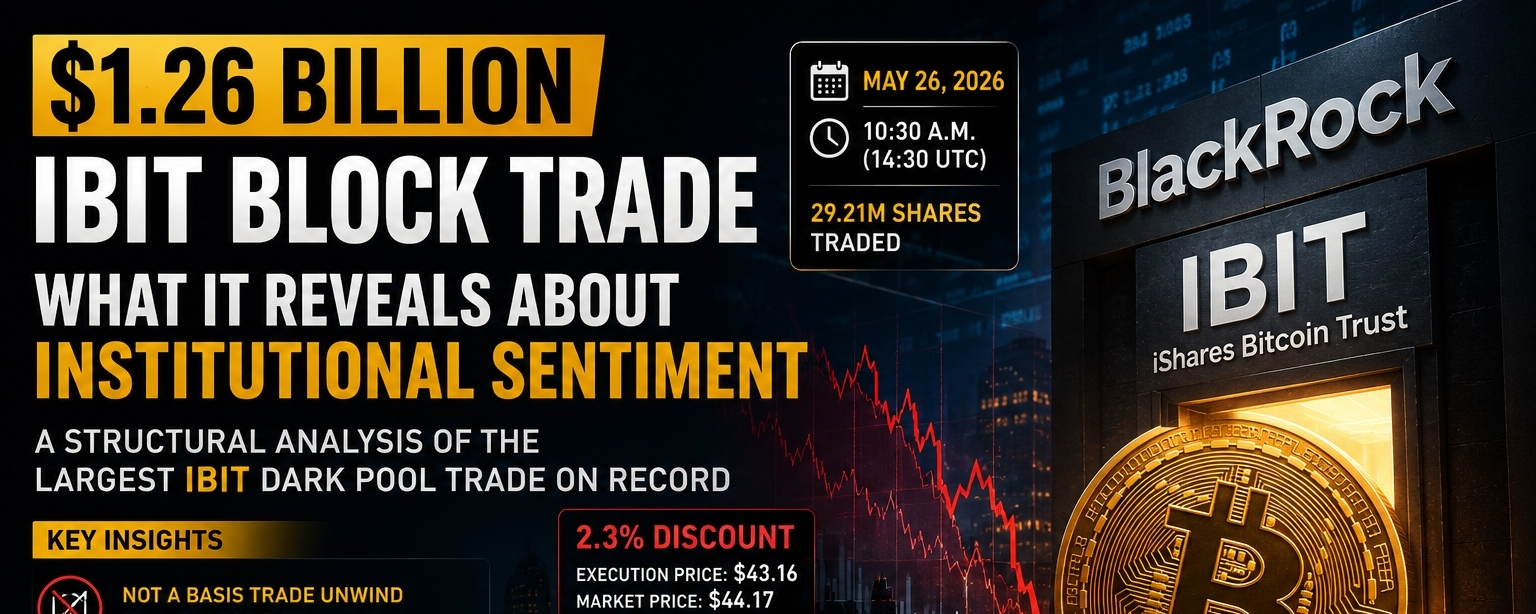
Article
Institutional Liquidity and Exit Dynamics: A Structural Analysis of the $1.26 Billion IBIT Block{spot}(BTCUSDT)
1. Executive Brief: The Anatomy of a High-Concession Exit
The $1.26 billion block trade of BlackRock’s iShares Bitcoin Trust (IBIT) on May 26, 2026, serves as a seminal stress test for the maturation of digital asset market microstructure. Executed at 10:30 a.m. (14:30 UTC), this transaction moved a significant volume of risk from the shadow of fragmented OTC desks into the regulated transparency of a U.S. ETF wrapper. While the scale confirms the product's ability to facilitate billion-dollar exits, the execution mechanics reveal a notable mandate-driven de-risking event rather than a tactical rebalance.
The core metrics of the transaction underscore a prioritization of speed over price optimization. Approximately 29.21 million shares of IBIT were traded off-exchange via the FINRA/Nasdaq TRF Carteret facility. The execution price was established at 43.16 per share—a 2.3% (1.01) discount relative to the contemporaneous market price of $44.17. For the seller, this resulted in an estimated $29.5 million execution cost. In clinical terms, this $29.5 million represents an "anonymity premium" paid to facilitate a massive counterparty risk transfer while attempting to mitigate the signaling risk inherent in visible exchange-based liquidations.
2. Deconstructing the "Basis Trade" Counter-Thesis
Within the current market regime, high-volume ETF spikes are frequently dismissed as the mechanical unwinding of "basis trades"—a market-neutral strategy where participants hold long spot ETF positions against short CME futures. However, structural data provided by NYDIG’s research team (Greg Cipolaro) suggests that the May 26 event was directional rather than arbitrage-related.
The 2.3% concession paid is incompatible with the tight margins of standard basis trades; such a discount would effectively negate the carry-trade yield. Furthermore, the absence of a corresponding footprint in the derivatives market is definitive. While the IBIT position represented exposure equivalent to roughly 3,700 CME $BTC futures contracts, only 91 contracts traded during the minute of execution, with no spike in volume observed.
Evidence Against Basis Trade Unwind
Metric
Observed Value
Strategic Implication
Execution Discount
2.3% ($1.01 per share)
Concession exceeds typical arbitrage margins; suggests non-arbitrage, directional motivation.
CME Futures Activity
91 contracts (vs. 3,700 required)
Lack of correlated futures volume rejects the "basis trade unwind" hypothesis.
Execution Venue
FINRA/Nasdaq TRF Carteret
Private negotiation indicates a deliberate strategic trade-off: paying a premium for anonymity.
Counterparty Identification
Exceeds all disclosed 13F holdings
Trade size surpasses every reported position in current 13F filings, implying an undisclosed or synthetic "whale" exit.
The rejection of a mechanical unwind confirms that a major discretionary holder has turned bearish or is facing external liquidity requirements, shifting the focus to broader sentiment erosion.
3. Market Microstructure: Dark Pools and Liquidity Constraints
Dark pools are optimized for institutional liquidity provision, designed to facilitate large-scale risk transfers while minimizing immediate price impact. Alex Thorn (Galaxy Digital) identified this as the largest IBIT dark pool trade on record, with Eric Balchunas (Bloomberg) noting the volume was 22 times larger than the day's next largest sell order.
The microstructural response to this trade highlights a lead-lag relationship between the ETF and spot markets:
Spot Volatility: Within 10 minutes of the 14:30 UTC print, Bitcoin spot price dropped 1.5% from $77,875 to $76,720, eventually sliding to $75,600.ETF Absorption: Despite the underlying spot volatility, the IBIT ETF price stabilized soon after. Analysts observed that the market "absorbed" the trade well within the fund structure itself, suggesting that while information leakage hit the spot market, the ETF's secondary market provided sufficient depth to prevent a cascading breakdown in the product's price relative to its NAV.
This divergence suggests that the ETF wrapper acted as a liquidity buffer, even as the scale of the exit signaled a breakdown in underlying support levels below the $80,000 threshold.
4. Macro-Sentiment and The Capital Rotation Narrative
The May 26 block trade was the apex of an 8-to-9-day net outflow streak (May 15–29) that saw total category AUM contract from $107.75 billion to $94.17 billion. This "capital flight" is not merely technical but reflective of a macro-pivot. Bitcoin has experienced a 16% decline year-to-date in 2026, causing it to drop to the 13th largest asset globally. This stands in stark contrast to the S&P 500’s nine-week rally and the surge in AI-linked equities and precious metals.
Specific macro-geopolitical catalysts have accelerated this rotation:
Regulatory Shifts: The "Clarity Act" has provided a compliance framework for digital assets but has ironically favored infrastructure-linked assets and Ethereum (fixing its compliance discount) while leaving Bitcoin exposed to a "risk-off" rotation.Geopolitical De-escalation: Reports of Iran ceasefire talks have eased global tensions, reducing the "geopolitical hedge" premium previously embedded in Bitcoin’s price.Institutional Position Trimming: 13F filings confirm mandate-driven de-risking by Tier-1 firms, with Jane Street reducing exposure by 70% and Goldman Sachs cutting positions by 10%.
5. Institutional Outlook: Market Maturity vs. Sentiment Shift
The IBIT block trade signals a "normalization" of institutional trading behavior, where billion-dollar exits are feasible but remain costly. The month of May saw IBIT record $1.41 billion in total net outflows, including the $528 million withdrawal on May 28—the second-largest daily outflow in the fund's history.
Strategic Takeaways for Institutional Allocators
Liquidity Reality & NAV Slippage: Billion-dollar exits now require significant concessions. Allocators must incorporate high-liquidity premiums (2%+ discounts) into their risk-management and exit-cost models for digital assets.Product Dominance as a "Primary Exit Ramp": IBIT has solidified its role as the market's primary liquidity venue. Institutions gravitate to BlackRock’s vehicle not just for entry, but because it provides the most robust infrastructure for massive, rapid counterparty risk transfers.Sentiment Indicator: The transition from technical arbitrage to discretionary de-risking suggests a fundamental re-evaluation of Bitcoin's role in the multi-asset portfolio. A seller’s willingness to accept a $29.5 million loss suggests that the perceived risk of holding the asset now outweighs the cost of a high-concession exit.
In conclusion, the May 26 IBIT block trade represents a structural milestone. While the infrastructure successfully facilitated the trade without a market-wide collapse, the event serves as a definitive reminder that institutional participation in digital assets remains subject to the same rigorous "risk-off" thresholds and mandate-driven de-risking as traditional asset classes. Institutional capital is increasingly mobile, and its presence is not a guarantee of permanent support.
#BTC #btcnews #CryptoNewsFlash
Institutional Liquidity and Exit Dynamics: A Structural Analysis of the $1.26 Billion IBIT Block
1. Executive Brief: The Anatomy of a High-Concession Exit
The $1.26 billion block trade of BlackRock’s iShares Bitcoin Trust (IBIT) on May 26, 2026, serves as a seminal stress test for the maturation of digital asset market microstructure. Executed at 10:30 a.m. (14:30 UTC), this transaction moved a significant volume of risk from the shadow of fragmented OTC desks into the regulated transparency of a U.S. ETF wrapper. While the scale confirms the product's ability to facilitate billion-dollar exits, the execution mechanics reveal a notable mandate-driven de-risking event rather than a tactical rebalance.
The core metrics of the transaction underscore a prioritization of speed over price optimization. Approximately 29.21 million shares of IBIT were traded off-exchange via the FINRA/Nasdaq TRF Carteret facility. The execution price was established at 43.16 per share—a 2.3% (1.01) discount relative to the contemporaneous market price of $44.17. For the seller, this resulted in an estimated $29.5 million execution cost. In clinical terms, this $29.5 million represents an "anonymity premium" paid to facilitate a massive counterparty risk transfer while attempting to mitigate the signaling risk inherent in visible exchange-based liquidations.
2. Deconstructing the "Basis Trade" Counter-Thesis
Within the current market regime, high-volume ETF spikes are frequently dismissed as the mechanical unwinding of "basis trades"—a market-neutral strategy where participants hold long spot ETF positions against short CME futures. However, structural data provided by NYDIG’s research team (Greg Cipolaro) suggests that the May 26 event was directional rather than arbitrage-related.
The 2.3% concession paid is incompatible with the tight margins of standard basis trades; such a discount would effectively negate the carry-trade yield. Furthermore, the absence of a corresponding footprint in the derivatives market is definitive. While the IBIT position represented exposure equivalent to roughly 3,700 CME $BTC futures contracts, only 91 contracts traded during the minute of execution, with no spike in volume observed.
Evidence Against Basis Trade Unwind
Metric
Observed Value
Strategic Implication
Execution Discount
2.3% ($1.01 per share)
Concession exceeds typical arbitrage margins; suggests non-arbitrage, directional motivation.
CME Futures Activity
91 contracts (vs. 3,700 required)
Lack of correlated futures volume rejects the "basis trade unwind" hypothesis.
Execution Venue
FINRA/Nasdaq TRF Carteret
Private negotiation indicates a deliberate strategic trade-off: paying a premium for anonymity.
Counterparty Identification
Exceeds all disclosed 13F holdings
Trade size surpasses every reported position in current 13F filings, implying an undisclosed or synthetic "whale" exit.
The rejection of a mechanical unwind confirms that a major discretionary holder has turned bearish or is facing external liquidity requirements, shifting the focus to broader sentiment erosion.
3. Market Microstructure: Dark Pools and Liquidity Constraints
Dark pools are optimized for institutional liquidity provision, designed to facilitate large-scale risk transfers while minimizing immediate price impact. Alex Thorn (Galaxy Digital) identified this as the largest IBIT dark pool trade on record, with Eric Balchunas (Bloomberg) noting the volume was 22 times larger than the day's next largest sell order.
The microstructural response to this trade highlights a lead-lag relationship between the ETF and spot markets:
Spot Volatility: Within 10 minutes of the 14:30 UTC print, Bitcoin spot price dropped 1.5% from $77,875 to $76,720, eventually sliding to $75,600.ETF Absorption: Despite the underlying spot volatility, the IBIT ETF price stabilized soon after. Analysts observed that the market "absorbed" the trade well within the fund structure itself, suggesting that while information leakage hit the spot market, the ETF's secondary market provided sufficient depth to prevent a cascading breakdown in the product's price relative to its NAV.
This divergence suggests that the ETF wrapper acted as a liquidity buffer, even as the scale of the exit signaled a breakdown in underlying support levels below the $80,000 threshold.
4. Macro-Sentiment and The Capital Rotation Narrative
The May 26 block trade was the apex of an 8-to-9-day net outflow streak (May 15–29) that saw total category AUM contract from $107.75 billion to $94.17 billion. This "capital flight" is not merely technical but reflective of a macro-pivot. Bitcoin has experienced a 16% decline year-to-date in 2026, causing it to drop to the 13th largest asset globally. This stands in stark contrast to the S&P 500’s nine-week rally and the surge in AI-linked equities and precious metals.
Specific macro-geopolitical catalysts have accelerated this rotation:
Regulatory Shifts: The "Clarity Act" has provided a compliance framework for digital assets but has ironically favored infrastructure-linked assets and Ethereum (fixing its compliance discount) while leaving Bitcoin exposed to a "risk-off" rotation.Geopolitical De-escalation: Reports of Iran ceasefire talks have eased global tensions, reducing the "geopolitical hedge" premium previously embedded in Bitcoin’s price.Institutional Position Trimming: 13F filings confirm mandate-driven de-risking by Tier-1 firms, with Jane Street reducing exposure by 70% and Goldman Sachs cutting positions by 10%.
5. Institutional Outlook: Market Maturity vs. Sentiment Shift
The IBIT block trade signals a "normalization" of institutional trading behavior, where billion-dollar exits are feasible but remain costly. The month of May saw IBIT record $1.41 billion in total net outflows, including the $528 million withdrawal on May 28—the second-largest daily outflow in the fund's history.
Strategic Takeaways for Institutional Allocators
Liquidity Reality & NAV Slippage: Billion-dollar exits now require significant concessions. Allocators must incorporate high-liquidity premiums (2%+ discounts) into their risk-management and exit-cost models for digital assets.Product Dominance as a "Primary Exit Ramp": IBIT has solidified its role as the market's primary liquidity venue. Institutions gravitate to BlackRock’s vehicle not just for entry, but because it provides the most robust infrastructure for massive, rapid counterparty risk transfers.Sentiment Indicator: The transition from technical arbitrage to discretionary de-risking suggests a fundamental re-evaluation of Bitcoin's role in the multi-asset portfolio. A seller’s willingness to accept a $29.5 million loss suggests that the perceived risk of holding the asset now outweighs the cost of a high-concession exit.
In conclusion, the May 26 IBIT block trade represents a structural milestone. While the infrastructure successfully facilitated the trade without a market-wide collapse, the event serves as a definitive reminder that institutional participation in digital assets remains subject to the same rigorous "risk-off" thresholds and mandate-driven de-risking as traditional asset classes. Institutional capital is increasingly mobile, and its presence is not a guarantee of permanent support.
#BTC #btcnews #CryptoNewsFlash
The $1.26 billion block trade of BlackRock’s iShares Bitcoin Trust (IBIT) on May 26, 2026, serves as a seminal stress test for the maturation of digital asset market microstructure. Executed at 10:30 a.m. (14:30 UTC), this transaction moved a significant volume of risk from the shadow of fragmented OTC desks into the regulated transparency of a U.S. ETF wrapper. While the scale confirms the product's ability to facilitate billion-dollar exits, the execution mechanics reveal a notable mandate-driven de-risking event rather than a tactical rebalance.
The core metrics of the transaction underscore a prioritization of speed over price optimization. Approximately 29.21 million shares of IBIT were traded off-exchange via the FINRA/Nasdaq TRF Carteret facility. The execution price was established at 43.16 per share—a 2.3% (1.01) discount relative to the contemporaneous market price of $44.17. For the seller, this resulted in an estimated $29.5 million execution cost. In clinical terms, this $29.5 million represents an "anonymity premium" paid to facilitate a massive counterparty risk transfer while attempting to mitigate the signaling risk inherent in visible exchange-based liquidations.
2. Deconstructing the "Basis Trade" Counter-Thesis
Within the current market regime, high-volume ETF spikes are frequently dismissed as the mechanical unwinding of "basis trades"—a market-neutral strategy where participants hold long spot ETF positions against short CME futures. However, structural data provided by NYDIG’s research team (Greg Cipolaro) suggests that the May 26 event was directional rather than arbitrage-related.
The 2.3% concession paid is incompatible with the tight margins of standard basis trades; such a discount would effectively negate the carry-trade yield. Furthermore, the absence of a corresponding footprint in the derivatives market is definitive. While the IBIT position represented exposure equivalent to roughly 3,700 CME $BTC futures contracts, only 91 contracts traded during the minute of execution, with no spike in volume observed.
Evidence Against Basis Trade Unwind
Metric
Observed Value
Strategic Implication
Execution Discount
2.3% ($1.01 per share)
Concession exceeds typical arbitrage margins; suggests non-arbitrage, directional motivation.
CME Futures Activity
91 contracts (vs. 3,700 required)
Lack of correlated futures volume rejects the "basis trade unwind" hypothesis.
Execution Venue
FINRA/Nasdaq TRF Carteret
Private negotiation indicates a deliberate strategic trade-off: paying a premium for anonymity.
Counterparty Identification
Exceeds all disclosed 13F holdings
Trade size surpasses every reported position in current 13F filings, implying an undisclosed or synthetic "whale" exit.
The rejection of a mechanical unwind confirms that a major discretionary holder has turned bearish or is facing external liquidity requirements, shifting the focus to broader sentiment erosion.
3. Market Microstructure: Dark Pools and Liquidity Constraints
Dark pools are optimized for institutional liquidity provision, designed to facilitate large-scale risk transfers while minimizing immediate price impact. Alex Thorn (Galaxy Digital) identified this as the largest IBIT dark pool trade on record, with Eric Balchunas (Bloomberg) noting the volume was 22 times larger than the day's next largest sell order.
The microstructural response to this trade highlights a lead-lag relationship between the ETF and spot markets:
Spot Volatility: Within 10 minutes of the 14:30 UTC print, Bitcoin spot price dropped 1.5% from $77,875 to $76,720, eventually sliding to $75,600.ETF Absorption: Despite the underlying spot volatility, the IBIT ETF price stabilized soon after. Analysts observed that the market "absorbed" the trade well within the fund structure itself, suggesting that while information leakage hit the spot market, the ETF's secondary market provided sufficient depth to prevent a cascading breakdown in the product's price relative to its NAV.
This divergence suggests that the ETF wrapper acted as a liquidity buffer, even as the scale of the exit signaled a breakdown in underlying support levels below the $80,000 threshold.
4. Macro-Sentiment and The Capital Rotation Narrative
The May 26 block trade was the apex of an 8-to-9-day net outflow streak (May 15–29) that saw total category AUM contract from $107.75 billion to $94.17 billion. This "capital flight" is not merely technical but reflective of a macro-pivot. Bitcoin has experienced a 16% decline year-to-date in 2026, causing it to drop to the 13th largest asset globally. This stands in stark contrast to the S&P 500’s nine-week rally and the surge in AI-linked equities and precious metals.
Specific macro-geopolitical catalysts have accelerated this rotation:
Regulatory Shifts: The "Clarity Act" has provided a compliance framework for digital assets but has ironically favored infrastructure-linked assets and Ethereum (fixing its compliance discount) while leaving Bitcoin exposed to a "risk-off" rotation.Geopolitical De-escalation: Reports of Iran ceasefire talks have eased global tensions, reducing the "geopolitical hedge" premium previously embedded in Bitcoin’s price.Institutional Position Trimming: 13F filings confirm mandate-driven de-risking by Tier-1 firms, with Jane Street reducing exposure by 70% and Goldman Sachs cutting positions by 10%.
5. Institutional Outlook: Market Maturity vs. Sentiment Shift
The IBIT block trade signals a "normalization" of institutional trading behavior, where billion-dollar exits are feasible but remain costly. The month of May saw IBIT record $1.41 billion in total net outflows, including the $528 million withdrawal on May 28—the second-largest daily outflow in the fund's history.
Strategic Takeaways for Institutional Allocators
Liquidity Reality & NAV Slippage: Billion-dollar exits now require significant concessions. Allocators must incorporate high-liquidity premiums (2%+ discounts) into their risk-management and exit-cost models for digital assets.Product Dominance as a "Primary Exit Ramp": IBIT has solidified its role as the market's primary liquidity venue. Institutions gravitate to BlackRock’s vehicle not just for entry, but because it provides the most robust infrastructure for massive, rapid counterparty risk transfers.Sentiment Indicator: The transition from technical arbitrage to discretionary de-risking suggests a fundamental re-evaluation of Bitcoin's role in the multi-asset portfolio. A seller’s willingness to accept a $29.5 million loss suggests that the perceived risk of holding the asset now outweighs the cost of a high-concession exit.
In conclusion, the May 26 IBIT block trade represents a structural milestone. While the infrastructure successfully facilitated the trade without a market-wide collapse, the event serves as a definitive reminder that institutional participation in digital assets remains subject to the same rigorous "risk-off" thresholds and mandate-driven de-risking as traditional asset classes. Institutional capital is increasingly mobile, and its presence is not a guarantee of permanent support.
#BTC #btcnews #CryptoNewsFlash
155
Article
"Cardano Stablecoin Market Surges 14.67% as Valuation Climbs Above $60M"The stablecoin market on the #Cardano network recorded a double-digit increase over the past week, pushing its valuation above the $60 million mark.
According to data from DeFiLlama, Cardano’s stablecoin market cap climbed to $60.39 million, representing a 14.67% increase over the past seven days. The rise marks one of the strongest short-term expansions in the network’s stablecoin sector in recent months and signals increasing participation in Cardano’s decentralized finance ecosystem.
Cardano Stablecoin Market Cap Soars
USDCx Fuels Cardano Stablecoin Valuation
The surge came only days after an unidentified user bridged more than $10 million worth of USDCx onto the Cardano blockchain. Several ecosystem participants highlighted the transaction, including Cardano DeFi aggregator DEX Hunter.
Meanwhile, additional USDCx tokens have continued to enter circulation on Cardano. Data shared by SNEK co-founder Rami indicates that roughly $4.5 million worth of USDCx was minted on the network within two days, further strengthening stablecoin liquidity. As a result, the fresh capital inflow has deepened liquidity across the ecosystem.
USDCx, the Circle-backed stablecoin introduced to Cardano earlier this year, has quickly established itself as the dominant stable asset on the network.
Currently, USDCx commands a market share of 59.38%, accounting for $35.85 million of Cardano’s total $60.39 million stablecoin market cap. The rapid growth highlights increasing adoption of the asset as users seek seamless access to cross-chain liquidity within the ecosystem.
Stablecoin Growth Supports Total Value Locked
The rise in stablecoin liquidity also lifted Cardano’s total value locked (TVL), which climbed to approximately $82 million earlier this week before retreating to around $75 million following the latest decline in ADA’s price.
Despite the pullback, analysts believe the recent increase in stablecoin reserves provides a stronger foundation for future DeFi expansion on the network. Cardano research analyst Dr. Cuadrado believes the recent influx of stablecoin liquidity marks the beginning of a major growth phase for the ecosystem.
According to him, the most explosive stage of the current bull market could begin once Cardano’s stablecoin market cap surpasses its total value locked. He argued that such a development would signal the presence of excess liquidity waiting to be deployed across decentralized applications.
In his view, higher stablecoin reserves would lead to deeper liquidity pools, increased borrowing and lending activity, larger trading volumes, and more attractive yield opportunities across the network.
ADA Remains Under Pressure Despite Improving Fundamentals
Meanwhile, ADA continues to face bearish pressure despite the improvement in on-chain metrics. The asset has gradually slipped down the global cryptocurrency rankings and currently stands as the world’s 18th-largest crypto by market cap.
At press time, ADA had a market valuation of $5.53 billion and traded at $0.1519 per token, representing a 35.43% decrease over the past month.
#CryptoNewsFlash
"Cardano Stablecoin Market Surges 14.67% as Valuation Climbs Above $60M"
The stablecoin market on the #Cardano network recorded a double-digit increase over the past week, pushing its valuation above the $60 million mark.
According to data from DeFiLlama, Cardano’s stablecoin market cap climbed to $60.39 million, representing a 14.67% increase over the past seven days. The rise marks one of the strongest short-term expansions in the network’s stablecoin sector in recent months and signals increasing participation in Cardano’s decentralized finance ecosystem.
Cardano Stablecoin Market Cap Soars
USDCx Fuels Cardano Stablecoin Valuation
The surge came only days after an unidentified user bridged more than $10 million worth of USDCx onto the Cardano blockchain. Several ecosystem participants highlighted the transaction, including Cardano DeFi aggregator DEX Hunter.
Meanwhile, additional USDCx tokens have continued to enter circulation on Cardano. Data shared by SNEK co-founder Rami indicates that roughly $4.5 million worth of USDCx was minted on the network within two days, further strengthening stablecoin liquidity. As a result, the fresh capital inflow has deepened liquidity across the ecosystem.
USDCx, the Circle-backed stablecoin introduced to Cardano earlier this year, has quickly established itself as the dominant stable asset on the network.
Currently, USDCx commands a market share of 59.38%, accounting for $35.85 million of Cardano’s total $60.39 million stablecoin market cap. The rapid growth highlights increasing adoption of the asset as users seek seamless access to cross-chain liquidity within the ecosystem.
Stablecoin Growth Supports Total Value Locked
The rise in stablecoin liquidity also lifted Cardano’s total value locked (TVL), which climbed to approximately $82 million earlier this week before retreating to around $75 million following the latest decline in ADA’s price.
Despite the pullback, analysts believe the recent increase in stablecoin reserves provides a stronger foundation for future DeFi expansion on the network. Cardano research analyst Dr. Cuadrado believes the recent influx of stablecoin liquidity marks the beginning of a major growth phase for the ecosystem.
According to him, the most explosive stage of the current bull market could begin once Cardano’s stablecoin market cap surpasses its total value locked. He argued that such a development would signal the presence of excess liquidity waiting to be deployed across decentralized applications.
In his view, higher stablecoin reserves would lead to deeper liquidity pools, increased borrowing and lending activity, larger trading volumes, and more attractive yield opportunities across the network.
ADA Remains Under Pressure Despite Improving Fundamentals
Meanwhile, ADA continues to face bearish pressure despite the improvement in on-chain metrics. The asset has gradually slipped down the global cryptocurrency rankings and currently stands as the world’s 18th-largest crypto by market cap.
At press time, ADA had a market valuation of $5.53 billion and traded at $0.1519 per token, representing a 35.43% decrease over the past month.
#CryptoNewsFlash
According to data from DeFiLlama, Cardano’s stablecoin market cap climbed to $60.39 million, representing a 14.67% increase over the past seven days. The rise marks one of the strongest short-term expansions in the network’s stablecoin sector in recent months and signals increasing participation in Cardano’s decentralized finance ecosystem.
Cardano Stablecoin Market Cap Soars
USDCx Fuels Cardano Stablecoin Valuation
The surge came only days after an unidentified user bridged more than $10 million worth of USDCx onto the Cardano blockchain. Several ecosystem participants highlighted the transaction, including Cardano DeFi aggregator DEX Hunter.
Meanwhile, additional USDCx tokens have continued to enter circulation on Cardano. Data shared by SNEK co-founder Rami indicates that roughly $4.5 million worth of USDCx was minted on the network within two days, further strengthening stablecoin liquidity. As a result, the fresh capital inflow has deepened liquidity across the ecosystem.
USDCx, the Circle-backed stablecoin introduced to Cardano earlier this year, has quickly established itself as the dominant stable asset on the network.
Currently, USDCx commands a market share of 59.38%, accounting for $35.85 million of Cardano’s total $60.39 million stablecoin market cap. The rapid growth highlights increasing adoption of the asset as users seek seamless access to cross-chain liquidity within the ecosystem.
Stablecoin Growth Supports Total Value Locked
The rise in stablecoin liquidity also lifted Cardano’s total value locked (TVL), which climbed to approximately $82 million earlier this week before retreating to around $75 million following the latest decline in ADA’s price.
Despite the pullback, analysts believe the recent increase in stablecoin reserves provides a stronger foundation for future DeFi expansion on the network. Cardano research analyst Dr. Cuadrado believes the recent influx of stablecoin liquidity marks the beginning of a major growth phase for the ecosystem.
According to him, the most explosive stage of the current bull market could begin once Cardano’s stablecoin market cap surpasses its total value locked. He argued that such a development would signal the presence of excess liquidity waiting to be deployed across decentralized applications.
In his view, higher stablecoin reserves would lead to deeper liquidity pools, increased borrowing and lending activity, larger trading volumes, and more attractive yield opportunities across the network.
ADA Remains Under Pressure Despite Improving Fundamentals
Meanwhile, ADA continues to face bearish pressure despite the improvement in on-chain metrics. The asset has gradually slipped down the global cryptocurrency rankings and currently stands as the world’s 18th-largest crypto by market cap.
At press time, ADA had a market valuation of $5.53 billion and traded at $0.1519 per token, representing a 35.43% decrease over the past month.
#CryptoNewsFlash
72
Partly True
Article
Pundit Says “I’ve Seen This Movie Before” as XRP 70% Drop Mirrors Setup That Delivered 1,200% Gains#XRP latest market downturn is drawing comparisons to one of the asset’s most dramatic recoveries.
Crypto commentator Digital Outlook argues that the current sell-off resembles the conditions that preceded XRP’s explosive rally after the SEC lawsuit in late 2020.
The commentator recalled aggressively accumulating XRP during the market panic triggered by the U.S. Securities and Exchange Commission’s lawsuit against Ripple. In his words:
“I put in multiple five figures the day before the SEC lawsuit dropped. The price collapsed to $0.17, and four months later? $1.97. That’s 1,200% return. I’ve seen this movie before, guys.”
Key Points
Digital Outlook says XRP’s current sell-off resembles the 2020 crash that preceded a 1,200% rally.XRP has fallen more than 70% from its cycle high, with the latest drop fueled by broader market weakness.A repeat of XRP’s historic rebound could theoretically send the asset toward the $14 level.XRPL validator Vet urged the community to focus on building and long-term growth during the downturn.
1,200% After Historic Crash
Data from CoinMarketCap supports the historical comparison. Following the SEC’s lawsuit against Ripple in December 2020, XRP’s price plunged to a low of about $0.1748. It marked one of the asset’s steepest declines.
However, sentiment shifted rapidly in the months that followed. By April 2021, XRP had surged to roughly $1.96 during the crypto bull market. That represented a gain of more than 1,000% from its post-lawsuit lows.
Digital Outlook believes the current market environment is similar to that period. In his view, today’s fear could eventually give way to another major recovery.
XRP Down More Than 70% From Peak
The latest decline has been severe. XRP fell to around $1.09 this week during the ongoing crypto market correction. The downturn also pushed Bitcoin to $59,000 after it traded above $70,000 just a week earlier.
Current market data shows XRP is down 19.3% over the past seven days. It has also fallen 23% over the past month and 41% year-to-date. From its cycle peak of $3.65, XRP has now declined by more than 70%.
The weakness has not been limited to XRP. Bitcoin has also posted significant losses. It is down 34% year-to-date, 25% over the past month, and 17% over the past week.
As a result, some XRP supporters view the current decline as a potential accumulation phase rather than a sign of failure. They see parallels with previous market cycles.
What a Similar Recovery Could Mean
While Digital Outlook did not provide a specific price target, his reference to XRP’s previous 1,200% recovery has fueled optimism among bullish investors.
If XRP were to replicate a similar percentage gain from its recent low near $1.09, the asset could theoretically climb toward the $14 level in a future bull run.
However, past performance does not guarantee future results.
XRPL Validator Urges Community to Focus on Building
Amid growing fear across the market, XRP community figure Vet encouraged investors to focus on long-term development rather than short-term price action.
According to Vet, periods of market weakness often create opportunities for education and building within the ecosystem.
He argued that XRP and the broader digital asset industry have repeatedly survived major downturns despite recurring predictions that the sector was finished.
The validator advised community members who feel overwhelmed by the volatility to step away from the charts temporarily. He suggested returning with a longer-term perspective.
#CryptoNewsFlash
Pundit Says “I’ve Seen This Movie Before” as XRP 70% Drop Mirrors Setup That Delivered 1,200% Gains
#XRP latest market downturn is drawing comparisons to one of the asset’s most dramatic recoveries.
Crypto commentator Digital Outlook argues that the current sell-off resembles the conditions that preceded XRP’s explosive rally after the SEC lawsuit in late 2020.
The commentator recalled aggressively accumulating XRP during the market panic triggered by the U.S. Securities and Exchange Commission’s lawsuit against Ripple. In his words:
“I put in multiple five figures the day before the SEC lawsuit dropped. The price collapsed to $0.17, and four months later? $1.97. That’s 1,200% return. I’ve seen this movie before, guys.”
Key Points
Digital Outlook says XRP’s current sell-off resembles the 2020 crash that preceded a 1,200% rally.XRP has fallen more than 70% from its cycle high, with the latest drop fueled by broader market weakness.A repeat of XRP’s historic rebound could theoretically send the asset toward the $14 level.XRPL validator Vet urged the community to focus on building and long-term growth during the downturn.
1,200% After Historic Crash
Data from CoinMarketCap supports the historical comparison. Following the SEC’s lawsuit against Ripple in December 2020, XRP’s price plunged to a low of about $0.1748. It marked one of the asset’s steepest declines.
However, sentiment shifted rapidly in the months that followed. By April 2021, XRP had surged to roughly $1.96 during the crypto bull market. That represented a gain of more than 1,000% from its post-lawsuit lows.
Digital Outlook believes the current market environment is similar to that period. In his view, today’s fear could eventually give way to another major recovery.
XRP Down More Than 70% From Peak
The latest decline has been severe. XRP fell to around $1.09 this week during the ongoing crypto market correction. The downturn also pushed Bitcoin to $59,000 after it traded above $70,000 just a week earlier.
Current market data shows XRP is down 19.3% over the past seven days. It has also fallen 23% over the past month and 41% year-to-date. From its cycle peak of $3.65, XRP has now declined by more than 70%.
The weakness has not been limited to XRP. Bitcoin has also posted significant losses. It is down 34% year-to-date, 25% over the past month, and 17% over the past week.
As a result, some XRP supporters view the current decline as a potential accumulation phase rather than a sign of failure. They see parallels with previous market cycles.
What a Similar Recovery Could Mean
While Digital Outlook did not provide a specific price target, his reference to XRP’s previous 1,200% recovery has fueled optimism among bullish investors.
If XRP were to replicate a similar percentage gain from its recent low near $1.09, the asset could theoretically climb toward the $14 level in a future bull run.
However, past performance does not guarantee future results.
XRPL Validator Urges Community to Focus on Building
Amid growing fear across the market, XRP community figure Vet encouraged investors to focus on long-term development rather than short-term price action.
According to Vet, periods of market weakness often create opportunities for education and building within the ecosystem.
He argued that XRP and the broader digital asset industry have repeatedly survived major downturns despite recurring predictions that the sector was finished.
The validator advised community members who feel overwhelmed by the volatility to step away from the charts temporarily. He suggested returning with a longer-term perspective.
#CryptoNewsFlash
Crypto commentator Digital Outlook argues that the current sell-off resembles the conditions that preceded XRP’s explosive rally after the SEC lawsuit in late 2020.
The commentator recalled aggressively accumulating XRP during the market panic triggered by the U.S. Securities and Exchange Commission’s lawsuit against Ripple. In his words:
“I put in multiple five figures the day before the SEC lawsuit dropped. The price collapsed to $0.17, and four months later? $1.97. That’s 1,200% return. I’ve seen this movie before, guys.”
Key Points
Digital Outlook says XRP’s current sell-off resembles the 2020 crash that preceded a 1,200% rally.XRP has fallen more than 70% from its cycle high, with the latest drop fueled by broader market weakness.A repeat of XRP’s historic rebound could theoretically send the asset toward the $14 level.XRPL validator Vet urged the community to focus on building and long-term growth during the downturn.
1,200% After Historic Crash
Data from CoinMarketCap supports the historical comparison. Following the SEC’s lawsuit against Ripple in December 2020, XRP’s price plunged to a low of about $0.1748. It marked one of the asset’s steepest declines.
However, sentiment shifted rapidly in the months that followed. By April 2021, XRP had surged to roughly $1.96 during the crypto bull market. That represented a gain of more than 1,000% from its post-lawsuit lows.
Digital Outlook believes the current market environment is similar to that period. In his view, today’s fear could eventually give way to another major recovery.
XRP Down More Than 70% From Peak
The latest decline has been severe. XRP fell to around $1.09 this week during the ongoing crypto market correction. The downturn also pushed Bitcoin to $59,000 after it traded above $70,000 just a week earlier.
Current market data shows XRP is down 19.3% over the past seven days. It has also fallen 23% over the past month and 41% year-to-date. From its cycle peak of $3.65, XRP has now declined by more than 70%.
The weakness has not been limited to XRP. Bitcoin has also posted significant losses. It is down 34% year-to-date, 25% over the past month, and 17% over the past week.
As a result, some XRP supporters view the current decline as a potential accumulation phase rather than a sign of failure. They see parallels with previous market cycles.
What a Similar Recovery Could Mean
While Digital Outlook did not provide a specific price target, his reference to XRP’s previous 1,200% recovery has fueled optimism among bullish investors.
If XRP were to replicate a similar percentage gain from its recent low near $1.09, the asset could theoretically climb toward the $14 level in a future bull run.
However, past performance does not guarantee future results.
XRPL Validator Urges Community to Focus on Building
Amid growing fear across the market, XRP community figure Vet encouraged investors to focus on long-term development rather than short-term price action.
According to Vet, periods of market weakness often create opportunities for education and building within the ecosystem.
He argued that XRP and the broader digital asset industry have repeatedly survived major downturns despite recurring predictions that the sector was finished.
The validator advised community members who feel overwhelmed by the volatility to step away from the charts temporarily. He suggested returning with a longer-term perspective.
#CryptoNewsFlash
1
628

🚨 Stablecoin rules may be heading beyond issuers and into secondary markets. That could reshape how crypto platforms, traders, and liquidity providers handle identity checks.
#BPIUrgesFinCENExpandStablecoinIDRulesToSecondaryMarkets
The Blockchain Policy Institute is urging FinCEN to expand stablecoin identity requirements into secondary-market activity—not only at issuance and redemption.
Why traders are watching: stablecoins are central to crypto liquidity, settlement, and on-chain transfers. If identity-related compliance reaches more secondary-market transactions, the impact could extend to exchange flows, DeFi access, cross-border transfers, and market liquidity.
📌 What to watch next:
• Any formal FinCEN proposal or guidance
• Which stablecoin transactions could be in scope
• Effects on liquidity, transaction friction, and privacy
• How issuers, exchanges, and DeFi protocols respond
This is a regulatory-development story, not a guaranteed price catalyst. Markets may react differently depending on the final rules, implementation timeline, and global policy response.
Follow for timely crypto policy updates, market context, and trader-focused breakdowns. 🔔
#cryptoupdate #BinanceSquareTalks #CryptoNewsFlash
🚨 Stablecoin rules may be heading beyond issuers and into secondary markets. That could reshape how crypto platforms, traders, and liquidity providers handle identity checks.
#BPIUrgesFinCENExpandStablecoinIDRulesToSecondaryMarkets
The Blockchain Policy Institute is urging FinCEN to expand stablecoin identity requirements into secondary-market activity—not only at issuance and redemption.
Why traders are watching: stablecoins are central to crypto liquidity, settlement, and on-chain transfers. If identity-related compliance reaches more secondary-market transactions, the impact could extend to exchange flows, DeFi access, cross-border transfers, and market liquidity.
📌 What to watch next:
• Any formal FinCEN proposal or guidance
• Which stablecoin transactions could be in scope
• Effects on liquidity, transaction friction, and privacy
• How issuers, exchanges, and DeFi protocols respond
This is a regulatory-development story, not a guaranteed price catalyst. Markets may react differently depending on the final rules, implementation timeline, and global policy response.
Follow for timely crypto policy updates, market context, and trader-focused breakdowns. 🔔
#cryptoupdate #BinanceSquareTalks #CryptoNewsFlash
#BPIUrgesFinCENExpandStablecoinIDRulesToSecondaryMarkets
The Blockchain Policy Institute is urging FinCEN to expand stablecoin identity requirements into secondary-market activity—not only at issuance and redemption.
Why traders are watching: stablecoins are central to crypto liquidity, settlement, and on-chain transfers. If identity-related compliance reaches more secondary-market transactions, the impact could extend to exchange flows, DeFi access, cross-border transfers, and market liquidity.
📌 What to watch next:
• Any formal FinCEN proposal or guidance
• Which stablecoin transactions could be in scope
• Effects on liquidity, transaction friction, and privacy
• How issuers, exchanges, and DeFi protocols respond
This is a regulatory-development story, not a guaranteed price catalyst. Markets may react differently depending on the final rules, implementation timeline, and global policy response.
Follow for timely crypto policy updates, market context, and trader-focused breakdowns. 🔔
#cryptoupdate #BinanceSquareTalks #CryptoNewsFlash

96
Article
"XRP Reaches $400M in Tokenized RWAs Faster Than Ethereum"XRPL has reached $400 million in tokenized real-world asset (RWA) value in just 15 months, significantly outpacing several major blockchain networks, including Ethereum.
Evernorth revealed this in a recent report, while XRP community commentator BankXRP amplified the findings across the crypto community. The comparison has drawn attention to XRPL’s accelerating tokenization activity and highlighted the network’s ability to scale at a pace comparable to some of the industry’s fastest-growing ecosystems.
Key Points
XRPL reached $400 million in tokenized real-world asset value within just 15 months. It took Ethereum 36 months to achieve a similar milestone. XRPL recorded 78% year-to-date growth in tokenized assets, rising from $227 million to $404 million.The network currently ranks tenth globally in represented tokenized value, while Ethereum remains the market leader with $16.8 billion.
XRPL Hits $400M in Tokenized Value Faster Than Ethereum
The report compared how long major blockchain networks took to grow from $10 million to $400 million in tokenized asset value. According to the data, XRPL completed the milestone in just 15 months, whereas Ethereum required 36 months to achieve the same level.
Specifically, XRPL’s tokenized RWA market stood at approximately $10 million in January 2025. However, the valuation surged to $400 million by April 2026, allowing the network to accomplish the feat within 14.9 months.
In contrast, Ethereum’s tokenized RWA market measured around $10 million in September 2018 before eventually climbing to $400 million in September 2021, roughly 35.9 months later. Additionally, the data showed that XRPL outpaced Avalanche and Polygon by six and seven months, respectively.
XRPL Outperforms Ethereum in YTD Growth
Furthermore, XRPL has also outperformed Ethereum in year-to-date tokenized asset growth. According to Evernorth, XRPL’s tokenized value increased by 78% this year, rising from $227 million to $404 million.
Meanwhile, Ethereum’s tokenized value grew by 36%, increasing from $13.8 billion to $18.66 billion during the same period. Notably, several other blockchain networks have also recorded strong tokenization growth in 2026.
Among blockchains with more than $200 million in tokenized assets, SEI leads with 858% year-to-date growth. Plume follows with 366%, while zkSync Era and Stellar recorded growth rates of 361% and 131%, respectively.
XRP Secures Top Position Among Enterprise-Focused Blockchain Networks
Meanwhile, XRPL has overtaken several enterprise-focused blockchain networks, including Aptos, Mantle, and Algorand. As of May 2025, XRPL ranked below those networks with a tokenized value of $116 million, while Aptos, Mantle, and Algorand stood at $120 million, $148 million, and $304 million, respectively.
However, the rankings have shifted significantly. XRPL now leads the group with $404 million in tokenized value, while Aptos and Algorand have declined to $64.9 million and $70.9 million, respectively. Although Mantle’s valuation climbed to $258 million, it remains below XRPL’s current level.
The development comes as competition intensifies among blockchain networks seeking dominance in the rapidly expanding tokenization market. According to data from RWA.xyz, XRPL currently ranks tenth globally in ‘represented’ tokenized value at $404.4 million. Nonetheless, Ethereum continues to dominate the sector with a tokenized valuation of $16.8 billion.
#CryptoNewsFlash
"XRP Reaches $400M in Tokenized RWAs Faster Than Ethereum"
XRPL has reached $400 million in tokenized real-world asset (RWA) value in just 15 months, significantly outpacing several major blockchain networks, including Ethereum.
Evernorth revealed this in a recent report, while XRP community commentator BankXRP amplified the findings across the crypto community. The comparison has drawn attention to XRPL’s accelerating tokenization activity and highlighted the network’s ability to scale at a pace comparable to some of the industry’s fastest-growing ecosystems.
Key Points
XRPL reached $400 million in tokenized real-world asset value within just 15 months. It took Ethereum 36 months to achieve a similar milestone. XRPL recorded 78% year-to-date growth in tokenized assets, rising from $227 million to $404 million.The network currently ranks tenth globally in represented tokenized value, while Ethereum remains the market leader with $16.8 billion.
XRPL Hits $400M in Tokenized Value Faster Than Ethereum
The report compared how long major blockchain networks took to grow from $10 million to $400 million in tokenized asset value. According to the data, XRPL completed the milestone in just 15 months, whereas Ethereum required 36 months to achieve the same level.
Specifically, XRPL’s tokenized RWA market stood at approximately $10 million in January 2025. However, the valuation surged to $400 million by April 2026, allowing the network to accomplish the feat within 14.9 months.
In contrast, Ethereum’s tokenized RWA market measured around $10 million in September 2018 before eventually climbing to $400 million in September 2021, roughly 35.9 months later. Additionally, the data showed that XRPL outpaced Avalanche and Polygon by six and seven months, respectively.
XRPL Outperforms Ethereum in YTD Growth
Furthermore, XRPL has also outperformed Ethereum in year-to-date tokenized asset growth. According to Evernorth, XRPL’s tokenized value increased by 78% this year, rising from $227 million to $404 million.
Meanwhile, Ethereum’s tokenized value grew by 36%, increasing from $13.8 billion to $18.66 billion during the same period. Notably, several other blockchain networks have also recorded strong tokenization growth in 2026.
Among blockchains with more than $200 million in tokenized assets, SEI leads with 858% year-to-date growth. Plume follows with 366%, while zkSync Era and Stellar recorded growth rates of 361% and 131%, respectively.
XRP Secures Top Position Among Enterprise-Focused Blockchain Networks
Meanwhile, XRPL has overtaken several enterprise-focused blockchain networks, including Aptos, Mantle, and Algorand. As of May 2025, XRPL ranked below those networks with a tokenized value of $116 million, while Aptos, Mantle, and Algorand stood at $120 million, $148 million, and $304 million, respectively.
However, the rankings have shifted significantly. XRPL now leads the group with $404 million in tokenized value, while Aptos and Algorand have declined to $64.9 million and $70.9 million, respectively. Although Mantle’s valuation climbed to $258 million, it remains below XRPL’s current level.
The development comes as competition intensifies among blockchain networks seeking dominance in the rapidly expanding tokenization market. According to data from RWA.xyz, XRPL currently ranks tenth globally in ‘represented’ tokenized value at $404.4 million. Nonetheless, Ethereum continues to dominate the sector with a tokenized valuation of $16.8 billion.
#CryptoNewsFlash
Evernorth revealed this in a recent report, while XRP community commentator BankXRP amplified the findings across the crypto community. The comparison has drawn attention to XRPL’s accelerating tokenization activity and highlighted the network’s ability to scale at a pace comparable to some of the industry’s fastest-growing ecosystems.
Key Points
XRPL reached $400 million in tokenized real-world asset value within just 15 months. It took Ethereum 36 months to achieve a similar milestone. XRPL recorded 78% year-to-date growth in tokenized assets, rising from $227 million to $404 million.The network currently ranks tenth globally in represented tokenized value, while Ethereum remains the market leader with $16.8 billion.
XRPL Hits $400M in Tokenized Value Faster Than Ethereum
The report compared how long major blockchain networks took to grow from $10 million to $400 million in tokenized asset value. According to the data, XRPL completed the milestone in just 15 months, whereas Ethereum required 36 months to achieve the same level.
Specifically, XRPL’s tokenized RWA market stood at approximately $10 million in January 2025. However, the valuation surged to $400 million by April 2026, allowing the network to accomplish the feat within 14.9 months.
In contrast, Ethereum’s tokenized RWA market measured around $10 million in September 2018 before eventually climbing to $400 million in September 2021, roughly 35.9 months later. Additionally, the data showed that XRPL outpaced Avalanche and Polygon by six and seven months, respectively.
XRPL Outperforms Ethereum in YTD Growth
Furthermore, XRPL has also outperformed Ethereum in year-to-date tokenized asset growth. According to Evernorth, XRPL’s tokenized value increased by 78% this year, rising from $227 million to $404 million.
Meanwhile, Ethereum’s tokenized value grew by 36%, increasing from $13.8 billion to $18.66 billion during the same period. Notably, several other blockchain networks have also recorded strong tokenization growth in 2026.
Among blockchains with more than $200 million in tokenized assets, SEI leads with 858% year-to-date growth. Plume follows with 366%, while zkSync Era and Stellar recorded growth rates of 361% and 131%, respectively.
XRP Secures Top Position Among Enterprise-Focused Blockchain Networks
Meanwhile, XRPL has overtaken several enterprise-focused blockchain networks, including Aptos, Mantle, and Algorand. As of May 2025, XRPL ranked below those networks with a tokenized value of $116 million, while Aptos, Mantle, and Algorand stood at $120 million, $148 million, and $304 million, respectively.
However, the rankings have shifted significantly. XRPL now leads the group with $404 million in tokenized value, while Aptos and Algorand have declined to $64.9 million and $70.9 million, respectively. Although Mantle’s valuation climbed to $258 million, it remains below XRPL’s current level.
The development comes as competition intensifies among blockchain networks seeking dominance in the rapidly expanding tokenization market. According to data from RWA.xyz, XRPL currently ranks tenth globally in ‘represented’ tokenized value at $404.4 million. Nonetheless, Ethereum continues to dominate the sector with a tokenized valuation of $16.8 billion.
#CryptoNewsFlash
1
893
Article
XRP at $10 Would Mean a $620 Billion Valuation, Analyst Says It’s Still More Achievable Than SpaceXXRP YouTuber Zach Rector has compared the upside potential of XRP with that of newly public aerospace giant SpaceX.
He argued that XRP offers a more realistic path to a 9x return on investment.
In a post on X, Rector said XRP reaching $10 would generate roughly a ninefold return for investors. By comparison, he noted that SpaceX would need to grow into a $15 trillion company to deliver similar gains from its recent IPO valuation.
“Same return. Wildly different odds,” Rector wrote.
XRP at $10 Could Push Valuation Above $600 Billion
In a YouTube video, Rector explained the math behind his comparison. He noted XRP was trading around $1.13 with a market capitalization of about $77 billion and a circulating supply of roughly 62 billion tokens.
Under those conditions, a move to $10 would represent an increase of about 800%, turning a $1 investment into nearly $9. XRP’s market capitalization would also climb to around $620 billion.
Rector acknowledged that a valuation above $600 billion sounds enormous. However, he argued it remains achievable given XRP’s ambitions in global payments and tokenized assets.
He added that if XRP’s circulating supply eventually expands to its 100 billion maximum, a $10 price would imply a valuation of roughly $1 trillion.
According to Rector, both scenarios remain “very doable” over the long term.
SpaceX Faces a Much Bigger Challenge
Meanwhile, Rector contrasted XRP’s outlook with SpaceX, which recently went public at a valuation of about $1.75 trillion and briefly traded above a $2 trillion market capitalization.
To generate the same 9x return as XRP reaching $10, SpaceX would need to achieve a valuation of roughly $15 trillion to $16 trillion, he said.
According to Rector, that figure would exceed the combined value of the world’s three largest companies today. It would also require SpaceX to reach an unprecedented level of corporate valuation.
He emphasized that the comparison was not meant as criticism of SpaceX or its founder, Elon Musk. Rather, he said he was simply evaluating the likelihood of each asset producing similar returns.
Why Rector Favors XRP
Rector argued that crypto markets have already shown that digital assets can reach valuations in the hundreds of billions of dollars. He pointed to the growth of Bitcoin and Ethereum as examples.
By contrast, he said SpaceX would need to become several times larger than today’s biggest public companies to provide comparable gains.
Rector also noted that many of SpaceX’s largest gains were captured by early private investors and venture capital firms during the company’s two decades as a private business.
While he acknowledged that public investors could still profit from SpaceX, he concluded that XRP price has the better chance of delivering a 9x return over the next three to five years.
#CryptoNewsFlash
XRP at $10 Would Mean a $620 Billion Valuation, Analyst Says It’s Still More Achievable Than SpaceX
XRP YouTuber Zach Rector has compared the upside potential of XRP with that of newly public aerospace giant SpaceX.
He argued that XRP offers a more realistic path to a 9x return on investment.
In a post on X, Rector said XRP reaching $10 would generate roughly a ninefold return for investors. By comparison, he noted that SpaceX would need to grow into a $15 trillion company to deliver similar gains from its recent IPO valuation.
“Same return. Wildly different odds,” Rector wrote.
XRP at $10 Could Push Valuation Above $600 Billion
In a YouTube video, Rector explained the math behind his comparison. He noted XRP was trading around $1.13 with a market capitalization of about $77 billion and a circulating supply of roughly 62 billion tokens.
Under those conditions, a move to $10 would represent an increase of about 800%, turning a $1 investment into nearly $9. XRP’s market capitalization would also climb to around $620 billion.
Rector acknowledged that a valuation above $600 billion sounds enormous. However, he argued it remains achievable given XRP’s ambitions in global payments and tokenized assets.
He added that if XRP’s circulating supply eventually expands to its 100 billion maximum, a $10 price would imply a valuation of roughly $1 trillion.
According to Rector, both scenarios remain “very doable” over the long term.
SpaceX Faces a Much Bigger Challenge
Meanwhile, Rector contrasted XRP’s outlook with SpaceX, which recently went public at a valuation of about $1.75 trillion and briefly traded above a $2 trillion market capitalization.
To generate the same 9x return as XRP reaching $10, SpaceX would need to achieve a valuation of roughly $15 trillion to $16 trillion, he said.
According to Rector, that figure would exceed the combined value of the world’s three largest companies today. It would also require SpaceX to reach an unprecedented level of corporate valuation.
He emphasized that the comparison was not meant as criticism of SpaceX or its founder, Elon Musk. Rather, he said he was simply evaluating the likelihood of each asset producing similar returns.
Why Rector Favors XRP
Rector argued that crypto markets have already shown that digital assets can reach valuations in the hundreds of billions of dollars. He pointed to the growth of Bitcoin and Ethereum as examples.
By contrast, he said SpaceX would need to become several times larger than today’s biggest public companies to provide comparable gains.
Rector also noted that many of SpaceX’s largest gains were captured by early private investors and venture capital firms during the company’s two decades as a private business.
While he acknowledged that public investors could still profit from SpaceX, he concluded that XRP price has the better chance of delivering a 9x return over the next three to five years.
#CryptoNewsFlash
He argued that XRP offers a more realistic path to a 9x return on investment.
In a post on X, Rector said XRP reaching $10 would generate roughly a ninefold return for investors. By comparison, he noted that SpaceX would need to grow into a $15 trillion company to deliver similar gains from its recent IPO valuation.
“Same return. Wildly different odds,” Rector wrote.
XRP at $10 Could Push Valuation Above $600 Billion
In a YouTube video, Rector explained the math behind his comparison. He noted XRP was trading around $1.13 with a market capitalization of about $77 billion and a circulating supply of roughly 62 billion tokens.
Under those conditions, a move to $10 would represent an increase of about 800%, turning a $1 investment into nearly $9. XRP’s market capitalization would also climb to around $620 billion.
Rector acknowledged that a valuation above $600 billion sounds enormous. However, he argued it remains achievable given XRP’s ambitions in global payments and tokenized assets.
He added that if XRP’s circulating supply eventually expands to its 100 billion maximum, a $10 price would imply a valuation of roughly $1 trillion.
According to Rector, both scenarios remain “very doable” over the long term.
SpaceX Faces a Much Bigger Challenge
Meanwhile, Rector contrasted XRP’s outlook with SpaceX, which recently went public at a valuation of about $1.75 trillion and briefly traded above a $2 trillion market capitalization.
To generate the same 9x return as XRP reaching $10, SpaceX would need to achieve a valuation of roughly $15 trillion to $16 trillion, he said.
According to Rector, that figure would exceed the combined value of the world’s three largest companies today. It would also require SpaceX to reach an unprecedented level of corporate valuation.
He emphasized that the comparison was not meant as criticism of SpaceX or its founder, Elon Musk. Rather, he said he was simply evaluating the likelihood of each asset producing similar returns.
Why Rector Favors XRP
Rector argued that crypto markets have already shown that digital assets can reach valuations in the hundreds of billions of dollars. He pointed to the growth of Bitcoin and Ethereum as examples.
By contrast, he said SpaceX would need to become several times larger than today’s biggest public companies to provide comparable gains.
Rector also noted that many of SpaceX’s largest gains were captured by early private investors and venture capital firms during the company’s two decades as a private business.
While he acknowledged that public investors could still profit from SpaceX, he concluded that XRP price has the better chance of delivering a 9x return over the next three to five years.
#CryptoNewsFlash
1
328
Article
"Bitcoin Whales With 1K+ BTC Accumulate 7.17M Coins, Largest Holding Since March"#Bitcoin whales are aggressively buying the dip, with addresses holding at least 1,000 BTC collectively pushing their stash to a 3-month high.
Data from Santiment suggests that these whales see the ongoing Bitcoin (BTC) correction as an opportunity to buy more. While retail market participants panicked, they increased their holdings to levels last seen since March 14.
1K+ BTC Wallets Now Hold 7.17M Coins
The Santiment data highlighted that this caliber of Bitcoin wallets has taken their total holdings back to 7.17 million coins. According to the market intelligence platform, the last time they held this much was over three months ago, when Bitcoin’s price was around $70,000.
As prices continued to climb, whales with at least 1,000 coins appeared to start taking profit. They sold through the strength as BTC reclaimed $82,000 in May. This is a classic smart money move where big market participants sell the top and buy the bottom.
With Bitcoin now sliding lower, these whales are back buying the dip. They have pushed their collective holdings back to the March 14 levels, stacking 7.17 million BTC (worth $461 million at the current price).
Meanwhile, this accounts for 35.82% of BTC’s available supply of 20.04 million coins. Despite the renewed accumulation, their exposure still falls below the February highs.
For context, as Bitcoin crashed to $60,000 in early February, these wallets aggressively bought the dip, pushing their holdings to around 7.26 million BTC and over 36.30% of the circulating supply.
Currently, there are 2,044 wallets with at least 1,000 BTC, culminating in an average holding of 3,507.8 BTC per wallet.
Bitcoin Accumulation Signals Conviction
Notably, the renewed accumulation amid price weakness indicates a strong conviction that Bitcoin will recover from the current setback. As such, they are positioning themselves to capture the upside when the asset rebounds.
It also boosts market sentiment. Seeing these whales buy the dip reestablishes optimism that the current phase could be temporary. Interestingly, the largest market whales have the reputation of buying near the bottom, further fueling positivity.
Additionally, the growing number of BTC’s supply among whales reduces selling pressure. Large wallets are known to hold longer than retail traders, minimizing the risks of increased selling pressure when market conditions worsen.
Has Bitcoin Price Bottomed?
Amid the whale accumulation, attention continues to shift to Bitcoin’s price action. The asset trades at $64,400, reacting adversely to the decision by the Federal Reserve (Fed) to hold interest rates steady on Wednesday.
Prominent market analysts continue to insist that Bitcoin has bottomed. Coinbase CEO Brian Armstrong stated in a recent episode of the Moonshots podcast that BTC bottomed at $60,000.
However, recent analysis places levels near $48,000 as the most likely bottom, citing the Bitcoin CVDD model that has accurately predicted previous cycles.
#CryptoNewsFlash
"Bitcoin Whales With 1K+ BTC Accumulate 7.17M Coins, Largest Holding Since March"
#Bitcoin whales are aggressively buying the dip, with addresses holding at least 1,000 BTC collectively pushing their stash to a 3-month high.
Data from Santiment suggests that these whales see the ongoing Bitcoin (BTC) correction as an opportunity to buy more. While retail market participants panicked, they increased their holdings to levels last seen since March 14.
1K+ BTC Wallets Now Hold 7.17M Coins
The Santiment data highlighted that this caliber of Bitcoin wallets has taken their total holdings back to 7.17 million coins. According to the market intelligence platform, the last time they held this much was over three months ago, when Bitcoin’s price was around $70,000.
As prices continued to climb, whales with at least 1,000 coins appeared to start taking profit. They sold through the strength as BTC reclaimed $82,000 in May. This is a classic smart money move where big market participants sell the top and buy the bottom.
With Bitcoin now sliding lower, these whales are back buying the dip. They have pushed their collective holdings back to the March 14 levels, stacking 7.17 million BTC (worth $461 million at the current price).
Meanwhile, this accounts for 35.82% of BTC’s available supply of 20.04 million coins. Despite the renewed accumulation, their exposure still falls below the February highs.
For context, as Bitcoin crashed to $60,000 in early February, these wallets aggressively bought the dip, pushing their holdings to around 7.26 million BTC and over 36.30% of the circulating supply.
Currently, there are 2,044 wallets with at least 1,000 BTC, culminating in an average holding of 3,507.8 BTC per wallet.
Bitcoin Accumulation Signals Conviction
Notably, the renewed accumulation amid price weakness indicates a strong conviction that Bitcoin will recover from the current setback. As such, they are positioning themselves to capture the upside when the asset rebounds.
It also boosts market sentiment. Seeing these whales buy the dip reestablishes optimism that the current phase could be temporary. Interestingly, the largest market whales have the reputation of buying near the bottom, further fueling positivity.
Additionally, the growing number of BTC’s supply among whales reduces selling pressure. Large wallets are known to hold longer than retail traders, minimizing the risks of increased selling pressure when market conditions worsen.
Has Bitcoin Price Bottomed?
Amid the whale accumulation, attention continues to shift to Bitcoin’s price action. The asset trades at $64,400, reacting adversely to the decision by the Federal Reserve (Fed) to hold interest rates steady on Wednesday.
Prominent market analysts continue to insist that Bitcoin has bottomed. Coinbase CEO Brian Armstrong stated in a recent episode of the Moonshots podcast that BTC bottomed at $60,000.
However, recent analysis places levels near $48,000 as the most likely bottom, citing the Bitcoin CVDD model that has accurately predicted previous cycles.
#CryptoNewsFlash
Data from Santiment suggests that these whales see the ongoing Bitcoin (BTC) correction as an opportunity to buy more. While retail market participants panicked, they increased their holdings to levels last seen since March 14.
1K+ BTC Wallets Now Hold 7.17M Coins
The Santiment data highlighted that this caliber of Bitcoin wallets has taken their total holdings back to 7.17 million coins. According to the market intelligence platform, the last time they held this much was over three months ago, when Bitcoin’s price was around $70,000.
As prices continued to climb, whales with at least 1,000 coins appeared to start taking profit. They sold through the strength as BTC reclaimed $82,000 in May. This is a classic smart money move where big market participants sell the top and buy the bottom.
With Bitcoin now sliding lower, these whales are back buying the dip. They have pushed their collective holdings back to the March 14 levels, stacking 7.17 million BTC (worth $461 million at the current price).
Meanwhile, this accounts for 35.82% of BTC’s available supply of 20.04 million coins. Despite the renewed accumulation, their exposure still falls below the February highs.
For context, as Bitcoin crashed to $60,000 in early February, these wallets aggressively bought the dip, pushing their holdings to around 7.26 million BTC and over 36.30% of the circulating supply.
Currently, there are 2,044 wallets with at least 1,000 BTC, culminating in an average holding of 3,507.8 BTC per wallet.
Bitcoin Accumulation Signals Conviction
Notably, the renewed accumulation amid price weakness indicates a strong conviction that Bitcoin will recover from the current setback. As such, they are positioning themselves to capture the upside when the asset rebounds.
It also boosts market sentiment. Seeing these whales buy the dip reestablishes optimism that the current phase could be temporary. Interestingly, the largest market whales have the reputation of buying near the bottom, further fueling positivity.
Additionally, the growing number of BTC’s supply among whales reduces selling pressure. Large wallets are known to hold longer than retail traders, minimizing the risks of increased selling pressure when market conditions worsen.
Has Bitcoin Price Bottomed?
Amid the whale accumulation, attention continues to shift to Bitcoin’s price action. The asset trades at $64,400, reacting adversely to the decision by the Federal Reserve (Fed) to hold interest rates steady on Wednesday.
Prominent market analysts continue to insist that Bitcoin has bottomed. Coinbase CEO Brian Armstrong stated in a recent episode of the Moonshots podcast that BTC bottomed at $60,000.
However, recent analysis places levels near $48,000 as the most likely bottom, citing the Bitcoin CVDD model that has accurately predicted previous cycles.
#CryptoNewsFlash
1
131
Article
"Cardano Whales Take ADA Holding to 3.5 Year High Amid Strong Dip Buying"Large #Cardano whales have continued to accumulate ADA, pushing their combined holdings to the highest level since February 2023.
The largest Cardano holders are steadily increasing their holdings, even as ADA looks weak. In contrast, retail participants continue to trim their positions, as they start to grow impatient with the persistent price trend.
The divergence between large and small holders has become one of the healthiest trends emerging on the Cardano network.
ADA Whales Increase Holdings While Retail Pulls Back
On-chain data from Santiment shows wallets holding between 100,000 and 100 million ADA now control more than 25.6 billion ADA.
The market intelligence platform highlighted that this marks their largest collective balance since February 2023. The milestone comes after roughly four months of consistent accumulation, as some of the network’s biggest participants take advantage of the weak market sentiment.
An accompanying chart highlights a steady rise in the balance held by wallets containing between 100,000 and 100 million ADA. Over the past four months, these addresses have increased their holdings by approximately 1.8%, lifting the total supply under their control to the current level.
At the same time, wallets holding fewer than 100 ADA have moved in the opposite direction. Their collective balance has fallen by around 0.7% during the same period, indicating they have gradually reduced their exposure.
According to Santiment, this contrast reflects different reactions to the same market condition. Specifically, larger holders are accumulating during periods of uncertainty, while retail traders are growing impatient after prolonged price weakness.
The firm noted that although this pattern does not guarantee a price reversal, it suggests confidence among whales, especially at a time when the crypto market is weak. Large holders are gradually deploying capital to buy the dip, moving the asset’s supply to wallets known to hold long-term.
Cardano Still Building Despite Weak Price Action
Cardano has struggled throughout 2026, dropping 52% YTD. The correction has taken ADA to levels last seen in 2020. Also, it has tested investor confidence, with small wallets slowly giving in to market pressure
Despite the bearish trend, Santiment emphasized that the Cardano ecosystem has continued building. The network is still consistently implementing progressive initiatives, according to its development roadmap.
Some of them include the Leios testnet launch in June, ongoing improvements to Hydra scaling, and continued progress on Mithril. Cardano has also integrated the Pyth oracles, further boosting institutional traction.
These upgrades aim to strengthen the network’s infrastructure in the long term, positioning Cardano for mainstream adoption when attention starts to return to crypto.
Santiment highlighted that while it does not look like it now, the combination of whale accumulation and network building is bullish for Cardano. It called this setup one of the healthiest that ADA has shown all year.
#CryptoNewsFlash
"Cardano Whales Take ADA Holding to 3.5 Year High Amid Strong Dip Buying"
Large #Cardano whales have continued to accumulate ADA, pushing their combined holdings to the highest level since February 2023.
The largest Cardano holders are steadily increasing their holdings, even as ADA looks weak. In contrast, retail participants continue to trim their positions, as they start to grow impatient with the persistent price trend.
The divergence between large and small holders has become one of the healthiest trends emerging on the Cardano network.
ADA Whales Increase Holdings While Retail Pulls Back
On-chain data from Santiment shows wallets holding between 100,000 and 100 million ADA now control more than 25.6 billion ADA.
The market intelligence platform highlighted that this marks their largest collective balance since February 2023. The milestone comes after roughly four months of consistent accumulation, as some of the network’s biggest participants take advantage of the weak market sentiment.
An accompanying chart highlights a steady rise in the balance held by wallets containing between 100,000 and 100 million ADA. Over the past four months, these addresses have increased their holdings by approximately 1.8%, lifting the total supply under their control to the current level.
At the same time, wallets holding fewer than 100 ADA have moved in the opposite direction. Their collective balance has fallen by around 0.7% during the same period, indicating they have gradually reduced their exposure.
According to Santiment, this contrast reflects different reactions to the same market condition. Specifically, larger holders are accumulating during periods of uncertainty, while retail traders are growing impatient after prolonged price weakness.
The firm noted that although this pattern does not guarantee a price reversal, it suggests confidence among whales, especially at a time when the crypto market is weak. Large holders are gradually deploying capital to buy the dip, moving the asset’s supply to wallets known to hold long-term.
Cardano Still Building Despite Weak Price Action
Cardano has struggled throughout 2026, dropping 52% YTD. The correction has taken ADA to levels last seen in 2020. Also, it has tested investor confidence, with small wallets slowly giving in to market pressure
Despite the bearish trend, Santiment emphasized that the Cardano ecosystem has continued building. The network is still consistently implementing progressive initiatives, according to its development roadmap.
Some of them include the Leios testnet launch in June, ongoing improvements to Hydra scaling, and continued progress on Mithril. Cardano has also integrated the Pyth oracles, further boosting institutional traction.
These upgrades aim to strengthen the network’s infrastructure in the long term, positioning Cardano for mainstream adoption when attention starts to return to crypto.
Santiment highlighted that while it does not look like it now, the combination of whale accumulation and network building is bullish for Cardano. It called this setup one of the healthiest that ADA has shown all year.
#CryptoNewsFlash
The largest Cardano holders are steadily increasing their holdings, even as ADA looks weak. In contrast, retail participants continue to trim their positions, as they start to grow impatient with the persistent price trend.
The divergence between large and small holders has become one of the healthiest trends emerging on the Cardano network.
ADA Whales Increase Holdings While Retail Pulls Back
On-chain data from Santiment shows wallets holding between 100,000 and 100 million ADA now control more than 25.6 billion ADA.
The market intelligence platform highlighted that this marks their largest collective balance since February 2023. The milestone comes after roughly four months of consistent accumulation, as some of the network’s biggest participants take advantage of the weak market sentiment.
An accompanying chart highlights a steady rise in the balance held by wallets containing between 100,000 and 100 million ADA. Over the past four months, these addresses have increased their holdings by approximately 1.8%, lifting the total supply under their control to the current level.
At the same time, wallets holding fewer than 100 ADA have moved in the opposite direction. Their collective balance has fallen by around 0.7% during the same period, indicating they have gradually reduced their exposure.
According to Santiment, this contrast reflects different reactions to the same market condition. Specifically, larger holders are accumulating during periods of uncertainty, while retail traders are growing impatient after prolonged price weakness.
The firm noted that although this pattern does not guarantee a price reversal, it suggests confidence among whales, especially at a time when the crypto market is weak. Large holders are gradually deploying capital to buy the dip, moving the asset’s supply to wallets known to hold long-term.
Cardano Still Building Despite Weak Price Action
Cardano has struggled throughout 2026, dropping 52% YTD. The correction has taken ADA to levels last seen in 2020. Also, it has tested investor confidence, with small wallets slowly giving in to market pressure
Despite the bearish trend, Santiment emphasized that the Cardano ecosystem has continued building. The network is still consistently implementing progressive initiatives, according to its development roadmap.
Some of them include the Leios testnet launch in June, ongoing improvements to Hydra scaling, and continued progress on Mithril. Cardano has also integrated the Pyth oracles, further boosting institutional traction.
These upgrades aim to strengthen the network’s infrastructure in the long term, positioning Cardano for mainstream adoption when attention starts to return to crypto.
Santiment highlighted that while it does not look like it now, the combination of whale accumulation and network building is bullish for Cardano. It called this setup one of the healthiest that ADA has shown all year.
#CryptoNewsFlash
302

🚨 Binance Quick Updates & Market Alert! 🚨If you are active on Binance today, make sure to take note of these critical market and platform updates:📉 Market Watch: Bitcoin ($BTC ) is currently consolidating around $61,900 - $62,900. Global geopolitical tensions and macroeconomic signals are keeping the crypto market under light pressure.🚫 Spot Pairs Delisting: Binance has officially removed GMX/USDC, PARTI/FDUSD, RUNE/BTC, SEI/$BTC , and T/USDC from spot trading due to low liquidity. Update your trading bots accordingly.⛓️ Network Notice: Starting July 14, 2026, Binance will suspend Vulcan Forged (PYR) and Vanar (VANRY) deposits and withdrawals via the Polygon Network. Avoid sending funds through this network after the deadline to prevent loss.🛠️ System Upgrade: A scheduled upgrade for Binance Stocks trading is set for July 11, 2026. Plan your trades ahead!#CryptoNewsFlash #BinanceUpdates #bitcoin.” #TradingAlerts #cryptotradingpro
🚨 Binance Quick Updates & Market Alert! 🚨If you are active on Binance today, make sure to take note of these critical market and platform updates:📉 Market Watch: Bitcoin ($BTC ) is currently consolidating around $61,900 - $62,900. Global geopolitical tensions and macroeconomic signals are keeping the crypto market under light pressure.🚫 Spot Pairs Delisting: Binance has officially removed GMX/USDC, PARTI/FDUSD, RUNE/BTC, SEI/$BTC , and T/USDC from spot trading due to low liquidity. Update your trading bots accordingly.⛓️ Network Notice: Starting July 14, 2026, Binance will suspend Vulcan Forged (PYR) and Vanar (VANRY) deposits and withdrawals via the Polygon Network. Avoid sending funds through this network after the deadline to prevent loss.🛠️ System Upgrade: A scheduled upgrade for Binance Stocks trading is set for July 11, 2026. Plan your trades ahead!#CryptoNewsFlash #BinanceUpdates #bitcoin.” #TradingAlerts #cryptotradingpro

230
Article
"XRP Liquidity Crashes to 6-Year Low: How Could This Impact Price?"#XRP has remained under pressure after pulling back from $1.54, and new market data now shows a drop in liquidity on major exchanges.
Verified CryptoQuant analyst Arab Chain recently revealed that XRP liquidity on Binance has fallen to its lowest level in more than six years. This raises concerns about how easily the market can handle large trades.
Key Points
XRP’s 30-day liquidity index on Binance dropped to 0.043, its lowest level since January 2020.Arab Chain says weaker liquidity could make XRP more vulnerable to sharp and sudden price movements.Santiment reveals that the average active XRP trader currently sits at a 47% loss.XRP’s 30-day MVRV fell to its lowest level since December 2020, signaling extreme fear among traders.Analyst Casi warned XRP could still fall toward $1.10 or $0.87 before staging a recovery.
XRP Liquidity Crashes to 6-Year Low
In his analysis, Arab Chain revealed that the 30-day liquidity index for XRP on Binance has continued to decline while XRP trades around $1.34.
The index has now dropped to roughly 0.043, its weakest level since January 2020. According to the analyst, this shows that market depth has weakened significantly and that there is far less liquidity available for trading than in previous years.
Arab Chain pointed out that XRP saw much stronger liquidity conditions between 2022 and 2024. During this period, the liquidity index moved above 3 and even crossed 4 points at times. These higher readings came during periods of stronger trading activity and heavier market volatility.
However, over the past few months, liquidity has collapsed. Arab Chain said this decline could mean that speculative interest in XRP has weakened and that fresh money is no longer flowing into the market at the same pace.
He added that low liquidity could make XRP more sensitive to sudden price swings because large buy or sell orders can now move the price more easily.
How This Could Impact the XRP Price
Speaking on the price impact, Arab Chain noted that markets with weak liquidity often become more vulnerable to sudden and aggressive price moves. If trading activity rises quickly when liquidity is low, prices can react sharply because there are not enough orders in the market to absorb the extra demand or selling pressure.
However, despite this possibility, the analyst clarified that low liquidity does not automatically mean XRP will turn bullish or bearish.
He stressed that the market currently remains cautious, with traders waiting for stronger signals before making major moves. XRP’s market activity has slowed noticeably compared to earlier periods that saw stronger inflows and more active trading.
XRP Has Entered an Undervalued Zone
In a separate report, blockchain analytics platform Santiment revealed that, amid the ongoing downtrend, the average XRP trader who has been active over the last 30 days is now sitting at a loss of around 47%.
This is based on XRP’s 30-day Market Value to Realized Value (MVRV) ratio. Santiment noted that MVRV readings usually move back toward 0% over time, which makes the current level an extreme undervalued zone for XRP. The company also noted that XRP’s 30-day MVRV has now dropped to its lowest level since December 2020.
Santiment said the deeply negative MVRV reading shows that many traders have reached high levels of fear and frustration. In previous market cycles, similar conditions often appeared before strong rebounds.
However, the platform warned that weak MVRV readings alone do not guarantee an immediate reversal, even though they may suggest that most panic selling has already happened.
Could XRP Revisit Lower Levels?
Meanwhile, market analyst Casi warned that XRP still faces strong resistance despite its recent decline. She said XRP has continued to face rejection below a key consolidation pattern over the last few days.
Casi explained that XRP has spent the past four months struggling to break above the $1.65 resistance level. According to the analyst, the longer XRP fails to reclaim that level, the higher the chances of one final drop toward lower macro support zones.
The analyst identified $1.10 and $0.87 as the key support levels to watch. However, Casi believes XRP could see a massive recovery after testing those lower support areas. The first major sign of a stronger recovery would come if XRP manages to reclaim the $1.65 level and turn it into support.
#CryptoNewsFlash
"XRP Liquidity Crashes to 6-Year Low: How Could This Impact Price?"
#XRP has remained under pressure after pulling back from $1.54, and new market data now shows a drop in liquidity on major exchanges.
Verified CryptoQuant analyst Arab Chain recently revealed that XRP liquidity on Binance has fallen to its lowest level in more than six years. This raises concerns about how easily the market can handle large trades.
Key Points
XRP’s 30-day liquidity index on Binance dropped to 0.043, its lowest level since January 2020.Arab Chain says weaker liquidity could make XRP more vulnerable to sharp and sudden price movements.Santiment reveals that the average active XRP trader currently sits at a 47% loss.XRP’s 30-day MVRV fell to its lowest level since December 2020, signaling extreme fear among traders.Analyst Casi warned XRP could still fall toward $1.10 or $0.87 before staging a recovery.
XRP Liquidity Crashes to 6-Year Low
In his analysis, Arab Chain revealed that the 30-day liquidity index for XRP on Binance has continued to decline while XRP trades around $1.34.
The index has now dropped to roughly 0.043, its weakest level since January 2020. According to the analyst, this shows that market depth has weakened significantly and that there is far less liquidity available for trading than in previous years.
Arab Chain pointed out that XRP saw much stronger liquidity conditions between 2022 and 2024. During this period, the liquidity index moved above 3 and even crossed 4 points at times. These higher readings came during periods of stronger trading activity and heavier market volatility.
However, over the past few months, liquidity has collapsed. Arab Chain said this decline could mean that speculative interest in XRP has weakened and that fresh money is no longer flowing into the market at the same pace.
He added that low liquidity could make XRP more sensitive to sudden price swings because large buy or sell orders can now move the price more easily.
How This Could Impact the XRP Price
Speaking on the price impact, Arab Chain noted that markets with weak liquidity often become more vulnerable to sudden and aggressive price moves. If trading activity rises quickly when liquidity is low, prices can react sharply because there are not enough orders in the market to absorb the extra demand or selling pressure.
However, despite this possibility, the analyst clarified that low liquidity does not automatically mean XRP will turn bullish or bearish.
He stressed that the market currently remains cautious, with traders waiting for stronger signals before making major moves. XRP’s market activity has slowed noticeably compared to earlier periods that saw stronger inflows and more active trading.
XRP Has Entered an Undervalued Zone
In a separate report, blockchain analytics platform Santiment revealed that, amid the ongoing downtrend, the average XRP trader who has been active over the last 30 days is now sitting at a loss of around 47%.
This is based on XRP’s 30-day Market Value to Realized Value (MVRV) ratio. Santiment noted that MVRV readings usually move back toward 0% over time, which makes the current level an extreme undervalued zone for XRP. The company also noted that XRP’s 30-day MVRV has now dropped to its lowest level since December 2020.
Santiment said the deeply negative MVRV reading shows that many traders have reached high levels of fear and frustration. In previous market cycles, similar conditions often appeared before strong rebounds.
However, the platform warned that weak MVRV readings alone do not guarantee an immediate reversal, even though they may suggest that most panic selling has already happened.
Could XRP Revisit Lower Levels?
Meanwhile, market analyst Casi warned that XRP still faces strong resistance despite its recent decline. She said XRP has continued to face rejection below a key consolidation pattern over the last few days.
Casi explained that XRP has spent the past four months struggling to break above the $1.65 resistance level. According to the analyst, the longer XRP fails to reclaim that level, the higher the chances of one final drop toward lower macro support zones.
The analyst identified $1.10 and $0.87 as the key support levels to watch. However, Casi believes XRP could see a massive recovery after testing those lower support areas. The first major sign of a stronger recovery would come if XRP manages to reclaim the $1.65 level and turn it into support.
#CryptoNewsFlash
Verified CryptoQuant analyst Arab Chain recently revealed that XRP liquidity on Binance has fallen to its lowest level in more than six years. This raises concerns about how easily the market can handle large trades.
Key Points
XRP’s 30-day liquidity index on Binance dropped to 0.043, its lowest level since January 2020.Arab Chain says weaker liquidity could make XRP more vulnerable to sharp and sudden price movements.Santiment reveals that the average active XRP trader currently sits at a 47% loss.XRP’s 30-day MVRV fell to its lowest level since December 2020, signaling extreme fear among traders.Analyst Casi warned XRP could still fall toward $1.10 or $0.87 before staging a recovery.
XRP Liquidity Crashes to 6-Year Low
In his analysis, Arab Chain revealed that the 30-day liquidity index for XRP on Binance has continued to decline while XRP trades around $1.34.
The index has now dropped to roughly 0.043, its weakest level since January 2020. According to the analyst, this shows that market depth has weakened significantly and that there is far less liquidity available for trading than in previous years.
Arab Chain pointed out that XRP saw much stronger liquidity conditions between 2022 and 2024. During this period, the liquidity index moved above 3 and even crossed 4 points at times. These higher readings came during periods of stronger trading activity and heavier market volatility.
However, over the past few months, liquidity has collapsed. Arab Chain said this decline could mean that speculative interest in XRP has weakened and that fresh money is no longer flowing into the market at the same pace.
He added that low liquidity could make XRP more sensitive to sudden price swings because large buy or sell orders can now move the price more easily.
How This Could Impact the XRP Price
Speaking on the price impact, Arab Chain noted that markets with weak liquidity often become more vulnerable to sudden and aggressive price moves. If trading activity rises quickly when liquidity is low, prices can react sharply because there are not enough orders in the market to absorb the extra demand or selling pressure.
However, despite this possibility, the analyst clarified that low liquidity does not automatically mean XRP will turn bullish or bearish.
He stressed that the market currently remains cautious, with traders waiting for stronger signals before making major moves. XRP’s market activity has slowed noticeably compared to earlier periods that saw stronger inflows and more active trading.
XRP Has Entered an Undervalued Zone
In a separate report, blockchain analytics platform Santiment revealed that, amid the ongoing downtrend, the average XRP trader who has been active over the last 30 days is now sitting at a loss of around 47%.
This is based on XRP’s 30-day Market Value to Realized Value (MVRV) ratio. Santiment noted that MVRV readings usually move back toward 0% over time, which makes the current level an extreme undervalued zone for XRP. The company also noted that XRP’s 30-day MVRV has now dropped to its lowest level since December 2020.
Santiment said the deeply negative MVRV reading shows that many traders have reached high levels of fear and frustration. In previous market cycles, similar conditions often appeared before strong rebounds.
However, the platform warned that weak MVRV readings alone do not guarantee an immediate reversal, even though they may suggest that most panic selling has already happened.
Could XRP Revisit Lower Levels?
Meanwhile, market analyst Casi warned that XRP still faces strong resistance despite its recent decline. She said XRP has continued to face rejection below a key consolidation pattern over the last few days.
Casi explained that XRP has spent the past four months struggling to break above the $1.65 resistance level. According to the analyst, the longer XRP fails to reclaim that level, the higher the chances of one final drop toward lower macro support zones.
The analyst identified $1.10 and $0.87 as the key support levels to watch. However, Casi believes XRP could see a massive recovery after testing those lower support areas. The first major sign of a stronger recovery would come if XRP manages to reclaim the $1.65 level and turn it into support.
#CryptoNewsFlash
343
Article
"The Largest Bitcoin Holders No Longer Buying"The biggest #Bitcoin holders are no longer adding aggressively to their positions, raising fresh concerns about the strength of the current market structure.
Fresh on-chain data from CryptoQuant shows a decline among prominent Bitcoin (BTC) whales. Prices are already beginning to look weak following an over 5% drop in the past seven days. This stalled accumulation adds fresh pressure to the cryptocurrency’s price.
Key Points
Both whale and dolphin wallets are slowing down accumulation at the same time.Dolphin wallets’ balances have been recording consistently lower highs since September 2025.Whale wallets have declined at their fastest rate of this year, mirroring the 2022 bear market.Historically, periods where whales and dolphins pause accumulation together have often preceded weaker price action.
Bitcoin Whales Stopped Accumulating
The CryptoQuant report shows that both whale and dolphin wallets are slowing down accumulation at the same time.
The balance of dolphin wallets—addresses holding between 100 and 1,000 BTC—has been recording consistently lower highs since September 2025. Their holdings have declined year-over-year, trading below their 365-day moving average.
Notably, dolphin wallets’ balance peaked at 970,000 BTC in October 2025. Since then, it has trended lower, as addresses in this category distribute holdings.
At the same time, whale wallets, which are addresses containing between 1,000 and 10,000 BTC, have seen their balance decline at the fastest rate of this year. This year-over-year drop resembles the distribution rate seen in the 2022 bear market.
Additionally, monthly growth of these high-caliber BTC holders remains near zero since February, highlighting persistent selling pressure.
What Does It Mean for Bitcoin?
This combined drop in buying pressure matters because these cohorts are some of the most influential participants in the market. When both groups slow down simultaneously, it usually signals that large-scale accumulation is losing momentum.
Rather than expanding positions aggressively as prices fluctuate, many of these holders now appear to be sitting on existing balances or selling while waiting for stronger confirmation from the broader market.
Notably, the CryptoQuant report classified ETFs and treasury firms within the dolphin category. The reduction in their holding coincides with weaker ETF inflows and softer spot demand, as institutional traction dwindles.
The US Bitcoin spot ETFs are on a 9-day outflow streak, with $1.3 billion worth of Bitcoin already sold this week. So far in May, these products have recorded a net outflow of $2.30 billion, the largest since November 2025.
Weak Participation Detrimental to Prices
Interestingly, this analysis comes on the back of the growth of long-term holders’ supply. Their share of the market rose to an unprecedented level of 74.3%, as their stash expanded to 14.85 million BTC.
Despite the growth, CryptoQuant believes the rise reflects slowing turnover instead of strong conviction. Fewer coins are changing hands at the current market state, causing more BTC to age into long-term holder status.
That dynamic creates a fragile setup. Markets driven mainly by inactive holders rather than expanding demand often struggle to maintain strong upward momentum. Without consistent spot buying pressure, rallies can become heavily dependent on leverage activity in futures markets, which tends to increase volatility.
Historically, periods where whales and dolphins pause accumulation together have often preceded weaker price action. While this does not guarantee a deeper correction, it suggests the market may continue lacking the strong participation needed for a sustained recovery in the near term.
#CryptoNewsFlash
"The Largest Bitcoin Holders No Longer Buying"
The biggest #Bitcoin holders are no longer adding aggressively to their positions, raising fresh concerns about the strength of the current market structure.
Fresh on-chain data from CryptoQuant shows a decline among prominent Bitcoin (BTC) whales. Prices are already beginning to look weak following an over 5% drop in the past seven days. This stalled accumulation adds fresh pressure to the cryptocurrency’s price.
Key Points
Both whale and dolphin wallets are slowing down accumulation at the same time.Dolphin wallets’ balances have been recording consistently lower highs since September 2025.Whale wallets have declined at their fastest rate of this year, mirroring the 2022 bear market.Historically, periods where whales and dolphins pause accumulation together have often preceded weaker price action.
Bitcoin Whales Stopped Accumulating
The CryptoQuant report shows that both whale and dolphin wallets are slowing down accumulation at the same time.
The balance of dolphin wallets—addresses holding between 100 and 1,000 BTC—has been recording consistently lower highs since September 2025. Their holdings have declined year-over-year, trading below their 365-day moving average.
Notably, dolphin wallets’ balance peaked at 970,000 BTC in October 2025. Since then, it has trended lower, as addresses in this category distribute holdings.
At the same time, whale wallets, which are addresses containing between 1,000 and 10,000 BTC, have seen their balance decline at the fastest rate of this year. This year-over-year drop resembles the distribution rate seen in the 2022 bear market.
Additionally, monthly growth of these high-caliber BTC holders remains near zero since February, highlighting persistent selling pressure.
What Does It Mean for Bitcoin?
This combined drop in buying pressure matters because these cohorts are some of the most influential participants in the market. When both groups slow down simultaneously, it usually signals that large-scale accumulation is losing momentum.
Rather than expanding positions aggressively as prices fluctuate, many of these holders now appear to be sitting on existing balances or selling while waiting for stronger confirmation from the broader market.
Notably, the CryptoQuant report classified ETFs and treasury firms within the dolphin category. The reduction in their holding coincides with weaker ETF inflows and softer spot demand, as institutional traction dwindles.
The US Bitcoin spot ETFs are on a 9-day outflow streak, with $1.3 billion worth of Bitcoin already sold this week. So far in May, these products have recorded a net outflow of $2.30 billion, the largest since November 2025.
Weak Participation Detrimental to Prices
Interestingly, this analysis comes on the back of the growth of long-term holders’ supply. Their share of the market rose to an unprecedented level of 74.3%, as their stash expanded to 14.85 million BTC.
Despite the growth, CryptoQuant believes the rise reflects slowing turnover instead of strong conviction. Fewer coins are changing hands at the current market state, causing more BTC to age into long-term holder status.
That dynamic creates a fragile setup. Markets driven mainly by inactive holders rather than expanding demand often struggle to maintain strong upward momentum. Without consistent spot buying pressure, rallies can become heavily dependent on leverage activity in futures markets, which tends to increase volatility.
Historically, periods where whales and dolphins pause accumulation together have often preceded weaker price action. While this does not guarantee a deeper correction, it suggests the market may continue lacking the strong participation needed for a sustained recovery in the near term.
#CryptoNewsFlash
Fresh on-chain data from CryptoQuant shows a decline among prominent Bitcoin (BTC) whales. Prices are already beginning to look weak following an over 5% drop in the past seven days. This stalled accumulation adds fresh pressure to the cryptocurrency’s price.
Key Points
Both whale and dolphin wallets are slowing down accumulation at the same time.Dolphin wallets’ balances have been recording consistently lower highs since September 2025.Whale wallets have declined at their fastest rate of this year, mirroring the 2022 bear market.Historically, periods where whales and dolphins pause accumulation together have often preceded weaker price action.
Bitcoin Whales Stopped Accumulating
The CryptoQuant report shows that both whale and dolphin wallets are slowing down accumulation at the same time.
The balance of dolphin wallets—addresses holding between 100 and 1,000 BTC—has been recording consistently lower highs since September 2025. Their holdings have declined year-over-year, trading below their 365-day moving average.
Notably, dolphin wallets’ balance peaked at 970,000 BTC in October 2025. Since then, it has trended lower, as addresses in this category distribute holdings.
At the same time, whale wallets, which are addresses containing between 1,000 and 10,000 BTC, have seen their balance decline at the fastest rate of this year. This year-over-year drop resembles the distribution rate seen in the 2022 bear market.
Additionally, monthly growth of these high-caliber BTC holders remains near zero since February, highlighting persistent selling pressure.
What Does It Mean for Bitcoin?
This combined drop in buying pressure matters because these cohorts are some of the most influential participants in the market. When both groups slow down simultaneously, it usually signals that large-scale accumulation is losing momentum.
Rather than expanding positions aggressively as prices fluctuate, many of these holders now appear to be sitting on existing balances or selling while waiting for stronger confirmation from the broader market.
Notably, the CryptoQuant report classified ETFs and treasury firms within the dolphin category. The reduction in their holding coincides with weaker ETF inflows and softer spot demand, as institutional traction dwindles.
The US Bitcoin spot ETFs are on a 9-day outflow streak, with $1.3 billion worth of Bitcoin already sold this week. So far in May, these products have recorded a net outflow of $2.30 billion, the largest since November 2025.
Weak Participation Detrimental to Prices
Interestingly, this analysis comes on the back of the growth of long-term holders’ supply. Their share of the market rose to an unprecedented level of 74.3%, as their stash expanded to 14.85 million BTC.
Despite the growth, CryptoQuant believes the rise reflects slowing turnover instead of strong conviction. Fewer coins are changing hands at the current market state, causing more BTC to age into long-term holder status.
That dynamic creates a fragile setup. Markets driven mainly by inactive holders rather than expanding demand often struggle to maintain strong upward momentum. Without consistent spot buying pressure, rallies can become heavily dependent on leverage activity in futures markets, which tends to increase volatility.
Historically, periods where whales and dolphins pause accumulation together have often preceded weaker price action. While this does not guarantee a deeper correction, it suggests the market may continue lacking the strong participation needed for a sustained recovery in the near term.
#CryptoNewsFlash
2
1
653
Log in to explore more content
Join global crypto users on Binance Square
⚡️ Get latest and useful information about crypto.
💬 Trusted by the world’s largest crypto exchange.
👍 Discover real insights from verified creators.
Email / Phone number
Trending Topics
1
#BitcoinRejectedAt$87K
0 views
20 Discussing
2
#FedOctoberRateHikeOddsFallTo17%
3,095 views
103 Discussing
3
#NvidiaHitsRecordHighUp2.4%
415 views
69 Discussing
4
#CanaryFilesAmendedS1ForPEPEETF
149 views
59 Discussing
5
#USRussiaUkraineTalksReportedlyIncludeLukoilOilDeal
3,694 views
150 Discussing
6
#BitcoinParesGainsAfterRallyTo$86.5K
32,859 views
128 Discussing
7
#CerebrasSinksNearly20%OnReportNvidiaToPowerOpenAI
66,749 views
723 Discussing
8
#SECProposesCryptoCustodyRules
90,228 views
893 Discussing
9
#SECApproves3xLongCryptoCommodityETPs
61,095 views
635 Discussing
10
#MASKHitsRecordMarketCapAbove$35M
3,935 views
33 Discussing