

#cryptomarkets
cryptomarkets
7.4M views
20,865 Discussing
Hot
Latest

·
--
Everyone thinks pouring everything into AI stocks is the winning strategy while they keep rising, but actually that's how a lot of people get overexposed and miss the bigger picture.
The real pain hits when you FOMO in at peak excitement and then have no idea when to exit as other sectors start looking cheaper. That's a classic way to lock in losses or sit on dead money.
Think of investment opportunities like different rooms in a house. The AI stocks room is packed and loud right now. But $BTC still holds its place as the reliable foundation, much like the kitchen you always come back to. $ETH keeps evolving as the living space where new things get built. Ignoring those rooms because one is trendy right now is a mistake many repeat every cycle. There is still room in crypto for positions that don't depend on the same stock market narrative.
$FET and similar tokens even give a more direct on-chain angle to AI without the same valuation stretch some equities have reached.
What's your take on the opportunities that get overlooked during an AI stock rally?
#AIStocksWhatNext #CryptoMarkets #SmartDiversification
Everyone thinks pouring everything into AI stocks is the winning strategy while they keep rising, but actually that's how a lot of people get overexposed and miss the bigger picture.
The real pain hits when you FOMO in at peak excitement and then have no idea when to exit as other sectors start looking cheaper. That's a classic way to lock in losses or sit on dead money.
Think of investment opportunities like different rooms in a house. The AI stocks room is packed and loud right now. But $BTC still holds its place as the reliable foundation, much like the kitchen you always come back to. $ETH keeps evolving as the living space where new things get built. Ignoring those rooms because one is trendy right now is a mistake many repeat every cycle. There is still room in crypto for positions that don't depend on the same stock market narrative.
$FET and similar tokens even give a more direct on-chain angle to AI without the same valuation stretch some equities have reached.
What's your take on the opportunities that get overlooked during an AI stock rally?
#AIStocksWhatNext #CryptoMarkets #SmartDiversification
The real pain hits when you FOMO in at peak excitement and then have no idea when to exit as other sectors start looking cheaper. That's a classic way to lock in losses or sit on dead money.
Think of investment opportunities like different rooms in a house. The AI stocks room is packed and loud right now. But $BTC still holds its place as the reliable foundation, much like the kitchen you always come back to. $ETH keeps evolving as the living space where new things get built. Ignoring those rooms because one is trendy right now is a mistake many repeat every cycle. There is still room in crypto for positions that don't depend on the same stock market narrative.
$FET and similar tokens even give a more direct on-chain angle to AI without the same valuation stretch some equities have reached.
What's your take on the opportunities that get overlooked during an AI stock rally?
#AIStocksWhatNext #CryptoMarkets #SmartDiversification
94

·
--
The gainers list is showing rare cross-generational strength today 📈
MUBARAK jumped 71% to 0.0759 on 92.8M volume — that's micro-cap parabolic action with liquidity to match. Bitcoin Cash surged 28% to $342 on 112M USDT, a meaningful breakout for an OG fork that's been range-bound for weeks, while ZEC climbed nearly 10% on 482M volume — the kind of deep liquidity that signals privacy-coin accumulation rather than thin-float speculation. Majors like BTC and ETH held flat with heavy turnover, suggesting capital rotation rather than broad risk-off.
When micro-caps, forks, and privacy coins rally together while majors consolidate, it typically reflects rotational appetite across price tiers — not noise.
Are you watching volume divergence between rallying alts and stable majors, or just tracking percentage moves?
#Bitcoin #BCH #BinanceSquare #CryptoMarkets
The gainers list is showing rare cross-generational strength today 📈
MUBARAK jumped 71% to 0.0759 on 92.8M volume — that's micro-cap parabolic action with liquidity to match. Bitcoin Cash surged 28% to $342 on 112M USDT, a meaningful breakout for an OG fork that's been range-bound for weeks, while ZEC climbed nearly 10% on 482M volume — the kind of deep liquidity that signals privacy-coin accumulation rather than thin-float speculation. Majors like BTC and ETH held flat with heavy turnover, suggesting capital rotation rather than broad risk-off.
When micro-caps, forks, and privacy coins rally together while majors consolidate, it typically reflects rotational appetite across price tiers — not noise.
Are you watching volume divergence between rallying alts and stable majors, or just tracking percentage moves?
#Bitcoin #BCH #BinanceSquare #CryptoMarkets
MUBARAK jumped 71% to 0.0759 on 92.8M volume — that's micro-cap parabolic action with liquidity to match. Bitcoin Cash surged 28% to $342 on 112M USDT, a meaningful breakout for an OG fork that's been range-bound for weeks, while ZEC climbed nearly 10% on 482M volume — the kind of deep liquidity that signals privacy-coin accumulation rather than thin-float speculation. Majors like BTC and ETH held flat with heavy turnover, suggesting capital rotation rather than broad risk-off.
When micro-caps, forks, and privacy coins rally together while majors consolidate, it typically reflects rotational appetite across price tiers — not noise.
Are you watching volume divergence between rallying alts and stable majors, or just tracking percentage moves?
#Bitcoin #BCH #BinanceSquare #CryptoMarkets
84

·
--
🔥 Crypto Rebounds After The Feds First Hike Since 2023.
Morning Minute: Crypto Rebounds After The Feds First Hike Since 2023
As for crypto, well, it briefly shrugged then rebounded. Bitcoin sat at $75,700 immediately after, and has since ground higher to $76,300. ETH and SOL were both green at $2,430 and $100, respectively. Hyperliquid was up 1% as well at $80. The recent alt darlings posted double-digit gains. ZEC jumped 12% to $1,350 and a new high; NEAR rallied +15%, LIT jumped +12%, and VVV continued its rally up +12%.
❓ What's your take is this the start of a bigger move or just noise? Drop it below.
$BTC $ETH
#EthereumUpgrade #AICryptoIntegration #CryptoMarkets
🔥 Crypto Rebounds After The Feds First Hike Since 2023.
Morning Minute: Crypto Rebounds After The Feds First Hike Since 2023
As for crypto, well, it briefly shrugged then rebounded. Bitcoin sat at $75,700 immediately after, and has since ground higher to $76,300. ETH and SOL were both green at $2,430 and $100, respectively. Hyperliquid was up 1% as well at $80. The recent alt darlings posted double-digit gains. ZEC jumped 12% to $1,350 and a new high; NEAR rallied +15%, LIT jumped +12%, and VVV continued its rally up +12%.
❓ What's your take is this the start of a bigger move or just noise? Drop it below.
$BTC $ETH
#EthereumUpgrade #AICryptoIntegration #CryptoMarkets
Morning Minute: Crypto Rebounds After The Feds First Hike Since 2023
As for crypto, well, it briefly shrugged then rebounded. Bitcoin sat at $75,700 immediately after, and has since ground higher to $76,300. ETH and SOL were both green at $2,430 and $100, respectively. Hyperliquid was up 1% as well at $80. The recent alt darlings posted double-digit gains. ZEC jumped 12% to $1,350 and a new high; NEAR rallied +15%, LIT jumped +12%, and VVV continued its rally up +12%.
❓ What's your take is this the start of a bigger move or just noise? Drop it below.
$BTC $ETH
#EthereumUpgrade #AICryptoIntegration #CryptoMarkets
123

·
--
Trump’s policy flip is faster than a pancake! Last year he was pushing for rate cuts, now his pick Walsh might lead the hike this week. Political pressure is coming either way. The Fed-White House "truce" is on shaky ground. History shows that maximum tightening is the dawn of easing. Rate hike expectations are rising, but this could be the bottom for crypto like Bitcoin. When the Fed gets politicized, buckle up for volatility - are you ready?
Trump's policy flip is faster than a pancake! Last year he was pushing for rate cuts, now his pick Walsh might lead the hike this week. Political pressure is coming either way. The Fed-White House "truce" is on shaky ground. History shows that maximum tightening is the dawn of easing. Rate hike expectations are rising, but this could be the bottom for crypto like Bitcoin. When the Fed gets politicized, buckle up for volatility - are you ready?
#FedPolicy #CryptoMarkets $BTC $ETH
Trump’s policy flip is faster than a pancake! Last year he was pushing for rate cuts, now his pick Walsh might lead the hike this week. Political pressure is coming either way. The Fed-White House "truce" is on shaky ground. History shows that maximum tightening is the dawn of easing. Rate hike expectations are rising, but this could be the bottom for crypto like Bitcoin. When the Fed gets politicized, buckle up for volatility - are you ready?
Trump's policy flip is faster than a pancake! Last year he was pushing for rate cuts, now his pick Walsh might lead the hike this week. Political pressure is coming either way. The Fed-White House "truce" is on shaky ground. History shows that maximum tightening is the dawn of easing. Rate hike expectations are rising, but this could be the bottom for crypto like Bitcoin. When the Fed gets politicized, buckle up for volatility - are you ready?
#FedPolicy #CryptoMarkets $BTC $ETH
Trump's policy flip is faster than a pancake! Last year he was pushing for rate cuts, now his pick Walsh might lead the hike this week. Political pressure is coming either way. The Fed-White House "truce" is on shaky ground. History shows that maximum tightening is the dawn of easing. Rate hike expectations are rising, but this could be the bottom for crypto like Bitcoin. When the Fed gets politicized, buckle up for volatility - are you ready?
#FedPolicy #CryptoMarkets $BTC $ETH
72

·
--
The structural supply picture in crypto has shifted in a way most traders are not pricing.
Exchange balances for major assets have been on a multi-year decline. $BTC exchange reserves are near multi-year lows. $ETH staking locks further compress circulating supply. $SOL validator delegation removes tokens from active float.
Here is what this means practically: the marginal seller is disappearing. When exchange reserves shrink, the inventory available for immediate sale drops. Any demand shock — an ETF inflow day, a sovereign allocation, a corporate treasury purchase — hits a thinner order book. Price moves are amplified on the upside because there is simply less supply sitting on exchanges ready to be sold.
The mistake is treating this as a short-term signal. Supply illiquidity is a structural condition. It compounds over months and years. Every token that moves to cold storage, every token staked, every token burned is removed from the active trading float. The price impact of that removal is non-linear.
The traders who understand this do not panic on 15% pullbacks. They recognize that the supply floor is rising beneath the market, and each cycle bottom is higher than the last because the available float keeps shrinking.
$BTC $ETH $SOL
#CryptoMarkets #OnChain #SupplyDynamics #Bitcoin #Ethereum
The structural supply picture in crypto has shifted in a way most traders are not pricing.
Exchange balances for major assets have been on a multi-year decline. $BTC exchange reserves are near multi-year lows. $ETH staking locks further compress circulating supply. $SOL validator delegation removes tokens from active float.
Here is what this means practically: the marginal seller is disappearing. When exchange reserves shrink, the inventory available for immediate sale drops. Any demand shock — an ETF inflow day, a sovereign allocation, a corporate treasury purchase — hits a thinner order book. Price moves are amplified on the upside because there is simply less supply sitting on exchanges ready to be sold.
The mistake is treating this as a short-term signal. Supply illiquidity is a structural condition. It compounds over months and years. Every token that moves to cold storage, every token staked, every token burned is removed from the active trading float. The price impact of that removal is non-linear.
The traders who understand this do not panic on 15% pullbacks. They recognize that the supply floor is rising beneath the market, and each cycle bottom is higher than the last because the available float keeps shrinking.
$BTC $ETH $SOL
#CryptoMarkets #OnChain #SupplyDynamics #Bitcoin #Ethereum
Exchange balances for major assets have been on a multi-year decline. $BTC exchange reserves are near multi-year lows. $ETH staking locks further compress circulating supply. $SOL validator delegation removes tokens from active float.
Here is what this means practically: the marginal seller is disappearing. When exchange reserves shrink, the inventory available for immediate sale drops. Any demand shock — an ETF inflow day, a sovereign allocation, a corporate treasury purchase — hits a thinner order book. Price moves are amplified on the upside because there is simply less supply sitting on exchanges ready to be sold.
The mistake is treating this as a short-term signal. Supply illiquidity is a structural condition. It compounds over months and years. Every token that moves to cold storage, every token staked, every token burned is removed from the active trading float. The price impact of that removal is non-linear.
The traders who understand this do not panic on 15% pullbacks. They recognize that the supply floor is rising beneath the market, and each cycle bottom is higher than the last because the available float keeps shrinking.
$BTC $ETH $SOL
#CryptoMarkets #OnChain #SupplyDynamics #Bitcoin #Ethereum
2
123
·
--
Volume tells the story when price action goes quiet 📊
$BTC absorbed 1.33 billion USDT while slipping just 1.45% — that's textbook two-way institutional flow, real size changing hands without structural breakdown. ETH followed suit with 572M USDT on a 1.29% dip, showing coordinated consolidation across majors rather than panic. Meanwhile ZEC printed 192.9M USDT on a 3.08% decline — unusually heavy volume for a privacy coin, suggesting event-driven repositioning or large block absorption. When majors compress on massive volume, it's often accumulation masquerading as drift.
The tape is digesting size, not dumping it. What's your read — institutional reloading or quiet distribution ahead of the next leg?
#Bitcoin #Ethereum #CryptoMarkets
Volume tells the story when price action goes quiet 📊
$BTC absorbed 1.33 billion USDT while slipping just 1.45% — that's textbook two-way institutional flow, real size changing hands without structural breakdown. ETH followed suit with 572M USDT on a 1.29% dip, showing coordinated consolidation across majors rather than panic. Meanwhile ZEC printed 192.9M USDT on a 3.08% decline — unusually heavy volume for a privacy coin, suggesting event-driven repositioning or large block absorption. When majors compress on massive volume, it's often accumulation masquerading as drift.
The tape is digesting size, not dumping it. What's your read — institutional reloading or quiet distribution ahead of the next leg?
#Bitcoin #Ethereum #CryptoMarkets
$BTC absorbed 1.33 billion USDT while slipping just 1.45% — that's textbook two-way institutional flow, real size changing hands without structural breakdown. ETH followed suit with 572M USDT on a 1.29% dip, showing coordinated consolidation across majors rather than panic. Meanwhile ZEC printed 192.9M USDT on a 3.08% decline — unusually heavy volume for a privacy coin, suggesting event-driven repositioning or large block absorption. When majors compress on massive volume, it's often accumulation masquerading as drift.
The tape is digesting size, not dumping it. What's your read — institutional reloading or quiet distribution ahead of the next leg?
#Bitcoin #Ethereum #CryptoMarkets
40

·
--
🇺🇸 FED PRESSURE: TRUMP DEMANDS RATE CUTS 🏛️
🔥 THE EXECUTIVE STATEMENT:
President Donald Trump has escalated public pressure on Federal Reserve Chair Kevin Warsh, calling current borrowing costs "boss-level ridiculous" and insisting the U.S. should hold the lowest interest rates globally.
• Trump's Stance: "Warsh will do what he's got to do", but demands immediate, aggressive rate cuts.
• The Fed's Reality: Inflation metrics remain elevated above the 2% target, creating a high-stakes standoff between executive economic policy and central bank independence.
💡 WHAT IS AT STAKE FOR CRYPTO MARKETS?
1️⃣ Liquidity Flood (If Rates Drop):
If political pressure eventually forces rate cuts, U.S. Treasury yields drop, pushing trillions in capital out of money market funds and directly into high-yield risk assets like Bitcoin, major Layer-1s, and speculative altcoins.
2️⃣ Inflationary Friction (If Fed Holds Firm):
If Fed Chair Warsh holds interest rates higher for longer to tame stubborn CPI numbers, short-term liquidity squeezes could trigger corrections across equity and crypto markets alike.
3️⃣ Macro Hedge Thesis:
Political friction over central bank policy reinforces $BTC’s narrative as an independent, decentralized store of value free from policy manipulation.
📊 TRADER DIRECTIVE:
Expect heightened volatility surrounding upcoming FOMC policy decisions and inflation data releases. High-leverage trades can easily get wiped out during political macro headlines—trade with defined risk! 🛡️
⚡ ALTCOIN RADAR WATCHLIST:
🚀 $FF
🌐 $PIPPIN
💬 Will Fed Chair Warsh bow to executive pressure and cut rates, or hold firm on inflation? Drop your take below! 👇
#MacroEconomy #FederalReserve #BinanceSquare #CryptoMarkets
🇺🇸 FED PRESSURE: TRUMP DEMANDS RATE CUTS 🏛️
🔥 THE EXECUTIVE STATEMENT:
President Donald Trump has escalated public pressure on Federal Reserve Chair Kevin Warsh, calling current borrowing costs "boss-level ridiculous" and insisting the U.S. should hold the lowest interest rates globally.
• Trump's Stance: "Warsh will do what he's got to do", but demands immediate, aggressive rate cuts.
• The Fed's Reality: Inflation metrics remain elevated above the 2% target, creating a high-stakes standoff between executive economic policy and central bank independence.
💡 WHAT IS AT STAKE FOR CRYPTO MARKETS?
1️⃣ Liquidity Flood (If Rates Drop):
If political pressure eventually forces rate cuts, U.S. Treasury yields drop, pushing trillions in capital out of money market funds and directly into high-yield risk assets like Bitcoin, major Layer-1s, and speculative altcoins.
2️⃣ Inflationary Friction (If Fed Holds Firm):
If Fed Chair Warsh holds interest rates higher for longer to tame stubborn CPI numbers, short-term liquidity squeezes could trigger corrections across equity and crypto markets alike.
3️⃣ Macro Hedge Thesis:
Political friction over central bank policy reinforces $BTC’s narrative as an independent, decentralized store of value free from policy manipulation.
📊 TRADER DIRECTIVE:
Expect heightened volatility surrounding upcoming FOMC policy decisions and inflation data releases. High-leverage trades can easily get wiped out during political macro headlines—trade with defined risk! 🛡️
⚡ ALTCOIN RADAR WATCHLIST:
🚀 $FF
🌐 $PIPPIN
💬 Will Fed Chair Warsh bow to executive pressure and cut rates, or hold firm on inflation? Drop your take below! 👇
#MacroEconomy #FederalReserve #BinanceSquare #CryptoMarkets
🔥 THE EXECUTIVE STATEMENT:
President Donald Trump has escalated public pressure on Federal Reserve Chair Kevin Warsh, calling current borrowing costs "boss-level ridiculous" and insisting the U.S. should hold the lowest interest rates globally.
• Trump's Stance: "Warsh will do what he's got to do", but demands immediate, aggressive rate cuts.
• The Fed's Reality: Inflation metrics remain elevated above the 2% target, creating a high-stakes standoff between executive economic policy and central bank independence.
💡 WHAT IS AT STAKE FOR CRYPTO MARKETS?
1️⃣ Liquidity Flood (If Rates Drop):
If political pressure eventually forces rate cuts, U.S. Treasury yields drop, pushing trillions in capital out of money market funds and directly into high-yield risk assets like Bitcoin, major Layer-1s, and speculative altcoins.
2️⃣ Inflationary Friction (If Fed Holds Firm):
If Fed Chair Warsh holds interest rates higher for longer to tame stubborn CPI numbers, short-term liquidity squeezes could trigger corrections across equity and crypto markets alike.
3️⃣ Macro Hedge Thesis:
Political friction over central bank policy reinforces $BTC’s narrative as an independent, decentralized store of value free from policy manipulation.
📊 TRADER DIRECTIVE:
Expect heightened volatility surrounding upcoming FOMC policy decisions and inflation data releases. High-leverage trades can easily get wiped out during political macro headlines—trade with defined risk! 🛡️
⚡ ALTCOIN RADAR WATCHLIST:
🚀 $FF
🌐 $PIPPIN
💬 Will Fed Chair Warsh bow to executive pressure and cut rates, or hold firm on inflation? Drop your take below! 👇
#MacroEconomy #FederalReserve #BinanceSquare #CryptoMarkets

1
154

·
--
$SAGA and $SPCX: a Monitoring Tag or major token unlock can look bearish, but crowded shorts may become the fuel for a squeeze.
Beginner lens: when many traders short the same event, negative funding means shorts are paying longs to maintain positions. If price stops falling, short sellers may buy back simultaneously, creating a cascade that pushes price higher even without improving fundamentals.
$SAGA is down 14.13% at $0.02717, while overall sentiment remains Greed at 70. That contrast can support a contrarian watchlist, but it is not proof of a bottom. The setup improves only if SAGA reclaims $0.0300 with stronger spot volume and open interest stabilizing or declining. Failure to reclaim that level keeps the breakdown structure intact. For $SPCX, monitor funding, unlock timing, and liquidation data before interpreting a sharp move.
Risk management: keep position size modest, define invalidation before entry, and avoid adding to a losing trade simply because shorts appear crowded.
#SAGA #SPCX #CryptoMarkets #RiskManagement
$SAGA and $SPCX : a Monitoring Tag or major token unlock can look bearish, but crowded shorts may become the fuel for a squeeze.
Beginner lens: when many traders short the same event, negative funding means shorts are paying longs to maintain positions. If price stops falling, short sellers may buy back simultaneously, creating a cascade that pushes price higher even without improving fundamentals.
$SAGA is down 14.13% at $0.02717, while overall sentiment remains Greed at 70. That contrast can support a contrarian watchlist, but it is not proof of a bottom. The setup improves only if SAGA reclaims $0.0300 with stronger spot volume and open interest stabilizing or declining. Failure to reclaim that level keeps the breakdown structure intact. For $SPCX , monitor funding, unlock timing, and liquidation data before interpreting a sharp move.
Risk management: keep position size modest, define invalidation before entry, and avoid adding to a losing trade simply because shorts appear crowded.
#SAGA #SPCX #CryptoMarkets #RiskManagement
Beginner lens: when many traders short the same event, negative funding means shorts are paying longs to maintain positions. If price stops falling, short sellers may buy back simultaneously, creating a cascade that pushes price higher even without improving fundamentals.
$SAGA is down 14.13% at $0.02717, while overall sentiment remains Greed at 70. That contrast can support a contrarian watchlist, but it is not proof of a bottom. The setup improves only if SAGA reclaims $0.0300 with stronger spot volume and open interest stabilizing or declining. Failure to reclaim that level keeps the breakdown structure intact. For $SPCX , monitor funding, unlock timing, and liquidation data before interpreting a sharp move.
Risk management: keep position size modest, define invalidation before entry, and avoid adding to a losing trade simply because shorts appear crowded.
#SAGA #SPCX #CryptoMarkets #RiskManagement
1
1k
·
--
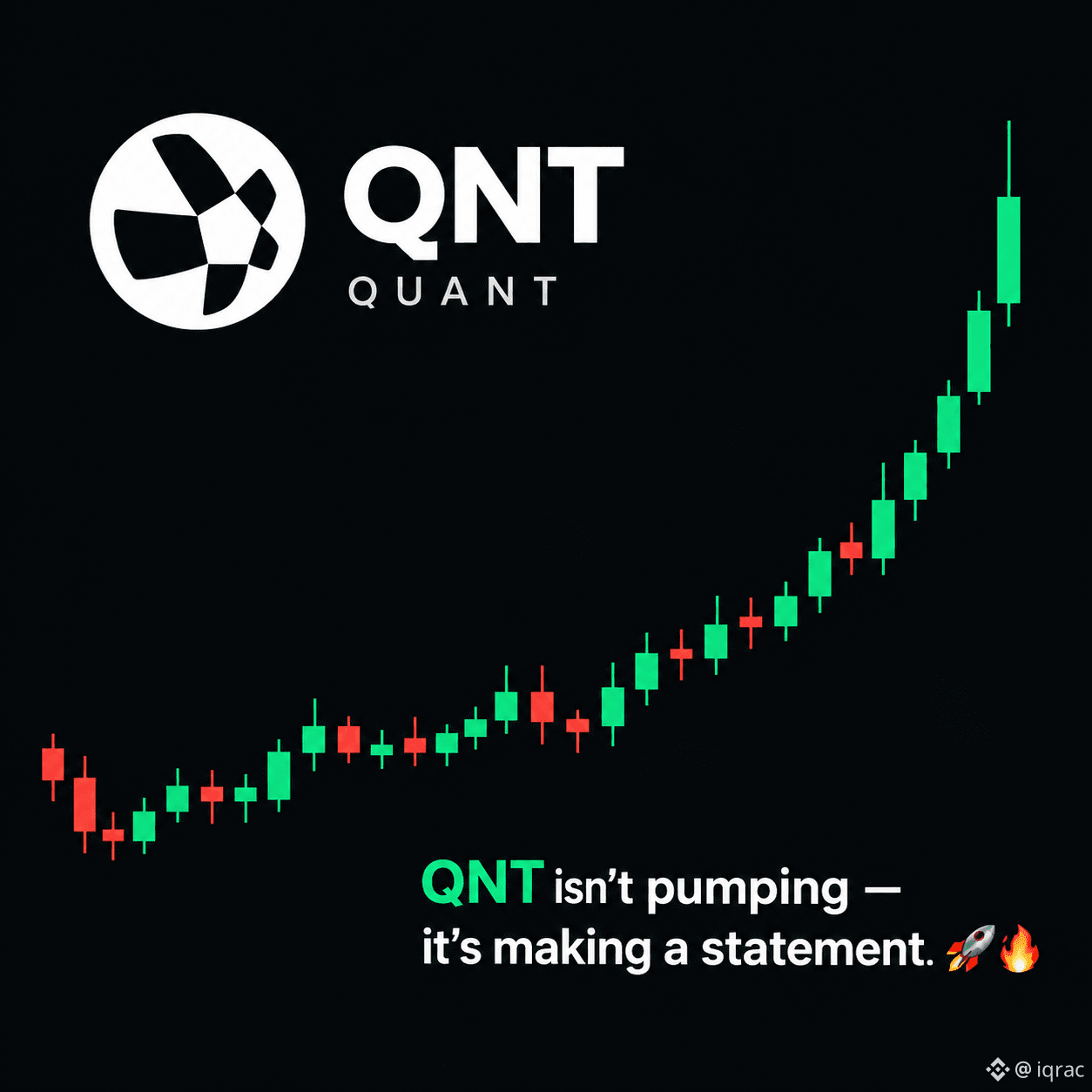
Altcoin surge season is showing signs of life 🔥
$QNT just crushed a 68% rally to 270.67 on serious 227M USDT volume — the kind of single-session explosion that only happens when dormant enterprise blockchain infrastructure catches a real bid. Quant's oracle tech rarely moves like this without coordinated capital backing it. GRT followed with a clean 26% push to 0.0343, indexing protocol momentum stacking as developers rotate back into Web3 data layer plays. Meanwhile PUMP printed an 18% gain to 0.00516 on 48M volume — speculative edge is alive in smaller caps.
What's notable: majors like BTC and ETH stayed flat while volume surged into selective altcoin names. That's rotation, not broad risk-on — capital is hunting specific narratives, not chasing everything.
Are we seeing the early edge of an altseason unwind, or just tactical scalp setups? 👀
#QNT #Altcoins #CryptoMarkets
Altcoin surge season is showing signs of life 🔥
$QNT just crushed a 68% rally to 270.67 on serious 227M USDT volume — the kind of single-session explosion that only happens when dormant enterprise blockchain infrastructure catches a real bid. Quant's oracle tech rarely moves like this without coordinated capital backing it. GRT followed with a clean 26% push to 0.0343, indexing protocol momentum stacking as developers rotate back into Web3 data layer plays. Meanwhile PUMP printed an 18% gain to 0.00516 on 48M volume — speculative edge is alive in smaller caps.
What's notable: majors like BTC and ETH stayed flat while volume surged into selective altcoin names. That's rotation, not broad risk-on — capital is hunting specific narratives, not chasing everything.
Are we seeing the early edge of an altseason unwind, or just tactical scalp setups? 👀
#QNT #Altcoins #CryptoMarkets
$QNT just crushed a 68% rally to 270.67 on serious 227M USDT volume — the kind of single-session explosion that only happens when dormant enterprise blockchain infrastructure catches a real bid. Quant's oracle tech rarely moves like this without coordinated capital backing it. GRT followed with a clean 26% push to 0.0343, indexing protocol momentum stacking as developers rotate back into Web3 data layer plays. Meanwhile PUMP printed an 18% gain to 0.00516 on 48M volume — speculative edge is alive in smaller caps.
What's notable: majors like BTC and ETH stayed flat while volume surged into selective altcoin names. That's rotation, not broad risk-on — capital is hunting specific narratives, not chasing everything.
Are we seeing the early edge of an altseason unwind, or just tactical scalp setups? 👀
#QNT #Altcoins #CryptoMarkets
391
·
--
$HYPE’s Binance Seed Tag listing is a liquidity stress test, not a confirmation of durable demand.
At $91.77, HYPE is down 0.79% over 24 hours on $15.84M in reported volume. The listing has brought sharp order-book swings, while FOMO longs have faced drawdowns. That makes entry quality and exit discipline more important than the headline. The broader market is mixed: sentiment is at 74 (Greed), BTC is near $84.7K, and SOL funding is slightly negative at -0.0014%; neither settles whether a Perp DEX token can retain its spot valuation as major CEX liquidity arrives.
Key invalidation: a sustained move below $90 would weaken the case that buyers are absorbing supply; reclaiming and holding above that area would be more constructive, but not proof of trend continuation.
For any setup, size for listing volatility and define the exit before entry; avoid widening risk after an invalidation.
#HYPE #CryptoMarkets #OrderFlow #RiskManagement
$HYPE ’s Binance Seed Tag listing is a liquidity stress test, not a confirmation of durable demand.
At $91.77, HYPE is down 0.79% over 24 hours on $15.84M in reported volume. The listing has brought sharp order-book swings, while FOMO longs have faced drawdowns. That makes entry quality and exit discipline more important than the headline. The broader market is mixed: sentiment is at 74 (Greed), BTC is near $84.7K, and SOL funding is slightly negative at -0.0014%; neither settles whether a Perp DEX token can retain its spot valuation as major CEX liquidity arrives.
Key invalidation: a sustained move below $90 would weaken the case that buyers are absorbing supply; reclaiming and holding above that area would be more constructive, but not proof of trend continuation.
For any setup, size for listing volatility and define the exit before entry; avoid widening risk after an invalidation.
#HYPE #CryptoMarkets #OrderFlow #RiskManagement
At $91.77, HYPE is down 0.79% over 24 hours on $15.84M in reported volume. The listing has brought sharp order-book swings, while FOMO longs have faced drawdowns. That makes entry quality and exit discipline more important than the headline. The broader market is mixed: sentiment is at 74 (Greed), BTC is near $84.7K, and SOL funding is slightly negative at -0.0014%; neither settles whether a Perp DEX token can retain its spot valuation as major CEX liquidity arrives.
Key invalidation: a sustained move below $90 would weaken the case that buyers are absorbing supply; reclaiming and holding above that area would be more constructive, but not proof of trend continuation.
For any setup, size for listing volatility and define the exit before entry; avoid widening risk after an invalidation.
#HYPE #CryptoMarkets #OrderFlow #RiskManagement
361
·
--
"Is $NEAR really just consolidating, or is there more to the story?"
$NEAR is stuck in a tight range between its 24h high and a key support level, showing traders are hesitant to commit to a clear direction. The 24h change of +X% suggests this consolidation isn't just a pause, but a moment of hesitation as buyers and sellers test the waters.
What traders should watch next is whether $NEAR can break out of this range or if it will continue to consolidate. If the price holds above the recent high, it could signal a bullish reversal. If it falls back to support, we might see more selling pressure.
What are you seeing on $NEAR right now? Is this just a pause or the start of something bigger?
Watching $NEAR vs this range.
#near #cryptotrading #altcoin #cryptomarkets
"Is $NEAR really just consolidating, or is there more to the story?"
$NEAR is stuck in a tight range between its 24h high and a key support level, showing traders are hesitant to commit to a clear direction. The 24h change of +X% suggests this consolidation isn't just a pause, but a moment of hesitation as buyers and sellers test the waters.
What traders should watch next is whether $NEAR can break out of this range or if it will continue to consolidate. If the price holds above the recent high, it could signal a bullish reversal. If it falls back to support, we might see more selling pressure.
What are you seeing on $NEAR right now? Is this just a pause or the start of something bigger?
Watching $NEAR vs this range.
#near #cryptotrading #altcoin #cryptomarkets
$NEAR is stuck in a tight range between its 24h high and a key support level, showing traders are hesitant to commit to a clear direction. The 24h change of +X% suggests this consolidation isn't just a pause, but a moment of hesitation as buyers and sellers test the waters.
What traders should watch next is whether $NEAR can break out of this range or if it will continue to consolidate. If the price holds above the recent high, it could signal a bullish reversal. If it falls back to support, we might see more selling pressure.
What are you seeing on $NEAR right now? Is this just a pause or the start of something bigger?
Watching $NEAR vs this range.
#near #cryptotrading #altcoin #cryptomarkets

·
--
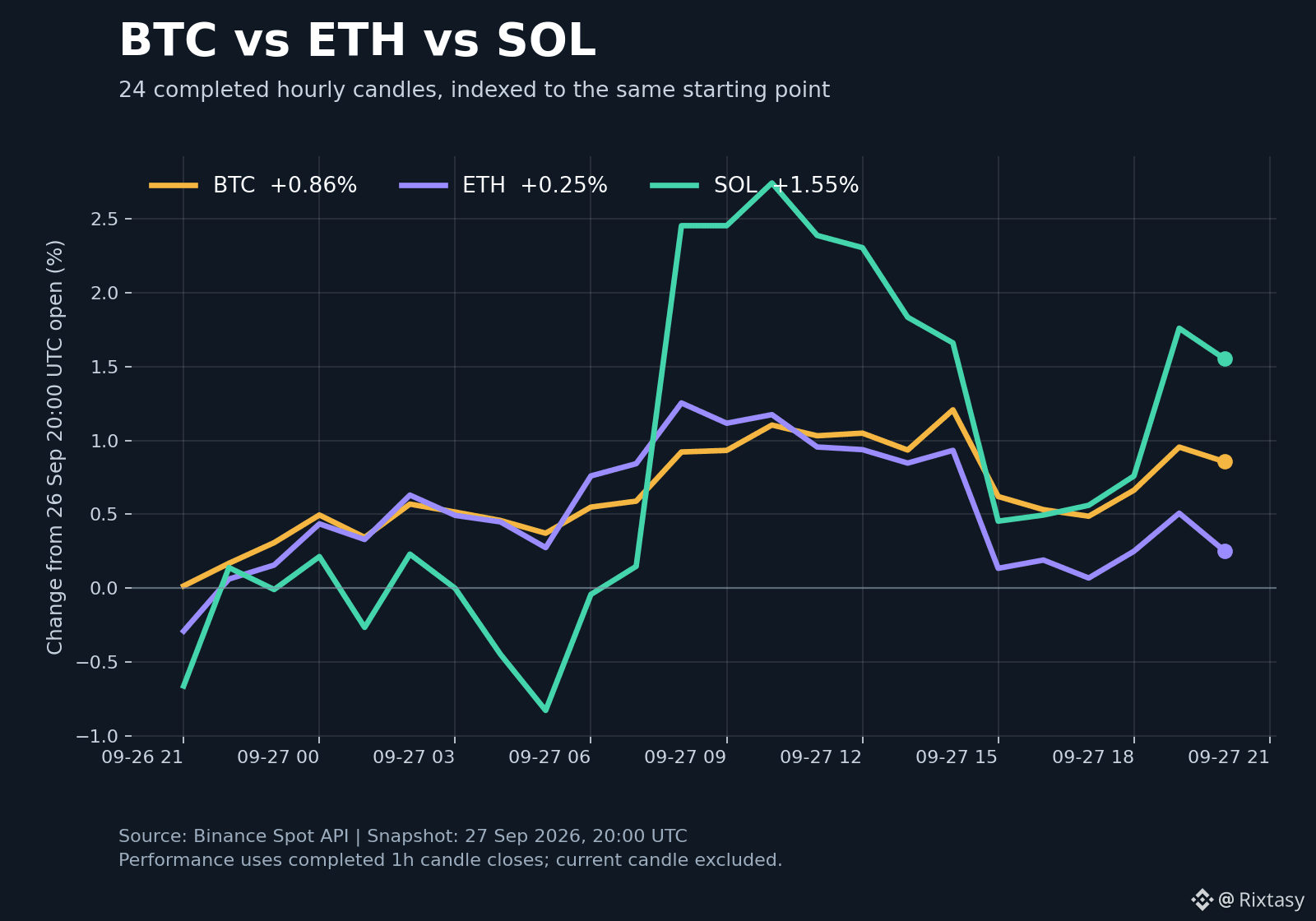
SOL won the percentage race today. BTC kept the cleaner finish.
At 20:00 UTC, Binance Spot showed $SOL up 1.60% over 24 hours, versus 0.87% for $BTC and 0.31% for $ETH. That makes SOL the headline leader, but the distance from each session high adds useful context:
• BTC: $84,750, about 0.48% below its 24h high.
• ETH: $2,692, about 1.16% below its 24h high.
• SOL: $123.03, about 1.54% below its 24h high.
So momentum broadened beyond Bitcoin, but conviction was uneven. SOL delivered the largest net move and also surrendered the most from its peak. BTC gained less, yet held its advance better into the evening.
For the next session, the useful test is simple: can SOL reclaim $124.95 while BTC holds above its $84,016 rolling open? If both happen, breadth improves. If SOL stays below its high while BTC weakens, today's leadership starts to look more fragile.
Source: Binance Spot, rolling 24h snapshot at 27 Sep 2026, 20:00 UTC. Reference levels, not trade signals.
#CryptoMarkets #MarketRecap
SOL won the percentage race today. BTC kept the cleaner finish.
At 20:00 UTC, Binance Spot showed $SOL up 1.60% over 24 hours, versus 0.87% for $BTC and 0.31% for $ETH . That makes SOL the headline leader, but the distance from each session high adds useful context:
• BTC: $84,750, about 0.48% below its 24h high.
• ETH: $2,692, about 1.16% below its 24h high.
• SOL: $123.03, about 1.54% below its 24h high.
So momentum broadened beyond Bitcoin, but conviction was uneven. SOL delivered the largest net move and also surrendered the most from its peak. BTC gained less, yet held its advance better into the evening.
For the next session, the useful test is simple: can SOL reclaim $124.95 while BTC holds above its $84,016 rolling open? If both happen, breadth improves. If SOL stays below its high while BTC weakens, today's leadership starts to look more fragile.
Source: Binance Spot, rolling 24h snapshot at 27 Sep 2026, 20:00 UTC. Reference levels, not trade signals.
#CryptoMarkets #MarketRecap
At 20:00 UTC, Binance Spot showed $SOL up 1.60% over 24 hours, versus 0.87% for $BTC and 0.31% for $ETH . That makes SOL the headline leader, but the distance from each session high adds useful context:
• BTC: $84,750, about 0.48% below its 24h high.
• ETH: $2,692, about 1.16% below its 24h high.
• SOL: $123.03, about 1.54% below its 24h high.
So momentum broadened beyond Bitcoin, but conviction was uneven. SOL delivered the largest net move and also surrendered the most from its peak. BTC gained less, yet held its advance better into the evening.
For the next session, the useful test is simple: can SOL reclaim $124.95 while BTC holds above its $84,016 rolling open? If both happen, breadth improves. If SOL stays below its high while BTC weakens, today's leadership starts to look more fragile.
Source: Binance Spot, rolling 24h snapshot at 27 Sep 2026, 20:00 UTC. Reference levels, not trade signals.
#CryptoMarkets #MarketRecap
93
·
--
$SOL is outperforming, but the key question is whether this is broad risk appetite or isolated speculation.
SOL trades at **$124.03, up 2.87% in 24 hours**, versus BTC at **$84,861 (+0.81%)**. That relative strength fits the high-beta rotation narrative, supported by ongoing DEX and meme-coin activity. However, BTC remains range-bound, while market sentiment is already at **70 (Greed)**. SOL funding at **0.0095%** is positive but not yet extreme, leaving room for continuation—but also less tolerance for a sharp unwind if flows fade.
**Key invalidation zone: $120–$121.** Holding above it would preserve the bullish rotation structure and allow a retest of recent highs. A decisive close below that zone would weaken the setup and suggest SOL strength was primarily speculative rather than ecosystem-wide demand.
Manage exposure conservatively; size for volatility and define the invalidation before entry rather than averaging into a failed breakout.
#SOL #CryptoMarkets #DEX #RiskManagement
$SOL is outperforming, but the key question is whether this is broad risk appetite or isolated speculation.
SOL trades at **$124.03, up 2.87% in 24 hours**, versus BTC at **$84,861 (+0.81%)**. That relative strength fits the high-beta rotation narrative, supported by ongoing DEX and meme-coin activity. However, BTC remains range-bound, while market sentiment is already at **70 (Greed)**. SOL funding at **0.0095%** is positive but not yet extreme, leaving room for continuation—but also less tolerance for a sharp unwind if flows fade.
**Key invalidation zone: $120–$121.** Holding above it would preserve the bullish rotation structure and allow a retest of recent highs. A decisive close below that zone would weaken the setup and suggest SOL strength was primarily speculative rather than ecosystem-wide demand.
Manage exposure conservatively; size for volatility and define the invalidation before entry rather than averaging into a failed breakout.
#SOL #CryptoMarkets #DEX #RiskManagement
SOL trades at **$124.03, up 2.87% in 24 hours**, versus BTC at **$84,861 (+0.81%)**. That relative strength fits the high-beta rotation narrative, supported by ongoing DEX and meme-coin activity. However, BTC remains range-bound, while market sentiment is already at **70 (Greed)**. SOL funding at **0.0095%** is positive but not yet extreme, leaving room for continuation—but also less tolerance for a sharp unwind if flows fade.
**Key invalidation zone: $120–$121.** Holding above it would preserve the bullish rotation structure and allow a retest of recent highs. A decisive close below that zone would weaken the setup and suggest SOL strength was primarily speculative rather than ecosystem-wide demand.
Manage exposure conservatively; size for volatility and define the invalidation before entry rather than averaging into a failed breakout.
#SOL #CryptoMarkets #DEX #RiskManagement
57

#Quant (+52.56% 24h, +149.08% 7d, market Cap $1.92 B)
Quant’s surge is driven by a partnership with The Clearing House to support a new tokenized bank deposit network, targeting a 2027 launch. This news sparked a 908% volume spike to $536.73M, indicating strong institutional and speculative demand.
What it means: This is a high-conviction, news-driven rally centered on real-world financial utility, not just market beta.
#BinanceSquareTalks #CryptoMarkets #VolatileCrypto
{spot}(QNTUSDT)
#Quant (+52.56% 24h, +149.08% 7d, market Cap $1.92 B)
Quant’s surge is driven by a partnership with The Clearing House to support a new tokenized bank deposit network, targeting a 2027 launch. This news sparked a 908% volume spike to $536.73M, indicating strong institutional and speculative demand.
What it means: This is a high-conviction, news-driven rally centered on real-world financial utility, not just market beta.
#BinanceSquareTalks #CryptoMarkets #VolatileCrypto
Quant’s surge is driven by a partnership with The Clearing House to support a new tokenized bank deposit network, targeting a 2027 launch. This news sparked a 908% volume spike to $536.73M, indicating strong institutional and speculative demand.
What it means: This is a high-conviction, news-driven rally centered on real-world financial utility, not just market beta.
#BinanceSquareTalks #CryptoMarkets #VolatileCrypto

1
164
·
--
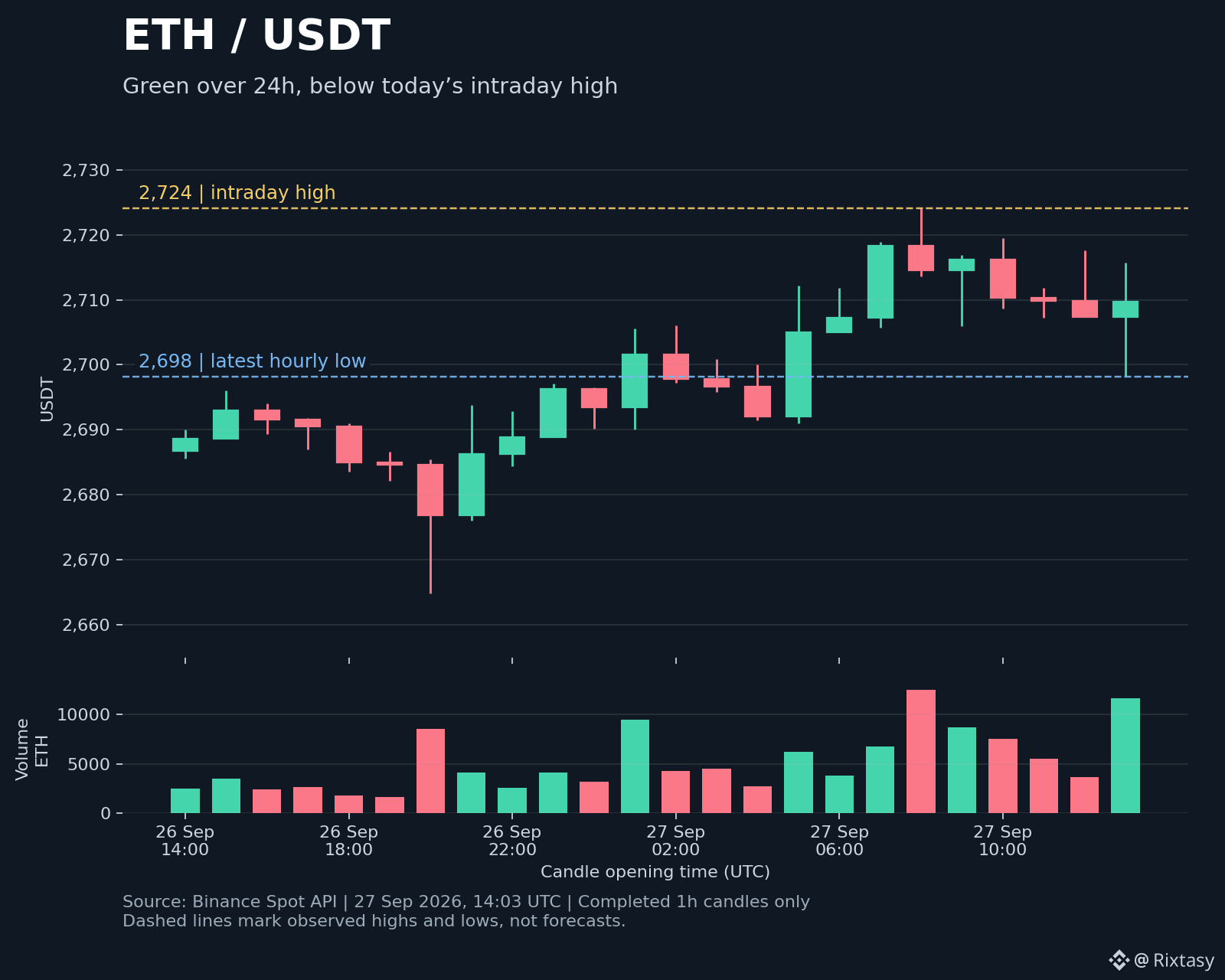
ETH is green on the 24-hour screen, but the intraday chart tells a quieter story.
At 14:03 UTC, $ETH was near $2,707 on Binance Spot, up 0.77% over the rolling 24 hours. Earlier today it reached $2,724. Since that 08:00 UTC hourly candle, none of the next five completed hourly candles closed above $2,717.
The distinction matters. A green 24-hour percentage tells you where the comparison started; it doesn't tell you whether buyers are still pressing now. ETH's rolling high-to-low range was about $59, while its net change was about $21.
An hourly close above $2,724 would make the recovery more convincing. Another rejection there, or a move below the recent $2,698 hourly low, would weaken it. These are reference levels, not guaranteed signals.
Source: Binance Spot ETHUSDT, 27 Sep 2026, 14:03 UTC. Chart shows completed 1-hour candles.
#Ethereum #CryptoMarkets
ETH is green on the 24-hour screen, but the intraday chart tells a quieter story.
At 14:03 UTC, $ETH was near $2,707 on Binance Spot, up 0.77% over the rolling 24 hours. Earlier today it reached $2,724. Since that 08:00 UTC hourly candle, none of the next five completed hourly candles closed above $2,717.
The distinction matters. A green 24-hour percentage tells you where the comparison started; it doesn't tell you whether buyers are still pressing now. ETH's rolling high-to-low range was about $59, while its net change was about $21.
An hourly close above $2,724 would make the recovery more convincing. Another rejection there, or a move below the recent $2,698 hourly low, would weaken it. These are reference levels, not guaranteed signals.
Source: Binance Spot ETHUSDT, 27 Sep 2026, 14:03 UTC. Chart shows completed 1-hour candles.
#Ethereum #CryptoMarkets
At 14:03 UTC, $ETH was near $2,707 on Binance Spot, up 0.77% over the rolling 24 hours. Earlier today it reached $2,724. Since that 08:00 UTC hourly candle, none of the next five completed hourly candles closed above $2,717.
The distinction matters. A green 24-hour percentage tells you where the comparison started; it doesn't tell you whether buyers are still pressing now. ETH's rolling high-to-low range was about $59, while its net change was about $21.
An hourly close above $2,724 would make the recovery more convincing. Another rejection there, or a move below the recent $2,698 hourly low, would weaken it. These are reference levels, not guaranteed signals.
Source: Binance Spot ETHUSDT, 27 Sep 2026, 14:03 UTC. Chart shows completed 1-hour candles.
#Ethereum #CryptoMarkets
49

·
--
Bullish
🚨 $BTC Pressing Key $85,000 Resistance: Breakout or Weekend Fakeout? 📊
Bitcoin is currently consolidating tightly in the $84,800 – $84,950 range, knocking directly on the doors of the major psychological $85,000 zone.
Here is what order books and market structure are showing right now:
🔹 The Bullish Scenario:
A clean 4H candle close above $85,200 with expanding volume could trigger a short squeeze, liquidating clustered stops toward $86,500+.
🔹 The Bearish Scenario:
Failure to clear $85,000 on low weekend volume risks a retest of the local liquidity pool around $84,200 – $83,800. Losing $83.8k opens room for a deeper pullback.
💡 Trading & Strategy Takeaway:
Trading ranges on weekends carries chop risk. Look for confirmed retests rather than market-buying green breakout candles. Keep your risk-to-reward ratio disciplined and use stop-losses.
👇 What’s your game plan for $BTC this weekend? Are you longing the breakout or waiting for a pullback? Drop your targets below!
#BTC #CryptoMarkets #Write2Earn #BinanceSquare
{spot}(BTCUSDT)
🚨 $BTC Pressing Key $85,000 Resistance: Breakout or Weekend Fakeout? 📊
Bitcoin is currently consolidating tightly in the $84,800 – $84,950 range, knocking directly on the doors of the major psychological $85,000 zone.
Here is what order books and market structure are showing right now:
🔹 The Bullish Scenario:
A clean 4H candle close above $85,200 with expanding volume could trigger a short squeeze, liquidating clustered stops toward $86,500+.
🔹 The Bearish Scenario:
Failure to clear $85,000 on low weekend volume risks a retest of the local liquidity pool around $84,200 – $83,800. Losing $83.8k opens room for a deeper pullback.
💡 Trading & Strategy Takeaway:
Trading ranges on weekends carries chop risk. Look for confirmed retests rather than market-buying green breakout candles. Keep your risk-to-reward ratio disciplined and use stop-losses.
👇 What’s your game plan for $BTC this weekend? Are you longing the breakout or waiting for a pullback? Drop your targets below!
#BTC #CryptoMarkets #Write2Earn #BinanceSquare
Bitcoin is currently consolidating tightly in the $84,800 – $84,950 range, knocking directly on the doors of the major psychological $85,000 zone.
Here is what order books and market structure are showing right now:
🔹 The Bullish Scenario:
A clean 4H candle close above $85,200 with expanding volume could trigger a short squeeze, liquidating clustered stops toward $86,500+.
🔹 The Bearish Scenario:
Failure to clear $85,000 on low weekend volume risks a retest of the local liquidity pool around $84,200 – $83,800. Losing $83.8k opens room for a deeper pullback.
💡 Trading & Strategy Takeaway:
Trading ranges on weekends carries chop risk. Look for confirmed retests rather than market-buying green breakout candles. Keep your risk-to-reward ratio disciplined and use stop-losses.
👇 What’s your game plan for $BTC this weekend? Are you longing the breakout or waiting for a pullback? Drop your targets below!
#BTC #CryptoMarkets #Write2Earn #BinanceSquare
1
73

·
--
Crypto Enhanced:
cual declaración bajista amigo esa fue causada por una vela de BTC
3
112
·
--
Volume doesn't whisper — it screams where capital is really moving.
$BTC absorbed 844M USDT in 24 hours while barely budging near 84,780, a textbook sideways consolidation with deep two-way flow and no clear directional bias. That kind of churn typically signals indecision or quiet positional rotation before the next leg. Meanwhile ZEC ripped 7.3% on an outsized 328M USDT — the second-highest volume on the entire board and wildly disproportionate to its usual flow. Explosive volume paired with a modest price gain often points to heavy accumulation or event-driven interest, not retail speculation 📊
ETH and SOL each printed over 270M USDT in modest green candles, reinforcing the theme: majors are absorbing liquidity without breaking structure. When blue-chips grind and privacy coins spike, the market is rotating, not panicking ⚡
What are you reading into unusual volume today — rotation or repricing?
#Bitcoin #ZCash #CryptoMarkets #BinanceSquare
Volume doesn't whisper — it screams where capital is really moving.
$BTC absorbed 844M USDT in 24 hours while barely budging near 84,780, a textbook sideways consolidation with deep two-way flow and no clear directional bias. That kind of churn typically signals indecision or quiet positional rotation before the next leg. Meanwhile ZEC ripped 7.3% on an outsized 328M USDT — the second-highest volume on the entire board and wildly disproportionate to its usual flow. Explosive volume paired with a modest price gain often points to heavy accumulation or event-driven interest, not retail speculation 📊
ETH and SOL each printed over 270M USDT in modest green candles, reinforcing the theme: majors are absorbing liquidity without breaking structure. When blue-chips grind and privacy coins spike, the market is rotating, not panicking ⚡
What are you reading into unusual volume today — rotation or repricing?
#Bitcoin #ZCash #CryptoMarkets #BinanceSquare
$BTC absorbed 844M USDT in 24 hours while barely budging near 84,780, a textbook sideways consolidation with deep two-way flow and no clear directional bias. That kind of churn typically signals indecision or quiet positional rotation before the next leg. Meanwhile ZEC ripped 7.3% on an outsized 328M USDT — the second-highest volume on the entire board and wildly disproportionate to its usual flow. Explosive volume paired with a modest price gain often points to heavy accumulation or event-driven interest, not retail speculation 📊
ETH and SOL each printed over 270M USDT in modest green candles, reinforcing the theme: majors are absorbing liquidity without breaking structure. When blue-chips grind and privacy coins spike, the market is rotating, not panicking ⚡
What are you reading into unusual volume today — rotation or repricing?
#Bitcoin #ZCash #CryptoMarkets #BinanceSquare
190
·
--
$NEAR is stuck in a tight 24h range, but the 2.4% gain suggests this isn't just consolidation. The current position near the midpoint of the range, combined with the steady 2.4% gain, indicates a potential accumulation phase. Traders should watch for volume spikes or a clear breakout to confirm the trend. What are you watching on $NEAR right now?
Current read: $NEAR, spot tape.
#near #cryptotrading #spottrading #cryptomarkets
$NEAR is stuck in a tight 24h range, but the 2.4% gain suggests this isn't just consolidation. The current position near the midpoint of the range, combined with the steady 2.4% gain, indicates a potential accumulation phase. Traders should watch for volume spikes or a clear breakout to confirm the trend. What are you watching on $NEAR right now?
Current read: $NEAR , spot tape.
#near #cryptotrading #spottrading #cryptomarkets
Current read: $NEAR , spot tape.
#near #cryptotrading #spottrading #cryptomarkets
7

"$NEAR is stuck at the midpoint of its 24h range, but the real story is in the volume. Today's trading volume is higher than usual, suggesting strong interest from spot traders.
Last price sits at the midpoint between the 24h high and low, indicating a pause in the current trend. This level of volume supports the move, as traders are actively participating in the consolidation.
The next level to watch is the 24h high, as a breakout above it could signal a resumption of the uptrend. Conversely, a break below the 24h low could indicate a reversal.
What are you watching on $NEAR right now?
Watching $NEAR vs this range.
Tap $NEAR to open NEAR/USDT and set alerts.
#near #cryptotrading #spottrading #cryptomarkets"
"$NEAR is stuck at the midpoint of its 24h range, but the real story is in the volume. Today's trading volume is higher than usual, suggesting strong interest from spot traders.
Last price sits at the midpoint between the 24h high and low, indicating a pause in the current trend. This level of volume supports the move, as traders are actively participating in the consolidation.
The next level to watch is the 24h high, as a breakout above it could signal a resumption of the uptrend. Conversely, a break below the 24h low could indicate a reversal.
What are you watching on $NEAR right now?
Watching $NEAR vs this range.
Tap $NEAR to open NEAR/USDT and set alerts.
#near #cryptotrading #spottrading #cryptomarkets"
Last price sits at the midpoint between the 24h high and low, indicating a pause in the current trend. This level of volume supports the move, as traders are actively participating in the consolidation.
The next level to watch is the 24h high, as a breakout above it could signal a resumption of the uptrend. Conversely, a break below the 24h low could indicate a reversal.
What are you watching on $NEAR right now?
Watching $NEAR vs this range.
Tap $NEAR to open NEAR/USDT and set alerts.
#near #cryptotrading #spottrading #cryptomarkets"
2
Log in to explore more content
Join global crypto users on Binance Square
⚡️ Get latest and useful information about crypto.
💬 Trusted by the world’s largest crypto exchange.
👍 Discover real insights from verified creators.
Email / Phone number
Trending Topics
1
#FedProposesPaymentStablecoinRules
1,720 views
78 Discussing
2
#ChinaMayLetAlibabaByteDanceBuyNvidiaChips
4,039 views
181 Discussing
3
#USChinaRelease$30BTariffCutProductLists
539 views
21 Discussing
4
#SKoreaFSCConsidersVirtualAssetMarketMaker
4,949 views
172 Discussing
5
#ChinaIndustrialProfitGrowthSlowsFourthMonth
6,106 views
190 Discussing
6
#BitwiseFilesFinalNEARSpotETFProspectus
117,638 views
1,717 Discussing
7
#BitgetHackerMoves$83MStolenXRP
39,760 views
177 Discussing
8
#SOLSpotETFWeeklyInflow$188M
25,043 views
139 Discussing
9
#DogecoinETFsPostBiggestWeekSinceLaunch
67,809 views
1,113 Discussing
10
#StrategyStriveAdd2305BitcoinThisWeek
167,776 views
2,388 Discussing