

#cryptoinfrastructure
cryptoinfrastructure
260,827 views
4,136 Discussing
Hot
Latest

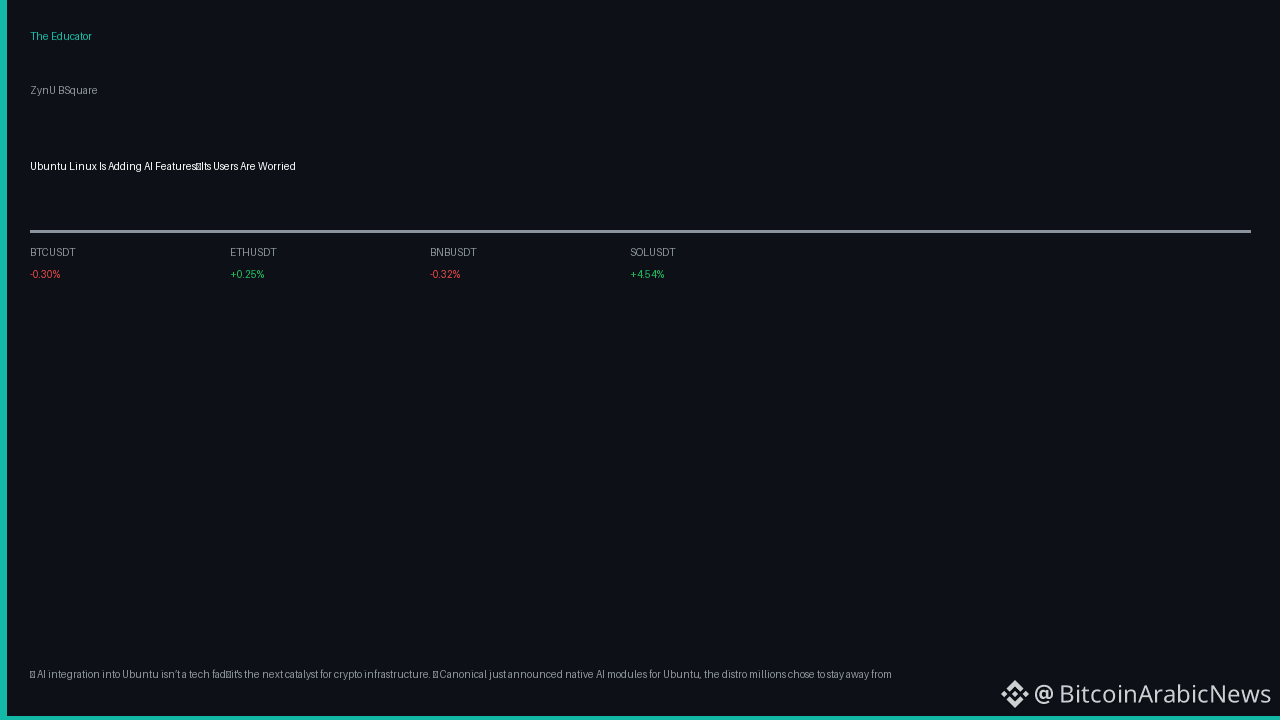
🔥 AI integration into Ubuntu isn’t a tech fad—it's the next catalyst for crypto infrastructure.
📊 Canonical just announced native AI modules for Ubuntu, the distro millions chose to stay away from AI, and the news is already spurring on‑chain moves #UbuntuAI #CryptoInfrastructure as #Solana climbs 4.54% to $122, BTC hovers at $83,901 (‑0.3%) with a bearish MACD crossover, and ETH nudges up to $2,688 (+0.25%).
💡 When the most trusted Linux platform embraces AI, developers flock to scalable, low‑fee
🔥 AI integration into Ubuntu isn’t a tech fad—it's the next catalyst for crypto infrastructure.
📊 Canonical just announced native AI modules for Ubuntu, the distro millions chose to stay away from AI, and the news is already spurring on‑chain moves #UbuntuAI #CryptoInfrastructure as #Solana climbs 4.54% to $122, BTC hovers at $83,901 (‑0.3%) with a bearish MACD crossover, and ETH nudges up to $2,688 (+0.25%).
💡 When the most trusted Linux platform embraces AI, developers flock to scalable, low‑fee
📊 Canonical just announced native AI modules for Ubuntu, the distro millions chose to stay away from AI, and the news is already spurring on‑chain moves #UbuntuAI #CryptoInfrastructure as #Solana climbs 4.54% to $122, BTC hovers at $83,901 (‑0.3%) with a bearish MACD crossover, and ETH nudges up to $2,688 (+0.25%).
💡 When the most trusted Linux platform embraces AI, developers flock to scalable, low‑fee
1
33

⚡ Market Leaders at Prime Levels — Infrastructure in Focus
$LINK | $FIL | $ENA
LINK, FIL, and ENA remain important names across infrastructure, decentralized storage, and DeFi. 🚀
Their ability to hold important technical zones keeps them relevant as market liquidity develops.
🎯 Key Takeaway: Established narratives holding support can become early signals of renewed sector momentum.
#LINK #FIL #ENA #CryptoInfrastructure #StrategicEntry
{future}(LINKUSDT)
{future}(FILUSDT)
{future}(ENAUSDT)
⚡ Market Leaders at Prime Levels — Infrastructure in Focus
$LINK | $FIL | $ENA
LINK, FIL, and ENA remain important names across infrastructure, decentralized storage, and DeFi. 🚀
Their ability to hold important technical zones keeps them relevant as market liquidity develops.
🎯 Key Takeaway: Established narratives holding support can become early signals of renewed sector momentum.
#LINK #FIL #ENA #CryptoInfrastructure #StrategicEntry
$LINK | $FIL | $ENA
LINK, FIL, and ENA remain important names across infrastructure, decentralized storage, and DeFi. 🚀
Their ability to hold important technical zones keeps them relevant as market liquidity develops.
🎯 Key Takeaway: Established narratives holding support can become early signals of renewed sector momentum.
#LINK #FIL #ENA #CryptoInfrastructure #StrategicEntry
1
62

·
--
🚀 $BTC SET TO GO INTERSTELLAR: SPACE MINING BY STARCLOUD IS ON THE HORIZON 🦈
Starcloud’s upcoming satellite will host ASIC farms powered by uninterrupted solar, sidestepping terrestrial permitting and delivering near‑zero‑carbon hash power. 📊🌊
The cost differential—$1 k per kW for ASICs versus $30 k for Nvidia GPUs—creates a massive efficiency margin, a classic smart‑money signal that could flood the network with gigawatt‑scale capacity. 📈🦈
💬 How are you positioning your exposure ahead of this extraterrestrial hash surge? 👇
⚠️ Not financial advice. Always manage your risk. 🛡️
🏷️ #BTC #SpaceMining #CryptoInfrastructure #LongSetup
🔥 💎
🚀 $BTC SET TO GO INTERSTELLAR: SPACE MINING BY STARCLOUD IS ON THE HORIZON 🦈
Starcloud’s upcoming satellite will host ASIC farms powered by uninterrupted solar, sidestepping terrestrial permitting and delivering near‑zero‑carbon hash power. 📊🌊
The cost differential—$1 k per kW for ASICs versus $30 k for Nvidia GPUs—creates a massive efficiency margin, a classic smart‑money signal that could flood the network with gigawatt‑scale capacity. 📈🦈
💬 How are you positioning your exposure ahead of this extraterrestrial hash surge? 👇
⚠️ Not financial advice. Always manage your risk. 🛡️
🏷️ #BTC #SpaceMining #CryptoInfrastructure #LongSetup
🔥 💎
Starcloud’s upcoming satellite will host ASIC farms powered by uninterrupted solar, sidestepping terrestrial permitting and delivering near‑zero‑carbon hash power. 📊🌊
The cost differential—$1 k per kW for ASICs versus $30 k for Nvidia GPUs—creates a massive efficiency margin, a classic smart‑money signal that could flood the network with gigawatt‑scale capacity. 📈🦈
💬 How are you positioning your exposure ahead of this extraterrestrial hash surge? 👇
⚠️ Not financial advice. Always manage your risk. 🛡️
🏷️ #BTC #SpaceMining #CryptoInfrastructure #LongSetup
🔥 💎
11
Market Leaders at Prime Levels — Position Before Acceleration
$INJ | $RUNE | $LINK
INJ, RUNE, and LINK remain important infrastructure-focused assets. Each represents a different part of the decentralized ecosystem, while their technical structures remain key during consolidation.
The market is preparing for its next directional decision.
Key Takeaway: Strong infrastructure narratives can regain momentum when support remains intact.
#INJ #RUNE #LINK #CryptoInfrastructure #HighConviction
{future}(INJUSDT)
{future}(RUNEUSDT)
{future}(LINKUSDT)
Market Leaders at Prime Levels — Position Before Acceleration
$INJ | $RUNE | $LINK
INJ, RUNE, and LINK remain important infrastructure-focused assets. Each represents a different part of the decentralized ecosystem, while their technical structures remain key during consolidation.
The market is preparing for its next directional decision.
Key Takeaway: Strong infrastructure narratives can regain momentum when support remains intact.
#INJ #RUNE #LINK #CryptoInfrastructure #HighConviction
$INJ | $RUNE | $LINK
INJ, RUNE, and LINK remain important infrastructure-focused assets. Each represents a different part of the decentralized ecosystem, while their technical structures remain key during consolidation.
The market is preparing for its next directional decision.
Key Takeaway: Strong infrastructure narratives can regain momentum when support remains intact.
#INJ #RUNE #LINK #CryptoInfrastructure #HighConviction
1
209

·
--
Here's what happened when privacy coins stopped being just about hiding payments and started powering actual trades and settlements.
Traders keep getting wrecked on public chains where every wallet move is visible, inviting copycats and MEV bots that snatch profits before you can exit. That transparency also fuels FOMO into the wrong pumps while the real shift happens off-ledger.
$ZEC recently pushed network upgrades that drew institutional interest, expanding privacy well beyond anonymous transfers. $NEAR is taking it further by baking privacy into trading and cross-chain settlement, a broader play than $XMR's earlier untraceable focus which often ran into regulatory walls like the mixer crackdowns of past cycles.
This setup feels like the DeFi explosion after Ethereum's scaling bottlenecks, except now privacy is the missing infrastructure layer. Both projects show how the narrative is maturing from niche tools into something traders actually need for private activity.
The lesson is that sitting this out means missing rotations as more volume moves into shielded environments.
Where do you think this privacy infrastructure heads next versus the last cycle's mixer drama?
#PrivacyCoins #CryptoInfrastructure #ZEC
Here's what happened when privacy coins stopped being just about hiding payments and started powering actual trades and settlements.
Traders keep getting wrecked on public chains where every wallet move is visible, inviting copycats and MEV bots that snatch profits before you can exit. That transparency also fuels FOMO into the wrong pumps while the real shift happens off-ledger.
$ZEC recently pushed network upgrades that drew institutional interest, expanding privacy well beyond anonymous transfers. $NEAR is taking it further by baking privacy into trading and cross-chain settlement, a broader play than $XMR 's earlier untraceable focus which often ran into regulatory walls like the mixer crackdowns of past cycles.
This setup feels like the DeFi explosion after Ethereum's scaling bottlenecks, except now privacy is the missing infrastructure layer. Both projects show how the narrative is maturing from niche tools into something traders actually need for private activity.
The lesson is that sitting this out means missing rotations as more volume moves into shielded environments.
Where do you think this privacy infrastructure heads next versus the last cycle's mixer drama?
#PrivacyCoins #CryptoInfrastructure #ZEC
Traders keep getting wrecked on public chains where every wallet move is visible, inviting copycats and MEV bots that snatch profits before you can exit. That transparency also fuels FOMO into the wrong pumps while the real shift happens off-ledger.
$ZEC recently pushed network upgrades that drew institutional interest, expanding privacy well beyond anonymous transfers. $NEAR is taking it further by baking privacy into trading and cross-chain settlement, a broader play than $XMR 's earlier untraceable focus which often ran into regulatory walls like the mixer crackdowns of past cycles.
This setup feels like the DeFi explosion after Ethereum's scaling bottlenecks, except now privacy is the missing infrastructure layer. Both projects show how the narrative is maturing from niche tools into something traders actually need for private activity.
The lesson is that sitting this out means missing rotations as more volume moves into shielded environments.
Where do you think this privacy infrastructure heads next versus the last cycle's mixer drama?
#PrivacyCoins #CryptoInfrastructure #ZEC

427

·
--
NOWNodes or QuickNode?The better RPC provider depends on the system you are trying to operate.
NOWNodes uses a comparatively direct request-quota model across its shared plans. That can make monthly budgeting easier when you already understand your request volume and mainly need node access, historical data, WebSockets or advanced methods.
QuickNode uses API Credits, so the chain, method class and adjacent data products matter. Its strongest case is often broader than RPC: Streams, Webhooks, filtering and delivery destinations can replace pollers, queues and part of an internal ingestion pipeline.
Before comparing plans, divide the workload into ordinary state reads, logs, historical calls, Trace or Debug requests and event delivery. Then calculate the engineering systems each provider lets you remove. A lower endpoint invoice can still produce a higher total cost if your team has to build and maintain the missing data pipeline.
No authenticated simultaneous latency benchmark was available for this comparison, so TokenToolHub does not invent a performance winner. The guide provides a controlled test specification teams can run with their own traffic mix.
Full comparison:
https://tokentoolhub.com/nownodes-vs-quicknode/
#blockchain #Web3 #Ethereum #CryptoInfrastructure #Developers
NOWNodes or QuickNode?
The better RPC provider depends on the system you are trying to operate.
NOWNodes uses a comparatively direct request-quota model across its shared plans. That can make monthly budgeting easier when you already understand your request volume and mainly need node access, historical data, WebSockets or advanced methods.
QuickNode uses API Credits, so the chain, method class and adjacent data products matter. Its strongest case is often broader than RPC: Streams, Webhooks, filtering and delivery destinations can replace pollers, queues and part of an internal ingestion pipeline.
Before comparing plans, divide the workload into ordinary state reads, logs, historical calls, Trace or Debug requests and event delivery. Then calculate the engineering systems each provider lets you remove. A lower endpoint invoice can still produce a higher total cost if your team has to build and maintain the missing data pipeline.
No authenticated simultaneous latency benchmark was available for this comparison, so TokenToolHub does not invent a performance winner. The guide provides a controlled test specification teams can run with their own traffic mix.
Full comparison:
https://tokentoolhub.com/nownodes-vs-quicknode/
#blockchain #Web3 #Ethereum #CryptoInfrastructure #Developers
NOWNodes uses a comparatively direct request-quota model across its shared plans. That can make monthly budgeting easier when you already understand your request volume and mainly need node access, historical data, WebSockets or advanced methods.
QuickNode uses API Credits, so the chain, method class and adjacent data products matter. Its strongest case is often broader than RPC: Streams, Webhooks, filtering and delivery destinations can replace pollers, queues and part of an internal ingestion pipeline.
Before comparing plans, divide the workload into ordinary state reads, logs, historical calls, Trace or Debug requests and event delivery. Then calculate the engineering systems each provider lets you remove. A lower endpoint invoice can still produce a higher total cost if your team has to build and maintain the missing data pipeline.
No authenticated simultaneous latency benchmark was available for this comparison, so TokenToolHub does not invent a performance winner. The guide provides a controlled test specification teams can run with their own traffic mix.
Full comparison:
https://tokentoolhub.com/nownodes-vs-quicknode/
#blockchain #Web3 #Ethereum #CryptoInfrastructure #Developers
32

·
--
Binance isn’t just an exchange.
It’s the liquidity layer, custody layer, fiat rails, and settlement infrastructure a large part of crypto actually runs on.
$34T traded in 2025
Deep books that set price discovery for BTC and ETH
Institutional custody + collateral
Fiat and stablecoin access
Compliance and security treated as core product, not an afterthought
Today’s scheduled wallet upgrade is the unglamorous part of that: pause deposits/withdrawals for about an hour, keep trading live, restore when the systems are stable. That’s how you run infrastructure instead of a hobby project.
Funds SAFU. Trading never stopped.
The industry still argues about “just an exchange.” The volumes and the rails say otherwise.
#Binance #CryptoInfrastructure
Binance isn’t just an exchange.
It’s the liquidity layer, custody layer, fiat rails, and settlement infrastructure a large part of crypto actually runs on.
$34T traded in 2025
Deep books that set price discovery for BTC and ETH
Institutional custody + collateral
Fiat and stablecoin access
Compliance and security treated as core product, not an afterthought
Today’s scheduled wallet upgrade is the unglamorous part of that: pause deposits/withdrawals for about an hour, keep trading live, restore when the systems are stable. That’s how you run infrastructure instead of a hobby project.
Funds SAFU. Trading never stopped.
The industry still argues about “just an exchange.” The volumes and the rails say otherwise.
#Binance #CryptoInfrastructure
It’s the liquidity layer, custody layer, fiat rails, and settlement infrastructure a large part of crypto actually runs on.
$34T traded in 2025
Deep books that set price discovery for BTC and ETH
Institutional custody + collateral
Fiat and stablecoin access
Compliance and security treated as core product, not an afterthought
Today’s scheduled wallet upgrade is the unglamorous part of that: pause deposits/withdrawals for about an hour, keep trading live, restore when the systems are stable. That’s how you run infrastructure instead of a hobby project.
Funds SAFU. Trading never stopped.
The industry still argues about “just an exchange.” The volumes and the rails say otherwise.
#Binance #CryptoInfrastructure
43


Circle is taking a massive leap beyond just issuing tokens. The team behind $USDC has unveiled Arc, their brand new Layer 1 blockchain built from the ground up purely for stablecoin-native finance. 🌐
Think about why this matters for a second. Instead of dealing with unpredictable gas spikes or network congestion on general-purpose networks, Arc is engineered to provide seamless, hyper-efficient rails specifically designed for global digital dollar movement. It is Circle's clear bid to become the foundational base layer for enterprise payments and fintech applications. 💡
What to watch next is how smoothly developer tooling rolls out and whether major payment giants decide to build native apps directly on Arc. If they manage to bootstrap liquidity quickly, this could redefine how dollars flow on-chain.
#Stablecoins #CryptoInfrastructure #Write2Earn #USDC
Circle is taking a massive leap beyond just issuing tokens. The team behind $USDC has unveiled Arc, their brand new Layer 1 blockchain built from the ground up purely for stablecoin-native finance. 🌐
Think about why this matters for a second. Instead of dealing with unpredictable gas spikes or network congestion on general-purpose networks, Arc is engineered to provide seamless, hyper-efficient rails specifically designed for global digital dollar movement. It is Circle's clear bid to become the foundational base layer for enterprise payments and fintech applications. 💡
What to watch next is how smoothly developer tooling rolls out and whether major payment giants decide to build native apps directly on Arc. If they manage to bootstrap liquidity quickly, this could redefine how dollars flow on-chain.
#Stablecoins #CryptoInfrastructure #Write2Earn #USDC
Think about why this matters for a second. Instead of dealing with unpredictable gas spikes or network congestion on general-purpose networks, Arc is engineered to provide seamless, hyper-efficient rails specifically designed for global digital dollar movement. It is Circle's clear bid to become the foundational base layer for enterprise payments and fintech applications. 💡
What to watch next is how smoothly developer tooling rolls out and whether major payment giants decide to build native apps directly on Arc. If they manage to bootstrap liquidity quickly, this could redefine how dollars flow on-chain.
#Stablecoins #CryptoInfrastructure #Write2Earn #USDC

203

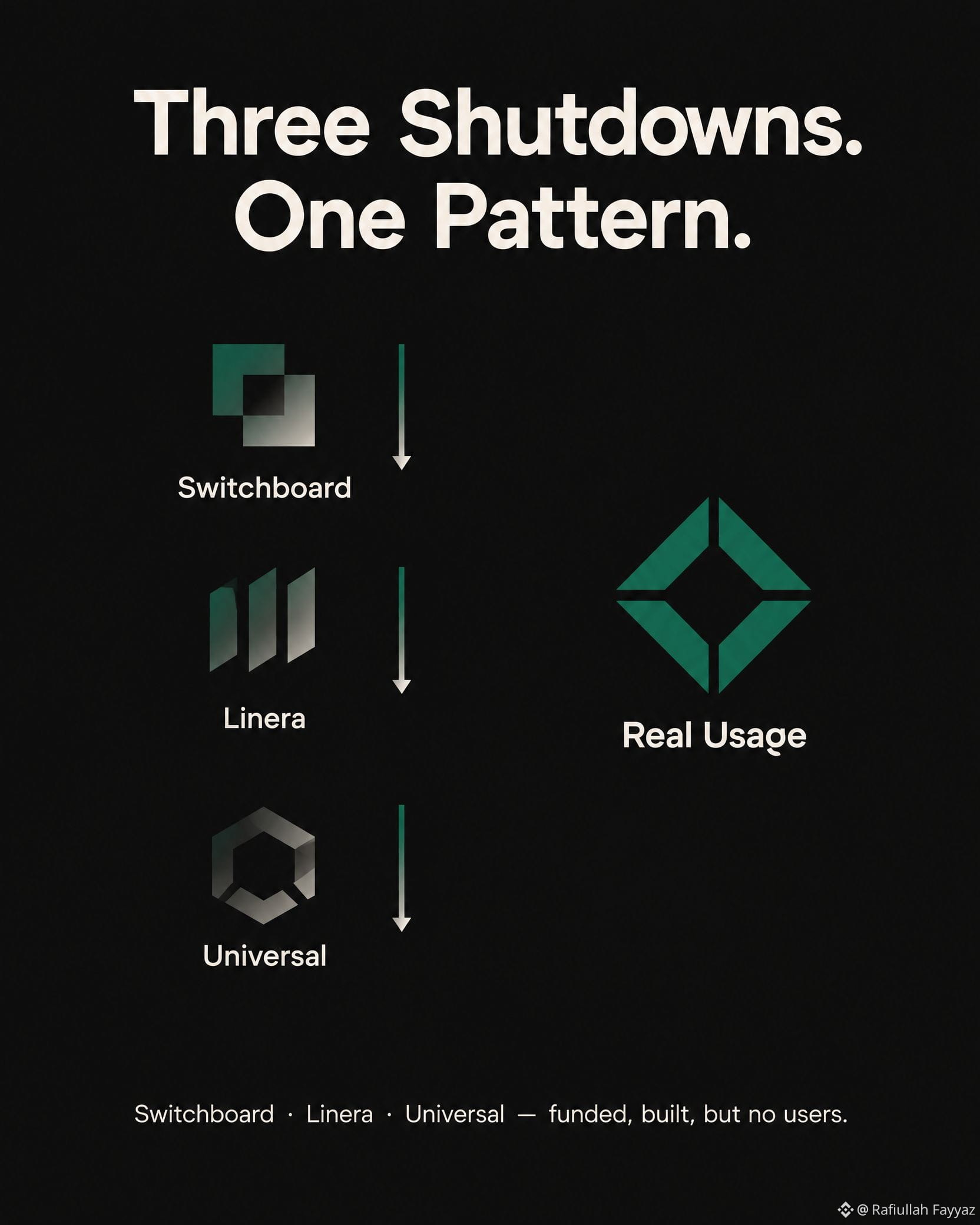
Three crypto infrastructure projects announced shutdowns this week. All backed by serious investors. All running out of time.
Switchboard — a multi-chain oracle network that raised $7.5 million. Shutting down September 25. Protocols using their data must migrate to Pyth or RedStone.
Linera — an a16z-backed Layer 1 that raised around $12 million. Failed to launch mainnet after four years. Its community token sale raised $850,000 — below the $1.5 million minimum. Ceasing operations.
Universal — a cross-chain protocol backed by a16z and Coinbase Ventures. Raised $9 million. Shutting down in November after supporting 80+ cross-chain assets.
These aren't failed projects in the traditional sense. They had funding, teams, and technology. What they didn't have was sustainable users or revenue.
Switchboard's closure note is telling: AI is lowering the cost of building oracle infrastructure in-house. Large protocols like Hyperliquid are connecting directly with data providers. Third-party middleware is getting squeezed.
The market is separating projects with real usage from projects with good narratives. That's a useful distinction to track.
#Binance #CryptoInfrastructure #Altcoins
Three crypto infrastructure projects announced shutdowns this week. All backed by serious investors. All running out of time.
Switchboard — a multi-chain oracle network that raised $7.5 million. Shutting down September 25. Protocols using their data must migrate to Pyth or RedStone.
Linera — an a16z-backed Layer 1 that raised around $12 million. Failed to launch mainnet after four years. Its community token sale raised $850,000 — below the $1.5 million minimum. Ceasing operations.
Universal — a cross-chain protocol backed by a16z and Coinbase Ventures. Raised $9 million. Shutting down in November after supporting 80+ cross-chain assets.
These aren't failed projects in the traditional sense. They had funding, teams, and technology. What they didn't have was sustainable users or revenue.
Switchboard's closure note is telling: AI is lowering the cost of building oracle infrastructure in-house. Large protocols like Hyperliquid are connecting directly with data providers. Third-party middleware is getting squeezed.
The market is separating projects with real usage from projects with good narratives. That's a useful distinction to track.
#Binance #CryptoInfrastructure #Altcoins
Switchboard — a multi-chain oracle network that raised $7.5 million. Shutting down September 25. Protocols using their data must migrate to Pyth or RedStone.
Linera — an a16z-backed Layer 1 that raised around $12 million. Failed to launch mainnet after four years. Its community token sale raised $850,000 — below the $1.5 million minimum. Ceasing operations.
Universal — a cross-chain protocol backed by a16z and Coinbase Ventures. Raised $9 million. Shutting down in November after supporting 80+ cross-chain assets.
These aren't failed projects in the traditional sense. They had funding, teams, and technology. What they didn't have was sustainable users or revenue.
Switchboard's closure note is telling: AI is lowering the cost of building oracle infrastructure in-house. Large protocols like Hyperliquid are connecting directly with data providers. Third-party middleware is getting squeezed.
The market is separating projects with real usage from projects with good narratives. That's a useful distinction to track.
#Binance #CryptoInfrastructure #Altcoins
50

·
--

Article
MicroStrategy Aims to Be the JPMorgan of Bitcoin: What That Means for YouHave you ever wondered what it would take to make Bitcoin as mainstream and reliable as a major bank? MicroStrategy’s CEO, Phong Le, just laid out a bold vision: turn the company into the “JPMorgan of Bitcoin,” creating markets and liquidity for an 8‑billion‑person economy. Let’s break that down.
The Concept: Institutionalizing Bitcoin Markets
MicroStrategy isn’t just buying and holding Bitcoin; it’s building the infrastructure that lets people trade, lend, and use Bitcoin like any other asset. Think of it as a giant digital bank that offers everything from spot trading to derivatives, all backed by a massive Bitcoin vault. By providing deep liquidity and robust market-making, the company hopes to reduce price swings and give traders the confidence to move large sums without slippage. #CryptoInfrastructure #DigitalBanking
Real‑World Example: How It Plays Out
Imagine a global corporation wants to hedge its exposure to Bitcoin. Instead of sending millions of dollars to a few exchanges, it can tap into MicroStrategy’s liquidity pool. The company’s market‑making engine instantly matches buy and sell orders, ensuring tight spreads and minimal impact on the market price. Meanwhile, investors can access a suite of products—spot, futures, and even tokenized bonds—making Bitcoin a versatile tool in their portfolios. This mirrors how JPMorgan offers a full suite of financial services under one roof, but in the crypto space.
Takeaway: Why You Should Care
If MicroStrategy succeeds, Bitcoin could become as accessible as a bank account. This means lower transaction costs, faster settlements, and a more stable price environment—benefits for traders, institutional investors, and everyday users alike. Keep an eye on MicroStrategy’s moves; they could signal the next step toward mainstream crypto adoption. #BitcoinFuture
What do you think? Will MicroStrategy’s “JPMorgan of Bitcoin” strategy change how we view digital assets?
MicroStrategy Aims to Be the JPMorgan of Bitcoin: What That Means for You
Have you ever wondered what it would take to make Bitcoin as mainstream and reliable as a major bank? MicroStrategy’s CEO, Phong Le, just laid out a bold vision: turn the company into the “JPMorgan of Bitcoin,” creating markets and liquidity for an 8‑billion‑person economy. Let’s break that down.
The Concept: Institutionalizing Bitcoin Markets
MicroStrategy isn’t just buying and holding Bitcoin; it’s building the infrastructure that lets people trade, lend, and use Bitcoin like any other asset. Think of it as a giant digital bank that offers everything from spot trading to derivatives, all backed by a massive Bitcoin vault. By providing deep liquidity and robust market-making, the company hopes to reduce price swings and give traders the confidence to move large sums without slippage. #CryptoInfrastructure #DigitalBanking
Real‑World Example: How It Plays Out
Imagine a global corporation wants to hedge its exposure to Bitcoin. Instead of sending millions of dollars to a few exchanges, it can tap into MicroStrategy’s liquidity pool. The company’s market‑making engine instantly matches buy and sell orders, ensuring tight spreads and minimal impact on the market price. Meanwhile, investors can access a suite of products—spot, futures, and even tokenized bonds—making Bitcoin a versatile tool in their portfolios. This mirrors how JPMorgan offers a full suite of financial services under one roof, but in the crypto space.
Takeaway: Why You Should Care
If MicroStrategy succeeds, Bitcoin could become as accessible as a bank account. This means lower transaction costs, faster settlements, and a more stable price environment—benefits for traders, institutional investors, and everyday users alike. Keep an eye on MicroStrategy’s moves; they could signal the next step toward mainstream crypto adoption. #BitcoinFuture
What do you think? Will MicroStrategy’s “JPMorgan of Bitcoin” strategy change how we view digital assets?
The Concept: Institutionalizing Bitcoin Markets
MicroStrategy isn’t just buying and holding Bitcoin; it’s building the infrastructure that lets people trade, lend, and use Bitcoin like any other asset. Think of it as a giant digital bank that offers everything from spot trading to derivatives, all backed by a massive Bitcoin vault. By providing deep liquidity and robust market-making, the company hopes to reduce price swings and give traders the confidence to move large sums without slippage. #CryptoInfrastructure #DigitalBanking
Real‑World Example: How It Plays Out
Imagine a global corporation wants to hedge its exposure to Bitcoin. Instead of sending millions of dollars to a few exchanges, it can tap into MicroStrategy’s liquidity pool. The company’s market‑making engine instantly matches buy and sell orders, ensuring tight spreads and minimal impact on the market price. Meanwhile, investors can access a suite of products—spot, futures, and even tokenized bonds—making Bitcoin a versatile tool in their portfolios. This mirrors how JPMorgan offers a full suite of financial services under one roof, but in the crypto space.
Takeaway: Why You Should Care
If MicroStrategy succeeds, Bitcoin could become as accessible as a bank account. This means lower transaction costs, faster settlements, and a more stable price environment—benefits for traders, institutional investors, and everyday users alike. Keep an eye on MicroStrategy’s moves; they could signal the next step toward mainstream crypto adoption. #BitcoinFuture
What do you think? Will MicroStrategy’s “JPMorgan of Bitcoin” strategy change how we view digital assets?
18
·
--
NOWNodes vs ChainstackNOWNodes and Chainstack both remove much of the operational work involved in running blockchain nodes, but their infrastructure models are not identical.
NOWNodes currently presents a direct shared-plan ladder based primarily on monthly request allowances. Its public documentation also covers archive nodes, WebSockets, trace and debug interfaces, Blockbook, gRPC and custom dedicated deployments. This can suit a team that wants broad multi-chain access and straightforward request-based budgeting.
Chainstack currently offers a wider set of infrastructure shapes inside one platform: geo-balanced Global Nodes, Archive Data, Unlimited Node capacity, Dedicated Nodes and Self-Hosted orchestration. That range can suit a team expecting its deployment model to change as traffic, retention and control requirements grow.
The headline quotas are not directly comparable. Chainstack meters shared usage through request units, while NOWNodes publishes monthly request allowances. Archive, trace, debug, WebSocket and dedicated products require their own verification.
Use one controlled benchmark for both providers:
• Same client region
• Same methods and block ranges
• Same concurrency and sample size
• Same timeout and retry settings
• Separate recent-state and archive tests
• p50, p95, p99 and failure-rate recording
Do not claim a provider is faster without running both endpoints under the same conditions. Choose by total ownership cost, method coverage, recovery behavior and migration risk.
Full TokenToolHub comparison:
https://tokentoolhub.com/nownodes-vs-chainstack/
#blockchain #Web3 #RPC #CryptoInfrastructure #Developers
NOWNodes vs Chainstack
NOWNodes and Chainstack both remove much of the operational work involved in running blockchain nodes, but their infrastructure models are not identical.
NOWNodes currently presents a direct shared-plan ladder based primarily on monthly request allowances. Its public documentation also covers archive nodes, WebSockets, trace and debug interfaces, Blockbook, gRPC and custom dedicated deployments. This can suit a team that wants broad multi-chain access and straightforward request-based budgeting.
Chainstack currently offers a wider set of infrastructure shapes inside one platform: geo-balanced Global Nodes, Archive Data, Unlimited Node capacity, Dedicated Nodes and Self-Hosted orchestration. That range can suit a team expecting its deployment model to change as traffic, retention and control requirements grow.
The headline quotas are not directly comparable. Chainstack meters shared usage through request units, while NOWNodes publishes monthly request allowances. Archive, trace, debug, WebSocket and dedicated products require their own verification.
Use one controlled benchmark for both providers:
• Same client region
• Same methods and block ranges
• Same concurrency and sample size
• Same timeout and retry settings
• Separate recent-state and archive tests
• p50, p95, p99 and failure-rate recording
Do not claim a provider is faster without running both endpoints under the same conditions. Choose by total ownership cost, method coverage, recovery behavior and migration risk.
Full TokenToolHub comparison:
https://tokentoolhub.com/nownodes-vs-chainstack/
#blockchain #Web3 #RPC #CryptoInfrastructure #Developers
NOWNodes currently presents a direct shared-plan ladder based primarily on monthly request allowances. Its public documentation also covers archive nodes, WebSockets, trace and debug interfaces, Blockbook, gRPC and custom dedicated deployments. This can suit a team that wants broad multi-chain access and straightforward request-based budgeting.
Chainstack currently offers a wider set of infrastructure shapes inside one platform: geo-balanced Global Nodes, Archive Data, Unlimited Node capacity, Dedicated Nodes and Self-Hosted orchestration. That range can suit a team expecting its deployment model to change as traffic, retention and control requirements grow.
The headline quotas are not directly comparable. Chainstack meters shared usage through request units, while NOWNodes publishes monthly request allowances. Archive, trace, debug, WebSocket and dedicated products require their own verification.
Use one controlled benchmark for both providers:
• Same client region
• Same methods and block ranges
• Same concurrency and sample size
• Same timeout and retry settings
• Separate recent-state and archive tests
• p50, p95, p99 and failure-rate recording
Do not claim a provider is faster without running both endpoints under the same conditions. Choose by total ownership cost, method coverage, recovery behavior and migration risk.
Full TokenToolHub comparison:
https://tokentoolhub.com/nownodes-vs-chainstack/
#blockchain #Web3 #RPC #CryptoInfrastructure #Developers
8

·
--
MASTERCARD AND ALCHEMY UNLOCK AUTOMATED INSTITUTIONAL AI PAYMENTS VIA $ACH ⚡
Institutional payment rails are shifting toward agentic execution as Mastercard and Alchemy deploy AgentCard, enabling AI models to settle transactions using tokenized credentials and $USDT rails. 📊 This structural migration moves traditional checkout interfaces directly into autonomous background protocols.
With global networks establishing unified Know-Your-Agent protocols, smart money infrastructure is cementing the bridge between legacy card rails and on-chain liquidity. 🔍 The speed of deployment—enabling agent wallets in under sixty seconds—signals a major acceleration in machine-to-machine commerce settlement.
💬 Will autonomous AI spending become the primary driver for stablecoin liquidity velocity by next year? 👇
⚠️ Not financial advice. Always manage your risk. 🛡️
🏷️ #ACH #USDT #AIPayments #CryptoInfrastructure
⚡ 🎯
MASTERCARD AND ALCHEMY UNLOCK AUTOMATED INSTITUTIONAL AI PAYMENTS VIA $ACH ⚡
Institutional payment rails are shifting toward agentic execution as Mastercard and Alchemy deploy AgentCard, enabling AI models to settle transactions using tokenized credentials and $USDT rails. 📊 This structural migration moves traditional checkout interfaces directly into autonomous background protocols.
With global networks establishing unified Know-Your-Agent protocols, smart money infrastructure is cementing the bridge between legacy card rails and on-chain liquidity. 🔍 The speed of deployment—enabling agent wallets in under sixty seconds—signals a major acceleration in machine-to-machine commerce settlement.
💬 Will autonomous AI spending become the primary driver for stablecoin liquidity velocity by next year? 👇
⚠️ Not financial advice. Always manage your risk. 🛡️
🏷️ #ACH #USDT #AIPayments #CryptoInfrastructure
⚡ 🎯
Institutional payment rails are shifting toward agentic execution as Mastercard and Alchemy deploy AgentCard, enabling AI models to settle transactions using tokenized credentials and $USDT rails. 📊 This structural migration moves traditional checkout interfaces directly into autonomous background protocols.
With global networks establishing unified Know-Your-Agent protocols, smart money infrastructure is cementing the bridge between legacy card rails and on-chain liquidity. 🔍 The speed of deployment—enabling agent wallets in under sixty seconds—signals a major acceleration in machine-to-machine commerce settlement.
💬 Will autonomous AI spending become the primary driver for stablecoin liquidity velocity by next year? 👇
⚠️ Not financial advice. Always manage your risk. 🛡️
🏷️ #ACH #USDT #AIPayments #CryptoInfrastructure
⚡ 🎯
184

·
--
Cross-Chain Account Abstraction Is the Real UX Unlock
The cross-chain conversation keeps fixating on bridges and token transfers. That’s layer one of the problem. The actual unlock is account abstraction spreading across chains.
When a wallet can hold balances on $ETH, $SOL, and $BNB simultaneously — with a single signature, unified fee payment, and chain-agnostic smart contract accounts — the user no longer needs to care which chain they’re on. That’s when cross-chain growth stops being infrastructure and starts being invisible.
We’re seeing early versions of this now. ERC-4337 account abstraction on Ethereum. Native account abstraction on Solana. BNB Chain’s paymaster integrations. Each chain is solving the same problem differently, but the convergence point is identical: users shouldn’t need to think about gas tokens, bridge routes, or nonce management.
The chains that win the next wave of cross-chain growth won’t be the ones with the fastest bridges. They’ll be the ones where the user doesn’t even realize they crossed a chain.
Interoperability measured in user experience — not transaction throughput — is the metric that determines which ecosystems capture the next 100 million wallets.
#CrossChain #AccountAbstraction #Web3UX #CryptoInfrastructure
Cross-Chain Account Abstraction Is the Real UX Unlock
The cross-chain conversation keeps fixating on bridges and token transfers. That’s layer one of the problem. The actual unlock is account abstraction spreading across chains.
When a wallet can hold balances on $ETH , $SOL , and $BNB simultaneously — with a single signature, unified fee payment, and chain-agnostic smart contract accounts — the user no longer needs to care which chain they’re on. That’s when cross-chain growth stops being infrastructure and starts being invisible.
We’re seeing early versions of this now. ERC-4337 account abstraction on Ethereum. Native account abstraction on Solana. BNB Chain’s paymaster integrations. Each chain is solving the same problem differently, but the convergence point is identical: users shouldn’t need to think about gas tokens, bridge routes, or nonce management.
The chains that win the next wave of cross-chain growth won’t be the ones with the fastest bridges. They’ll be the ones where the user doesn’t even realize they crossed a chain.
Interoperability measured in user experience — not transaction throughput — is the metric that determines which ecosystems capture the next 100 million wallets.
#CrossChain #AccountAbstraction #Web3UX #CryptoInfrastructure
The cross-chain conversation keeps fixating on bridges and token transfers. That’s layer one of the problem. The actual unlock is account abstraction spreading across chains.
When a wallet can hold balances on $ETH , $SOL , and $BNB simultaneously — with a single signature, unified fee payment, and chain-agnostic smart contract accounts — the user no longer needs to care which chain they’re on. That’s when cross-chain growth stops being infrastructure and starts being invisible.
We’re seeing early versions of this now. ERC-4337 account abstraction on Ethereum. Native account abstraction on Solana. BNB Chain’s paymaster integrations. Each chain is solving the same problem differently, but the convergence point is identical: users shouldn’t need to think about gas tokens, bridge routes, or nonce management.
The chains that win the next wave of cross-chain growth won’t be the ones with the fastest bridges. They’ll be the ones where the user doesn’t even realize they crossed a chain.
Interoperability measured in user experience — not transaction throughput — is the metric that determines which ecosystems capture the next 100 million wallets.
#CrossChain #AccountAbstraction #Web3UX #CryptoInfrastructure
59

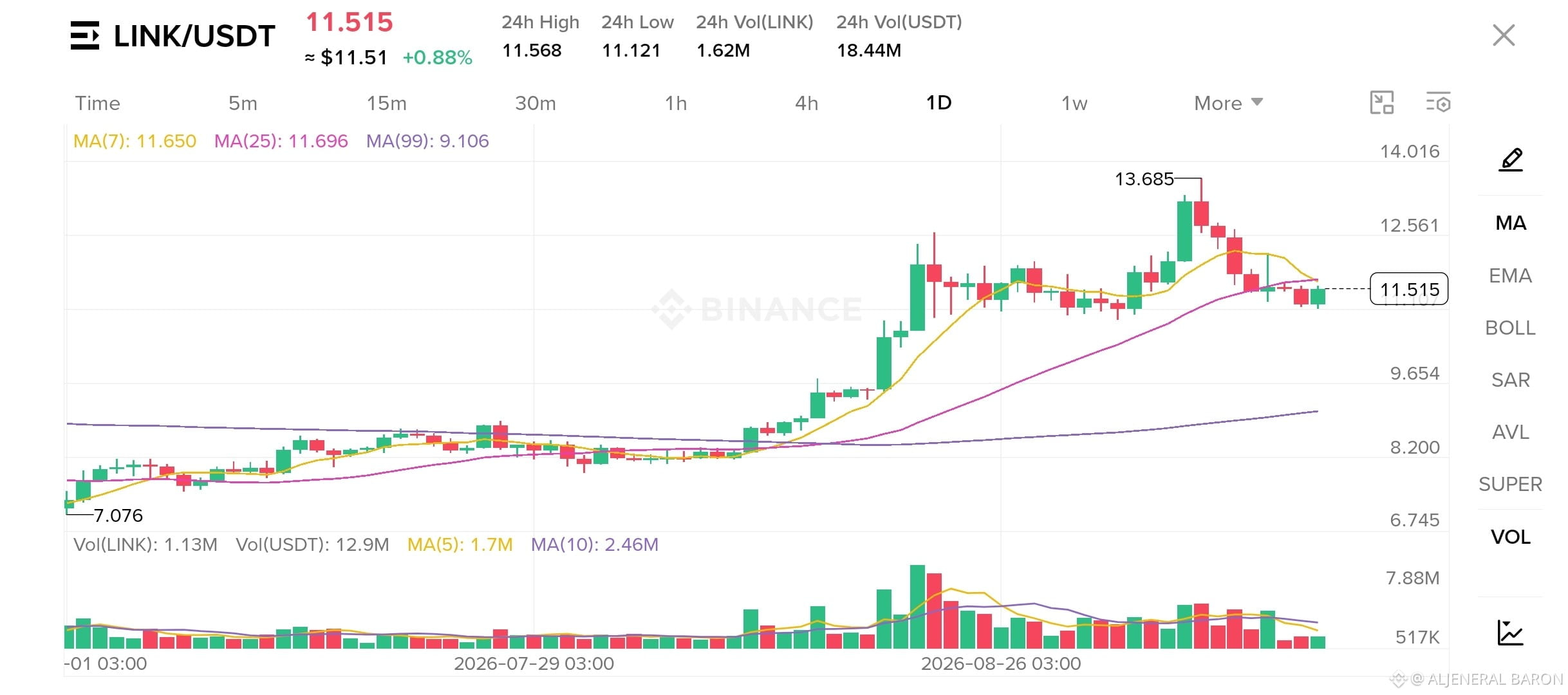
🐋 INFRASTRUCTURE WHALE WATCH: Liquidity Heatmap & Level Breakdowns
Infrastructure and Oracle heavyweights ($LINK , $TIA , $PYTH ) are compressing at critical trendline supports. Let's trace where the smart money liquidity is resting across the daily timeframe:
📡 1. LINK - Retesting Macro Support Zone
• Current Price: $11.515
• Resistance: $12.56 - $13.685 | Major Support: $11.12 - $11.50
• Liquidity Analysis: LINK pulled back sharply from its $13.685 peak and is currently consolidating around the MA(7) and MA(25) cluster ($11.65–$11.69). Decreasing sell volume indicates smart money accumulation around $11.12. Holding this zone keeps the bullish structure intact.
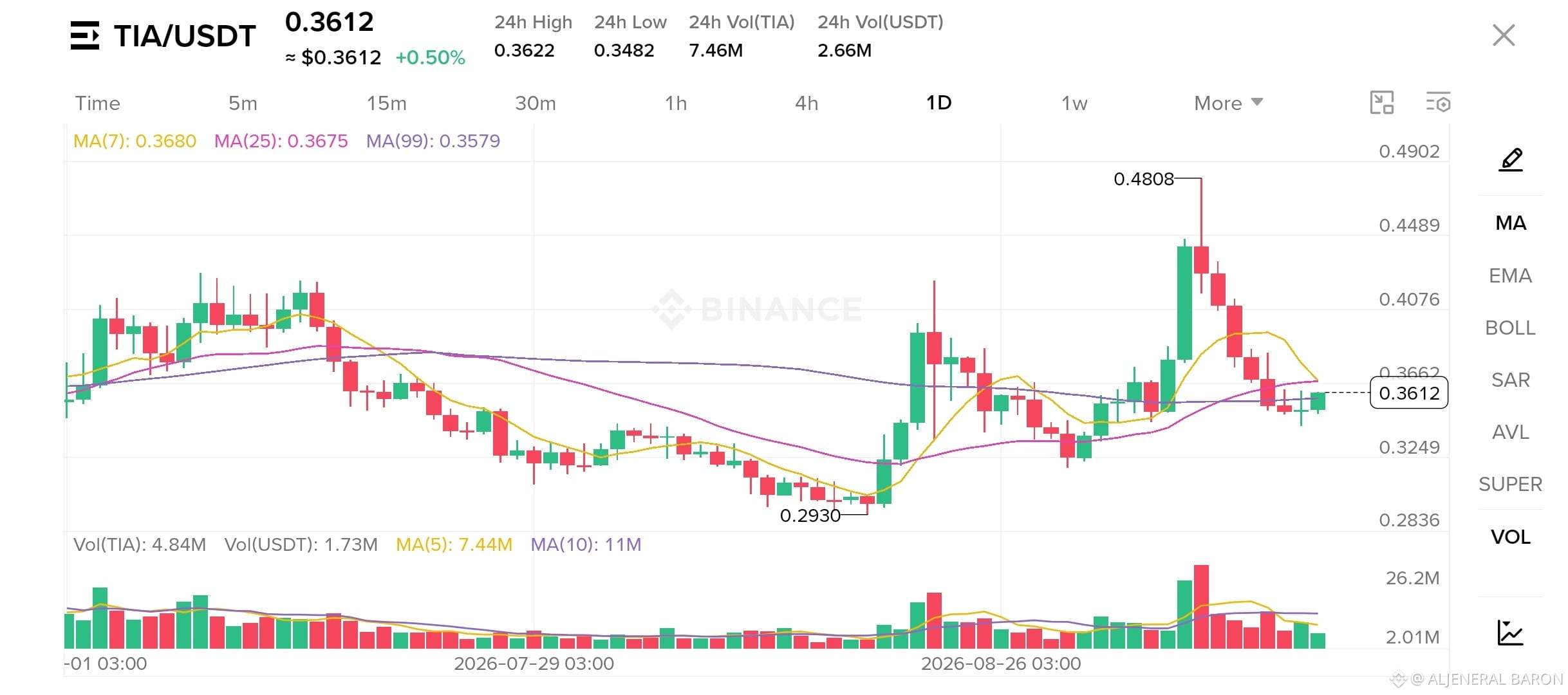
⚡ 2. TIA - Coiling at the MA(99) Floor
• Current Price: $0.3612
• Resistance: $0.4076 - $0.4808 | Primary Support: $0.3482 - $0.3579
• Liquidity Analysis: TIA is hovering right on top of its MA(99) line ($0.3579) after a rejection at $0.4808. A high-volume push above $0.3680 (MA7) could quickly trigger a squeeze toward $0.40, while losing $0.3482 opens liquidity down to $0.2930.
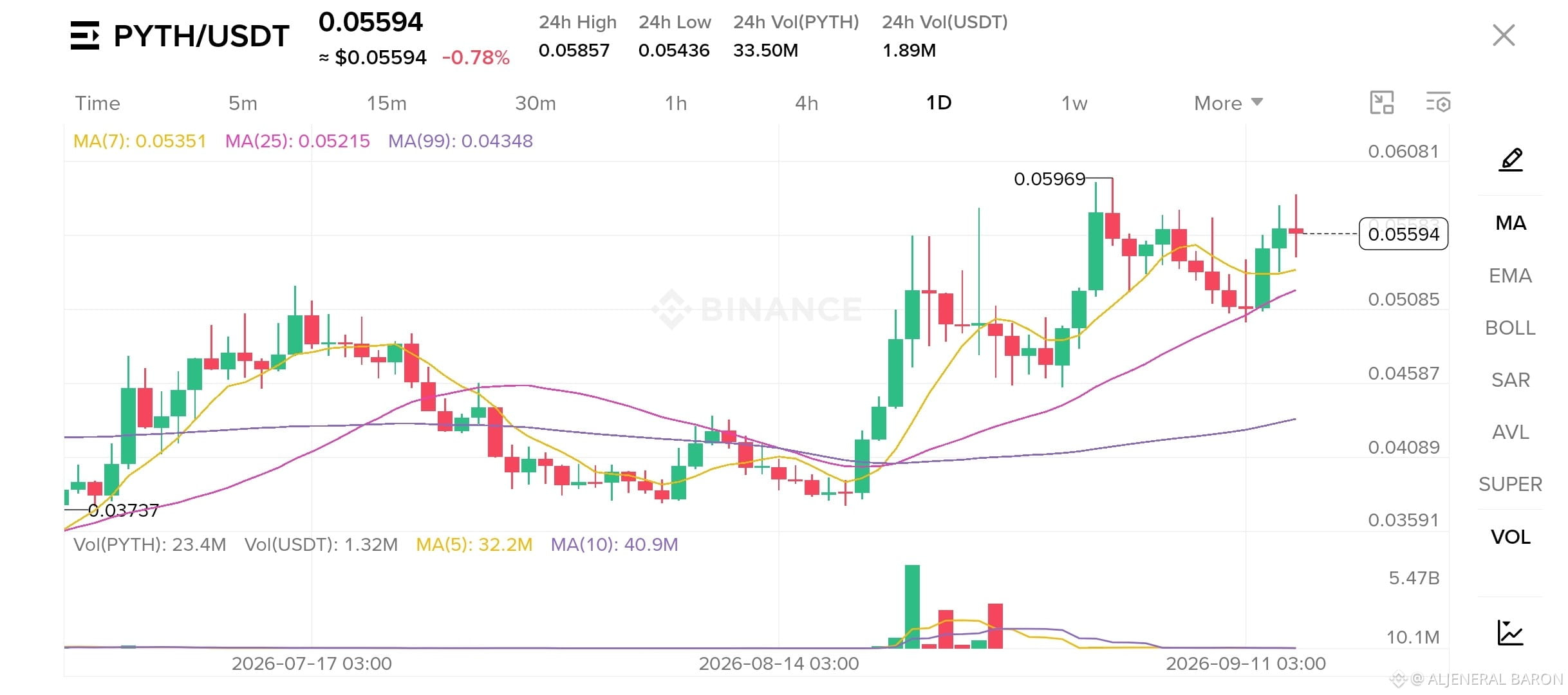
🔮 3. PYTH - Bullish Trendline Holding
• Current Price: $0.05594
• Resistance: $0.05969 | Key Support: $0.05215 (MA25)
• Liquidity Analysis: PYTH continues to print clean higher lows above its moving averages ($0.0535 MA7 / $0.0521 MA25). The chart shows steady absorption from buyers. Reclaiming $0.05969 could unleash a breakout leg toward new local highs.
🎯 Which infrastructure token shows the cleanest setup for the next liquidity grab?
👇 Drop your pick below!
#Chainlink #TIA #PYTH #CryptoInfrastructure #BinanceSquare
🐋 INFRASTRUCTURE WHALE WATCH: Liquidity Heatmap & Level Breakdowns
Infrastructure and Oracle heavyweights ($LINK , $TIA , $PYTH ) are compressing at critical trendline supports. Let's trace where the smart money liquidity is resting across the daily timeframe:
📡 1. LINK - Retesting Macro Support Zone
• Current Price: $11.515
• Resistance: $12.56 - $13.685 | Major Support: $11.12 - $11.50
• Liquidity Analysis: LINK pulled back sharply from its $13.685 peak and is currently consolidating around the MA(7) and MA(25) cluster ($11.65–$11.69). Decreasing sell volume indicates smart money accumulation around $11.12. Holding this zone keeps the bullish structure intact.
⚡ 2. TIA - Coiling at the MA(99) Floor
• Current Price: $0.3612
• Resistance: $0.4076 - $0.4808 | Primary Support: $0.3482 - $0.3579
• Liquidity Analysis: TIA is hovering right on top of its MA(99) line ($0.3579) after a rejection at $0.4808. A high-volume push above $0.3680 (MA7) could quickly trigger a squeeze toward $0.40, while losing $0.3482 opens liquidity down to $0.2930.
🔮 3. PYTH - Bullish Trendline Holding
• Current Price: $0.05594
• Resistance: $0.05969 | Key Support: $0.05215 (MA25)
• Liquidity Analysis: PYTH continues to print clean higher lows above its moving averages ($0.0535 MA7 / $0.0521 MA25). The chart shows steady absorption from buyers. Reclaiming $0.05969 could unleash a breakout leg toward new local highs.
🎯 Which infrastructure token shows the cleanest setup for the next liquidity grab?
👇 Drop your pick below!
#Chainlink #TIA #PYTH #CryptoInfrastructure #BinanceSquare
Infrastructure and Oracle heavyweights ($LINK , $TIA , $PYTH ) are compressing at critical trendline supports. Let's trace where the smart money liquidity is resting across the daily timeframe:
📡 1. LINK - Retesting Macro Support Zone
• Current Price: $11.515
• Resistance: $12.56 - $13.685 | Major Support: $11.12 - $11.50
• Liquidity Analysis: LINK pulled back sharply from its $13.685 peak and is currently consolidating around the MA(7) and MA(25) cluster ($11.65–$11.69). Decreasing sell volume indicates smart money accumulation around $11.12. Holding this zone keeps the bullish structure intact.
⚡ 2. TIA - Coiling at the MA(99) Floor
• Current Price: $0.3612
• Resistance: $0.4076 - $0.4808 | Primary Support: $0.3482 - $0.3579
• Liquidity Analysis: TIA is hovering right on top of its MA(99) line ($0.3579) after a rejection at $0.4808. A high-volume push above $0.3680 (MA7) could quickly trigger a squeeze toward $0.40, while losing $0.3482 opens liquidity down to $0.2930.
🔮 3. PYTH - Bullish Trendline Holding
• Current Price: $0.05594
• Resistance: $0.05969 | Key Support: $0.05215 (MA25)
• Liquidity Analysis: PYTH continues to print clean higher lows above its moving averages ($0.0535 MA7 / $0.0521 MA25). The chart shows steady absorption from buyers. Reclaiming $0.05969 could unleash a breakout leg toward new local highs.
🎯 Which infrastructure token shows the cleanest setup for the next liquidity grab?
👇 Drop your pick below!
#Chainlink #TIA #PYTH #CryptoInfrastructure #BinanceSquare
1
2
346

·
--
Kaiko pulled off a major move—traditional finance giants (S&P, BNP Paribas) just threw $110M its way! When data companies get serious backing from traditional players, you know crypto is about to hit a new level.
Hey folks, take note: this isn’t just small-time hype. Traditional money is starting to recognize crypto data infrastructure, which shows the industry’s maturity is increasing. Mainstream coins like Bitcoin and Ethereum may see a fresh round of capital inflows.
Remember: traditional finance entering the space usually means crypto is being officially adopted. Long term, this is bullish!
Kaiko pulling off a major move with traditional finance giants (S&P, BNP Paribas) throwing $110M their way! When data companies get serious backing from traditional players, you know crypto's about to hit a new level.
Peeps take note: traditional money recognizing crypto infrastructure signals industry maturation. Bitcoin, Ethereum are likely to see fresh institutional flows.
Remember: traditional finance entry usually means crypto is getting officially adopted. Long term, this is bullish!
#CryptoInfrastructure $BTC $ETH
Kaiko pulled off a major move—traditional finance giants (S&P, BNP Paribas) just threw $110M its way! When data companies get serious backing from traditional players, you know crypto is about to hit a new level.
Hey folks, take note: this isn’t just small-time hype. Traditional money is starting to recognize crypto data infrastructure, which shows the industry’s maturity is increasing. Mainstream coins like Bitcoin and Ethereum may see a fresh round of capital inflows.
Remember: traditional finance entering the space usually means crypto is being officially adopted. Long term, this is bullish!
Kaiko pulling off a major move with traditional finance giants (S&P, BNP Paribas) throwing $110M their way! When data companies get serious backing from traditional players, you know crypto's about to hit a new level.
Peeps take note: traditional money recognizing crypto infrastructure signals industry maturation. Bitcoin, Ethereum are likely to see fresh institutional flows.
Remember: traditional finance entry usually means crypto is getting officially adopted. Long term, this is bullish!
#CryptoInfrastructure $BTC $ETH
Hey folks, take note: this isn’t just small-time hype. Traditional money is starting to recognize crypto data infrastructure, which shows the industry’s maturity is increasing. Mainstream coins like Bitcoin and Ethereum may see a fresh round of capital inflows.
Remember: traditional finance entering the space usually means crypto is being officially adopted. Long term, this is bullish!
Kaiko pulling off a major move with traditional finance giants (S&P, BNP Paribas) throwing $110M their way! When data companies get serious backing from traditional players, you know crypto's about to hit a new level.
Peeps take note: traditional money recognizing crypto infrastructure signals industry maturation. Bitcoin, Ethereum are likely to see fresh institutional flows.
Remember: traditional finance entry usually means crypto is getting officially adopted. Long term, this is bullish!
#CryptoInfrastructure $BTC $ETH
140
·
--
Binance isn’t just an exchange.
It’s the infrastructure crypto runs on.
Deep liquidity and price discovery.
Regulated custody and compliance.
Fiat and stablecoin rails.
Payments that actually settle.
Now: Agent OS so AI apps can tap trading, data, wallets, and on-chain tools through a single layer.
Network status today: core services operating. Always check deposit/withdrawal routes for your asset before you move funds.
Infrastructure isn’t the headline. It’s what keeps the market open 24/7.
#Binance #CryptoInfrastructure
Binance isn’t just an exchange.
It’s the infrastructure crypto runs on.
Deep liquidity and price discovery.
Regulated custody and compliance.
Fiat and stablecoin rails.
Payments that actually settle.
Now: Agent OS so AI apps can tap trading, data, wallets, and on-chain tools through a single layer.
Network status today: core services operating. Always check deposit/withdrawal routes for your asset before you move funds.
Infrastructure isn’t the headline. It’s what keeps the market open 24/7.
#Binance #CryptoInfrastructure
It’s the infrastructure crypto runs on.
Deep liquidity and price discovery.
Regulated custody and compliance.
Fiat and stablecoin rails.
Payments that actually settle.
Now: Agent OS so AI apps can tap trading, data, wallets, and on-chain tools through a single layer.
Network status today: core services operating. Always check deposit/withdrawal routes for your asset before you move funds.
Infrastructure isn’t the headline. It’s what keeps the market open 24/7.
#Binance #CryptoInfrastructure
34

·
--
Without $LINK , DeFi simply cannot function 🔗
Price feeds, verifiable randomness, and the Cross-Chain Interoperability Protocol (CCIP) make Chainlink the backbone of decentralized finance. When major banks experiment with blockchain settlements, CCIP is frequently the bridge.
Infrastructure projects don't always pump overnight, but they are built to last across market cycles.
Is $LINK an essential long-term hold in your bag? 💼
#Chainlink #Oracle #CryptoInfrastructure
Without $LINK , DeFi simply cannot function 🔗
Price feeds, verifiable randomness, and the Cross-Chain Interoperability Protocol (CCIP) make Chainlink the backbone of decentralized finance. When major banks experiment with blockchain settlements, CCIP is frequently the bridge.
Infrastructure projects don't always pump overnight, but they are built to last across market cycles.
Is $LINK an essential long-term hold in your bag? 💼
#Chainlink #Oracle #CryptoInfrastructure
Price feeds, verifiable randomness, and the Cross-Chain Interoperability Protocol (CCIP) make Chainlink the backbone of decentralized finance. When major banks experiment with blockchain settlements, CCIP is frequently the bridge.
Infrastructure projects don't always pump overnight, but they are built to last across market cycles.
Is $LINK an essential long-term hold in your bag? 💼
#Chainlink #Oracle #CryptoInfrastructure
15
·
--
Cross-chain liquidity fragmentation is crypto's most expensive invisible tax.
Right now every chain is an island. Your $ETH sits on Ethereum. Your $SOL lives on Solana. Your $BNB stays on BNB Chain. Moving value between them means bridges — and bridges mean latency, fees, counterparty risk, and the occasional catastrophic exploit.
But the deeper problem isn't just movement. It's fragmentation of liquidity itself. A pool of $50M on one chain and $50M on another isn't a $100M market. It's two separate $50M markets that can't price-discover against each other efficiently.
The projects solving this aren't trying to build one chain to rule them all. They're building infrastructure that makes chains irrelevant to the end user — cross-chain messaging protocols, shared liquidity layers, intent-based execution frameworks where you specify what you want done, not which chain to use.
The parallel to TradFi is exact. Stock exchanges consolidated because fragmented liquidity across regional venues created arbitrage tunnels and inefficient pricing. Crypto is repeating that arc, just with chains instead of exchanges.
The chains that win won't be the ones with the best tech. They'll be the ones that integrate most seamlessly into a cross-chain abstraction layer where users never think about which chain they're on.
$ETH $BNB $SOL
#CrossChain #CryptoInfrastructure #DeFi #Web3
Cross-chain liquidity fragmentation is crypto's most expensive invisible tax.
Right now every chain is an island. Your $ETH sits on Ethereum. Your $SOL lives on Solana. Your $BNB stays on BNB Chain. Moving value between them means bridges — and bridges mean latency, fees, counterparty risk, and the occasional catastrophic exploit.
But the deeper problem isn't just movement. It's fragmentation of liquidity itself. A pool of $50M on one chain and $50M on another isn't a $100M market. It's two separate $50M markets that can't price-discover against each other efficiently.
The projects solving this aren't trying to build one chain to rule them all. They're building infrastructure that makes chains irrelevant to the end user — cross-chain messaging protocols, shared liquidity layers, intent-based execution frameworks where you specify what you want done, not which chain to use.
The parallel to TradFi is exact. Stock exchanges consolidated because fragmented liquidity across regional venues created arbitrage tunnels and inefficient pricing. Crypto is repeating that arc, just with chains instead of exchanges.
The chains that win won't be the ones with the best tech. They'll be the ones that integrate most seamlessly into a cross-chain abstraction layer where users never think about which chain they're on.
$ETH $BNB $SOL
#CrossChain #CryptoInfrastructure #DeFi #Web3
Right now every chain is an island. Your $ETH sits on Ethereum. Your $SOL lives on Solana. Your $BNB stays on BNB Chain. Moving value between them means bridges — and bridges mean latency, fees, counterparty risk, and the occasional catastrophic exploit.
But the deeper problem isn't just movement. It's fragmentation of liquidity itself. A pool of $50M on one chain and $50M on another isn't a $100M market. It's two separate $50M markets that can't price-discover against each other efficiently.
The projects solving this aren't trying to build one chain to rule them all. They're building infrastructure that makes chains irrelevant to the end user — cross-chain messaging protocols, shared liquidity layers, intent-based execution frameworks where you specify what you want done, not which chain to use.
The parallel to TradFi is exact. Stock exchanges consolidated because fragmented liquidity across regional venues created arbitrage tunnels and inefficient pricing. Crypto is repeating that arc, just with chains instead of exchanges.
The chains that win won't be the ones with the best tech. They'll be the ones that integrate most seamlessly into a cross-chain abstraction layer where users never think about which chain they're on.
$ETH $BNB $SOL
#CrossChain #CryptoInfrastructure #DeFi #Web3
64
·
--
The Layer 1 race stopped being about TPS a long time ago. Most people just haven't noticed yet.
Throughput numbers are a marketing exercise. What actually determines which chain wins institutional and developer mindshare is the tooling layer — the debuggers, oracles, SDKs, account abstraction modules, and testing frameworks that make building real applications possible.
$ETH figured this out first. The reason Ethereum dominates DeFi TVL isn't speed — it's that every developer tool you could possibly need already exists, is battle-tested, and has years of audit history behind it. That's a moat you can't replicate with a higher gas limit.
$SOL took a different bet: make the runtime fast enough that tooling constraints matter less. It worked for consumer-facing apps and high-frequency trading, but the developer experience gap is still real. Solana is closing it fast — but closing a gap is different from having one.
$BNB quietly built the most accessible onboarding pipeline in crypto. BNB Chain's developer tooling isn't the most sophisticated, but it's the most frictionless. That matters when you're competing for the next million builders, not the next hundred.
Here's the thesis: the L1 that wins in 2026-2027 won't have the highest TPS. It'll have the best developer experience. Builder gravity is everything.
#Layer1 #CryptoInfrastructure #Web3 #DeveloperTools
The Layer 1 race stopped being about TPS a long time ago. Most people just haven't noticed yet.
Throughput numbers are a marketing exercise. What actually determines which chain wins institutional and developer mindshare is the tooling layer — the debuggers, oracles, SDKs, account abstraction modules, and testing frameworks that make building real applications possible.
$ETH figured this out first. The reason Ethereum dominates DeFi TVL isn't speed — it's that every developer tool you could possibly need already exists, is battle-tested, and has years of audit history behind it. That's a moat you can't replicate with a higher gas limit.
$SOL took a different bet: make the runtime fast enough that tooling constraints matter less. It worked for consumer-facing apps and high-frequency trading, but the developer experience gap is still real. Solana is closing it fast — but closing a gap is different from having one.
$BNB quietly built the most accessible onboarding pipeline in crypto. BNB Chain's developer tooling isn't the most sophisticated, but it's the most frictionless. That matters when you're competing for the next million builders, not the next hundred.
Here's the thesis: the L1 that wins in 2026-2027 won't have the highest TPS. It'll have the best developer experience. Builder gravity is everything.
#Layer1 #CryptoInfrastructure #Web3 #DeveloperTools
Throughput numbers are a marketing exercise. What actually determines which chain wins institutional and developer mindshare is the tooling layer — the debuggers, oracles, SDKs, account abstraction modules, and testing frameworks that make building real applications possible.
$ETH figured this out first. The reason Ethereum dominates DeFi TVL isn't speed — it's that every developer tool you could possibly need already exists, is battle-tested, and has years of audit history behind it. That's a moat you can't replicate with a higher gas limit.
$SOL took a different bet: make the runtime fast enough that tooling constraints matter less. It worked for consumer-facing apps and high-frequency trading, but the developer experience gap is still real. Solana is closing it fast — but closing a gap is different from having one.
$BNB quietly built the most accessible onboarding pipeline in crypto. BNB Chain's developer tooling isn't the most sophisticated, but it's the most frictionless. That matters when you're competing for the next million builders, not the next hundred.
Here's the thesis: the L1 that wins in 2026-2027 won't have the highest TPS. It'll have the best developer experience. Builder gravity is everything.
#Layer1 #CryptoInfrastructure #Web3 #DeveloperTools
64
·
--
The next 100 million crypto users won't know which chain they're on — and that's exactly the point.
Chain abstraction is quietly becoming the most important infrastructure shift in crypto. For years, the industry treated cross-chain UX as a bridge problem. Build a better bridge, and users will come. But bridges are duct tape. They're slow, they fragment liquidity, and they introduce attack surface after attack surface.
The real unlock isn't better bridges. It's eliminating the need for users to think about chains at all.
Intent-based architecture is doing this. Instead of asking users to pick a chain, sign a transaction, wait for confirmation, switch networks, and sign again — users express what they want. A decentralized solver network handles routing, execution, and settlement across chains. The user sees a single confirmation. The backend handles the rest.
This matters because value accrual is shifting. When users don't know which chain they're on, the chain with the deepest liquidity and most reliable settlement wins — not the chain with the best marketing. $ETH settlement finality becomes infrastructure. $BNB chain distribution becomes a rail. $SOL execution speed becomes a commodity.
The chains that survive chain abstraction are the ones that stop competing for user attention and start competing for solver liquidity. That's a fundamentally different game.
The projects building solver networks, intent routers, and unified liquidity layers today are laying the rails for the next cycle. Not the next narrative — the actual infrastructure that makes crypto usable for people who don't care about crypto.
That's the real mass adoption thesis. Not everyone gets a wallet and learns gas fees. But everyone uses crypto without knowing it.
#CrossChain #ChainAbstraction #CryptoInfrastructure #DeFi
The next 100 million crypto users won't know which chain they're on — and that's exactly the point.
Chain abstraction is quietly becoming the most important infrastructure shift in crypto. For years, the industry treated cross-chain UX as a bridge problem. Build a better bridge, and users will come. But bridges are duct tape. They're slow, they fragment liquidity, and they introduce attack surface after attack surface.
The real unlock isn't better bridges. It's eliminating the need for users to think about chains at all.
Intent-based architecture is doing this. Instead of asking users to pick a chain, sign a transaction, wait for confirmation, switch networks, and sign again — users express what they want. A decentralized solver network handles routing, execution, and settlement across chains. The user sees a single confirmation. The backend handles the rest.
This matters because value accrual is shifting. When users don't know which chain they're on, the chain with the deepest liquidity and most reliable settlement wins — not the chain with the best marketing. $ETH settlement finality becomes infrastructure. $BNB chain distribution becomes a rail. $SOL execution speed becomes a commodity.
The chains that survive chain abstraction are the ones that stop competing for user attention and start competing for solver liquidity. That's a fundamentally different game.
The projects building solver networks, intent routers, and unified liquidity layers today are laying the rails for the next cycle. Not the next narrative — the actual infrastructure that makes crypto usable for people who don't care about crypto.
That's the real mass adoption thesis. Not everyone gets a wallet and learns gas fees. But everyone uses crypto without knowing it.
#CrossChain #ChainAbstraction #CryptoInfrastructure #DeFi
Chain abstraction is quietly becoming the most important infrastructure shift in crypto. For years, the industry treated cross-chain UX as a bridge problem. Build a better bridge, and users will come. But bridges are duct tape. They're slow, they fragment liquidity, and they introduce attack surface after attack surface.
The real unlock isn't better bridges. It's eliminating the need for users to think about chains at all.
Intent-based architecture is doing this. Instead of asking users to pick a chain, sign a transaction, wait for confirmation, switch networks, and sign again — users express what they want. A decentralized solver network handles routing, execution, and settlement across chains. The user sees a single confirmation. The backend handles the rest.
This matters because value accrual is shifting. When users don't know which chain they're on, the chain with the deepest liquidity and most reliable settlement wins — not the chain with the best marketing. $ETH settlement finality becomes infrastructure. $BNB chain distribution becomes a rail. $SOL execution speed becomes a commodity.
The chains that survive chain abstraction are the ones that stop competing for user attention and start competing for solver liquidity. That's a fundamentally different game.
The projects building solver networks, intent routers, and unified liquidity layers today are laying the rails for the next cycle. Not the next narrative — the actual infrastructure that makes crypto usable for people who don't care about crypto.
That's the real mass adoption thesis. Not everyone gets a wallet and learns gas fees. But everyone uses crypto without knowing it.
#CrossChain #ChainAbstraction #CryptoInfrastructure #DeFi
96
Log in to explore more content
Join global crypto users on Binance Square
⚡️ Get latest and useful information about crypto.
💬 Trusted by the world’s largest crypto exchange.
👍 Discover real insights from verified creators.
Email / Phone number
Trending Topics
1
#CircleMints500MUSDCOnSolana
106,668 views
2,247 Discussing
2
#PolymarketBankFailureBetsDrawFDICConcern
101,772 views
1,952 Discussing
3
#BlackRockBuildsTokenizedPortfoliosForOndo
96,570 views
1,393 Discussing
4
#BitwiseFilesToListNEARETFOnNYSEArca
73,041 views
1,133 Discussing
5
#SECCommissionerPeirceToLeaveOct2
76,524 views
929 Discussing
6
#SECSaysBuybacksUpgradesDontMakeTokenSecurity
59,743 views
665 Discussing
7
#StrategyProposesDailyDividendsForPreferreds
14,501 views
245 Discussing
8
#CircleTetherFreezeBitgetHackerWallet
14,488 views
143 Discussing
9
#CoinMarketCapCompletesCoinglassAcquisition
15,861 views
194 Discussing
10
#QNTRises39%
123,326 views
1,730 Discussing