

#ethereumfoundationlauncheszkapionmainnet
ethereumfoundationlauncheszkapionmainnet
93,241 views
843 Discussing
Hot
Latest

·
--
AI knows your prompt.
But does it need to know who PAID for it? 👀
Ethereum just made that question interesting.
The Ethereum Foundation + Open Anonymity Project have launched zkAPI on Ethereum mainnet.
The idea:
You fund API credits → use a zero-knowledge proof → access an AI/API service without directly linking each request to the wallet that funded it.
Important: this does NOT make your prompt invisible to the AI provider.
It separates payment identity from usage.
And that makes me wonder…
If AI agents eventually pay for models, data and services themselves, could private machine-to-machine payments become a real Ethereum use case?
YES or NO? 👇
—Master CX
$ETH
#EthereumFoundationLaunchesZkAPIOnMainnet
AI knows your prompt.
But does it need to know who PAID for it? 👀
Ethereum just made that question interesting.
The Ethereum Foundation + Open Anonymity Project have launched zkAPI on Ethereum mainnet.
The idea:
You fund API credits → use a zero-knowledge proof → access an AI/API service without directly linking each request to the wallet that funded it.
Important: this does NOT make your prompt invisible to the AI provider.
It separates payment identity from usage.
And that makes me wonder…
If AI agents eventually pay for models, data and services themselves, could private machine-to-machine payments become a real Ethereum use case?
YES or NO? 👇
—Master CX
$ETH
#EthereumFoundationLaunchesZkAPIOnMainnet
But does it need to know who PAID for it? 👀
Ethereum just made that question interesting.
The Ethereum Foundation + Open Anonymity Project have launched zkAPI on Ethereum mainnet.
The idea:
You fund API credits → use a zero-knowledge proof → access an AI/API service without directly linking each request to the wallet that funded it.
Important: this does NOT make your prompt invisible to the AI provider.
It separates payment identity from usage.
And that makes me wonder…
If AI agents eventually pay for models, data and services themselves, could private machine-to-machine payments become a real Ethereum use case?
YES or NO? 👇
—Master CX
$ETH
#EthereumFoundationLaunchesZkAPIOnMainnet
31


·
--
Verified
🔐 Ethereum zkAPI: Is Privacy the Ultimate Catalyst for ETH?
Privacy has long been the missing piece for mainstream institutional and retail adoption on public blockchains. With the introduction of zkAPI on Ethereum, zero-knowledge technology is transforming on-chain payments by enabling privacy-preserving transactions directly on the layer-1 network.
💡 How zkAPI Transforms On-Chain Payments
Traditional public ledgers expose all transactional details, including wallet balances and counterparties. The integration of zkAPI allows users and institutions to execute payments while revealing only the necessary cryptographic proofs, ensuring complete confidentiality without compromising security or regulatory compliance.
🚀 Why This Is Highly Bullish for ETH
🌐 1. Increased Institutional Capital Flows
Institutions have hesitated to move major treasury operations on-chain due to corporate privacy concerns. zkAPI removes this barrier, enabling compliant corporate payments, payroll, and high-value settlements on Ethereum.
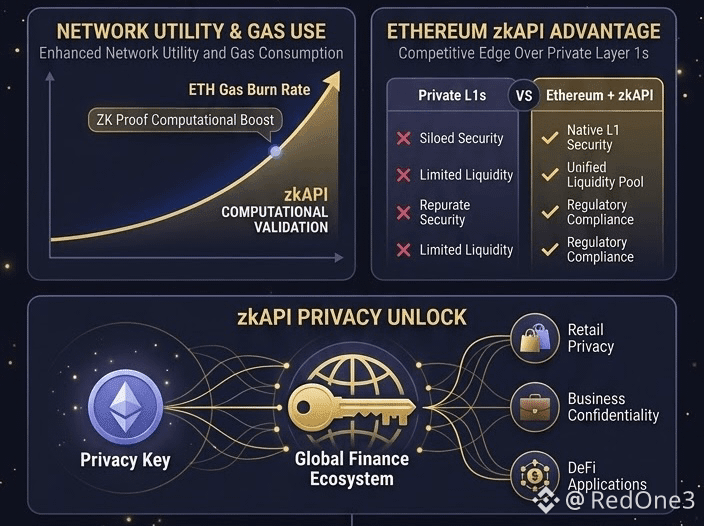
🔥 2. Enhanced Network Utility and Gas Consumption
Privacy-focused smart contract interactions require additional computational validation. As adoption scales, demand for ETH as gas will rise, directly driving network revenue and burn rate under EIP-1559.
🛡️ 3. Competitive Edge Over Private Layer 1s
By embedding zero-knowledge privacy tooling into its ecosystem, Ethereum diminishes the market share of dedicated privacy chains while offering native security and liquidity.
📉 Conclusion
The launch of zkAPI bridges the gap between decentralized transparency and enterprise privacy requirements. This milestone strengthens the long-term utility proposition for ETH, solidifying its place as the settlement layer for global finance.
#Ethereum #ETH #zkAPI
#ethereumfoundationlauncheszkapionmainnet .
🔐 Ethereum zkAPI: Is Privacy the Ultimate Catalyst for ETH?
Privacy has long been the missing piece for mainstream institutional and retail adoption on public blockchains. With the introduction of zkAPI on Ethereum, zero-knowledge technology is transforming on-chain payments by enabling privacy-preserving transactions directly on the layer-1 network.
💡 How zkAPI Transforms On-Chain Payments
Traditional public ledgers expose all transactional details, including wallet balances and counterparties. The integration of zkAPI allows users and institutions to execute payments while revealing only the necessary cryptographic proofs, ensuring complete confidentiality without compromising security or regulatory compliance.
🚀 Why This Is Highly Bullish for ETH
🌐 1. Increased Institutional Capital Flows
Institutions have hesitated to move major treasury operations on-chain due to corporate privacy concerns. zkAPI removes this barrier, enabling compliant corporate payments, payroll, and high-value settlements on Ethereum.
🔥 2. Enhanced Network Utility and Gas Consumption
Privacy-focused smart contract interactions require additional computational validation. As adoption scales, demand for ETH as gas will rise, directly driving network revenue and burn rate under EIP-1559.
🛡️ 3. Competitive Edge Over Private Layer 1s
By embedding zero-knowledge privacy tooling into its ecosystem, Ethereum diminishes the market share of dedicated privacy chains while offering native security and liquidity.
📉 Conclusion
The launch of zkAPI bridges the gap between decentralized transparency and enterprise privacy requirements. This milestone strengthens the long-term utility proposition for ETH, solidifying its place as the settlement layer for global finance.
#Ethereum #ETH #zkAPI
#ethereumfoundationlauncheszkapionmainnet .
Privacy has long been the missing piece for mainstream institutional and retail adoption on public blockchains. With the introduction of zkAPI on Ethereum, zero-knowledge technology is transforming on-chain payments by enabling privacy-preserving transactions directly on the layer-1 network.
💡 How zkAPI Transforms On-Chain Payments
Traditional public ledgers expose all transactional details, including wallet balances and counterparties. The integration of zkAPI allows users and institutions to execute payments while revealing only the necessary cryptographic proofs, ensuring complete confidentiality without compromising security or regulatory compliance.
🚀 Why This Is Highly Bullish for ETH
🌐 1. Increased Institutional Capital Flows
Institutions have hesitated to move major treasury operations on-chain due to corporate privacy concerns. zkAPI removes this barrier, enabling compliant corporate payments, payroll, and high-value settlements on Ethereum.
🔥 2. Enhanced Network Utility and Gas Consumption
Privacy-focused smart contract interactions require additional computational validation. As adoption scales, demand for ETH as gas will rise, directly driving network revenue and burn rate under EIP-1559.
🛡️ 3. Competitive Edge Over Private Layer 1s
By embedding zero-knowledge privacy tooling into its ecosystem, Ethereum diminishes the market share of dedicated privacy chains while offering native security and liquidity.
📉 Conclusion
The launch of zkAPI bridges the gap between decentralized transparency and enterprise privacy requirements. This milestone strengthens the long-term utility proposition for ETH, solidifying its place as the settlement layer for global finance.
#Ethereum #ETH #zkAPI
#ethereumfoundationlauncheszkapionmainnet .
244

·
--
Verified
#ethereumfoundationlauncheszkapionmainnet
Ethereum Just Built a Way to Pay for AI Without Revealing Who's Asking
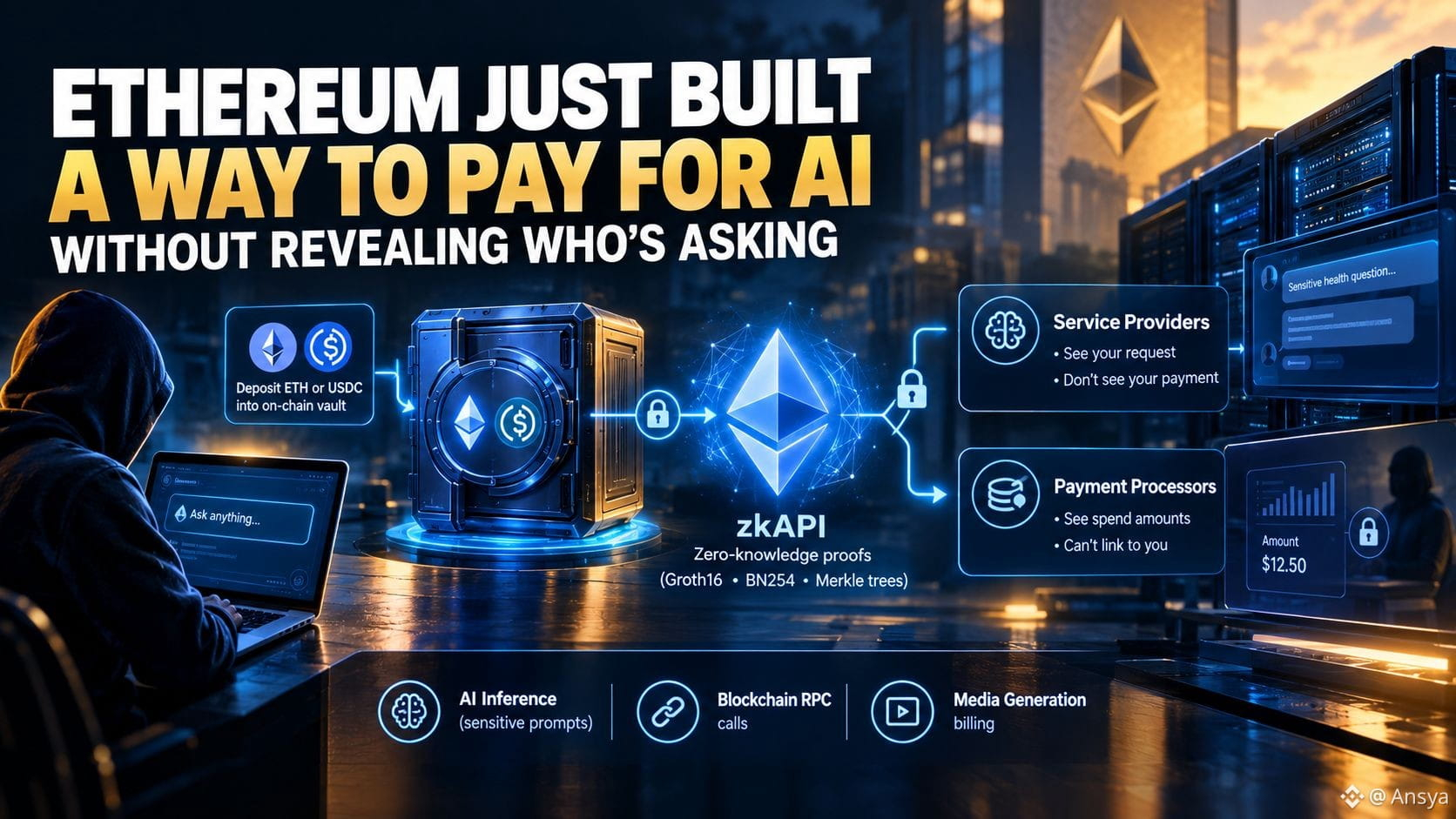
The Ethereum Foundation just launched a system that lets you pay for AI services on-chain while keeping your identity completely separate from what you're actually asking the AI to do.
Here's what shipped: on October 1, the Ethereum Foundation, working with the Open Anonymity Project, deployed zkAPI on Ethereum mainnet — a privacy-preserving payment system built on a design co-authored by researcher Davide Crapis and Ethereum co-founder Vitalik Buterin. The mechanism works by having users deposit ETH or USDC into an on-chain vault, then generate zero-knowledge proofs to demonstrate they hold sufficient credit for an API request without revealing which specific deposit funds it. Service providers see the content of a request but never who's paying for it; payment processors see spend amounts but can't link them to individual users. Built using Groth16, BN254, and Merkle tree cryptography, the system initially targets AI inference — specifically protecting sensitive prompts involving health or financial topics — while also supporting blockchain RPC calls and media generation billing.
Why does this matter? As AI usage grows, so does the amount of sensitive information flowing through prompts tied directly to payment identities. A system that cryptographically separates "who paid" from "what was asked" addresses a privacy gap that's largely gone unaddressed as AI and blockchain payment rails increasingly intersect. It's also a concrete example of zero-knowledge proofs solving a practical, non-speculative problem rather than a purely theoretical one.
Whether this sees meaningful adoption beyond its initial AI-inference use case, or remains a niche privacy tool, will likely depend on how many service providers choose to integrate it.
Does separating payment identity from usage change how comfortable people feel using AI for sensitive tasks? 🤔
#Ethereum #zkAPI #Privacy #AI
$ETH $SAND $US
{future}(USUSDT)
{future}(SANDUSDT)
{future}(ETHUSDT)
#ethereumfoundationlauncheszkapionmainnet
Ethereum Just Built a Way to Pay for AI Without Revealing Who's Asking
The Ethereum Foundation just launched a system that lets you pay for AI services on-chain while keeping your identity completely separate from what you're actually asking the AI to do.
Here's what shipped: on October 1, the Ethereum Foundation, working with the Open Anonymity Project, deployed zkAPI on Ethereum mainnet — a privacy-preserving payment system built on a design co-authored by researcher Davide Crapis and Ethereum co-founder Vitalik Buterin. The mechanism works by having users deposit ETH or USDC into an on-chain vault, then generate zero-knowledge proofs to demonstrate they hold sufficient credit for an API request without revealing which specific deposit funds it. Service providers see the content of a request but never who's paying for it; payment processors see spend amounts but can't link them to individual users. Built using Groth16, BN254, and Merkle tree cryptography, the system initially targets AI inference — specifically protecting sensitive prompts involving health or financial topics — while also supporting blockchain RPC calls and media generation billing.
Why does this matter? As AI usage grows, so does the amount of sensitive information flowing through prompts tied directly to payment identities. A system that cryptographically separates "who paid" from "what was asked" addresses a privacy gap that's largely gone unaddressed as AI and blockchain payment rails increasingly intersect. It's also a concrete example of zero-knowledge proofs solving a practical, non-speculative problem rather than a purely theoretical one.
Whether this sees meaningful adoption beyond its initial AI-inference use case, or remains a niche privacy tool, will likely depend on how many service providers choose to integrate it.
Does separating payment identity from usage change how comfortable people feel using AI for sensitive tasks? 🤔
#Ethereum #zkAPI #Privacy #AI
$ETH $SAND $US
Ethereum Just Built a Way to Pay for AI Without Revealing Who's Asking
The Ethereum Foundation just launched a system that lets you pay for AI services on-chain while keeping your identity completely separate from what you're actually asking the AI to do.
Here's what shipped: on October 1, the Ethereum Foundation, working with the Open Anonymity Project, deployed zkAPI on Ethereum mainnet — a privacy-preserving payment system built on a design co-authored by researcher Davide Crapis and Ethereum co-founder Vitalik Buterin. The mechanism works by having users deposit ETH or USDC into an on-chain vault, then generate zero-knowledge proofs to demonstrate they hold sufficient credit for an API request without revealing which specific deposit funds it. Service providers see the content of a request but never who's paying for it; payment processors see spend amounts but can't link them to individual users. Built using Groth16, BN254, and Merkle tree cryptography, the system initially targets AI inference — specifically protecting sensitive prompts involving health or financial topics — while also supporting blockchain RPC calls and media generation billing.
Why does this matter? As AI usage grows, so does the amount of sensitive information flowing through prompts tied directly to payment identities. A system that cryptographically separates "who paid" from "what was asked" addresses a privacy gap that's largely gone unaddressed as AI and blockchain payment rails increasingly intersect. It's also a concrete example of zero-knowledge proofs solving a practical, non-speculative problem rather than a purely theoretical one.
Whether this sees meaningful adoption beyond its initial AI-inference use case, or remains a niche privacy tool, will likely depend on how many service providers choose to integrate it.
Does separating payment identity from usage change how comfortable people feel using AI for sensitive tasks? 🤔
#Ethereum #zkAPI #Privacy #AI
$ETH $SAND $US
2
3.2k

·
--
Bullish
Verified
#ethereumfoundationlauncheszkapionmainnet
⚡ Ethereum Foundation drops ZkAPI on Mainnet: A game-changer for zero-knowledge scaling!
🔐 PRIVACY & AI CONVERGENCE: The Ethereum Foundation, in collaboration with the Open Anonymity Project, has officially launched zkAPI on the Ethereum mainnet!
By enabling users to turn ETH or USDC deposits into anonymous, metered API credits via zero-knowledge proofs, this release establishes a framework for private payments across Web3 infrastructure and AI model access (supporting OpenAI and Ollama protocols). Here is why this L1 upgrade is generating buzz across the ecosystem 👇
🔍 Key Breakthroughs of zkAPI
1️⃣ Anonymous API Metering: Users can fund access to AI models, RPC endpoints, and cloud services without attaching an address, identity, or credit card to individual API queries.
2️⃣ Native Multi-Asset Support: Supports direct pre-stored ETH and USDC funding, allowing Web3 developers to integrate zkAPI into existing dApps seamlessly without third-party settlement layers.
🎯 Ecosystem & Strategy Watch
🛡️ Ethereum ($ETH) Fundamentals: While zkAPI improves developer utility rather than driving immediate spot buying, expanding Ethereum's role in the AI data economy strengthens long-term L1 network effects
🎯 ZK & L2 Tokens to Watch: $STRK, $ZK,$IMX, and privacy-centric L2s often capture speculative tailwinds whenever the Ethereum Foundation rolls out zero-knowledge breakthroughs.
⚡ Trading Tip: Keep an eye on Layer-2 network adoption metrics over the coming weeks as developers integrate zkAPI for decentralized AI agent micropayments.
💡 Community Poll: How do you see zero-knowledge AI payments impacting ETH?
🚀 Massive long-term bullish catalyst for ETH utility
🧠 Bullish for ZK-scaling tokens ($ZK,$STRK)
📊 Important tech upgrade, but price won't react immediately
$ETH
{future}(ETHUSDT)
Drop your thoughts and predictions in the comments! 👇
#NFPWatch #BitcoinSurpasses$86KUp2.99% #ETH #zkAPI
#ethereumfoundationlauncheszkapionmainnet
⚡ Ethereum Foundation drops ZkAPI on Mainnet: A game-changer for zero-knowledge scaling!
🔐 PRIVACY & AI CONVERGENCE: The Ethereum Foundation, in collaboration with the Open Anonymity Project, has officially launched zkAPI on the Ethereum mainnet!
By enabling users to turn ETH or USDC deposits into anonymous, metered API credits via zero-knowledge proofs, this release establishes a framework for private payments across Web3 infrastructure and AI model access (supporting OpenAI and Ollama protocols). Here is why this L1 upgrade is generating buzz across the ecosystem 👇
🔍 Key Breakthroughs of zkAPI
1️⃣ Anonymous API Metering: Users can fund access to AI models, RPC endpoints, and cloud services without attaching an address, identity, or credit card to individual API queries.
2️⃣ Native Multi-Asset Support: Supports direct pre-stored ETH and USDC funding, allowing Web3 developers to integrate zkAPI into existing dApps seamlessly without third-party settlement layers.
🎯 Ecosystem & Strategy Watch
🛡️ Ethereum ($ETH ) Fundamentals: While zkAPI improves developer utility rather than driving immediate spot buying, expanding Ethereum's role in the AI data economy strengthens long-term L1 network effects
🎯 ZK & L2 Tokens to Watch: $STRK, $ZK,$IMX, and privacy-centric L2s often capture speculative tailwinds whenever the Ethereum Foundation rolls out zero-knowledge breakthroughs.
⚡ Trading Tip: Keep an eye on Layer-2 network adoption metrics over the coming weeks as developers integrate zkAPI for decentralized AI agent micropayments.
💡 Community Poll: How do you see zero-knowledge AI payments impacting ETH?
🚀 Massive long-term bullish catalyst for ETH utility
🧠 Bullish for ZK-scaling tokens ($ZK,$STRK)
📊 Important tech upgrade, but price won't react immediately
$ETH
Drop your thoughts and predictions in the comments! 👇
#NFPWatch #BitcoinSurpasses$86KUp2.99% #ETH #zkAPI
⚡ Ethereum Foundation drops ZkAPI on Mainnet: A game-changer for zero-knowledge scaling!
🔐 PRIVACY & AI CONVERGENCE: The Ethereum Foundation, in collaboration with the Open Anonymity Project, has officially launched zkAPI on the Ethereum mainnet!
By enabling users to turn ETH or USDC deposits into anonymous, metered API credits via zero-knowledge proofs, this release establishes a framework for private payments across Web3 infrastructure and AI model access (supporting OpenAI and Ollama protocols). Here is why this L1 upgrade is generating buzz across the ecosystem 👇
🔍 Key Breakthroughs of zkAPI
1️⃣ Anonymous API Metering: Users can fund access to AI models, RPC endpoints, and cloud services without attaching an address, identity, or credit card to individual API queries.
2️⃣ Native Multi-Asset Support: Supports direct pre-stored ETH and USDC funding, allowing Web3 developers to integrate zkAPI into existing dApps seamlessly without third-party settlement layers.
🎯 Ecosystem & Strategy Watch
🛡️ Ethereum ($ETH ) Fundamentals: While zkAPI improves developer utility rather than driving immediate spot buying, expanding Ethereum's role in the AI data economy strengthens long-term L1 network effects
🎯 ZK & L2 Tokens to Watch: $STRK, $ZK,$IMX, and privacy-centric L2s often capture speculative tailwinds whenever the Ethereum Foundation rolls out zero-knowledge breakthroughs.
⚡ Trading Tip: Keep an eye on Layer-2 network adoption metrics over the coming weeks as developers integrate zkAPI for decentralized AI agent micropayments.
💡 Community Poll: How do you see zero-knowledge AI payments impacting ETH?
🚀 Massive long-term bullish catalyst for ETH utility
🧠 Bullish for ZK-scaling tokens ($ZK,$STRK)
📊 Important tech upgrade, but price won't react immediately
$ETH
Drop your thoughts and predictions in the comments! 👇
#NFPWatch #BitcoinSurpasses$86KUp2.99% #ETH #zkAPI

2
208

If you’re ignoring Ethereum infrastructure updates just because there’s no new token attached, you might be missing an important part of the bigger picture.
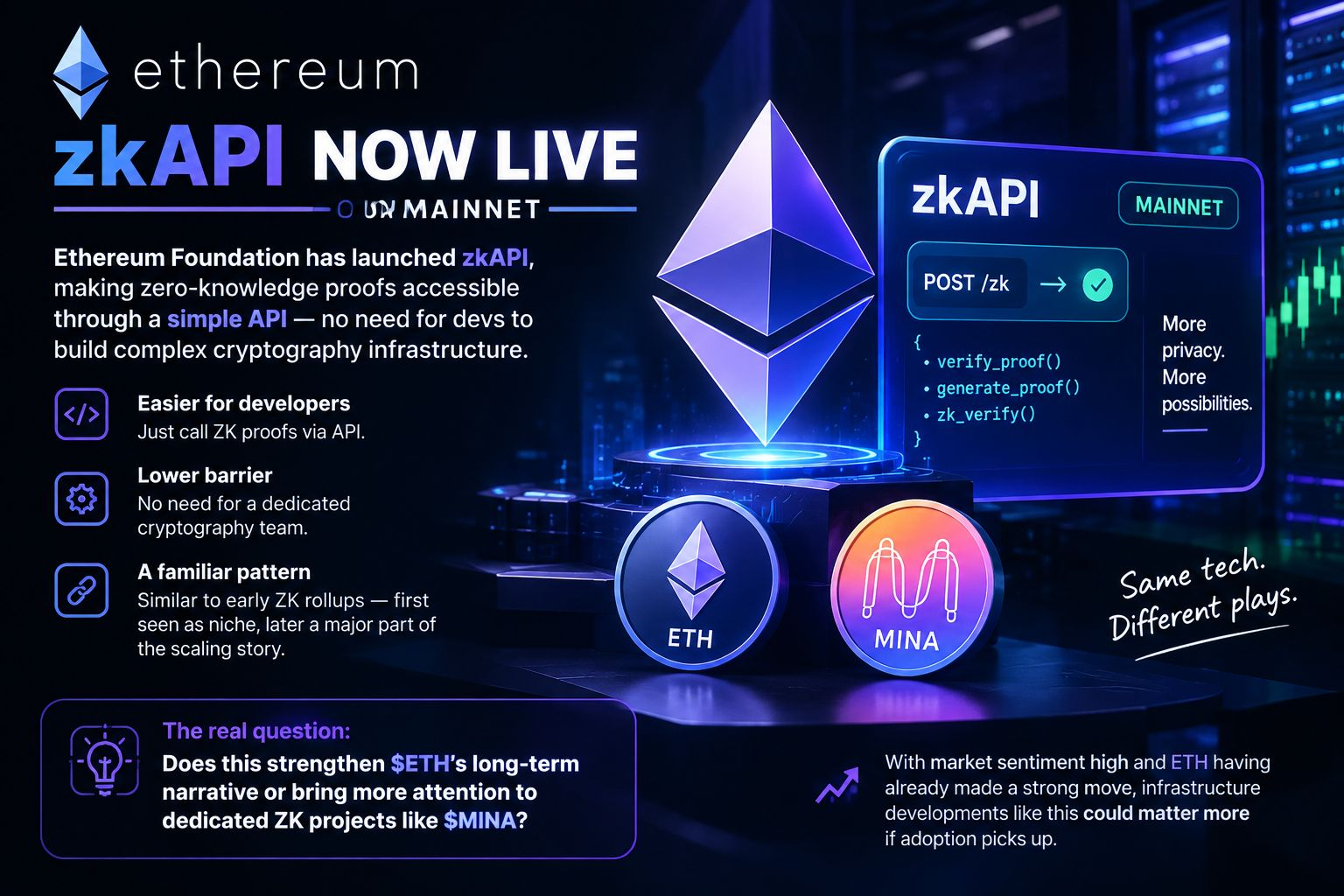
Ethereum Foundation has now brought zkAPI to mainnet, allowing developers to access zero-knowledge proofs through a much simpler API-based approach instead of building complex cryptography infrastructure from scratch.
This kind of development often gets overlooked at first. We saw something similar with early ZK rollups — initially treated as niche technology, before becoming a major part of the Ethereum scaling narrative.
$MINA remains one of the dedicated ZK projects, while Ethereum continues integrating ZK technology directly into its broader ecosystem.
The interesting question is whether this strengthens the long-term $ETH narrative or creates more attention for specialized ZK projects.
With market sentiment already elevated and ETH having made a strong move, infrastructure developments like this could become more relevant if adoption starts accelerating.
Would you focus more on $ETH or dedicated ZK names as this technology develops? 👀
#NFPWatch #ZcashFalls21%FromSeptemberPeak #XRPPostsFirstThreeGreenMonthsInQ3 #EthereumFoundationLaunchesZkAPIOnMainnet #EvernorthPlansNasdaqListingOct8
{spot}(ETHUSDT)
If you’re ignoring Ethereum infrastructure updates just because there’s no new token attached, you might be missing an important part of the bigger picture.
Ethereum Foundation has now brought zkAPI to mainnet, allowing developers to access zero-knowledge proofs through a much simpler API-based approach instead of building complex cryptography infrastructure from scratch.
This kind of development often gets overlooked at first. We saw something similar with early ZK rollups — initially treated as niche technology, before becoming a major part of the Ethereum scaling narrative.
$MINA remains one of the dedicated ZK projects, while Ethereum continues integrating ZK technology directly into its broader ecosystem.
The interesting question is whether this strengthens the long-term $ETH narrative or creates more attention for specialized ZK projects.
With market sentiment already elevated and ETH having made a strong move, infrastructure developments like this could become more relevant if adoption starts accelerating.
Would you focus more on $ETH or dedicated ZK names as this technology develops? 👀
#NFPWatch #ZcashFalls21%FromSeptemberPeak #XRPPostsFirstThreeGreenMonthsInQ3 #EthereumFoundationLaunchesZkAPIOnMainnet #EvernorthPlansNasdaqListingOct8
Ethereum Foundation has now brought zkAPI to mainnet, allowing developers to access zero-knowledge proofs through a much simpler API-based approach instead of building complex cryptography infrastructure from scratch.
This kind of development often gets overlooked at first. We saw something similar with early ZK rollups — initially treated as niche technology, before becoming a major part of the Ethereum scaling narrative.
$MINA remains one of the dedicated ZK projects, while Ethereum continues integrating ZK technology directly into its broader ecosystem.
The interesting question is whether this strengthens the long-term $ETH narrative or creates more attention for specialized ZK projects.
With market sentiment already elevated and ETH having made a strong move, infrastructure developments like this could become more relevant if adoption starts accelerating.
Would you focus more on $ETH or dedicated ZK names as this technology develops? 👀
#NFPWatch #ZcashFalls21%FromSeptemberPeak #XRPPostsFirstThreeGreenMonthsInQ3 #EthereumFoundationLaunchesZkAPIOnMainnet #EvernorthPlansNasdaqListingOct8
182

·
--
If you're still skipping Ethereum infrastructure news because it doesn't come with a new ticker, stop now.
That habit is how traders miss the cheap part of the cycle and then overpay once the narrative finally shows up. I've done it, you've done it. We all pretended a GitHub commit wasn't a catalyst until the chart disagreed.
The Ethereum Foundation just put zkAPI live on mainnet. Devs can call zero-knowledge proofs like a normal API instead of assembling a cryptography team. We've seen this exact shrug before. First zk rollup launches were treated like academic side projects, then they ate the entire L2 conversation. $MINA has been the ZK specialist for years and still gets sidelined while Ethereum just absorbs the idea into the base layer. That's the L1 playbook. Copy the homework, own the classroom.
Greed index sitting at 70, search bar stuffed with $USDT and whatever pumped overnight. Meanwhile Ether already ran hard and an API launch is the last thing anyone wants to discuss. Which is usually when it actually matters.
Does this change how you think about $ETH versus the dedicated ZK names, or does price just ignore it until it doesn't?
#EthereumFoundationLaunchesZkAPIOnMainnet #EtherGains70
If you're still skipping Ethereum infrastructure news because it doesn't come with a new ticker, stop now.
That habit is how traders miss the cheap part of the cycle and then overpay once the narrative finally shows up. I've done it, you've done it. We all pretended a GitHub commit wasn't a catalyst until the chart disagreed.
The Ethereum Foundation just put zkAPI live on mainnet. Devs can call zero-knowledge proofs like a normal API instead of assembling a cryptography team. We've seen this exact shrug before. First zk rollup launches were treated like academic side projects, then they ate the entire L2 conversation. $MINA has been the ZK specialist for years and still gets sidelined while Ethereum just absorbs the idea into the base layer. That's the L1 playbook. Copy the homework, own the classroom.
Greed index sitting at 70, search bar stuffed with $USDT and whatever pumped overnight. Meanwhile Ether already ran hard and an API launch is the last thing anyone wants to discuss. Which is usually when it actually matters.
Does this change how you think about $ETH versus the dedicated ZK names, or does price just ignore it until it doesn't?
#EthereumFoundationLaunchesZkAPIOnMainnet #EtherGains70
That habit is how traders miss the cheap part of the cycle and then overpay once the narrative finally shows up. I've done it, you've done it. We all pretended a GitHub commit wasn't a catalyst until the chart disagreed.
The Ethereum Foundation just put zkAPI live on mainnet. Devs can call zero-knowledge proofs like a normal API instead of assembling a cryptography team. We've seen this exact shrug before. First zk rollup launches were treated like academic side projects, then they ate the entire L2 conversation. $MINA has been the ZK specialist for years and still gets sidelined while Ethereum just absorbs the idea into the base layer. That's the L1 playbook. Copy the homework, own the classroom.
Greed index sitting at 70, search bar stuffed with $USDT and whatever pumped overnight. Meanwhile Ether already ran hard and an API launch is the last thing anyone wants to discuss. Which is usually when it actually matters.
Does this change how you think about $ETH versus the dedicated ZK names, or does price just ignore it until it doesn't?
#EthereumFoundationLaunchesZkAPIOnMainnet #EtherGains70
129

Have you noticed nobody is talking about the Ethereum Foundation launching a ZK API on mainnet while $FIL sits at the top of searches?
Traders keep jumping into whatever is pumping and getting caught in the reversal. They never quite know when to exit or rotate into something with actual staying power like $ETH.
The ZK API is a genuine step forward even if it does not make headlines. Developers can integrate zero-knowledge proofs on mainnet far more easily now, which supports better privacy and more efficient scaling for the whole ecosystem. Ethereum needed practical tools like this to stay the chain people actually build on.
Most of the market is sitting in greed and looking the other way. To actually use this information, keep an eye on $ETH pullbacks and look at how $AAVE could benefit from improved ZK capabilities in DeFi.
Where do you think this goes from here?
#EthereumFoundationLaunchesZkAPIOnMainnet #EtherGains70
Have you noticed nobody is talking about the Ethereum Foundation launching a ZK API on mainnet while $FIL sits at the top of searches?
Traders keep jumping into whatever is pumping and getting caught in the reversal. They never quite know when to exit or rotate into something with actual staying power like $ETH .
The ZK API is a genuine step forward even if it does not make headlines. Developers can integrate zero-knowledge proofs on mainnet far more easily now, which supports better privacy and more efficient scaling for the whole ecosystem. Ethereum needed practical tools like this to stay the chain people actually build on.
Most of the market is sitting in greed and looking the other way. To actually use this information, keep an eye on $ETH pullbacks and look at how $AAVE could benefit from improved ZK capabilities in DeFi.
Where do you think this goes from here?
#EthereumFoundationLaunchesZkAPIOnMainnet #EtherGains70
Traders keep jumping into whatever is pumping and getting caught in the reversal. They never quite know when to exit or rotate into something with actual staying power like $ETH .
The ZK API is a genuine step forward even if it does not make headlines. Developers can integrate zero-knowledge proofs on mainnet far more easily now, which supports better privacy and more efficient scaling for the whole ecosystem. Ethereum needed practical tools like this to stay the chain people actually build on.
Most of the market is sitting in greed and looking the other way. To actually use this information, keep an eye on $ETH pullbacks and look at how $AAVE could benefit from improved ZK capabilities in DeFi.
Where do you think this goes from here?
#EthereumFoundationLaunchesZkAPIOnMainnet #EtherGains70

59

·
--
Bullish
Verified
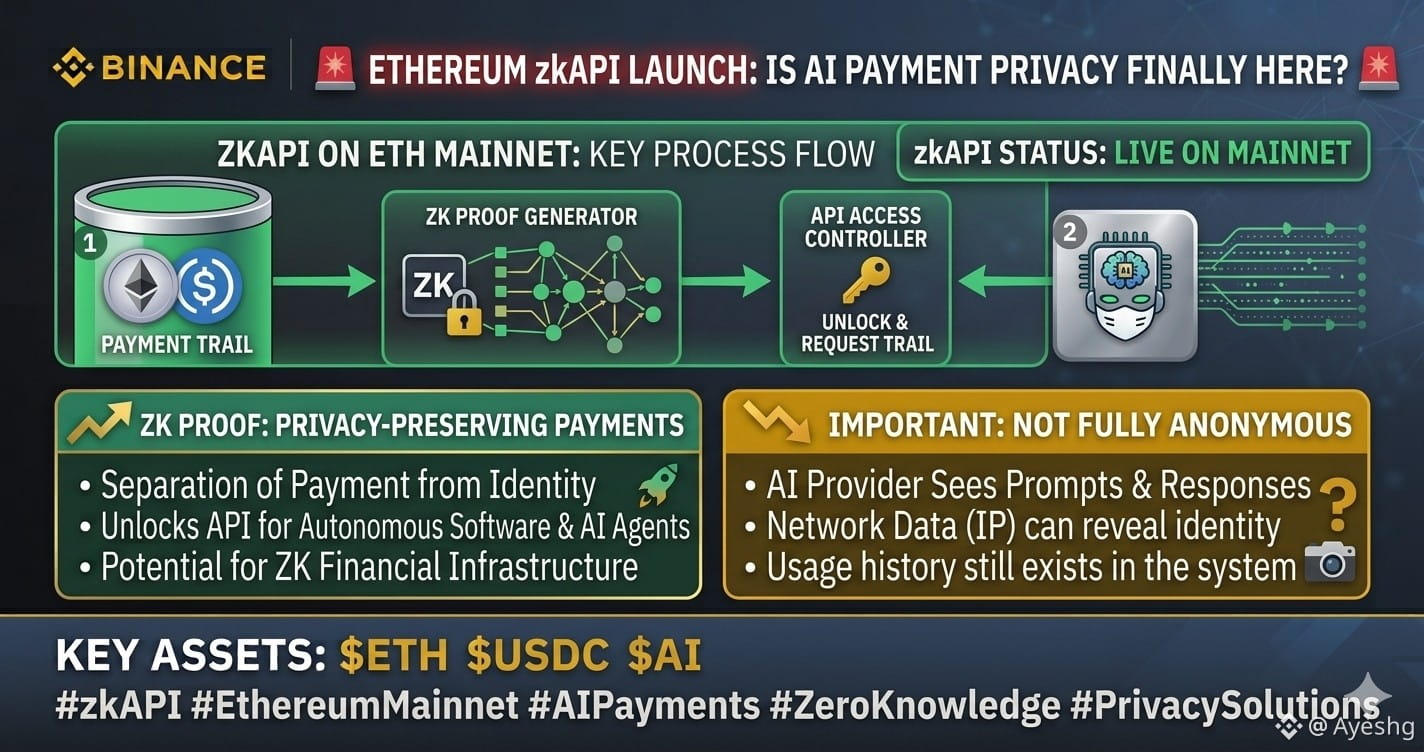
#ethereumfoundationlauncheszkapionmainnet 🚨 ETHEREUM JUST MADE AI PAYMENTS PRIVATE — BUT NOT FULLY ANONYMOUS
Ethereum Foundation and the Open Anonymity Project have launched zkAPI on Ethereum mainnet, introducing a way to pay for metered API usage without directly linking the payment to the user.
🔐 How it works:
Users deposit assets such as ETH or USDC into an Ethereum vault. Instead of sending an identity-linked API key, the client generates a zero-knowledge proof showing that the user has funds available.
A short-lived API key is then issued, separating the payment trail from the actual API request.
In simple terms:
Payment → ZK Proof → API Access
Instead of:
Payment → Identity → Permanent Usage History
The technology isn't limited to AI. Ethereum Foundation lists potential applications including:
🤖 AI agents & inference
⛓️ Blockchain RPC
🎨 Image/video generation
🌐 VPN & bandwidth services
⚙️ Machine-to-machine payments
But there is an important limitation.
zkAPI does not make AI usage completely anonymous. The AI provider can still see prompts and responses, while network information such as an IP address can potentially reveal or correlate activity. Timing and prompt content can also create privacy leaks.
So the bigger innovation isn't simply “private AI.”
It's the possibility of privacy-preserving payments becoming financial infrastructure for autonomous software and AI agents.
zkAPI is live on Ethereum mainnet, but real-world adoption and economic scale are still unproven.
$ETH $USDC $AI
#Ethereum #ETH #AI #Crypto #Privacy #ZeroKnowledge #zkAPI
#ethereumfoundationlauncheszkapionmainnet 🚨 ETHEREUM JUST MADE AI PAYMENTS PRIVATE — BUT NOT FULLY ANONYMOUS
Ethereum Foundation and the Open Anonymity Project have launched zkAPI on Ethereum mainnet, introducing a way to pay for metered API usage without directly linking the payment to the user.
🔐 How it works:
Users deposit assets such as ETH or USDC into an Ethereum vault. Instead of sending an identity-linked API key, the client generates a zero-knowledge proof showing that the user has funds available.
A short-lived API key is then issued, separating the payment trail from the actual API request.
In simple terms:
Payment → ZK Proof → API Access
Instead of:
Payment → Identity → Permanent Usage History
The technology isn't limited to AI. Ethereum Foundation lists potential applications including:
🤖 AI agents & inference
⛓️ Blockchain RPC
🎨 Image/video generation
🌐 VPN & bandwidth services
⚙️ Machine-to-machine payments
But there is an important limitation.
zkAPI does not make AI usage completely anonymous. The AI provider can still see prompts and responses, while network information such as an IP address can potentially reveal or correlate activity. Timing and prompt content can also create privacy leaks.
So the bigger innovation isn't simply “private AI.”
It's the possibility of privacy-preserving payments becoming financial infrastructure for autonomous software and AI agents.
zkAPI is live on Ethereum mainnet, but real-world adoption and economic scale are still unproven.
$ETH $USDC $AI
#Ethereum #ETH #AI #Crypto #Privacy #ZeroKnowledge #zkAPI
Ethereum Foundation and the Open Anonymity Project have launched zkAPI on Ethereum mainnet, introducing a way to pay for metered API usage without directly linking the payment to the user.
🔐 How it works:
Users deposit assets such as ETH or USDC into an Ethereum vault. Instead of sending an identity-linked API key, the client generates a zero-knowledge proof showing that the user has funds available.
A short-lived API key is then issued, separating the payment trail from the actual API request.
In simple terms:
Payment → ZK Proof → API Access
Instead of:
Payment → Identity → Permanent Usage History
The technology isn't limited to AI. Ethereum Foundation lists potential applications including:
🤖 AI agents & inference
⛓️ Blockchain RPC
🎨 Image/video generation
🌐 VPN & bandwidth services
⚙️ Machine-to-machine payments
But there is an important limitation.
zkAPI does not make AI usage completely anonymous. The AI provider can still see prompts and responses, while network information such as an IP address can potentially reveal or correlate activity. Timing and prompt content can also create privacy leaks.
So the bigger innovation isn't simply “private AI.”
It's the possibility of privacy-preserving payments becoming financial infrastructure for autonomous software and AI agents.
zkAPI is live on Ethereum mainnet, but real-world adoption and economic scale are still unproven.
$ETH $USDC $AI
#Ethereum #ETH #AI #Crypto #Privacy #ZeroKnowledge #zkAPI
925

·
--
Verified
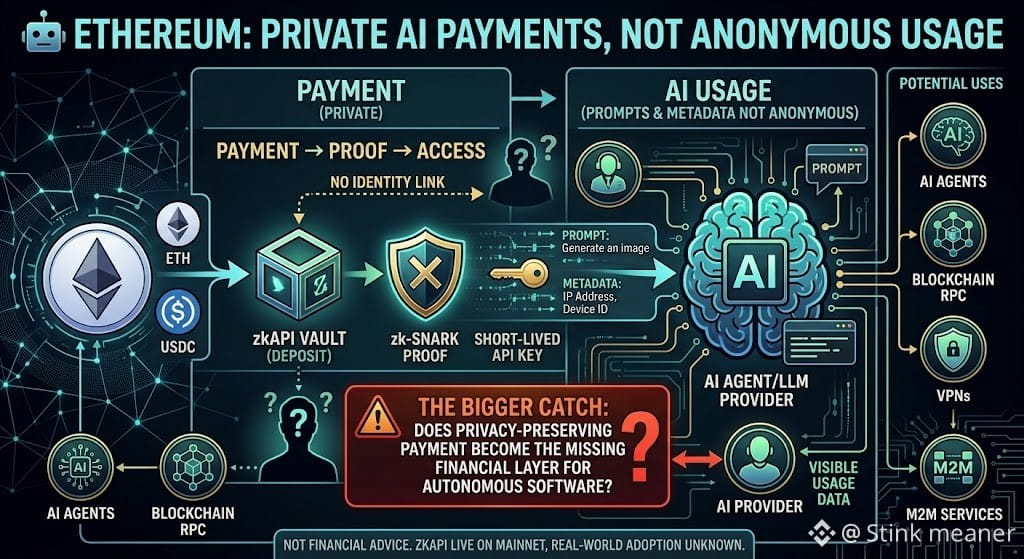
🤖 Ethereum just made AI payments private. But it didn't make AI usage anonymous...
#ethereumfoundationlauncheszkapionmainnet
The Ethereum Foundation and Open Anonymity Project just put zkAPI live on Ethereum mainnet.
Users can deposit ETH or USDC into a vault, then prove they have paid for API usage without revealing which deposit or identity is behind the request. The system issues short-lived API keys and separates the payment trail from the AI request.
That's a bigger shift than “private AI.”
It's:
payment → proof → access
without:
payment → identity → permanent usage history
And the architecture isn't limited to AI. Ethereum Foundation lists AI agents, blockchain RPC, image generation, VPNs and machine-to-machine services as potential uses.
But there's a catch.
The provider can still see your prompts and network metadata. zkAPI hides the billing link, not the entire activity trail.
So the bigger question is:
Does privacy-preserving payment become the missing financial layer for autonomous software?
Not financial advice. zkAPI is live on mainnet, but real-world adoption and economic scale have not yet been established.
$ETH $USDC $ZKC
#Ethereum #AI #EtherGains70.9%InQ3 #EthereumFoundationLaunchesZkAPIOnMainnet
🤖 Ethereum just made AI payments private. But it didn't make AI usage anonymous...
#ethereumfoundationlauncheszkapionmainnet
The Ethereum Foundation and Open Anonymity Project just put zkAPI live on Ethereum mainnet.
Users can deposit ETH or USDC into a vault, then prove they have paid for API usage without revealing which deposit or identity is behind the request. The system issues short-lived API keys and separates the payment trail from the AI request.
That's a bigger shift than “private AI.”
It's:
payment → proof → access
without:
payment → identity → permanent usage history
And the architecture isn't limited to AI. Ethereum Foundation lists AI agents, blockchain RPC, image generation, VPNs and machine-to-machine services as potential uses.
But there's a catch.
The provider can still see your prompts and network metadata. zkAPI hides the billing link, not the entire activity trail.
So the bigger question is:
Does privacy-preserving payment become the missing financial layer for autonomous software?
Not financial advice. zkAPI is live on mainnet, but real-world adoption and economic scale have not yet been established.
$ETH $USDC $ZKC
#Ethereum #AI #EtherGains70.9%InQ3 #EthereumFoundationLaunchesZkAPIOnMainnet
#ethereumfoundationlauncheszkapionmainnet
The Ethereum Foundation and Open Anonymity Project just put zkAPI live on Ethereum mainnet.
Users can deposit ETH or USDC into a vault, then prove they have paid for API usage without revealing which deposit or identity is behind the request. The system issues short-lived API keys and separates the payment trail from the AI request.
That's a bigger shift than “private AI.”
It's:
payment → proof → access
without:
payment → identity → permanent usage history
And the architecture isn't limited to AI. Ethereum Foundation lists AI agents, blockchain RPC, image generation, VPNs and machine-to-machine services as potential uses.
But there's a catch.
The provider can still see your prompts and network metadata. zkAPI hides the billing link, not the entire activity trail.
So the bigger question is:
Does privacy-preserving payment become the missing financial layer for autonomous software?
Not financial advice. zkAPI is live on mainnet, but real-world adoption and economic scale have not yet been established.
$ETH $USDC $ZKC
#Ethereum #AI #EtherGains70.9%InQ3 #EthereumFoundationLaunchesZkAPIOnMainnet
10
7.3k

·
--
#EthereumFoundationLaunchesZkAPIOnMainnet
The $ETH
{future}(ETHUSDT)
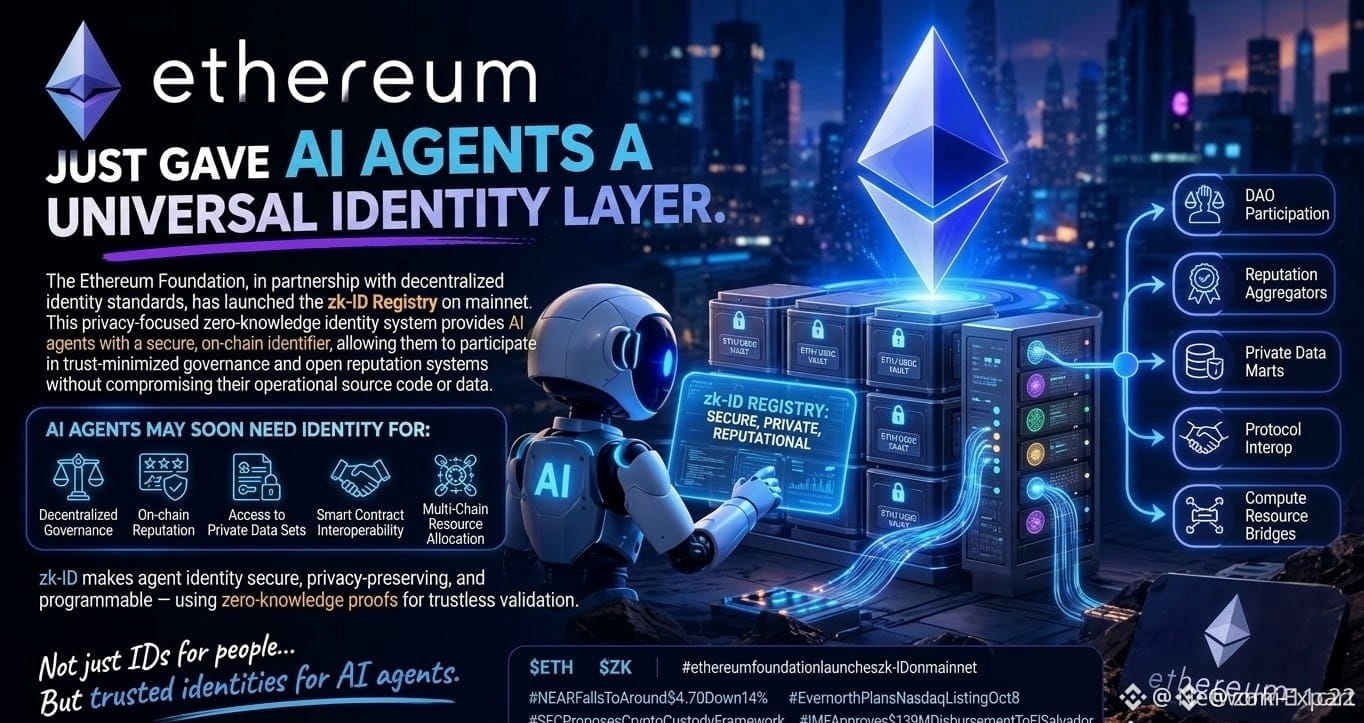
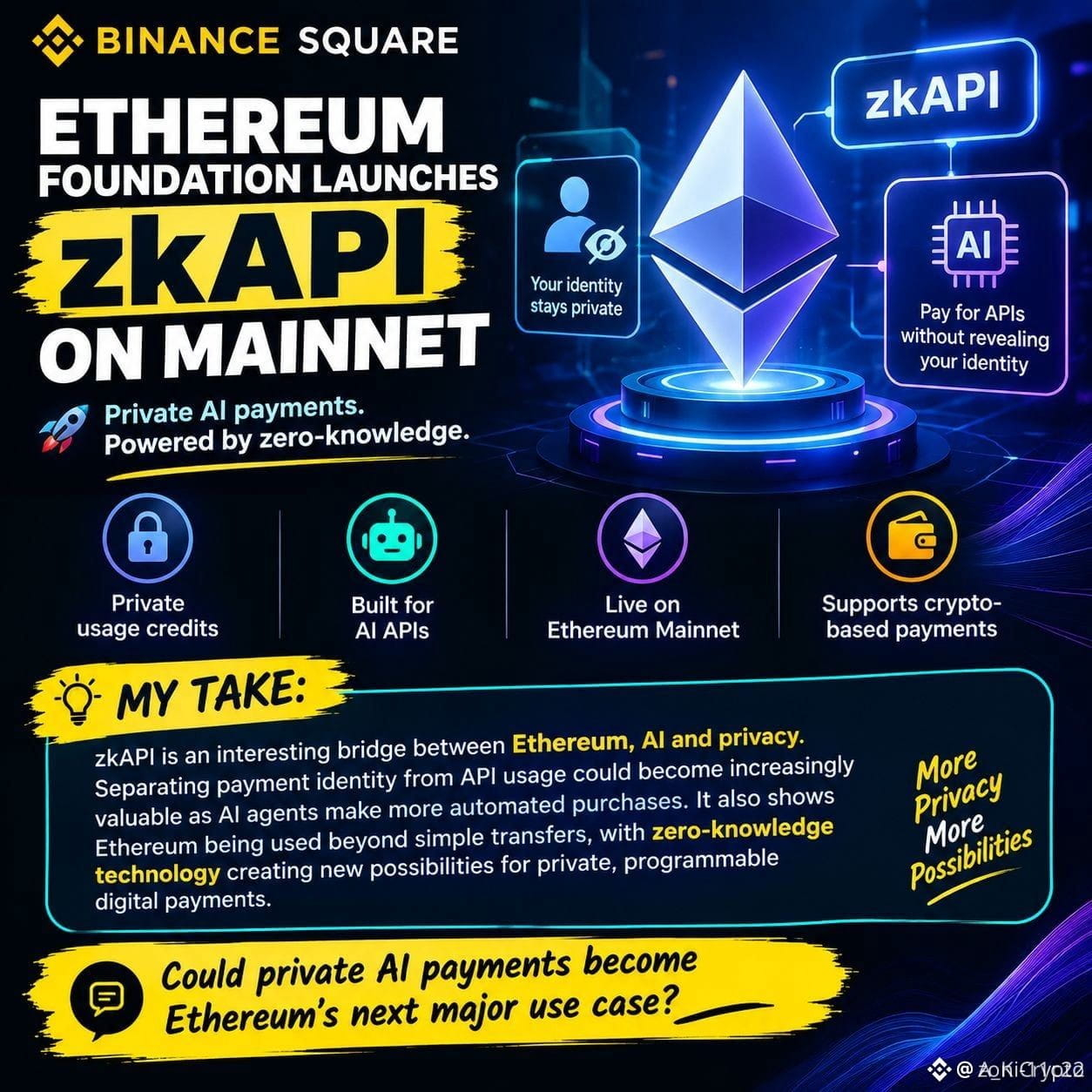
ereum Foundation, in collaboration with the Open Anonymity Project, has officially launched zkAPI on the Ethereum mainnet. [1, 2]
This new privacy infrastructure turns a February proposal co-authored by Vitalik Buterin and Davide Crapis into a working mainnet reality. The system allows users to pay for metered AI models and other usage-based APIs without linking their payments to their real-world billing identities. [1, 2, 3]
$NVDAB
{spot}(NVDABUSDT)
$XUSD
{spot}(XUSDUSDT)
#EthereumFoundationLaunchesZkAPIOnMainnet
The $ETH
ereum Foundation, in collaboration with the Open Anonymity Project, has officially launched zkAPI on the Ethereum mainnet. [1, 2]
This new privacy infrastructure turns a February proposal co-authored by Vitalik Buterin and Davide Crapis into a working mainnet reality. The system allows users to pay for metered AI models and other usage-based APIs without linking their payments to their real-world billing identities. [1, 2, 3]
$NVDAB
$XUSD
The $ETH
ereum Foundation, in collaboration with the Open Anonymity Project, has officially launched zkAPI on the Ethereum mainnet. [1, 2]
This new privacy infrastructure turns a February proposal co-authored by Vitalik Buterin and Davide Crapis into a working mainnet reality. The system allows users to pay for metered AI models and other usage-based APIs without linking their payments to their real-world billing identities. [1, 2, 3]
$NVDAB
$XUSD
67

Verified
#ethereumfoundationlauncheszkapionmainnet
Are you tired of AI companies tracking every prompt you make? Ethereum just solved the ultimate privacy problem. 🚨
The Ethereum Foundation and the Open Anonymity Project have officially launched zkAPI on the Ethereum mainnet!
What does this mean? It’s a total game-changer for AI and API payments. Today, every AI prompt you send is linked to your billing identity. zkAPI fixes this by separating payment from identity using Zero-Knowledge (ZK) proofs.
Here is how it works:
1️⃣ Deposit ETH orUSDC into a smart contract vault on Ethereum.
2️⃣ Your balance becomes a private, untraceable digital note.
3️⃣ Pay for metered AI usage with ZK proofs—no identity attached!
The AI provider sees your prompt, the payment layer sees the spend, but NO ONE can link them together. This brings absolute privacy to personal AI usage, keeping your sensitive health, financial, and personal queries completely anonymous.
This is a massive leap for real-world utility and privacy on the Ethereum network. 🌐
Are you bullish on ZK tech scaling Web3 privacy? Drop your thoughts below! 👇
$ETH $ZKC
#Ethereum #zkAPI #CryptoAi
#ethereumfoundationlauncheszkapionmainnet
Are you tired of AI companies tracking every prompt you make? Ethereum just solved the ultimate privacy problem. 🚨
The Ethereum Foundation and the Open Anonymity Project have officially launched zkAPI on the Ethereum mainnet!
What does this mean? It’s a total game-changer for AI and API payments. Today, every AI prompt you send is linked to your billing identity. zkAPI fixes this by separating payment from identity using Zero-Knowledge (ZK) proofs.
Here is how it works:
1️⃣ Deposit ETH orUSDC into a smart contract vault on Ethereum.
2️⃣ Your balance becomes a private, untraceable digital note.
3️⃣ Pay for metered AI usage with ZK proofs—no identity attached!
The AI provider sees your prompt, the payment layer sees the spend, but NO ONE can link them together. This brings absolute privacy to personal AI usage, keeping your sensitive health, financial, and personal queries completely anonymous.
This is a massive leap for real-world utility and privacy on the Ethereum network. 🌐
Are you bullish on ZK tech scaling Web3 privacy? Drop your thoughts below! 👇
$ETH $ZKC
#Ethereum #zkAPI #CryptoAi
Are you tired of AI companies tracking every prompt you make? Ethereum just solved the ultimate privacy problem. 🚨
The Ethereum Foundation and the Open Anonymity Project have officially launched zkAPI on the Ethereum mainnet!
What does this mean? It’s a total game-changer for AI and API payments. Today, every AI prompt you send is linked to your billing identity. zkAPI fixes this by separating payment from identity using Zero-Knowledge (ZK) proofs.
Here is how it works:
1️⃣ Deposit ETH orUSDC into a smart contract vault on Ethereum.
2️⃣ Your balance becomes a private, untraceable digital note.
3️⃣ Pay for metered AI usage with ZK proofs—no identity attached!
The AI provider sees your prompt, the payment layer sees the spend, but NO ONE can link them together. This brings absolute privacy to personal AI usage, keeping your sensitive health, financial, and personal queries completely anonymous.
This is a massive leap for real-world utility and privacy on the Ethereum network. 🌐
Are you bullish on ZK tech scaling Web3 privacy? Drop your thoughts below! 👇
$ETH $ZKC
#Ethereum #zkAPI #CryptoAi
1
745

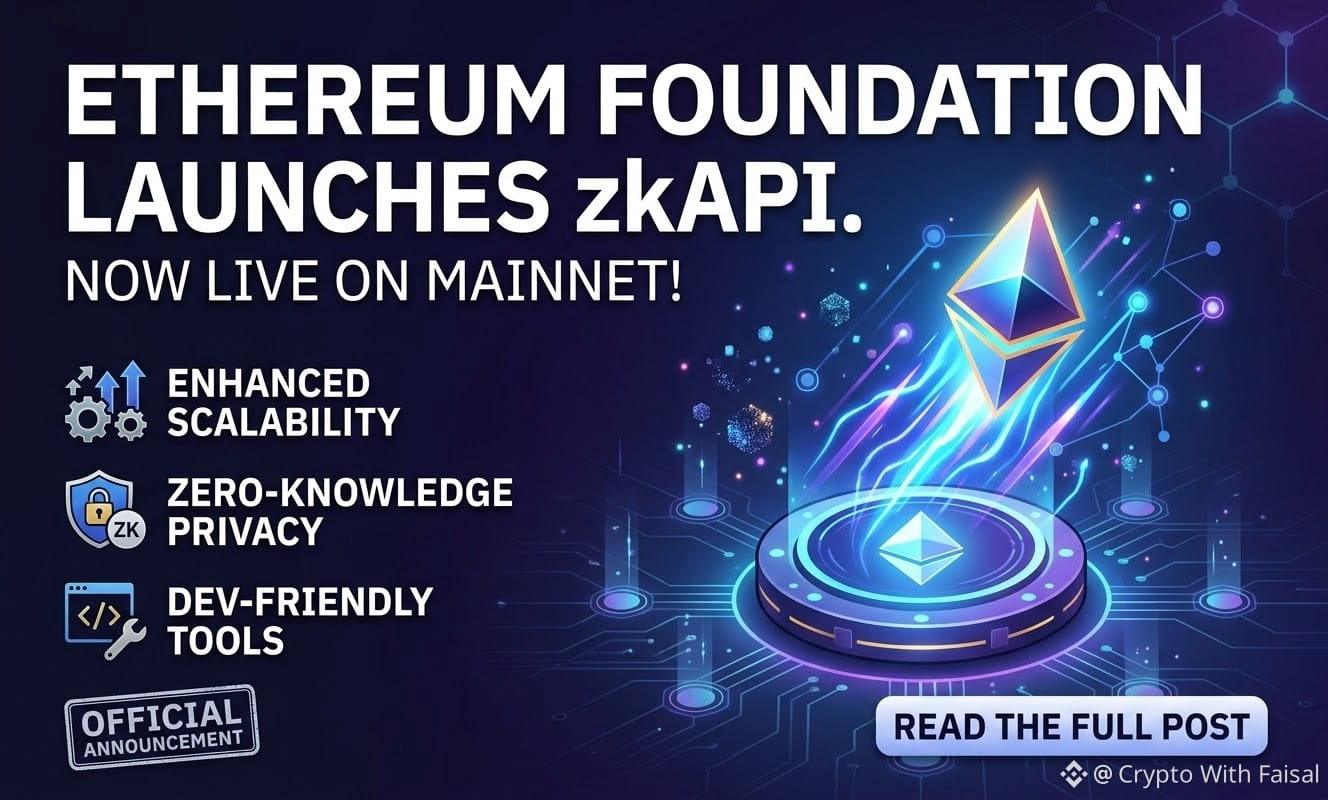
🔐 ETHEREUM LAUNCHES zkAPI
Users can deposit ETH or USDC into a vault and authorize API spending with zero-knowledge proofs.
The provider can process the request without learning which deposit funded it. $ETH
{spot}(ETHUSDT)
#ethereumfoundationlauncheszkapionmainnet
🔐 ETHEREUM LAUNCHES zkAPI
Users can deposit ETH or USDC into a vault and authorize API spending with zero-knowledge proofs.
The provider can process the request without learning which deposit funded it. $ETH
#ethereumfoundationlauncheszkapionmainnet
Users can deposit ETH or USDC into a vault and authorize API spending with zero-knowledge proofs.
The provider can process the request without learning which deposit funded it. $ETH
#ethereumfoundationlauncheszkapionmainnet
34
🚨 ETHEREUM GOES PRIVATE
The Ethereum Foundation has launched zkAPI on mainnet, enabling users to pay for AI and other APIs without revealing their billing identity.
🔐 Zero-knowledge payments meet AI.
$ETH
#ethereumfoundationlauncheszkapionmainnet
🚨 ETHEREUM GOES PRIVATE
The Ethereum Foundation has launched zkAPI on mainnet, enabling users to pay for AI and other APIs without revealing their billing identity.
🔐 Zero-knowledge payments meet AI.
$ETH
#ethereumfoundationlauncheszkapionmainnet
The Ethereum Foundation has launched zkAPI on mainnet, enabling users to pay for AI and other APIs without revealing their billing identity.
🔐 Zero-knowledge payments meet AI.
$ETH
#ethereumfoundationlauncheszkapionmainnet
14
🤖 AI + ETH JUST GOT INTERESTING
Ethereum Foundation’s new zkAPI lets users fund AI/API usage through an Ethereum vault while keeping the payment link private.
🔐 Privacy-focused infrastructure is moving to mainnet. $ETH
{spot}(ETHUSDT)
#ethereumfoundationlauncheszkapionmainnet
🤖 AI + ETH JUST GOT INTERESTING
Ethereum Foundation’s new zkAPI lets users fund AI/API usage through an Ethereum vault while keeping the payment link private.
🔐 Privacy-focused infrastructure is moving to mainnet. $ETH
#ethereumfoundationlauncheszkapionmainnet
Ethereum Foundation’s new zkAPI lets users fund AI/API usage through an Ethereum vault while keeping the payment link private.
🔐 Privacy-focused infrastructure is moving to mainnet. $ETH
#ethereumfoundationlauncheszkapionmainnet
18

·
--
Bullish
Disputed
#ethereumfoundationlauncheszkapionmainnet
🚨 BREAKING: ETHEREUM FOUNDATION LAUNCHES ZKAPION MAINNET
Ethereum’s scaling narrative just got another boost. ⚡️
With ZKAPION Mainnet now live, zero-knowledge technology is once again taking center stage as Ethereum continues working toward faster and more scalable infrastructure.
👀 Why this matters:
🔹 ZK technology could help scale blockchain activity
🔹 Ethereum’s L2 and ZK ecosystem continues to grow
🔹 New infrastructure may drive more demand across the ETH ecosystem
🔹 Developers are still building toward a more scalable Ethereum
Now the question is:
Could this become another catalyst for $ETH ? 👀🔥
#Ethereum #ETH #ZKAPION
#ethereumfoundationlauncheszkapionmainnet
🚨 BREAKING: ETHEREUM FOUNDATION LAUNCHES ZKAPION MAINNET
Ethereum’s scaling narrative just got another boost. ⚡️
With ZKAPION Mainnet now live, zero-knowledge technology is once again taking center stage as Ethereum continues working toward faster and more scalable infrastructure.
👀 Why this matters:
🔹 ZK technology could help scale blockchain activity
🔹 Ethereum’s L2 and ZK ecosystem continues to grow
🔹 New infrastructure may drive more demand across the ETH ecosystem
🔹 Developers are still building toward a more scalable Ethereum
Now the question is:
Could this become another catalyst for $ETH ? 👀🔥
#Ethereum #ETH #ZKAPION
🚨 BREAKING: ETHEREUM FOUNDATION LAUNCHES ZKAPION MAINNET
Ethereum’s scaling narrative just got another boost. ⚡️
With ZKAPION Mainnet now live, zero-knowledge technology is once again taking center stage as Ethereum continues working toward faster and more scalable infrastructure.
👀 Why this matters:
🔹 ZK technology could help scale blockchain activity
🔹 Ethereum’s L2 and ZK ecosystem continues to grow
🔹 New infrastructure may drive more demand across the ETH ecosystem
🔹 Developers are still building toward a more scalable Ethereum
Now the question is:
Could this become another catalyst for $ETH ? 👀🔥
#Ethereum #ETH #ZKAPION
2
4.5k

#EthereumFoundationLaunchesZkAPIOnMainnet
It uses zero knowledge proofs to let users pay for AI models and other APIs without directly revealing their billing identity.
Users can deposit ETH or USDC into a vault, then prove they have sufficient credit without revealing which deposit belongs to them. The system can be issued temporarily, spending limited API keys. $ZKP
zkAPI is experimental and does not automatically hide IP addresses, timing information, or the content of prompts from the AI provider.
#Mahanadi $ETH
#EthereumFoundationLaunchesZkAPIOnMainnet
It uses zero knowledge proofs to let users pay for AI models and other APIs without directly revealing their billing identity.
Users can deposit ETH or USDC into a vault, then prove they have sufficient credit without revealing which deposit belongs to them. The system can be issued temporarily, spending limited API keys. $ZKP
zkAPI is experimental and does not automatically hide IP addresses, timing information, or the content of prompts from the AI provider.
#Mahanadi $ETH
It uses zero knowledge proofs to let users pay for AI models and other APIs without directly revealing their billing identity.
Users can deposit ETH or USDC into a vault, then prove they have sufficient credit without revealing which deposit belongs to them. The system can be issued temporarily, spending limited API keys. $ZKP
zkAPI is experimental and does not automatically hide IP addresses, timing information, or the content of prompts from the AI provider.
#Mahanadi $ETH

Privacy 🔏
From Digital Mahanadi
4
371

·
--
Verified
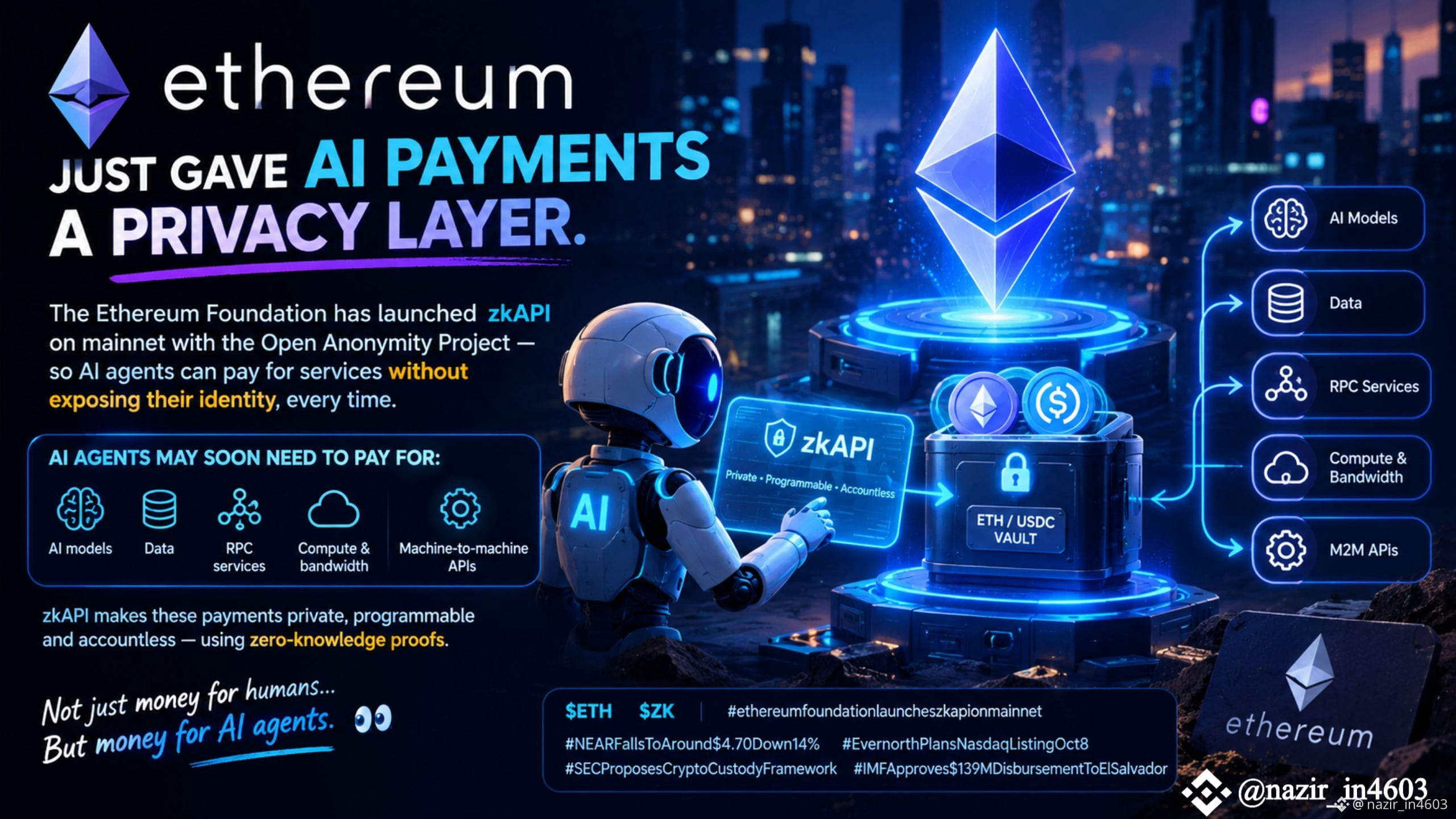
🚨 $ETH IS QUIETLY BUILDING A PRIVACY LAYER FOR AI PAYMENTS.
Ethereum Foundation has launched zkAPI on mainnet with the Open Anonymity Project — and the bigger story may not be the ZK tech itself.
It’s about how AI agents could pay for services without exposing the full trail behind every transaction.
The basic idea:
Users can fund a vault with ETH or USDC and prove they’re authorized to use an API without linking every request directly to their identity or billing account.
That matters because AI agents may soon need to pay for things like:
• AI models
• Data
• RPC services
• Compute & bandwidth
• Machine-to-machine APIs
If agents are going to operate independently, they’ll need their own payment infrastructure.
And that infrastructure probably needs to be private, programmable and automated.
That’s where zkAPI gets interesting.
Ethereum isn’t just thinking about how humans move money.
It may also be preparing for a world where AI agents transact with each other. 👀
$ETH $ZKC #ethereumfoundationlauncheszkapionmainnet #NEARFallsToAround$4.70Down14% #EvernorthPlansNasdaqListingOct8 #SECProposesCryptoCustodyFramework #IMFApproves$139MDisbursementToElSalvador
{future}(ZKCUSDT)
{future}(ETHUSDT)
🚨 $ETH IS QUIETLY BUILDING A PRIVACY LAYER FOR AI PAYMENTS.
Ethereum Foundation has launched zkAPI on mainnet with the Open Anonymity Project — and the bigger story may not be the ZK tech itself.
It’s about how AI agents could pay for services without exposing the full trail behind every transaction.
The basic idea:
Users can fund a vault with ETH or USDC and prove they’re authorized to use an API without linking every request directly to their identity or billing account.
That matters because AI agents may soon need to pay for things like:
• AI models
• Data
• RPC services
• Compute & bandwidth
• Machine-to-machine APIs
If agents are going to operate independently, they’ll need their own payment infrastructure.
And that infrastructure probably needs to be private, programmable and automated.
That’s where zkAPI gets interesting.
Ethereum isn’t just thinking about how humans move money.
It may also be preparing for a world where AI agents transact with each other. 👀
$ETH $ZKC #ethereumfoundationlauncheszkapionmainnet #NEARFallsToAround$4.70Down14% #EvernorthPlansNasdaqListingOct8 #SECProposesCryptoCustodyFramework #IMFApproves$139MDisbursementToElSalvador
Ethereum Foundation has launched zkAPI on mainnet with the Open Anonymity Project — and the bigger story may not be the ZK tech itself.
It’s about how AI agents could pay for services without exposing the full trail behind every transaction.
The basic idea:
Users can fund a vault with ETH or USDC and prove they’re authorized to use an API without linking every request directly to their identity or billing account.
That matters because AI agents may soon need to pay for things like:
• AI models
• Data
• RPC services
• Compute & bandwidth
• Machine-to-machine APIs
If agents are going to operate independently, they’ll need their own payment infrastructure.
And that infrastructure probably needs to be private, programmable and automated.
That’s where zkAPI gets interesting.
Ethereum isn’t just thinking about how humans move money.
It may also be preparing for a world where AI agents transact with each other. 👀
$ETH $ZKC #ethereumfoundationlauncheszkapionmainnet #NEARFallsToAround$4.70Down14% #EvernorthPlansNasdaqListingOct8 #SECProposesCryptoCustodyFramework #IMFApproves$139MDisbursementToElSalvador
Thea Eacret zVpo:
Fff
2
1
9
16.2k

Verified
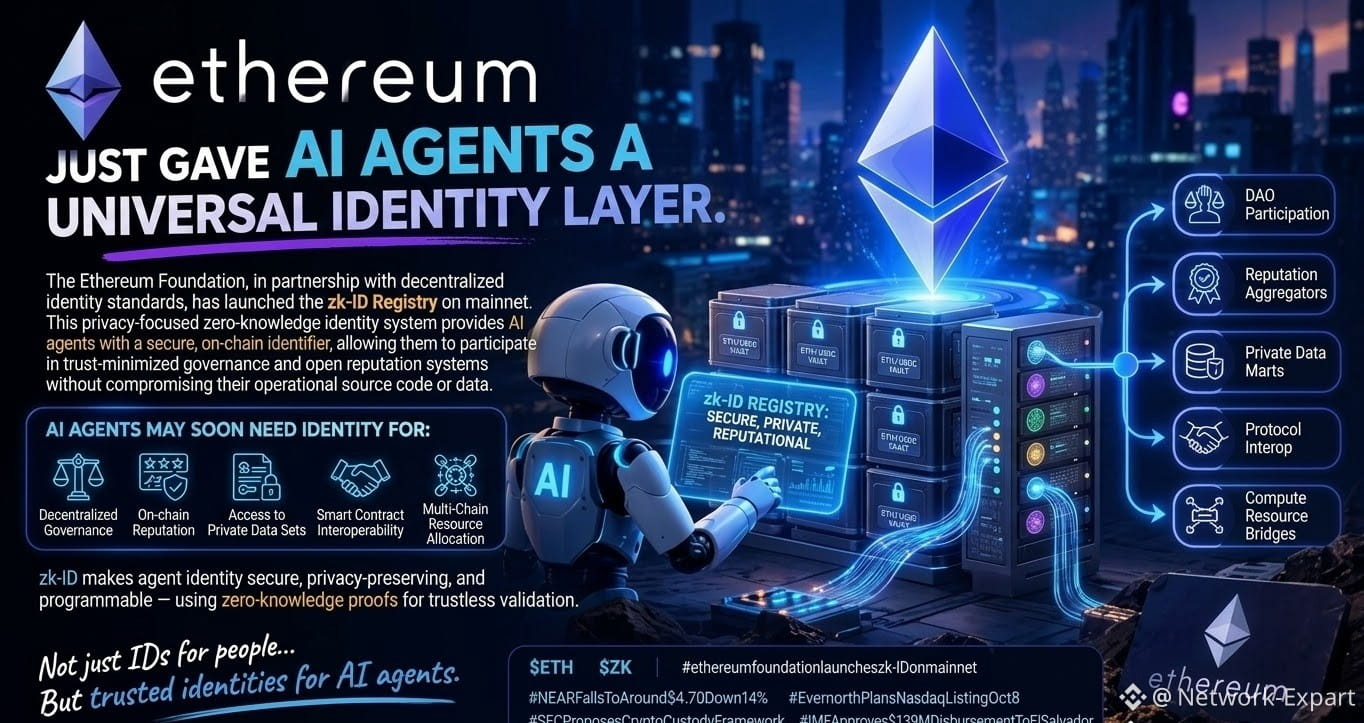
🚨 $ETH — THE AI PAYMENT PRIVACY STORY IS GETTING INTERESTING
Ethereum may be quietly building infrastructure for a future where AI agents can transact privately and autonomously.
The Ethereum Foundation’s zkAPI initiative with the Open Anonymity Project brings a bigger idea into focus — not just ZK technology, but private machine-to-machine payments.
How it could work: Users can fund a vault with ETH or USDC and prove they’re authorized to access an API without exposing their identity or connecting every request to their personal billing account.
Why could this matter? 👇
AI agents may increasingly need to pay for:
AI models
Data & information
RPC services
Compute & bandwidth
Machine-to-machine APIs
If AI agents are going to operate independently, they’ll need a payment system that is:
Private
Programmable
Automated
Built for machine-to-machine transactions
And that’s where zkAPI becomes especially interesting.
Ethereum isn’t only evolving how humans move money.
It could also be laying the groundwork for a future where AI agents pay, interact, and transact with each other autonomously.
$ETH $ZKC #ethereumfoundationlauncheszkapionmainnet #EvernorthPlansNasdaqListingOct8 #SECProposesCryptoCustodyFramework
#EtherGains70.9%InQ3
#US10YearYieldNears5.3%
🚨 $ETH — THE AI PAYMENT PRIVACY STORY IS GETTING INTERESTING
Ethereum may be quietly building infrastructure for a future where AI agents can transact privately and autonomously.
The Ethereum Foundation’s zkAPI initiative with the Open Anonymity Project brings a bigger idea into focus — not just ZK technology, but private machine-to-machine payments.
How it could work: Users can fund a vault with ETH or USDC and prove they’re authorized to access an API without exposing their identity or connecting every request to their personal billing account.
Why could this matter? 👇
AI agents may increasingly need to pay for:
AI models
Data & information
RPC services
Compute & bandwidth
Machine-to-machine APIs
If AI agents are going to operate independently, they’ll need a payment system that is:
Private
Programmable
Automated
Built for machine-to-machine transactions
And that’s where zkAPI becomes especially interesting.
Ethereum isn’t only evolving how humans move money.
It could also be laying the groundwork for a future where AI agents pay, interact, and transact with each other autonomously.
$ETH $ZKC #ethereumfoundationlauncheszkapionmainnet #EvernorthPlansNasdaqListingOct8 #SECProposesCryptoCustodyFramework
#EtherGains70.9%InQ3
#US10YearYieldNears5.3%
Ethereum may be quietly building infrastructure for a future where AI agents can transact privately and autonomously.
The Ethereum Foundation’s zkAPI initiative with the Open Anonymity Project brings a bigger idea into focus — not just ZK technology, but private machine-to-machine payments.
How it could work: Users can fund a vault with ETH or USDC and prove they’re authorized to access an API without exposing their identity or connecting every request to their personal billing account.
Why could this matter? 👇
AI agents may increasingly need to pay for:
AI models
Data & information
RPC services
Compute & bandwidth
Machine-to-machine APIs
If AI agents are going to operate independently, they’ll need a payment system that is:
Private
Programmable
Automated
Built for machine-to-machine transactions
And that’s where zkAPI becomes especially interesting.
Ethereum isn’t only evolving how humans move money.
It could also be laying the groundwork for a future where AI agents pay, interact, and transact with each other autonomously.
$ETH $ZKC #ethereumfoundationlauncheszkapionmainnet #EvernorthPlansNasdaqListingOct8 #SECProposesCryptoCustodyFramework
#EtherGains70.9%InQ3
#US10YearYieldNears5.3%
1
10
12.2k

·
--
Ethereum Just Put Private AI Payments on Mainnet 🔐
The Ethereum Foundation and Open Anonymity Project have launched zkAPI on Ethereum mainnet, letting users pay for metered AI and other APIs without directly linking payments to their identity. Users deposit ETH or USDC into a vault, then authorize spending with zero-knowledge proofs.
The clever part: the AI provider sees the requests, while the payment layer verifies spending without learning which deposit or person is behind it. Temporary API keys also keep payment credentials separate from the actual prompts. 🤖
It’s still an experimental system and doesn’t provide full network anonymity. But Ethereum is now being used not just to move money, but to separate AI usage from payment identity.
#EthereumFoundationLaunchesZkAPIOnMainnet
Ethereum Just Put Private AI Payments on Mainnet 🔐
The Ethereum Foundation and Open Anonymity Project have launched zkAPI on Ethereum mainnet, letting users pay for metered AI and other APIs without directly linking payments to their identity. Users deposit ETH or USDC into a vault, then authorize spending with zero-knowledge proofs.
The clever part: the AI provider sees the requests, while the payment layer verifies spending without learning which deposit or person is behind it. Temporary API keys also keep payment credentials separate from the actual prompts. 🤖
It’s still an experimental system and doesn’t provide full network anonymity. But Ethereum is now being used not just to move money, but to separate AI usage from payment identity.
#EthereumFoundationLaunchesZkAPIOnMainnet
The Ethereum Foundation and Open Anonymity Project have launched zkAPI on Ethereum mainnet, letting users pay for metered AI and other APIs without directly linking payments to their identity. Users deposit ETH or USDC into a vault, then authorize spending with zero-knowledge proofs.
The clever part: the AI provider sees the requests, while the payment layer verifies spending without learning which deposit or person is behind it. Temporary API keys also keep payment credentials separate from the actual prompts. 🤖
It’s still an experimental system and doesn’t provide full network anonymity. But Ethereum is now being used not just to move money, but to separate AI usage from payment identity.
#EthereumFoundationLaunchesZkAPIOnMainnet
1
474

·
--
#EthereumFoundationLaunchesZkAPIOnMainnet
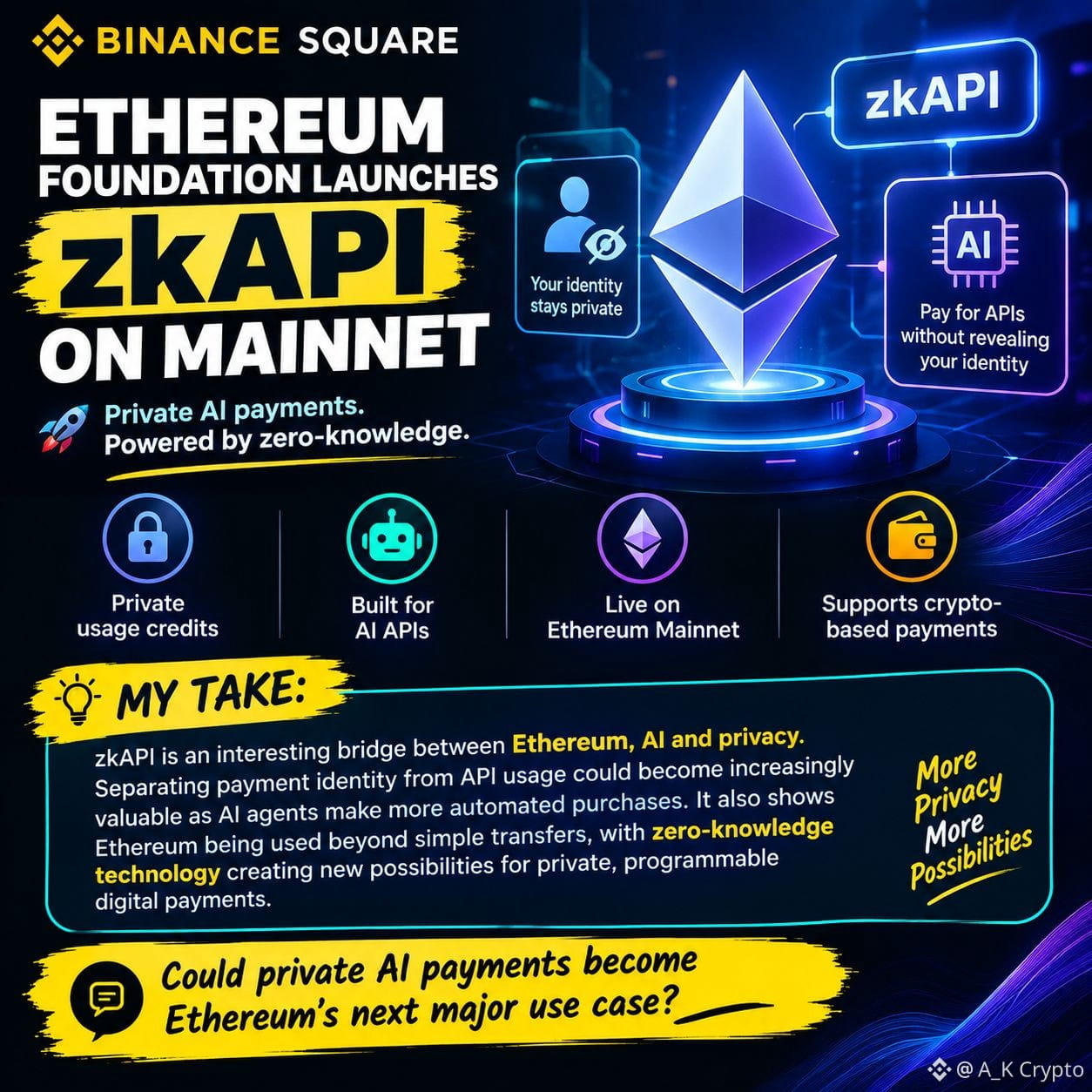
🚨 $ETH JUST MADE PRIVATE AI PAYMENTS A REALITY!
The $ETH Foundation has launched zkAPI on Ethereum Mainnet — using zero-knowledge proofs to let users pay for AI and other metered APIs without directly revealing their identity to the payment layer.
🔐 Private usage credits
🤖 Built for AI APIs
⚡ Live on Ethereum Mainnet
💰 Supports crypto-based payments
zkAPI is an interesting bridge between Ethereum, AI and privacy. Separating payment identity from API usage could become increasingly valuable as AI agents make more automated purchases. It also shows Ethereum being used beyond simple transfers, with zero-knowledge technology creating new possibilities for private, programmable digital payments.
🔥 Could private AI payments become $ETH ’s next major use case?
#ETH #crypto #Binanace #EthereumFoundationLaunchesZkAPIOnMainnet
{spot}(ETHUSDT)
#EthereumFoundationLaunchesZkAPIOnMainnet
🚨 $ETH JUST MADE PRIVATE AI PAYMENTS A REALITY!
The $ETH Foundation has launched zkAPI on Ethereum Mainnet — using zero-knowledge proofs to let users pay for AI and other metered APIs without directly revealing their identity to the payment layer.
🔐 Private usage credits
🤖 Built for AI APIs
⚡ Live on Ethereum Mainnet
💰 Supports crypto-based payments
zkAPI is an interesting bridge between Ethereum, AI and privacy. Separating payment identity from API usage could become increasingly valuable as AI agents make more automated purchases. It also shows Ethereum being used beyond simple transfers, with zero-knowledge technology creating new possibilities for private, programmable digital payments.
🔥 Could private AI payments become $ETH ’s next major use case?
#ETH #crypto #Binanace #EthereumFoundationLaunchesZkAPIOnMainnet
🚨 $ETH JUST MADE PRIVATE AI PAYMENTS A REALITY!
The $ETH Foundation has launched zkAPI on Ethereum Mainnet — using zero-knowledge proofs to let users pay for AI and other metered APIs without directly revealing their identity to the payment layer.
🔐 Private usage credits
🤖 Built for AI APIs
⚡ Live on Ethereum Mainnet
💰 Supports crypto-based payments
zkAPI is an interesting bridge between Ethereum, AI and privacy. Separating payment identity from API usage could become increasingly valuable as AI agents make more automated purchases. It also shows Ethereum being used beyond simple transfers, with zero-knowledge technology creating new possibilities for private, programmable digital payments.
🔥 Could private AI payments become $ETH ’s next major use case?
#ETH #crypto #Binanace #EthereumFoundationLaunchesZkAPIOnMainnet
143
Log in to explore more content
Join global crypto users on Binance Square
⚡️ Get latest and useful information about crypto.
💬 Trusted by the world’s largest crypto exchange.
👍 Discover real insights from verified creators.
Email / Phone number
Trending Topics
1
#BNBSurpasses$790
4,041 views
61 Discussing
2
#ZamaRises15.99%ToIntradayHigh$0.09
1,569 views
57 Discussing
3
#BitcoinSpotETFsDraw$6.34BInflowsInQ3
2,289 views
47 Discussing
4
#EthereumValidatorExitQueueJumps392%
37,459 views
464 Discussing
5
#IMFApprovesElSalvador$138MWithBitcoinWaiver
4,374 views
34 Discussing
6
#SECHaltsCryptoETFReviewsAmidFundingLapse
180,584 views
1,381 Discussing
7
#ZcashETFPostsFirstWeeklyOutflow$93.6M
83,039 views
239 Discussing
8
#GreekPoliceBustCryptoScamRingArrest17
311,539 views
2,068 Discussing
9
#BitcoinRejectedAt$87K
196,555 views
294 Discussing
10
#FedOctoberRateHikeOddsFallTo17%
310,426 views
2,218 Discussing