

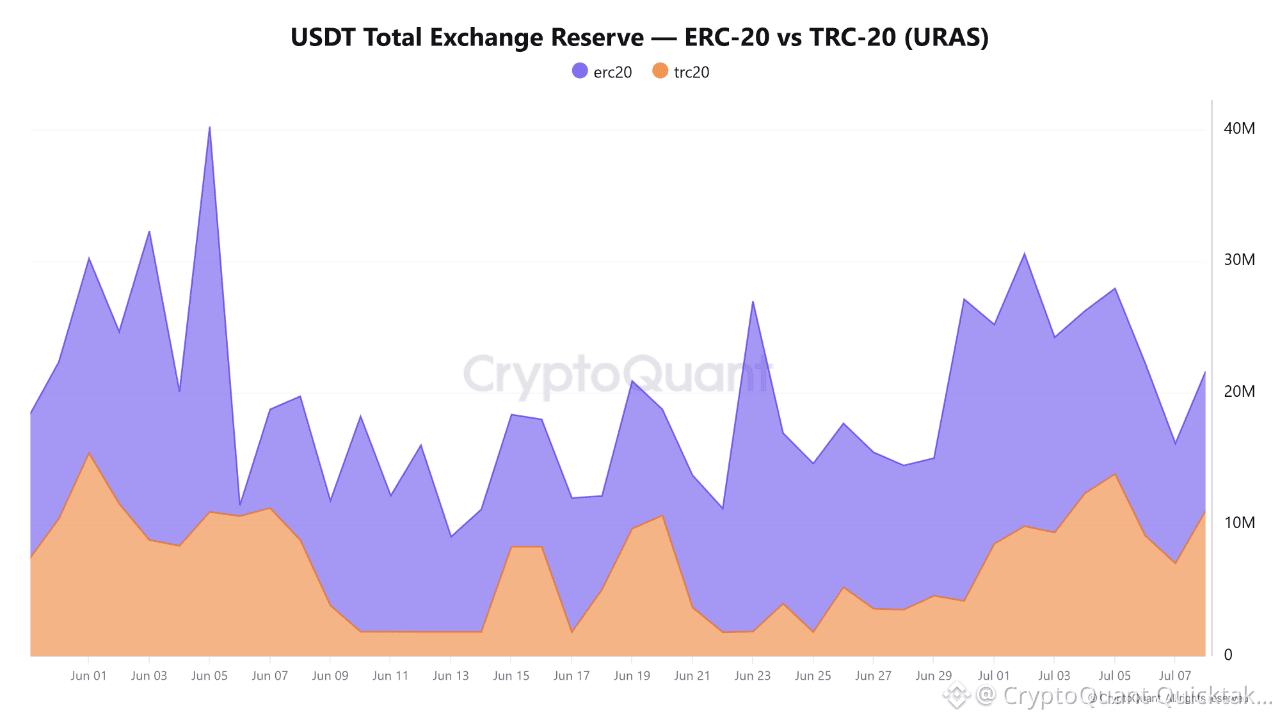
Total USDT on centralized exchanges ended July 8 at $53.06B, down $1.2B week-over-week and $1.05B over thirty days. The headline conceals a structural story. ERC-20 holds 92.9% of all exchange-resident USDT at $49.26B and is essentially flat over the month, while TRC-20 has bled 28.8% of its balance, falling from $5.32B to $3.79B. That chain dynamic explains almost the entire thirty-day drawdown in dry powder.
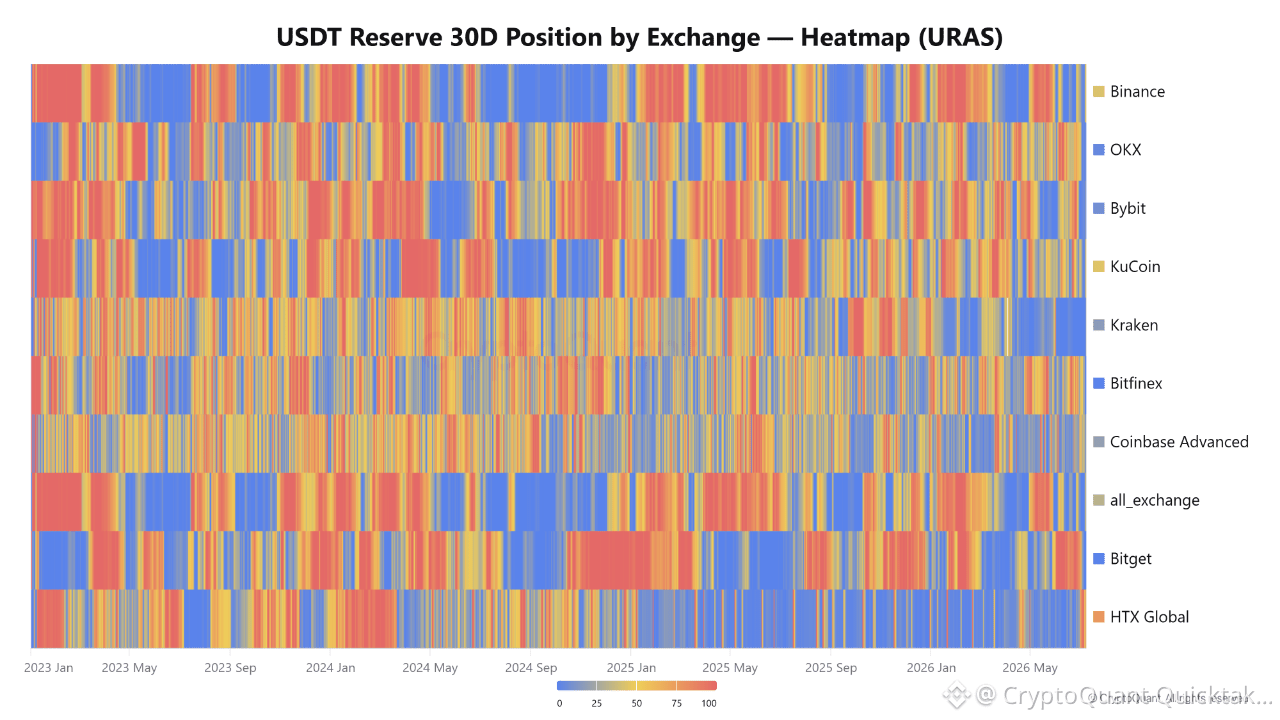
Binance anchors the system. It holds $40.80B of USDT across both chains, 76.9% of the CEX complex, and its ERC-20 balance of $39.2B has barely moved in thirty days. Outside Binance, OKX and Bybit, almost no venue carries material inventory. This concentration means the marginal price-setting venue for crypto is structurally long dollars, and that one balance sheet determines whether spot bids absorb sell pressure.
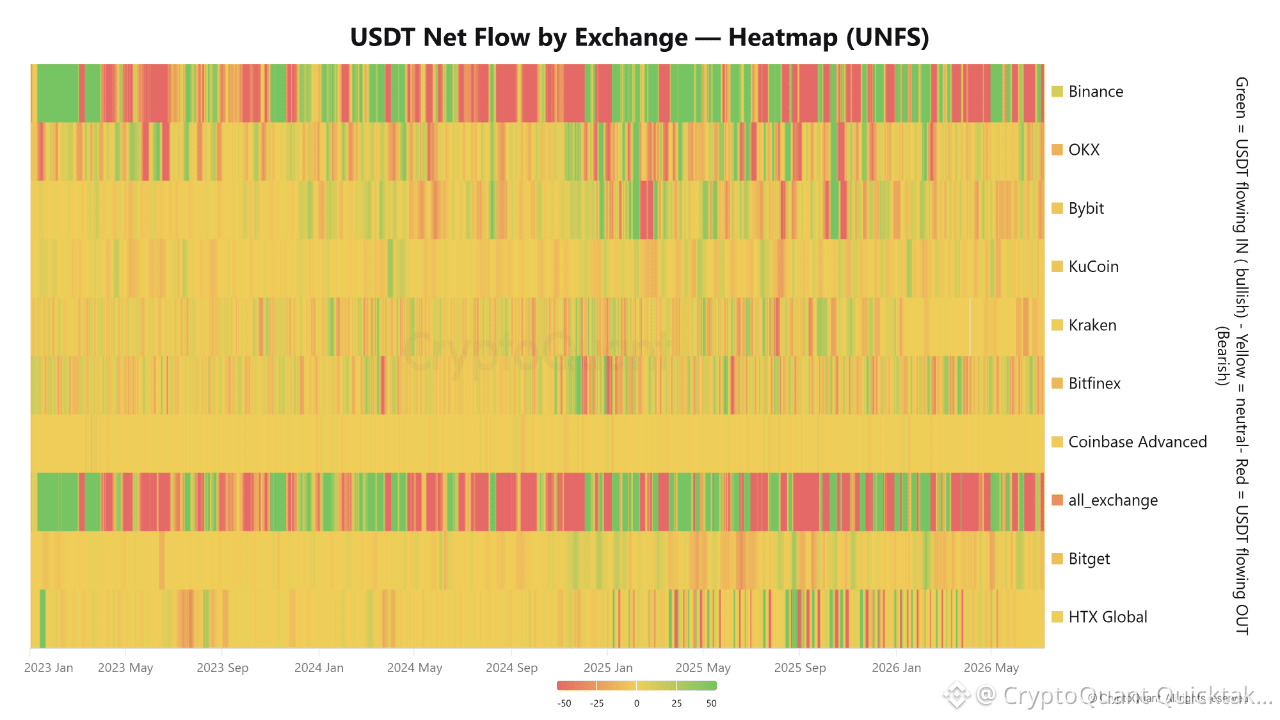
The Net Flow Signal confirms distribution is broad. Ten of fourteen exchange-chain pairs sit in mild distribution, three in mild accumulation, and Binance TRC-20 is flagged strong distribution with a thirty-day outflow of $1.35B. Per-exchange netflow over the past seven days is minus $1.43B, with ten of the last fourteen daily readings negative. July 7 alone was minus $337M.
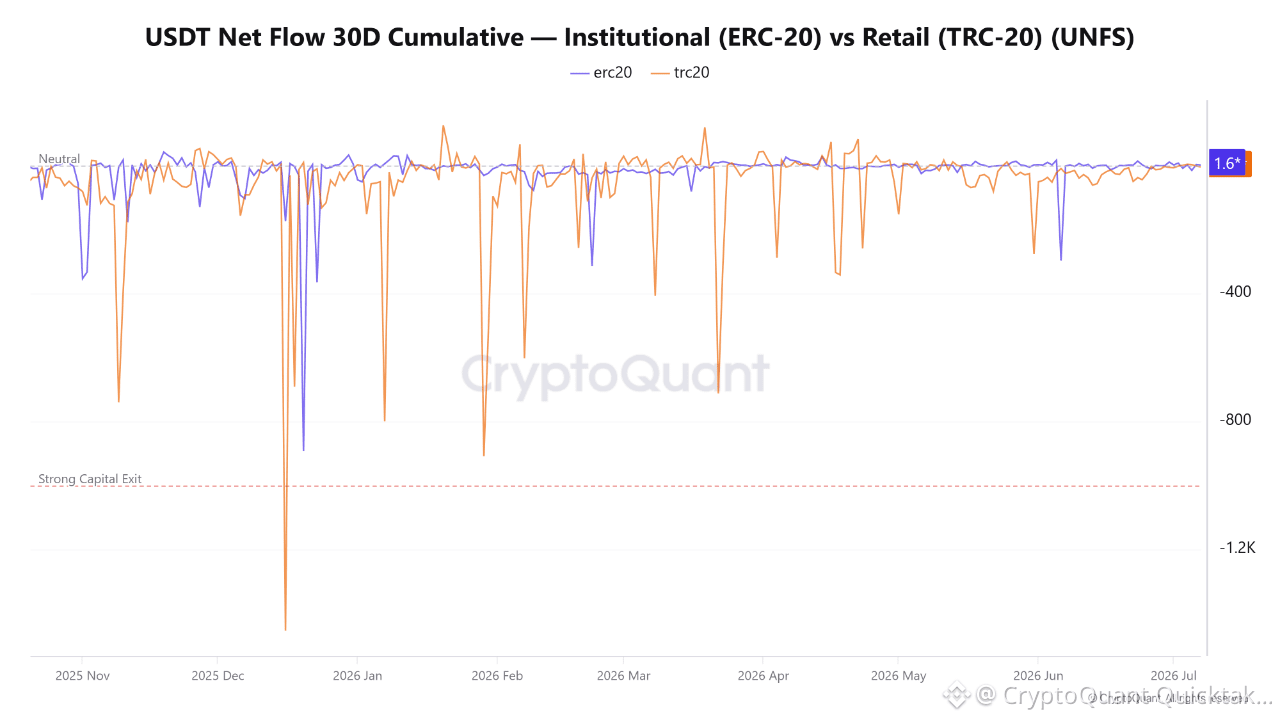
The whale skew makes this bleed worth watching. TRC-20 whale share of inflows runs 42-96% across venues, while ERC-20 inflows are retail-dominated, with whale participation under 1% at Binance, OKX, Bybit and Coinbase. Large holders pull dollars off Tron-routed venues while retail deposits via Ethereum rails. The divergence signals smart-money de-risking, not panic, but removes buy-side liquidity from venues that historically absorb whale BTC distributions.
The counter-signal is July 7 Binance TRC-20: plus $797.7M single-day net inflow at z-score 3.15. Statistically extreme, it partially reverses the prior week outflow streak but does not break the thirty-day regime. Until Tether issues fresh supply or ERC-20 expands, dry powder remains slow attrition, not active rebuilding.
Written by Crazzyblockk