

#stonfi
stonfi
308,431 views
4,064 Discussing
Hot
Latest

The One Swap Across Chains Campaign.
STON.fi's current “One Swap. Across Chains.” campaign is an interesting way to introduce users to its cross-chain infrastructure.
Instead of simply telling users that cross-chain swaps exist, the campaign turns the experience into missions.
Users can connect their TON wallet, pair Telegram and complete different activities to earn miles.
The campaign also includes destinations such as TON, TRON, Ethereum, BNB Chain, Polygon, Base, Arbitrum, Avalanche, X Layer and Robinhood.
There are also qualifying swap requirements for some missions.
What I like about this approach is that it turns a technical concept — cross-chain execution — into something users can actually explore.
The best educational campaigns are often the ones that let users learn by doing.
@stonfi #STONfi
The One Swap Across Chains Campaign.
STON.fi's current “One Swap. Across Chains.” campaign is an interesting way to introduce users to its cross-chain infrastructure.
Instead of simply telling users that cross-chain swaps exist, the campaign turns the experience into missions.
Users can connect their TON wallet, pair Telegram and complete different activities to earn miles.
The campaign also includes destinations such as TON, TRON, Ethereum, BNB Chain, Polygon, Base, Arbitrum, Avalanche, X Layer and Robinhood.
There are also qualifying swap requirements for some missions.
What I like about this approach is that it turns a technical concept — cross-chain execution — into something users can actually explore.
The best educational campaigns are often the ones that let users learn by doing.
@STONfi DEX #STONfi
STON.fi's current “One Swap. Across Chains.” campaign is an interesting way to introduce users to its cross-chain infrastructure.
Instead of simply telling users that cross-chain swaps exist, the campaign turns the experience into missions.
Users can connect their TON wallet, pair Telegram and complete different activities to earn miles.
The campaign also includes destinations such as TON, TRON, Ethereum, BNB Chain, Polygon, Base, Arbitrum, Avalanche, X Layer and Robinhood.
There are also qualifying swap requirements for some missions.
What I like about this approach is that it turns a technical concept — cross-chain execution — into something users can actually explore.
The best educational campaigns are often the ones that let users learn by doing.
@STONfi DEX #STONfi
1
62

·
--
Most traders still treat a DEX like a CEX with extra steps.
That is the wrong mental model.
A real DEX is infrastructure. The product is not the swap screen. The product is whether liquidity can move, whether fees stay understandable, and whether a user can see risk before they click confirm.
This is why STONfi’s new “What is DEX” educational project is more useful than another generic campaign post. Too many people farm APY without knowing what APY actually measures. Too many people provide liquidity without understanding impermanent loss. Too many people hear “cross-chain” and assume it is the same thing as “multi-chain.” It is not.
Multi-chain means the same protocol exists in several places. Cross-chain means value can move between those places without the user becoming the bridge. That difference matters when you are moving USDT across TON, TRON, Ethereum or Base and wondering why a “simple send” suddenly turns into a routing problem.
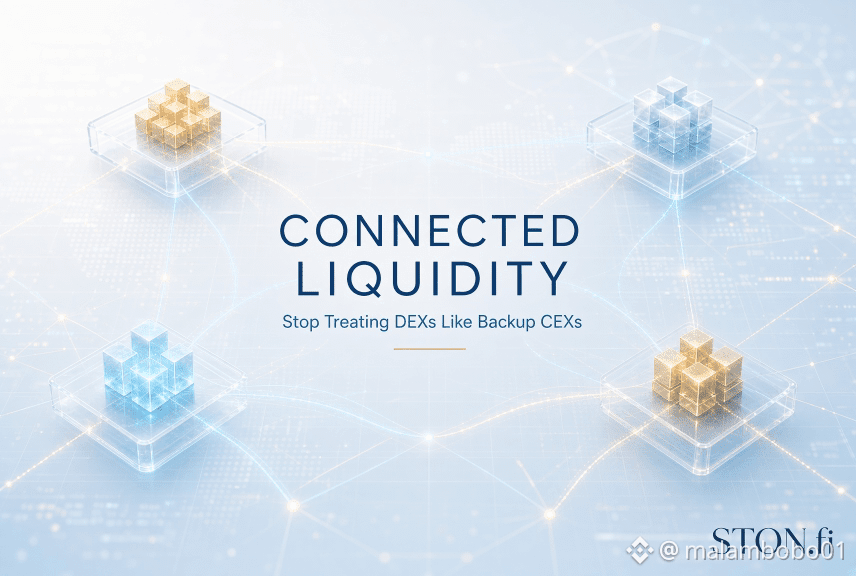
Connected liquidity is the next real upgrade in DeFi. Isolated pools create fake depth. They look liquid until you try to size into them. When wallets and DEXs start coordinating across networks — Keeper evolving from a TON-native wallet into a multichain one is a good example — the market gets cleaner. Less wrapping theater. Less hidden price impact. More honest execution.
Education plus working rails is the combination that survives a full cycle. Everything else is just another announcement with a banner.
If you are using DEXs this year, learn the mechanics first. Then swap. Not the other way around. $BTC $GRAM $ETH
#Dafi #TON #CrossChain #Web3 #STONfi
Most traders still treat a DEX like a CEX with extra steps.
That is the wrong mental model.
A real DEX is infrastructure. The product is not the swap screen. The product is whether liquidity can move, whether fees stay understandable, and whether a user can see risk before they click confirm.
This is why STONfi’s new “What is DEX” educational project is more useful than another generic campaign post. Too many people farm APY without knowing what APY actually measures. Too many people provide liquidity without understanding impermanent loss. Too many people hear “cross-chain” and assume it is the same thing as “multi-chain.” It is not.
Multi-chain means the same protocol exists in several places. Cross-chain means value can move between those places without the user becoming the bridge. That difference matters when you are moving USDT across TON, TRON, Ethereum or Base and wondering why a “simple send” suddenly turns into a routing problem.
Connected liquidity is the next real upgrade in DeFi. Isolated pools create fake depth. They look liquid until you try to size into them. When wallets and DEXs start coordinating across networks — Keeper evolving from a TON-native wallet into a multichain one is a good example — the market gets cleaner. Less wrapping theater. Less hidden price impact. More honest execution.
Education plus working rails is the combination that survives a full cycle. Everything else is just another announcement with a banner.
If you are using DEXs this year, learn the mechanics first. Then swap. Not the other way around. $BTC $GRAM $ETH
#Dafi #TON #CrossChain #Web3 #STONfi
That is the wrong mental model.
A real DEX is infrastructure. The product is not the swap screen. The product is whether liquidity can move, whether fees stay understandable, and whether a user can see risk before they click confirm.
This is why STONfi’s new “What is DEX” educational project is more useful than another generic campaign post. Too many people farm APY without knowing what APY actually measures. Too many people provide liquidity without understanding impermanent loss. Too many people hear “cross-chain” and assume it is the same thing as “multi-chain.” It is not.
Multi-chain means the same protocol exists in several places. Cross-chain means value can move between those places without the user becoming the bridge. That difference matters when you are moving USDT across TON, TRON, Ethereum or Base and wondering why a “simple send” suddenly turns into a routing problem.
Connected liquidity is the next real upgrade in DeFi. Isolated pools create fake depth. They look liquid until you try to size into them. When wallets and DEXs start coordinating across networks — Keeper evolving from a TON-native wallet into a multichain one is a good example — the market gets cleaner. Less wrapping theater. Less hidden price impact. More honest execution.
Education plus working rails is the combination that survives a full cycle. Everything else is just another announcement with a banner.
If you are using DEXs this year, learn the mechanics first. Then swap. Not the other way around. $BTC $GRAM $ETH
#Dafi #TON #CrossChain #Web3 #STONfi
121

·
--
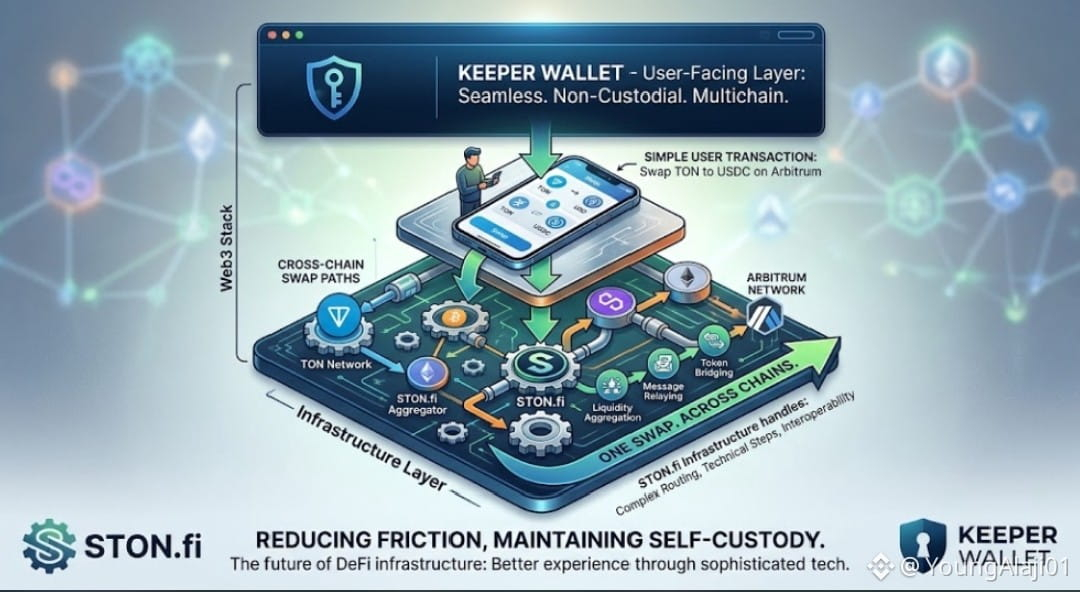
The move from Tonkeeper to Keeper feels like more than just a name change.
It reflects a bigger shift in how the wallet layer is being built. What started as a TON focused wallet is expanding toward a more connected multichain experience.
That makes @keeper_wallet a natural fit for @stonfi One Swap Across Chains campaign.
Think of the stack in simple terms
Keeper handles the user facing wallet layer, while @stonfi focuses on the infrastructure that connects assets across different ecosystems.
The important part is what happens underneath. Cross chain transactions can involve multiple networks, routes, and technical steps, but users shouldn’t need to understand all of that just to complete a swap.
That’s where good infrastructure matters.
The goal isn’t to hide complexity through centralization. It’s to reduce unnecessary friction while keeping users in control of their assets.
For Web3, that’s a meaningful direction: better infrastructure, simpler experiences, and self custody at the center.
#KeeperWallet #STONfi
The move from Tonkeeper to Keeper feels like more than just a name change.
It reflects a bigger shift in how the wallet layer is being built. What started as a TON focused wallet is expanding toward a more connected multichain experience.
That makes @keeper_wallet a natural fit for @STONfi DEX One Swap Across Chains campaign.
Think of the stack in simple terms
Keeper handles the user facing wallet layer, while @STONfi DEX focuses on the infrastructure that connects assets across different ecosystems.
The important part is what happens underneath. Cross chain transactions can involve multiple networks, routes, and technical steps, but users shouldn’t need to understand all of that just to complete a swap.
That’s where good infrastructure matters.
The goal isn’t to hide complexity through centralization. It’s to reduce unnecessary friction while keeping users in control of their assets.
For Web3, that’s a meaningful direction: better infrastructure, simpler experiences, and self custody at the center.
#KeeperWallet #STONfi
It reflects a bigger shift in how the wallet layer is being built. What started as a TON focused wallet is expanding toward a more connected multichain experience.
That makes @keeper_wallet a natural fit for @STONfi DEX One Swap Across Chains campaign.
Think of the stack in simple terms
Keeper handles the user facing wallet layer, while @STONfi DEX focuses on the infrastructure that connects assets across different ecosystems.
The important part is what happens underneath. Cross chain transactions can involve multiple networks, routes, and technical steps, but users shouldn’t need to understand all of that just to complete a swap.
That’s where good infrastructure matters.
The goal isn’t to hide complexity through centralization. It’s to reduce unnecessary friction while keeping users in control of their assets.
For Web3, that’s a meaningful direction: better infrastructure, simpler experiences, and self custody at the center.
#KeeperWallet #STONfi
74

·
--
Bullish
Why You Can’t Always Swap Your Entire GRAM Balance on STONfi
Your wallet may show your full GRAM balance, but that doesn't mean every GRAM can be used as swap input.
On TON, transactions require TON for network fees and execution.
So you may need to leave part of your balance available for transaction costs.
The result:
• Full GRAM balance ≠ full swapable balance
• Some TON may need to remain in the wallet
• The swap input may need to be reduced
• This isn't necessarily a liquidity problem
A failed swap doesn't automatically mean the token or pool is broken.
Sometimes, the wallet simply needs enough TON to complete the transaction.
Understanding the network underneath the interface makes these situations easier to diagnose.
#STONfi #TON
$KII
{alpha}(560xeec6574eabba52bac3f0277f2cd5ac7e67197886)
Why You Can’t Always Swap Your Entire GRAM Balance on STONfi
Your wallet may show your full GRAM balance, but that doesn't mean every GRAM can be used as swap input.
On TON, transactions require TON for network fees and execution.
So you may need to leave part of your balance available for transaction costs.
The result:
• Full GRAM balance ≠ full swapable balance
• Some TON may need to remain in the wallet
• The swap input may need to be reduced
• This isn't necessarily a liquidity problem
A failed swap doesn't automatically mean the token or pool is broken.
Sometimes, the wallet simply needs enough TON to complete the transaction.
Understanding the network underneath the interface makes these situations easier to diagnose.
#STONfi #TON
$KII
Your wallet may show your full GRAM balance, but that doesn't mean every GRAM can be used as swap input.
On TON, transactions require TON for network fees and execution.
So you may need to leave part of your balance available for transaction costs.
The result:
• Full GRAM balance ≠ full swapable balance
• Some TON may need to remain in the wallet
• The swap input may need to be reduced
• This isn't necessarily a liquidity problem
A failed swap doesn't automatically mean the token or pool is broken.
Sometimes, the wallet simply needs enough TON to complete the transaction.
Understanding the network underneath the interface makes these situations easier to diagnose.
#STONfi #TON
$KII
162

·
--
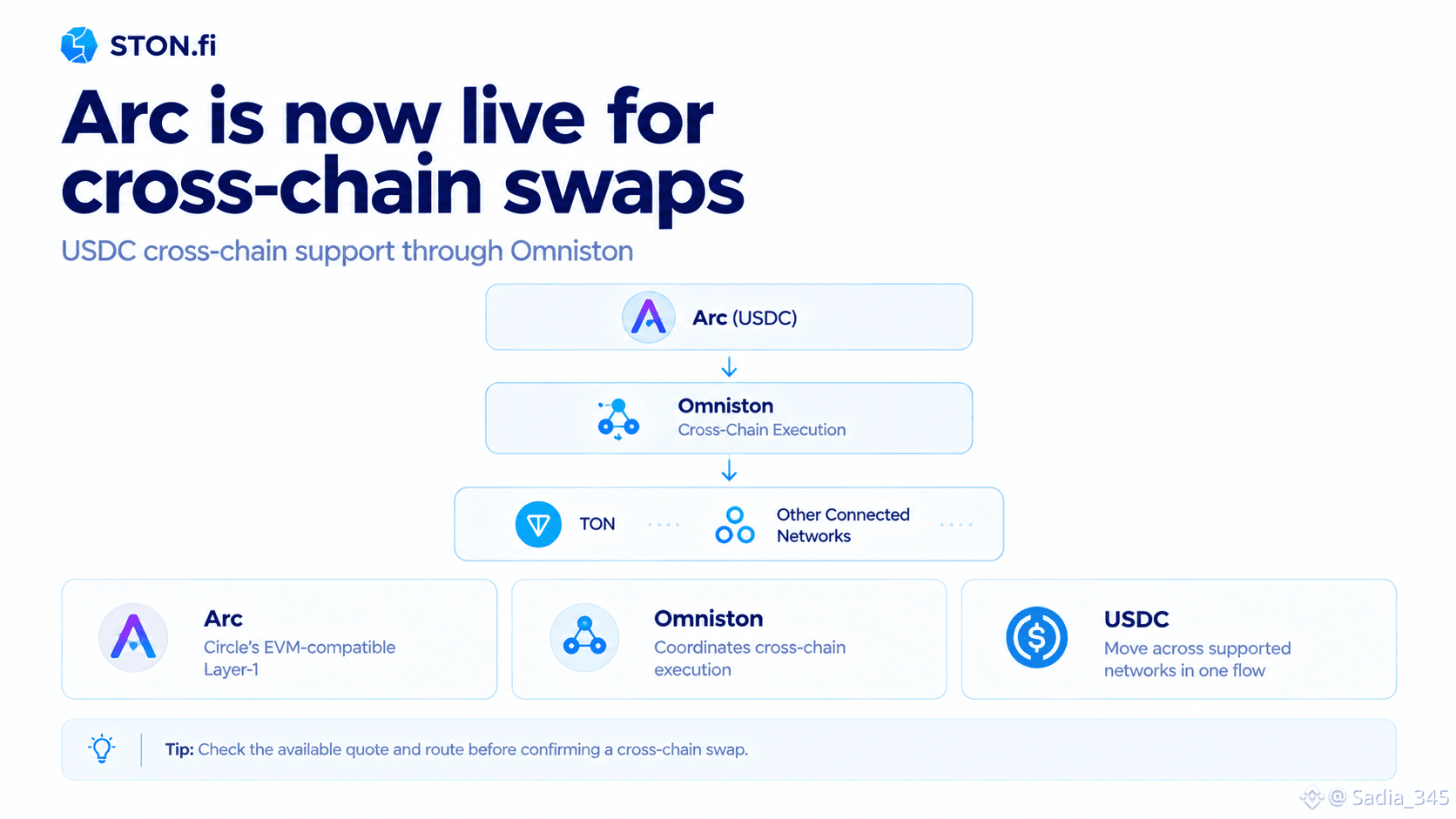
Arc is now live for cross-chain swaps on STONfi
A useful expansion in the cross-chain setup: Arc has been added to STONfi’s supported networks.
Arc is Circle’s new EVM-compatible Layer-1, built specifically for stablecoin finance. With Omniston supporting USDC on Arc, users can now move the asset between Arc, TON, and other connected networks in one flow.
The practical benefit is straightforward. Instead of treating Arc as a separate environment, stablecoin transfers can sit inside the same cross-chain experience already used for other networks. This is especially relevant for users who regularly move USDC across ecosystems.
It is still an early-stage route, so checking the available quotes and limits before confirming a swap is a sensible step.
Have you tried any of the newer network additions yet, or are you mainly using the more established routes?
#STONfi $GRAM
Arc is now live for cross-chain swaps on STONfi
A useful expansion in the cross-chain setup: Arc has been added to STONfi’s supported networks.
Arc is Circle’s new EVM-compatible Layer-1, built specifically for stablecoin finance. With Omniston supporting USDC on Arc, users can now move the asset between Arc, TON, and other connected networks in one flow.
The practical benefit is straightforward. Instead of treating Arc as a separate environment, stablecoin transfers can sit inside the same cross-chain experience already used for other networks. This is especially relevant for users who regularly move USDC across ecosystems.
It is still an early-stage route, so checking the available quotes and limits before confirming a swap is a sensible step.
Have you tried any of the newer network additions yet, or are you mainly using the more established routes?
#STONfi $GRAM
A useful expansion in the cross-chain setup: Arc has been added to STONfi’s supported networks.
Arc is Circle’s new EVM-compatible Layer-1, built specifically for stablecoin finance. With Omniston supporting USDC on Arc, users can now move the asset between Arc, TON, and other connected networks in one flow.
The practical benefit is straightforward. Instead of treating Arc as a separate environment, stablecoin transfers can sit inside the same cross-chain experience already used for other networks. This is especially relevant for users who regularly move USDC across ecosystems.
It is still an early-stage route, so checking the available quotes and limits before confirming a swap is a sensible step.
Have you tried any of the newer network additions yet, or are you mainly using the more established routes?
#STONfi $GRAM
1
226
The Bigger Idea Behind the Flight Campaign.
The “One Swap. Across Chains.” campaign is more than a points system.
At its core, it is an introduction to the idea that liquidity can travel between different blockchain ecosystems.
TON users can explore destinations beyond TON.
That matters because the future of DeFi isn't likely to be one chain dominating every use case.
Different networks will continue developing different strengths.
The challenge is connecting those ecosystems without forcing users through unnecessary complexity.
STON.fi is using its campaign to make that concept more accessible.
And that's probably the most interesting part of it.
Behind the miles, tickets and missions is a much bigger question:
Can cross-chain DeFi eventually feel as simple as a normal swap?
That's the problem infrastructure like Omniston is trying to solve.
@stonfi #STONfi
The Bigger Idea Behind the Flight Campaign.
The “One Swap. Across Chains.” campaign is more than a points system.
At its core, it is an introduction to the idea that liquidity can travel between different blockchain ecosystems.
TON users can explore destinations beyond TON.
That matters because the future of DeFi isn't likely to be one chain dominating every use case.
Different networks will continue developing different strengths.
The challenge is connecting those ecosystems without forcing users through unnecessary complexity.
STON.fi is using its campaign to make that concept more accessible.
And that's probably the most interesting part of it.
Behind the miles, tickets and missions is a much bigger question:
Can cross-chain DeFi eventually feel as simple as a normal swap?
That's the problem infrastructure like Omniston is trying to solve.
@STONfi DEX #STONfi
The “One Swap. Across Chains.” campaign is more than a points system.
At its core, it is an introduction to the idea that liquidity can travel between different blockchain ecosystems.
TON users can explore destinations beyond TON.
That matters because the future of DeFi isn't likely to be one chain dominating every use case.
Different networks will continue developing different strengths.
The challenge is connecting those ecosystems without forcing users through unnecessary complexity.
STON.fi is using its campaign to make that concept more accessible.
And that's probably the most interesting part of it.
Behind the miles, tickets and missions is a much bigger question:
Can cross-chain DeFi eventually feel as simple as a normal swap?
That's the problem infrastructure like Omniston is trying to solve.
@STONfi DEX #STONfi
1
2
The $10 Detail Matters.
If you're looking at STON.fi's current cross-chain campaign, pay attention to the qualifying swap requirements.
The official campaign page currently lists $10 or more per swap for certain cross-chain missions.
That doesn't mean users should randomly make $10 swaps just to collect miles.
The correct approach is to understand the campaign first.
Check which mission you're completing.
Check the minimum.
Check the network.
Check the fee.
Then decide whether the activity makes sense for you.
This is a good general rule for Web3 campaigns:
Never let the reward become bigger in your mind than the transaction you're making to obtain it.
Rewards can be temporary.
Your assets are real.
Participate carefully.
@stonfi #STONfi
The $10 Detail Matters.
If you're looking at STON.fi's current cross-chain campaign, pay attention to the qualifying swap requirements.
The official campaign page currently lists $10 or more per swap for certain cross-chain missions.
That doesn't mean users should randomly make $10 swaps just to collect miles.
The correct approach is to understand the campaign first.
Check which mission you're completing.
Check the minimum.
Check the network.
Check the fee.
Then decide whether the activity makes sense for you.
This is a good general rule for Web3 campaigns:
Never let the reward become bigger in your mind than the transaction you're making to obtain it.
Rewards can be temporary.
Your assets are real.
Participate carefully.
@STONfi DEX #STONfi
If you're looking at STON.fi's current cross-chain campaign, pay attention to the qualifying swap requirements.
The official campaign page currently lists $10 or more per swap for certain cross-chain missions.
That doesn't mean users should randomly make $10 swaps just to collect miles.
The correct approach is to understand the campaign first.
Check which mission you're completing.
Check the minimum.
Check the network.
Check the fee.
Then decide whether the activity makes sense for you.
This is a good general rule for Web3 campaigns:
Never let the reward become bigger in your mind than the transaction you're making to obtain it.
Rewards can be temporary.
Your assets are real.
Participate carefully.
@STONfi DEX #STONfi
1
3
Don't Confuse a Campaign Ticket With an NFT.
A small but useful detail from STON.fi's current campaign:
The Priority Passenger Ticket is not an NFT.
The official campaign information describes it as a campaign image distributed through the Telegram bot after qualifying wallet and Telegram connection steps.
Likewise, the Boarding Pass generated after a qualifying cross-chain swap is described as a shareable digital memento, not an NFT.
These distinctions are useful because Web3 users often assume every digital collectible is an on-chain asset.
Not everything that looks like a badge, ticket or pass is actually an NFT.
Always check what a campaign item actually represents before assuming it has on-chain ownership or value.
Small clarification, but important for newcomers
@stonfi #STONfi
Don't Confuse a Campaign Ticket With an NFT.
A small but useful detail from STON.fi's current campaign:
The Priority Passenger Ticket is not an NFT.
The official campaign information describes it as a campaign image distributed through the Telegram bot after qualifying wallet and Telegram connection steps.
Likewise, the Boarding Pass generated after a qualifying cross-chain swap is described as a shareable digital memento, not an NFT.
These distinctions are useful because Web3 users often assume every digital collectible is an on-chain asset.
Not everything that looks like a badge, ticket or pass is actually an NFT.
Always check what a campaign item actually represents before assuming it has on-chain ownership or value.
Small clarification, but important for newcomers
@STONfi DEX #STONfi
A small but useful detail from STON.fi's current campaign:
The Priority Passenger Ticket is not an NFT.
The official campaign information describes it as a campaign image distributed through the Telegram bot after qualifying wallet and Telegram connection steps.
Likewise, the Boarding Pass generated after a qualifying cross-chain swap is described as a shareable digital memento, not an NFT.
These distinctions are useful because Web3 users often assume every digital collectible is an on-chain asset.
Not everything that looks like a badge, ticket or pass is actually an NFT.
Always check what a campaign item actually represents before assuming it has on-chain ownership or value.
Small clarification, but important for newcomers
@STONfi DEX #STONfi
1
3
Cross-Chain Campaigns Are Becoming Product Education.
The interesting thing about STON.fi's current campaign is that it doesn't only advertise cross-chain swaps.
It gives users reasons to explore them.
TON users can look at different destinations and learn that blockchain liquidity isn't confined to one ecosystem.
For someone new to DeFi, this can be useful.
You begin with a TON wallet.
Then you learn about another chain.
Then you see what it means to receive an asset on another network.
Eventually, concepts like wallets, gas, destination chains and liquidity become less intimidating.
That's the value of good product education.
Instead of explaining everything in a 20-page document, you give users a structured way to experience the product.
STON.fi's campaign is an interesting example of that approach.
@stonfi #STONfi
Cross-Chain Campaigns Are Becoming Product Education.
The interesting thing about STON.fi's current campaign is that it doesn't only advertise cross-chain swaps.
It gives users reasons to explore them.
TON users can look at different destinations and learn that blockchain liquidity isn't confined to one ecosystem.
For someone new to DeFi, this can be useful.
You begin with a TON wallet.
Then you learn about another chain.
Then you see what it means to receive an asset on another network.
Eventually, concepts like wallets, gas, destination chains and liquidity become less intimidating.
That's the value of good product education.
Instead of explaining everything in a 20-page document, you give users a structured way to experience the product.
STON.fi's campaign is an interesting example of that approach.
@STONfi DEX #STONfi
The interesting thing about STON.fi's current campaign is that it doesn't only advertise cross-chain swaps.
It gives users reasons to explore them.
TON users can look at different destinations and learn that blockchain liquidity isn't confined to one ecosystem.
For someone new to DeFi, this can be useful.
You begin with a TON wallet.
Then you learn about another chain.
Then you see what it means to receive an asset on another network.
Eventually, concepts like wallets, gas, destination chains and liquidity become less intimidating.
That's the value of good product education.
Instead of explaining everything in a 20-page document, you give users a structured way to experience the product.
STON.fi's campaign is an interesting example of that approach.
@STONfi DEX #STONfi
1
2
Your Wallet, Your Keys.
One thing I always think is worth repeating to new DeFi users:
Never give anyone your seed phrase.
Not STON.fi.
Not a Telegram admin.
Not an ambassador.
Not someone promising rewards.
Your seed phrase gives control over your wallet.
STON.fi's official wallet guide also recommends keeping the seed phrase offline, not storing it in cloud services and never taking screenshots of it.
This is especially important when participating in campaigns.
A campaign can offer miles, rewards or access, but none of those should require handing over your recovery phrase.
Connect your wallet.
Review the transaction.
Sign only what you understand.
And keep your recovery phrase private.
Security should always come before campaign rewards.
@stonfi #STONfi
Your Wallet, Your Keys.
One thing I always think is worth repeating to new DeFi users:
Never give anyone your seed phrase.
Not STON.fi.
Not a Telegram admin.
Not an ambassador.
Not someone promising rewards.
Your seed phrase gives control over your wallet.
STON.fi's official wallet guide also recommends keeping the seed phrase offline, not storing it in cloud services and never taking screenshots of it.
This is especially important when participating in campaigns.
A campaign can offer miles, rewards or access, but none of those should require handing over your recovery phrase.
Connect your wallet.
Review the transaction.
Sign only what you understand.
And keep your recovery phrase private.
Security should always come before campaign rewards.
@STONfi DEX #STONfi
One thing I always think is worth repeating to new DeFi users:
Never give anyone your seed phrase.
Not STON.fi.
Not a Telegram admin.
Not an ambassador.
Not someone promising rewards.
Your seed phrase gives control over your wallet.
STON.fi's official wallet guide also recommends keeping the seed phrase offline, not storing it in cloud services and never taking screenshots of it.
This is especially important when participating in campaigns.
A campaign can offer miles, rewards or access, but none of those should require handing over your recovery phrase.
Connect your wallet.
Review the transaction.
Sign only what you understand.
And keep your recovery phrase private.
Security should always come before campaign rewards.
@STONfi DEX #STONfi
1
29
Why Flight Class Is Interesting.
STON.fi's current campaign uses a Flight Class system to turn activity into progression.
Instead of treating every participant exactly the same, the campaign tracks miles earned from different missions.
That gives users a visible way to follow their progress.
The important thing is that the system encourages multiple forms of participation rather than one repetitive action.
Users can complete different missions, interact with supported routes and accumulate campaign miles.
Whether you're participating for the rewards or simply exploring STON.fi's cross-chain functionality, the system creates a structured way to discover the product.
My advice with campaigns like this is simple:
Don't chase every mission blindly.
Understand what the mission requires, what transaction it involves and what the cost is before participating.
That's how you make campaign participation more meaningful.
@stonfi #STONfi
Why Flight Class Is Interesting.
STON.fi's current campaign uses a Flight Class system to turn activity into progression.
Instead of treating every participant exactly the same, the campaign tracks miles earned from different missions.
That gives users a visible way to follow their progress.
The important thing is that the system encourages multiple forms of participation rather than one repetitive action.
Users can complete different missions, interact with supported routes and accumulate campaign miles.
Whether you're participating for the rewards or simply exploring STON.fi's cross-chain functionality, the system creates a structured way to discover the product.
My advice with campaigns like this is simple:
Don't chase every mission blindly.
Understand what the mission requires, what transaction it involves and what the cost is before participating.
That's how you make campaign participation more meaningful.
@STONfi DEX #STONfi
STON.fi's current campaign uses a Flight Class system to turn activity into progression.
Instead of treating every participant exactly the same, the campaign tracks miles earned from different missions.
That gives users a visible way to follow their progress.
The important thing is that the system encourages multiple forms of participation rather than one repetitive action.
Users can complete different missions, interact with supported routes and accumulate campaign miles.
Whether you're participating for the rewards or simply exploring STON.fi's cross-chain functionality, the system creates a structured way to discover the product.
My advice with campaigns like this is simple:
Don't chase every mission blindly.
Understand what the mission requires, what transaction it involves and what the cost is before participating.
That's how you make campaign participation more meaningful.
@STONfi DEX #STONfi
1
4
Why the Telegram Connection Matters.
One of the steps in STON.fi's current cross-chain campaign is pairing Telegram with your TON wallet.
At first glance, that might look like just another campaign task.
But it is actually part of how the campaign distributes notifications and campaign-related information.
The official campaign page states that pairing Telegram unlocks campaign notifications and the campaign ticket.
That makes the Telegram connection part of the campaign experience rather than simply a social requirement.
As always, users should make sure they are interacting with the official STON.fi campaign interface and Telegram resources.
In Web3, small details matter.
A legitimate campaign task and a malicious wallet connection can sometimes look surprisingly similar to an inexperienced user.
Verify before signing.
@stonfi #STONfi
Why the Telegram Connection Matters.
One of the steps in STON.fi's current cross-chain campaign is pairing Telegram with your TON wallet.
At first glance, that might look like just another campaign task.
But it is actually part of how the campaign distributes notifications and campaign-related information.
The official campaign page states that pairing Telegram unlocks campaign notifications and the campaign ticket.
That makes the Telegram connection part of the campaign experience rather than simply a social requirement.
As always, users should make sure they are interacting with the official STON.fi campaign interface and Telegram resources.
In Web3, small details matter.
A legitimate campaign task and a malicious wallet connection can sometimes look surprisingly similar to an inexperienced user.
Verify before signing.
@STONfi DEX #STONfi
One of the steps in STON.fi's current cross-chain campaign is pairing Telegram with your TON wallet.
At first glance, that might look like just another campaign task.
But it is actually part of how the campaign distributes notifications and campaign-related information.
The official campaign page states that pairing Telegram unlocks campaign notifications and the campaign ticket.
That makes the Telegram connection part of the campaign experience rather than simply a social requirement.
As always, users should make sure they are interacting with the official STON.fi campaign interface and Telegram resources.
In Web3, small details matter.
A legitimate campaign task and a malicious wallet connection can sometimes look surprisingly similar to an inexperienced user.
Verify before signing.
@STONfi DEX #STONfi
1
28
Why Campaigns Can Teach Users About DeFi.
Crypto campaigns are often associated with rewards.
But the better ones can also introduce users to actual products.
STON.fi's current cross-chain campaign is a good example.
Instead of simply asking users to repost content, the campaign encourages activities around wallets, swaps and different blockchain destinations.
That means participants can learn what cross-chain execution actually looks like while completing missions.
Of course, users should never make a transaction solely because of a reward.
The transaction should make sense independently, and users should understand fees and requirements before participating.
But when campaigns are designed around genuine product usage, they can become an interesting bridge between community engagement and product education.
That's something I think more Web3 projects should explore.
@stonfi #STONfi
Why Campaigns Can Teach Users About DeFi.
Crypto campaigns are often associated with rewards.
But the better ones can also introduce users to actual products.
STON.fi's current cross-chain campaign is a good example.
Instead of simply asking users to repost content, the campaign encourages activities around wallets, swaps and different blockchain destinations.
That means participants can learn what cross-chain execution actually looks like while completing missions.
Of course, users should never make a transaction solely because of a reward.
The transaction should make sense independently, and users should understand fees and requirements before participating.
But when campaigns are designed around genuine product usage, they can become an interesting bridge between community engagement and product education.
That's something I think more Web3 projects should explore.
@STONfi DEX #STONfi
Crypto campaigns are often associated with rewards.
But the better ones can also introduce users to actual products.
STON.fi's current cross-chain campaign is a good example.
Instead of simply asking users to repost content, the campaign encourages activities around wallets, swaps and different blockchain destinations.
That means participants can learn what cross-chain execution actually looks like while completing missions.
Of course, users should never make a transaction solely because of a reward.
The transaction should make sense independently, and users should understand fees and requirements before participating.
But when campaigns are designed around genuine product usage, they can become an interesting bridge between community engagement and product education.
That's something I think more Web3 projects should explore.
@STONfi DEX #STONfi
1
44

·
--
Bullish
Stablecoins are becoming more than a way to hold dollar value in crypto. They are increasingly becoming the liquidity layer connecting different ecosystems.
That’s why the STON.fi integration with Arc caught my attention.
Arc is built with stablecoin finance in mind, while USDC serves as its native gas token. Bringing that environment into Omniston creates another route for stablecoin liquidity to interact with assets across supported chains.
What I find interesting is the bigger infrastructure shift.
Instead of liquidity staying isolated inside individual ecosystems, cross-chain systems can help make that liquidity more accessible without forcing users to manage every network separately.
This is where I think the real value of cross-chain infrastructure becomes clearer: not simply adding more chains, but making liquidity more connected and useful.
The initial $1,000 transaction limit on the Arc integration is also worth keeping in mind. Adoption is built through real usage, and practical limits matter alongside the technology.
@ston_fi #STONfi #Omniston #Arc #USDC #DeFi
#STONfi
Stablecoins are becoming more than a way to hold dollar value in crypto. They are increasingly becoming the liquidity layer connecting different ecosystems.
That’s why the STON.fi integration with Arc caught my attention.
Arc is built with stablecoin finance in mind, while USDC serves as its native gas token. Bringing that environment into Omniston creates another route for stablecoin liquidity to interact with assets across supported chains.
What I find interesting is the bigger infrastructure shift.
Instead of liquidity staying isolated inside individual ecosystems, cross-chain systems can help make that liquidity more accessible without forcing users to manage every network separately.
This is where I think the real value of cross-chain infrastructure becomes clearer: not simply adding more chains, but making liquidity more connected and useful.
The initial $1,000 transaction limit on the Arc integration is also worth keeping in mind. Adoption is built through real usage, and practical limits matter alongside the technology.
@ston_fi #STONfi #Omniston #Arc #USDC #DeFi
#STONfi
That’s why the STON.fi integration with Arc caught my attention.
Arc is built with stablecoin finance in mind, while USDC serves as its native gas token. Bringing that environment into Omniston creates another route for stablecoin liquidity to interact with assets across supported chains.
What I find interesting is the bigger infrastructure shift.
Instead of liquidity staying isolated inside individual ecosystems, cross-chain systems can help make that liquidity more accessible without forcing users to manage every network separately.
This is where I think the real value of cross-chain infrastructure becomes clearer: not simply adding more chains, but making liquidity more connected and useful.
The initial $1,000 transaction limit on the Arc integration is also worth keeping in mind. Adoption is built through real usage, and practical limits matter alongside the technology.
@ston_fi #STONfi #Omniston #Arc #USDC #DeFi
#STONfi
117
How the STON.fi Flight Campaign Works.
The current STON.fi campaign uses a flight theme to explain cross-chain activity.
Users connect their TON wallet, pair Telegram and then complete missions to earn miles.
Those miles contribute toward campaign progress and Flight Class.
Some missions involve completing cross-chain swaps, while others involve additional ecosystem activities.
One detail worth paying attention to is that the campaign currently lists a minimum qualifying swap amount of $10 for certain cross-chain missions.
So this isn't simply a “connect wallet and claim” campaign.
There is an activity component.
For anyone participating, I'd recommend reading the mission rules carefully before making transactions.
Campaign rewards can change, and users should always verify the current official campaign page rather than relying on screenshots or old posts.
@stonfi #STONfi
How the STON.fi Flight Campaign Works.
The current STON.fi campaign uses a flight theme to explain cross-chain activity.
Users connect their TON wallet, pair Telegram and then complete missions to earn miles.
Those miles contribute toward campaign progress and Flight Class.
Some missions involve completing cross-chain swaps, while others involve additional ecosystem activities.
One detail worth paying attention to is that the campaign currently lists a minimum qualifying swap amount of $10 for certain cross-chain missions.
So this isn't simply a “connect wallet and claim” campaign.
There is an activity component.
For anyone participating, I'd recommend reading the mission rules carefully before making transactions.
Campaign rewards can change, and users should always verify the current official campaign page rather than relying on screenshots or old posts.
@STONfi DEX #STONfi
The current STON.fi campaign uses a flight theme to explain cross-chain activity.
Users connect their TON wallet, pair Telegram and then complete missions to earn miles.
Those miles contribute toward campaign progress and Flight Class.
Some missions involve completing cross-chain swaps, while others involve additional ecosystem activities.
One detail worth paying attention to is that the campaign currently lists a minimum qualifying swap amount of $10 for certain cross-chain missions.
So this isn't simply a “connect wallet and claim” campaign.
There is an activity component.
For anyone participating, I'd recommend reading the mission rules carefully before making transactions.
Campaign rewards can change, and users should always verify the current official campaign page rather than relying on screenshots or old posts.
@STONfi DEX #STONfi
1
55

·
--
You deposit 2 tokens into a liquidity pool.But you shouldn’t think of your LP position as “those same 2 tokens sitting there.”
This is one of the easiest parts of DeFi to misunderstand.
When you provide liquidity to a STON.fi pool, your position represents a share of the pool.
And that pool keeps changing.
Traders swap.
Token balances change.
Fees accumulate.
The value and composition of your position can change.
Think about your LP position in 3 layers:
SHARE
Your percentage of the pool.
INVENTORY
The assets currently represented by your share.
VALUE
What that position is worth right now.
Share ≠ Inventory ≠ Value
That distinction matters.
When you withdraw liquidity, you aren't necessarily getting back the exact token amounts you deposited.
You're receiving the assets represented by your current share of the pool.
So LPing isn't simply:
“I deposit these tokens and get the same tokens back.”
It's:
“I own a share of a pool that changes as people trade.”
That changing pool is also why LPs need to understand fees, price movements, and impermanent loss before judging their returns.
So don't only ask:
“What am I depositing?”
Ask:
“What does my share represent as the pool changes?”
Once you understand that, LP tokens stop looking like a receipt.
They start looking like what they really are: a representation of your share in a changing pool.
What part of LPing was most confusing when you first started?
$GRAM
#DeFi #Liquidity #STONfi #DEX
You deposit 2 tokens into a liquidity pool.
But you shouldn’t think of your LP position as “those same 2 tokens sitting there.”
This is one of the easiest parts of DeFi to misunderstand.
When you provide liquidity to a STON.fi pool, your position represents a share of the pool.
And that pool keeps changing.
Traders swap.
Token balances change.
Fees accumulate.
The value and composition of your position can change.
Think about your LP position in 3 layers:
SHARE
Your percentage of the pool.
INVENTORY
The assets currently represented by your share.
VALUE
What that position is worth right now.
Share ≠ Inventory ≠ Value
That distinction matters.
When you withdraw liquidity, you aren't necessarily getting back the exact token amounts you deposited.
You're receiving the assets represented by your current share of the pool.
So LPing isn't simply:
“I deposit these tokens and get the same tokens back.”
It's:
“I own a share of a pool that changes as people trade.”
That changing pool is also why LPs need to understand fees, price movements, and impermanent loss before judging their returns.
So don't only ask:
“What am I depositing?”
Ask:
“What does my share represent as the pool changes?”
Once you understand that, LP tokens stop looking like a receipt.
They start looking like what they really are: a representation of your share in a changing pool.
What part of LPing was most confusing when you first started?
$GRAM
#DeFi #Liquidity #STONfi #DEX
This is one of the easiest parts of DeFi to misunderstand.
When you provide liquidity to a STON.fi pool, your position represents a share of the pool.
And that pool keeps changing.
Traders swap.
Token balances change.
Fees accumulate.
The value and composition of your position can change.
Think about your LP position in 3 layers:
SHARE
Your percentage of the pool.
INVENTORY
The assets currently represented by your share.
VALUE
What that position is worth right now.
Share ≠ Inventory ≠ Value
That distinction matters.
When you withdraw liquidity, you aren't necessarily getting back the exact token amounts you deposited.
You're receiving the assets represented by your current share of the pool.
So LPing isn't simply:
“I deposit these tokens and get the same tokens back.”
It's:
“I own a share of a pool that changes as people trade.”
That changing pool is also why LPs need to understand fees, price movements, and impermanent loss before judging their returns.
So don't only ask:
“What am I depositing?”
Ask:
“What does my share represent as the pool changes?”
Once you understand that, LP tokens stop looking like a receipt.
They start looking like what they really are: a representation of your share in a changing pool.
What part of LPing was most confusing when you first started?
$GRAM
#DeFi #Liquidity #STONfi #DEX
217

·
--
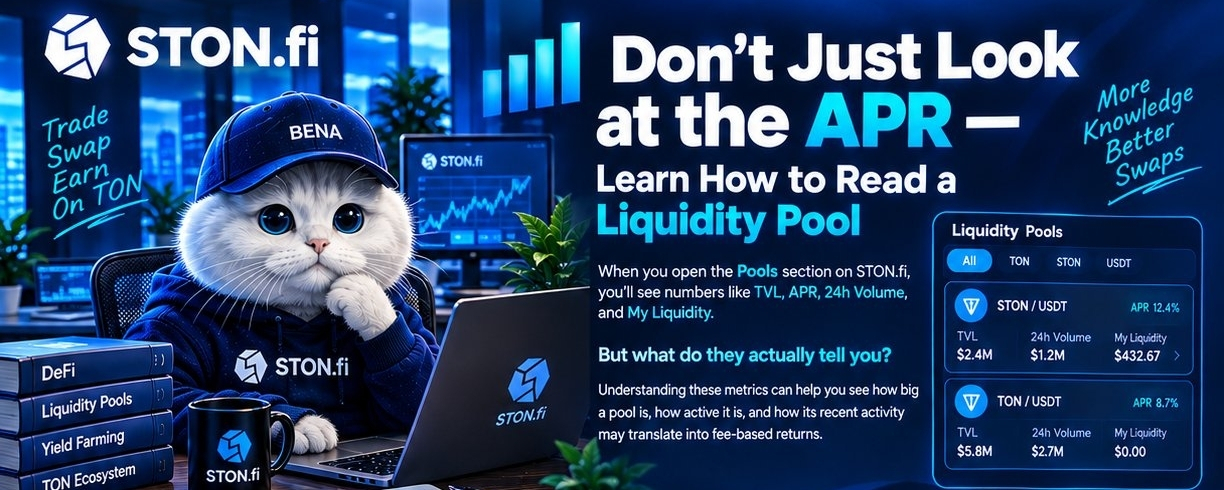
Article
📊 Don’t Just Look at the APR — Learn How to Read a Liquidity PoolWhen you open the Pools section on STON.fi, you’ll see numbers like TVL, APR, 24h Volume, and My Liquidity.
But what do they actually tell you?
Understanding these metrics can help you see how big a pool is, how active it is, and how its recent activity may translate into fee-based returns.
💰 TVL — How Much Liquidity Is There?
TVL (Total Value Locked) represents the total dollar value deposited in the pool.
Generally, higher TVL means deeper liquidity, which can help support larger swaps with lower price impact.
📈 APR — What Could the Recent Activity Generate?
APR is an annualized estimate based on recent pool activity.
It can change as trading volume, liquidity, fees, and market conditions change.
So remember:
APR is an estimate, not a guaranteed return.
🔄 24h Volume — Is the Pool Active?
24h Volume shows how much trading has happened through the pool over the last 24 hours.
Higher trading activity can generate more swap fees for liquidity providers.
But don't look at volume alone. A pool with high volume and very low TVL can behave very differently from a deep pool with high TVL.
👤 My Liquidity — What Did You Provide?
My Liquidity shows the amount of liquidity you personally provided to the pool.
It helps you quickly track your position and see how much you currently have in that pool.
🧠 How Should You Read Them Together?
Think of it like this:
TVL → How deep is the pool?
24h Volume → How active is it?
APR → What recent activity may translate into annually?
My Liquidity → What's your position?
The important part is not to judge a pool using just one number.
Pool metrics are dynamic, so they can change as liquidity, trading activity, token prices, and market conditions change.
Before providing liquidity, don't just ask “What is the APR?”
Ask:
“How deep is the pool, how active is it, and what is actually driving the return?” 📊
@stonfi
#STONfi #TON #DeFi #LiquidityPools #APR #TVL #Crypto $HBAR
{spot}(HBARUSDT)
$QNT
{future}(QNTUSDT)
$GRAM
{future}(GRAMUSDT)
📊 Don’t Just Look at the APR — Learn How to Read a Liquidity Pool
When you open the Pools section on STON.fi, you’ll see numbers like TVL, APR, 24h Volume, and My Liquidity.
But what do they actually tell you?
Understanding these metrics can help you see how big a pool is, how active it is, and how its recent activity may translate into fee-based returns.
💰 TVL — How Much Liquidity Is There?
TVL (Total Value Locked) represents the total dollar value deposited in the pool.
Generally, higher TVL means deeper liquidity, which can help support larger swaps with lower price impact.
📈 APR — What Could the Recent Activity Generate?
APR is an annualized estimate based on recent pool activity.
It can change as trading volume, liquidity, fees, and market conditions change.
So remember:
APR is an estimate, not a guaranteed return.
🔄 24h Volume — Is the Pool Active?
24h Volume shows how much trading has happened through the pool over the last 24 hours.
Higher trading activity can generate more swap fees for liquidity providers.
But don't look at volume alone. A pool with high volume and very low TVL can behave very differently from a deep pool with high TVL.
👤 My Liquidity — What Did You Provide?
My Liquidity shows the amount of liquidity you personally provided to the pool.
It helps you quickly track your position and see how much you currently have in that pool.
🧠 How Should You Read Them Together?
Think of it like this:
TVL → How deep is the pool?
24h Volume → How active is it?
APR → What recent activity may translate into annually?
My Liquidity → What's your position?
The important part is not to judge a pool using just one number.
Pool metrics are dynamic, so they can change as liquidity, trading activity, token prices, and market conditions change.
Before providing liquidity, don't just ask “What is the APR?”
Ask:
“How deep is the pool, how active is it, and what is actually driving the return?” 📊
@STONfi DEX
#STONfi #TON #DeFi #LiquidityPools #APR #TVL #Crypto $HBAR
$QNT
$GRAM
But what do they actually tell you?
Understanding these metrics can help you see how big a pool is, how active it is, and how its recent activity may translate into fee-based returns.
💰 TVL — How Much Liquidity Is There?
TVL (Total Value Locked) represents the total dollar value deposited in the pool.
Generally, higher TVL means deeper liquidity, which can help support larger swaps with lower price impact.
📈 APR — What Could the Recent Activity Generate?
APR is an annualized estimate based on recent pool activity.
It can change as trading volume, liquidity, fees, and market conditions change.
So remember:
APR is an estimate, not a guaranteed return.
🔄 24h Volume — Is the Pool Active?
24h Volume shows how much trading has happened through the pool over the last 24 hours.
Higher trading activity can generate more swap fees for liquidity providers.
But don't look at volume alone. A pool with high volume and very low TVL can behave very differently from a deep pool with high TVL.
👤 My Liquidity — What Did You Provide?
My Liquidity shows the amount of liquidity you personally provided to the pool.
It helps you quickly track your position and see how much you currently have in that pool.
🧠 How Should You Read Them Together?
Think of it like this:
TVL → How deep is the pool?
24h Volume → How active is it?
APR → What recent activity may translate into annually?
My Liquidity → What's your position?
The important part is not to judge a pool using just one number.
Pool metrics are dynamic, so they can change as liquidity, trading activity, token prices, and market conditions change.
Before providing liquidity, don't just ask “What is the APR?”
Ask:
“How deep is the pool, how active is it, and what is actually driving the return?” 📊
@STONfi DEX
#STONfi #TON #DeFi #LiquidityPools #APR #TVL #Crypto $HBAR
$QNT
$GRAM
114


·
--
Article
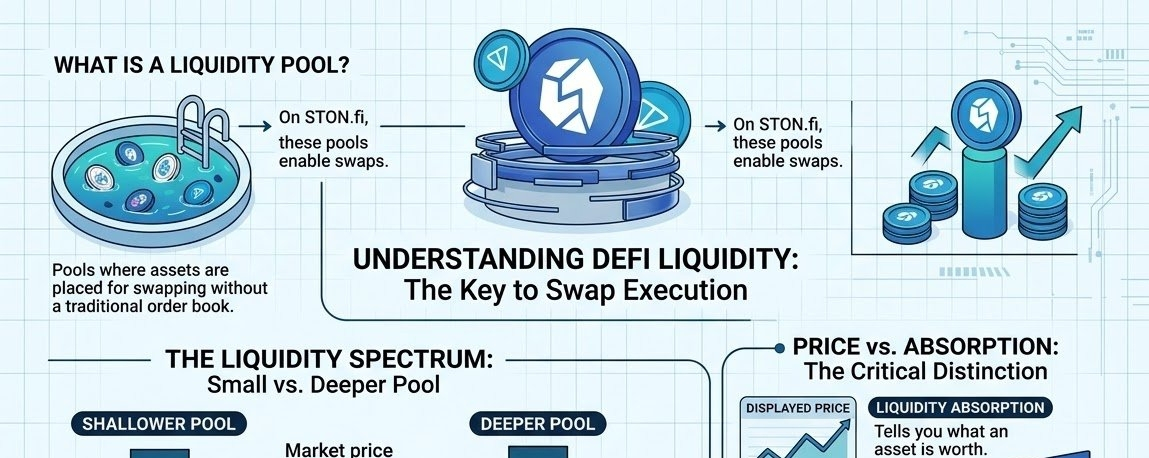
Liquidity is one of those DeFi concepts that sounds simple untilLiquidity is one of those DeFi concepts that sounds simple until you see what happens without enough of it.
A liquidity pool is where assets are placed so users can swap between them without needing a traditional order book.
On @ston_fi, these pools provide the liquidity that makes swaps possible.
But having liquidity is not enough.
The depth of that liquidity matters.
If a pool is small and someone makes a large swap, that trade can change the pool's token ratio significantly.
That creates higher price impact.
A deeper pool can generally absorb larger trades with less movement in the pool price.
This is why two tokens can have similar market prices but very different trading experiences.
The displayed price tells you what an asset is worth.
Liquidity tells you how much of that asset the market can actually absorb.
For anyone using a DEX, liquidity is therefore not just a number on a dashboard.
It directly affects execution.
And that is why understanding liquidity is one of the first steps toward understanding DeFi.
@ston_fi
#STONfi #DeFi #TON
Liquidity is one of those DeFi concepts that sounds simple until
Liquidity is one of those DeFi concepts that sounds simple until you see what happens without enough of it.
A liquidity pool is where assets are placed so users can swap between them without needing a traditional order book.
On @ston_fi, these pools provide the liquidity that makes swaps possible.
But having liquidity is not enough.
The depth of that liquidity matters.
If a pool is small and someone makes a large swap, that trade can change the pool's token ratio significantly.
That creates higher price impact.
A deeper pool can generally absorb larger trades with less movement in the pool price.
This is why two tokens can have similar market prices but very different trading experiences.
The displayed price tells you what an asset is worth.
Liquidity tells you how much of that asset the market can actually absorb.
For anyone using a DEX, liquidity is therefore not just a number on a dashboard.
It directly affects execution.
And that is why understanding liquidity is one of the first steps toward understanding DeFi.
@ston_fi
#STONfi #DeFi #TON
A liquidity pool is where assets are placed so users can swap between them without needing a traditional order book.
On @ston_fi, these pools provide the liquidity that makes swaps possible.
But having liquidity is not enough.
The depth of that liquidity matters.
If a pool is small and someone makes a large swap, that trade can change the pool's token ratio significantly.
That creates higher price impact.
A deeper pool can generally absorb larger trades with less movement in the pool price.
This is why two tokens can have similar market prices but very different trading experiences.
The displayed price tells you what an asset is worth.
Liquidity tells you how much of that asset the market can actually absorb.
For anyone using a DEX, liquidity is therefore not just a number on a dashboard.
It directly affects execution.
And that is why understanding liquidity is one of the first steps toward understanding DeFi.
@ston_fi
#STONfi #DeFi #TON
50
·
--
Bullish
🌐 STONfi Cross-Chain: One Token In, Another Token Out
A cross-chain swap doesn’t always involve sending the same asset from one network to another.
With STONfi and Omniston, an available route may let you spend Token A on one chain and receive Token B on a different chain.
For example:
Token A → Chain 1
Token B ← Chain 2
🔎 How it works
1️⃣ Pick the source network, token and amount.
2️⃣ Select the destination network and the asset you actually want to receive.
3️⃣ Omniston asks eligible resolvers for quotes.
4️⃣ A resolver supplies liquidity on the destination side.
5️⃣ Settlement mechanisms manage execution or a refund.
💡 Why the quote matters
This is more than a transfer. It’s a cross-network exchange.
The amount you receive may depend on:
• Market prices
• Resolver liquidity
• Fees
• Quote validity
• Execution conditions
So don’t evaluate a route by token numbers alone.
Look at what actually lands in your wallet.
If there’s no quote, that particular token-and-network combination may not have an executable route right now.
The main question is pretty simple:
How much of the asset I want will actually arrive?
🔄 Confirm the destination asset first. Then check what you’ll spend.
Which different-token pair would you try first?
#STONfi #DeFi #TON
$PUMP
{spot}(PUMPUSDT)
🌐 STONfi Cross-Chain: One Token In, Another Token Out
A cross-chain swap doesn’t always involve sending the same asset from one network to another.
With STONfi and Omniston, an available route may let you spend Token A on one chain and receive Token B on a different chain.
For example:
Token A → Chain 1
Token B ← Chain 2
🔎 How it works
1️⃣ Pick the source network, token and amount.
2️⃣ Select the destination network and the asset you actually want to receive.
3️⃣ Omniston asks eligible resolvers for quotes.
4️⃣ A resolver supplies liquidity on the destination side.
5️⃣ Settlement mechanisms manage execution or a refund.
💡 Why the quote matters
This is more than a transfer. It’s a cross-network exchange.
The amount you receive may depend on:
• Market prices
• Resolver liquidity
• Fees
• Quote validity
• Execution conditions
So don’t evaluate a route by token numbers alone.
Look at what actually lands in your wallet.
If there’s no quote, that particular token-and-network combination may not have an executable route right now.
The main question is pretty simple:
How much of the asset I want will actually arrive?
🔄 Confirm the destination asset first. Then check what you’ll spend.
Which different-token pair would you try first?
#STONfi #DeFi #TON
$PUMP
A cross-chain swap doesn’t always involve sending the same asset from one network to another.
With STONfi and Omniston, an available route may let you spend Token A on one chain and receive Token B on a different chain.
For example:
Token A → Chain 1
Token B ← Chain 2
🔎 How it works
1️⃣ Pick the source network, token and amount.
2️⃣ Select the destination network and the asset you actually want to receive.
3️⃣ Omniston asks eligible resolvers for quotes.
4️⃣ A resolver supplies liquidity on the destination side.
5️⃣ Settlement mechanisms manage execution or a refund.
💡 Why the quote matters
This is more than a transfer. It’s a cross-network exchange.
The amount you receive may depend on:
• Market prices
• Resolver liquidity
• Fees
• Quote validity
• Execution conditions
So don’t evaluate a route by token numbers alone.
Look at what actually lands in your wallet.
If there’s no quote, that particular token-and-network combination may not have an executable route right now.
The main question is pretty simple:
How much of the asset I want will actually arrive?
🔄 Confirm the destination asset first. Then check what you’ll spend.
Which different-token pair would you try first?
#STONfi #DeFi #TON
$PUMP
174
Log in to explore more content
Join global crypto users on Binance Square
⚡️ Get latest and useful information about crypto.
💬 Trusted by the world’s largest crypto exchange.
👍 Discover real insights from verified creators.
Email / Phone number
Trending Topics
1
#EarningsSeason
67,423 views
668 Discussing
2
#ECBToTestAIAgentsInDigitalEuroPayments
0 views
0 Discussing
3
#JapanFSABacksFourthStablecoinTradeSettlementPilot
1,326 views
120 Discussing
4
#BitgetHackerFailsToMoveStolenFunds
7,537 views
255 Discussing
5
#BitMineETHHoldingsTop6Million
10,707 views
415 Discussing
6
#StrategyAdds1666BTCHoldingsReach847666
9,598 views
286 Discussing
7
#NvidiaApproves$150BBuyback
3,287 views
60 Discussing
8
#OpenAIDelaysGPT6.1OverSafetyIssues
22,388 views
624 Discussing
9
#AMDToAcquireWorldLabsFor$8.2B
1,643 views
51 Discussing
10
#AnthropicIPOProspectusCouldValueItOver$2T
5,360 views
74 Discussing