
There is something deeply human hiding inside the AI boom.
People often talk about AI like it appeared out of nowhere — like it floated in from some digital sky, powered by math and machines alone. But that is not the truth. AI is built from people. From their words, their work, their ideas, their mistakes, their corrections, their voices, their data, and their everyday behavior. It is shaped by human effort long before it becomes a product.
That is why the question of who captures value in the AI supply chain matters so much.
Because once you look closely, you start to see that AI is not just a technology story. It is a story about power. About who gets paid, who gets credited, who gets protected, and who quietly gives more than they receive.
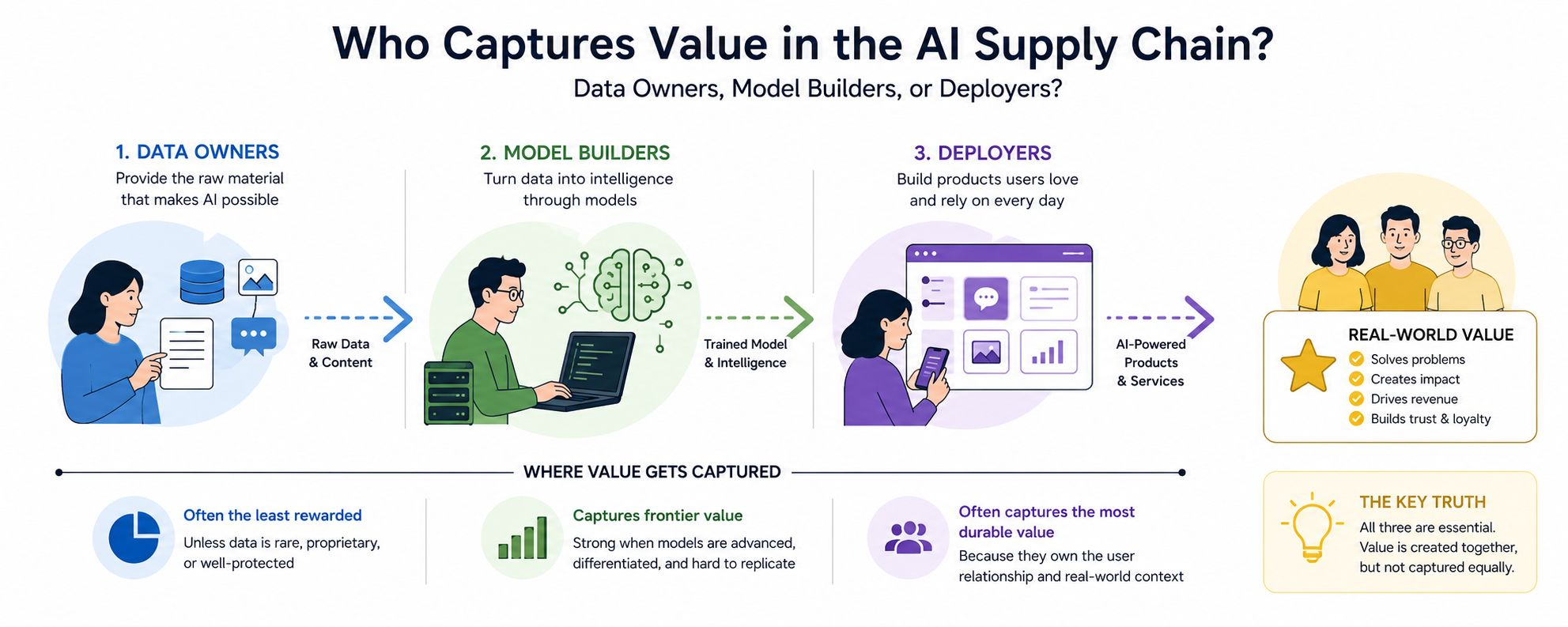
At the center of this story are three groups: data owners, model builders, and deployers. All three matter. All three contribute. But they do not benefit equally.
Data owners are often the first source of value, but not always the ones who see the reward. Their data trains the systems. Their documents, images, conversations, behaviors, and feedback help AI learn. Without that material, there is no intelligence to package, no model to sell, no product to deploy. And yet, in many cases, the people who provided the raw material are never truly invited into the upside.
That is one of the quiet injustices of the AI era. People create value, but the system does not always recognize them as creators. It recognizes them as inputs.
And that can feel cold.
Imagine spending years building something meaningful — a body of writing, a photo archive, a software repository, a customer dataset, a research collection — only to discover that parts of it helped train a system that now generates value somewhere else. The work was real. The contribution was real. But the return may be invisible. That gap is what makes this topic so emotionally charged.
Still, data owners are not always weak. In the right setting, they can become powerful. If the data is rare, proprietary, high quality, or constantly updated, then it can become incredibly valuable. A company with exclusive customer behavior data, a hospital with clinical records, a factory with operational data, or a platform with deep user interaction signals may hold something no model builder can easily replace.
That kind of data is not just fuel. It is leverage.
Then there are the model builders.
These are the people and companies that create the actual intelligence engines. They spend enormous time, money, and energy training systems that can reason, generate, classify, and predict. They need compute, talent, experimentation, and patience. They are the ones who turn raw information into something that feels almost alive.
And when they succeed, they can capture enormous value.
For a while, it can seem like the model itself is the whole story. The biggest breakthroughs, the biggest headlines, the biggest prestige often sit here. The model builder becomes the face of the AI moment. Their technical edge can create strong pricing power, brand power, and market attention.
But there is a catch.
A model can be impressive and still not be enough.
The moment models start becoming easier to copy, or competitors begin closing the gap, or open-source alternatives improve, the value starts moving again. A great model is powerful, but it is not always the final place where money settles.
That place is often the deployer.
Deployers are the ones who take AI and put it into the real world. They build the apps, services, workflows, and products that people actually use. They know the customer. They know the pain point. They know what needs to happen for someone to trust the system, return to it, and depend on it.
This is where value often becomes sticky.
The deployer may not own the model, and they may not own the original data, but they often own the relationship with the user. And in business, that relationship is priceless. Whoever controls the interface controls attention. Whoever controls attention controls usage. Whoever controls usage controls recurring value.
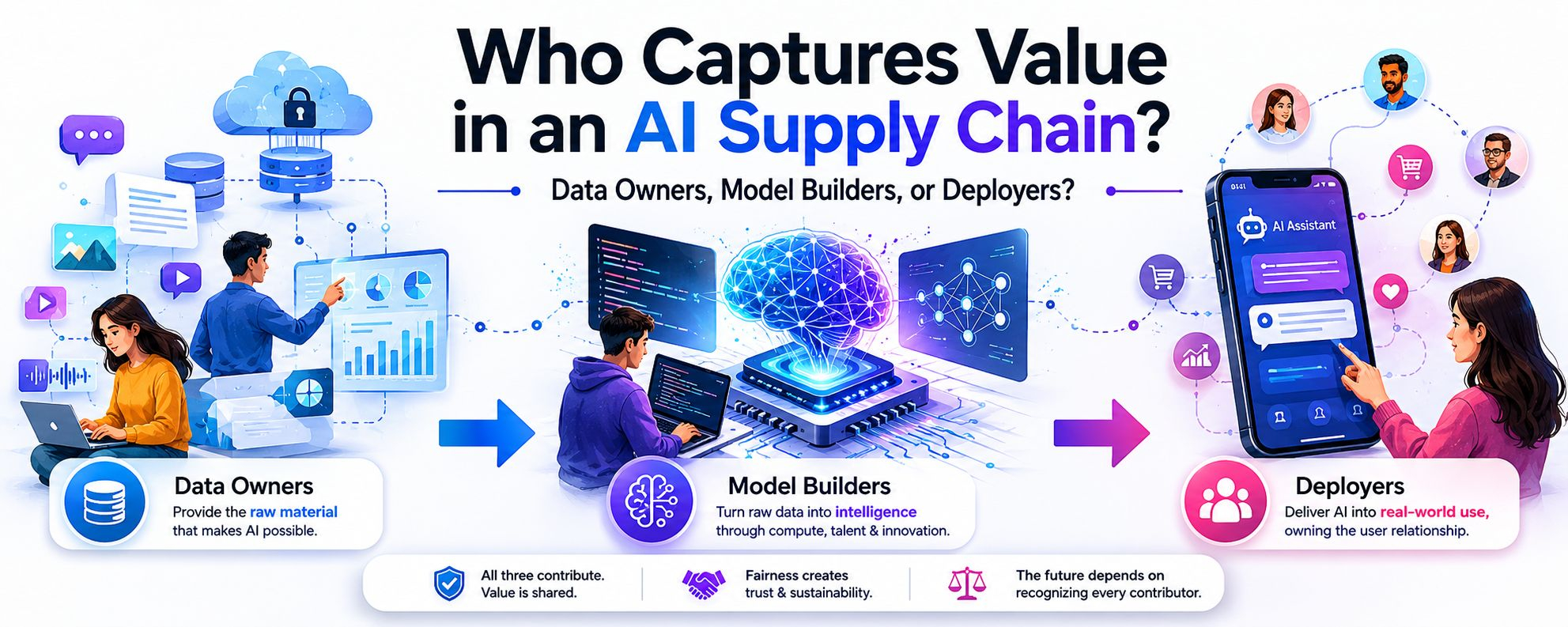
That is why deployers can often end up capturing the most durable share of the upside. They are the ones who make AI useful in a way that feels personal, immediate, and necessary. They do not just sell intelligence. They turn it into habit.
And once something becomes habit, it becomes very hard to replace.
This is where the AI supply chain becomes emotionally interesting, because each layer feels like it deserves the reward.
The data owner says, “Without my data, there is nothing.”
The model builder says, “Without my model, there is no intelligence.”
The deployer says, “Without my product, nobody gets value.”
And honestly, all three are right.
That is what makes this such a difficult question.
Value in AI is not created by one actor alone. It is created through a chain of dependence. But the chain is not equal. Some links are stronger. Some links are more visible. Some links are easier to monetize. And some links, especially the upstream ones, are too often forgotten once the product is working.
That is why so many people are now paying attention to ideas around attribution, provenance, and shared value. Systems like OpenLedger are trying to address a very old human problem in a new technical way: how do you make contribution visible? How do you make sure the people who helped train a system are not erased from the story? How do you turn invisible labor into something measurable and payworthy?
That question matters because people do not just want compensation. They want fairness. They want acknowledgment. They want to know that what they gave actually meant something.
And that is where the emotional heart of this entire debate lives.
AI can feel extraordinary, but it can also feel strangely detached from the people who made it possible. It can learn from human knowledge without ever showing gratitude. It can generate remarkable outputs without revealing the labor underneath. It can scale on top of the work of millions while making itself look self-made.
That is not just a technical issue. It is a moral one.
So who captures value in the AI supply chain?
The most honest answer is: it depends on where the scarcity is and who controls the relationship.
If the data is rare and irreplaceable, data owners can capture value.
If the model is advanced and hard to replicate, model builders can capture value.
If the product is embedded into real workflows and trusted by users, deployers often capture the most durable value.
But in today’s AI economy, the balance often tilts toward the deployer, with model builders capturing strong frontier value and data owners often receiving the least unless there is a deliberate system built to reward them.
That does not mean the current system is permanent. It just means it has not been fully challenged yet.
And maybe that is the hopeful part.
Because every major technology wave eventually has to answer the same questions: Who helped build this? Who owns it? Who benefits from it? Who gets left out?
AI is still early enough that those answers are not fixed. That means the rules are still being written. And that leaves room for better design, better contracts, better platforms, and better ways of sharing value.
If AI is going to shape the future, then the people feeding it should not disappear inside it.
They should be seen.
They should be credited.
They should be paid.
Because AI is not only a machine story. It is a human story.
And in that story, the real challenge is not simply making intelligence. It is making sure the people who made intelligence possible are not the ones left standing in the background while everyone else takes the applause.
