
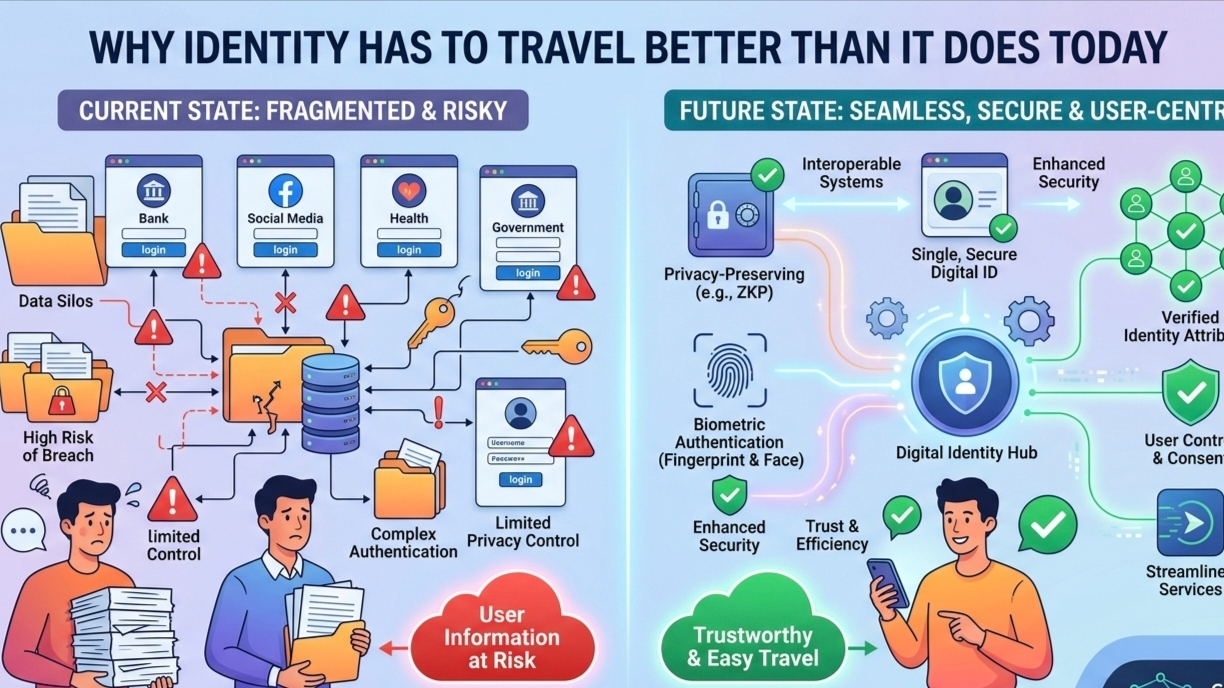

When I think about the way digital systems handle identity today, one thing becomes obvious: they were never really built for movement.
They work well enough in one place, but the moment life stretches across platforms, countries, and institutions, friction starts to show.
Inside a single system, identity usually feels straightforward. A person signs up, proves who they are, and gets access. But real life does not stay inside one system anymore. People live in one country, earn from another, build with teams in different regions, and rely on services that do not always recognize them in the same way.
That is where the real difficulty begins.
The problem is not that people do not have an identity. The problem is that every system wants to verify that identity all over again, in its own format and by its own rules. The same person can be trusted in one place and then treated like a stranger in another.
You can already see this happening in cross-border business. A founder in the UAE might be building locally, hiring remote workers from Pakistan or Egypt, speaking with investors overseas, and using financial services based in a different market. None of this feels unusual anymore. What does feel outdated is the way identity gets handled in the middle of all this. The same documents are requested again. Verification happens more than once. Records do not always line up properly. Small delays start adding up.
At first, these issues can seem minor. But over time, they become expensive. They waste time, slow down onboarding, and create friction for people who are simply trying to work, build, and move between systems without unnecessary obstacles.
That is why portable identity matters.
If trust has already been established properly, it should not disappear every time a person enters a new platform or jurisdiction. Identity should be able to carry forward in a secure and structured way. Verification still matters, of course, but it should not have to begin again from zero every single time.
This is not just a theoretical idea. In Europe, the eIDAS framework was introduced to support trusted digital identity across borders, allowing an identity recognized in one member state to be accepted in another under clear conditions. In the UAE, UAE Pass shows how a strong digital identity system can make access easier across many services within one national environment. Both examples point to the same thing: digital identity becomes far more useful when it is built to move, not just stay where it started.
That is where Sign becomes relevant.
What makes Sign important is that it does not treat identity like a one-time check locked inside a single system. It works more like a trust layer, where credentials and attestations can still hold meaning across different environments. Instead of forcing every institution to rebuild trust from the beginning, it offers a way to rely on structured proof that already exists.
This matters because the modern economy does not stay still. Work moves. Capital moves. Services move. People are already living and building across multiple systems. Identity needs to support that reality instead of making it harder.
In the end, the real question is simple: should every new interaction force people to prove themselves all over again? In a connected world, that model no longer feels efficient. It feels outdated.
That is why portable identity is starting to look like more than just a technical feature. It is beginning to feel like a necessary part of digital infrastructure.