
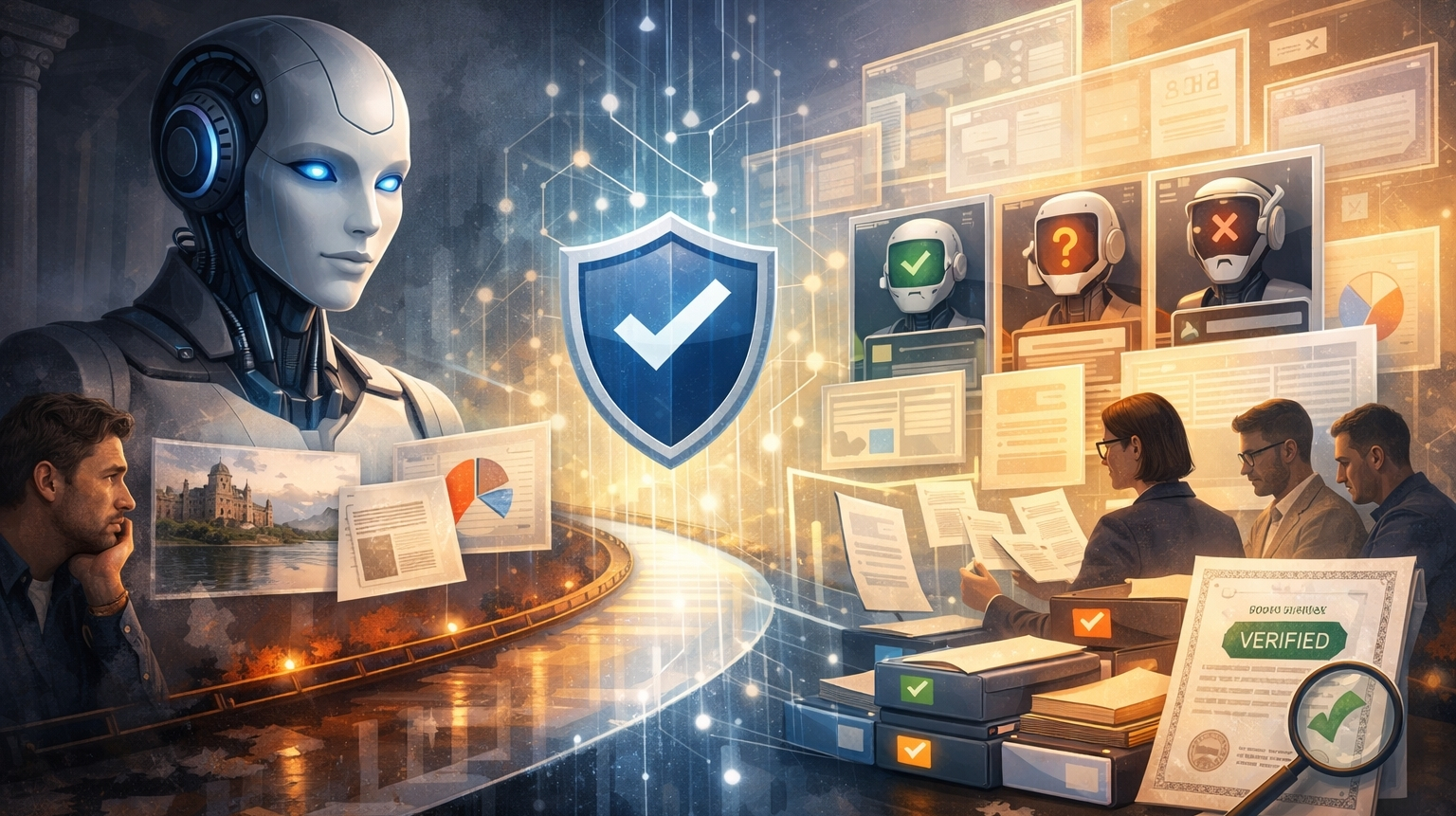

I keep coming back to the same uncomfortable thought: the scariest part of AI isn’t that it can be wrong. It’s that it can be wrong in a way that feels calm, polished, and strangely comforting. There’s no awkward pause, no “I’m not sure,” no little human hesitation that makes you lean in and double-check. It just delivers the answer like it’s reading from a finished script, and your brain—without asking permission—starts treating it like it must be true.
I didn’t understand how much that mattered until I had my own small “oh no” moment. I asked an AI something I genuinely needed. Not a random curiosity, but something I was going to use. The response sounded perfect. It was clean, confident, and it had that reassuring tone that makes you feel like you’ve been rescued from confusion. I remember thinking, finally, I can move on. I repeated it to someone else. I made a decision around it. And then, later, I found out it was simply wrong.
What surprised me wasn’t just the mistake. It was how easily I’d trusted it. I didn’t feel stupid exactly. I felt… tricked. Like I’d been gently nudged into believing something because it sounded good enough to be true. And if you’ve ever experienced that—whether it was an AI, a confident coworker, a company policy page, or a viral post—you know the specific flavor of that feeling. It’s not dramatic, but it lingers. You start questioning your own instincts, and you also start noticing how often “confidence” gets mistaken for “correct.”
That’s the emotional mess we’re all stepping into right now. AI is becoming the voice people consult for everything, and it’s doing it with this smooth authority that feels almost human, but without the human accountability. When a person gives you bad info, there’s usually context. You can ask why. You can see their uncertainty. You can tell if they’re guessing. With AI, the guess can come wrapped in the same perfect tone as the truth. And because it’s so fluent, we treat it like it’s knowledgeable. Most people don’t realize how much our brains are wired to relax when something sounds coherent. We’re tired. We have too much going on. We want answers, not homework.
But the truth is, AI isn’t “knowing” in the way we mean it when we talk about a careful expert who can defend their reasoning. A lot of the time it’s producing the most likely-sounding response based on patterns, not verifying facts like a responsible researcher would. And that’s fine when you’re brainstorming. It’s not fine when you’re making real decisions. The consequences of being wrong show up in normal, human ways: someone spends money they shouldn’t have spent, someone makes a policy mistake, someone shares a false claim publicly, someone gets legal guidance they rely on, someone’s reputation takes a hit because they repeated something that sounded authoritative.
I think that’s why the idea behind Mira’s verification workflow grabbed my attention. Not because it promises some magical world where AI never hallucinates, but because it seems to admit something that a lot of people avoid saying out loud: we can’t keep treating AI output like it’s automatically safe to trust. We need a system that acts like a second set of eyes, and not in a shallow “add citations and call it credible” way. In a real way. In a way that makes it harder for a confident mistake to slip through unnoticed.
What makes this approach feel different, at least conceptually, is that it doesn’t treat an AI response as one big block you either accept or reject. It treats it like what it really is: a bundle of claims. Because that’s what an answer actually contains when you look closely. There are little statements hiding inside the paragraph—facts, numbers, names, cause-and-effect assumptions, timelines, definitions. If you want trust, you can’t just admire the paragraph. You have to pull those claims out and ask, one by one, “Is this actually true? Can this be backed up? Or are we just being swept along by a convincing tone?”
That idea sounds simple, but it changes everything. It forces the output to become testable instead of merely readable. And once you have testable claims, you can do something meaningful with them. You can send them through verification instead of hoping the original model behaved.
Then there’s the part that, honestly, just feels more psychologically honest: it doesn’t rely on one “judge” model to decide what’s true. It pushes the claims out to multiple independent verifiers. Different models, separate checks, and a consensus step that makes disagreement visible. The reason that matters is the same reason you wouldn’t ask one person to fact-check themselves and call it a day. You want independent confirmation, because independence is what makes checking real. If you ask one system to grade its own output, you’re just moving the trust problem around. You’re not solving it.
I like thinking about it in everyday terms. It’s like asking a few people the same question separately. If they all come back with the same answer, you feel safer. If they split, you slow down. You start asking what’s unclear. You stop moving forward like the matter is settled. That slowing down is the whole point. It’s the moment we usually skip when we’re rushing.
And the thing that makes verification feel like more than a vague promise is the idea of leaving a trail—some kind of certificate or record that shows what was checked and what passed. Because otherwise, “verified” is just another marketing word. A sticker. Something you’re supposed to trust because it says “trust.” A record turns it into something you can point to. Something you can keep. Something you can audit later, especially when the stakes are high and you need to explain how you arrived at a conclusion.
I also can’t ignore the bigger reality that’s pushing this conversation forward: we’re entering an era where companies and creators are going to be held responsible for what their AI says. It’s already happening. Once AI is deployed into customer support, content creation, finance, legal drafting, or anything public-facing, it stops being “just a tool” and starts becoming a liability if it’s not controlled. And the worst part is that the person harmed by a wrong answer is often not the person who chose to deploy the AI in the first place. It’s the customer. The user. The person who trusted the output because it looked official enough, because it sounded calm enough, because they assumed someone had checked it.
That’s why I keep saying this isn’t just a tech issue. It’s a trust issue. People are already exhausted by misinformation and fast-moving nonsense. AI can either make that problem unbearable or help repair it, but it can’t do both at the same time. If we keep shipping AI that speaks confidently without guardrails, we’re basically training the world to stop believing anything. And that’s not just sad, it’s dangerous. When trust collapses, everything becomes harder—business, relationships, institutions, even basic communication.
So when someone says Mira’s workflow turns AI output into trust, I don’t hear it as a claim that truth has been conquered. I hear it as a more humble, more realistic goal: turn AI output into something that has earned its credibility, instead of something that merely sounds credible. That’s the difference between a polished answer and a reliable one. A polished answer is easy to produce. A reliable answer costs something. It costs time, compute, process, and the willingness to admit uncertainty when certainty can’t be justified.
And I think that’s what stays with me the most. The future probably isn’t AI that never makes mistakes. The future is AI that makes mistakes inside systems that catch them before they become real-world harm. Systems that don’t shame uncertainty, but label it. Systems that don’t treat everything as equally true, but separate what’s confirmed from what’s speculative. Systems that give people a way to rely on AI without feeling like they’re gambling every time they accept an answer.
Because once you’ve been burned by a confident wrong answer, you start craving something simple: a reason to trust that isn’t just a feeling. You want proof. You want a trail. You want the bridge to be visible under your feet, not a leap into the fog. And maybe that’s the quiet promise behind verification workflows like Mira’s. Not perfection. Just a world where trust is built with receipts, not vibes.
#Mira @Mira - Trust Layer of AI $MIRA
