

@Mira - Trust Layer of AI #Mira
Artificial intelligence is transforming industries at an unprecedented pace. From automated financial strategies and enterprise analytics to medical research and digital governance, AI systems are becoming deeply embedded in decision-making processes. However, despite rapid innovation, one critical limitation remains: reliability. AI models can generate hallucinations, misinterpret data, and reflect hidden biases. In high-stakes environments, these weaknesses pose serious risks. Mira Network is designed to solve this problem by introducing a decentralized verification protocol that strengthens trust in AI-generated outputs.
At its foundation, Mira Network acts as a verification layer for artificial intelligence. Instead of treating AI responses as final and unquestionable, Mira transforms outputs into structured, verifiable claims. Complex answers are broken down into smaller components that can be independently evaluated. This claim-level decomposition ensures that each part of an AI response is subject to scrutiny rather than relying on blind acceptance of a single system’s output.
Once claims are created, they are distributed across a decentralized network of independent validators and AI models. These participants review, cross-check, and evaluate the information. Through blockchain-based consensus mechanisms, the network determines which claims are valid. This distributed approach dramatically reduces the likelihood of hallucinations and misinformation. Instead of central oversight, verification is achieved through collective agreement supported by cryptographic proof.
A key strength of Mira Network lies in its incentive structure. Validators are rewarded for accurate participation and penalized for dishonest or low-quality behavior. The $MIRA token plays a central role in aligning economic incentives within the ecosystem. By embedding financial accountability into the protocol, Mira ensures that network participants are motivated to maintain high standards of verification. This economic model transforms trust into a measurable and enforceable mechanism rather than a theoretical promise.
The decentralized nature of Mira provides additional advantages. Traditional AI validation methods often depend on centralized authorities, corporations, or internal audit systems. While these methods can improve reliability, they introduce single points of failure and potential bias. Mira eliminates centralized control by anchoring verification results on blockchain infrastructure. This makes outcomes transparent, immutable, and independently auditable. In decentralized finance and Web3 environments, such properties are essential for secure integration.
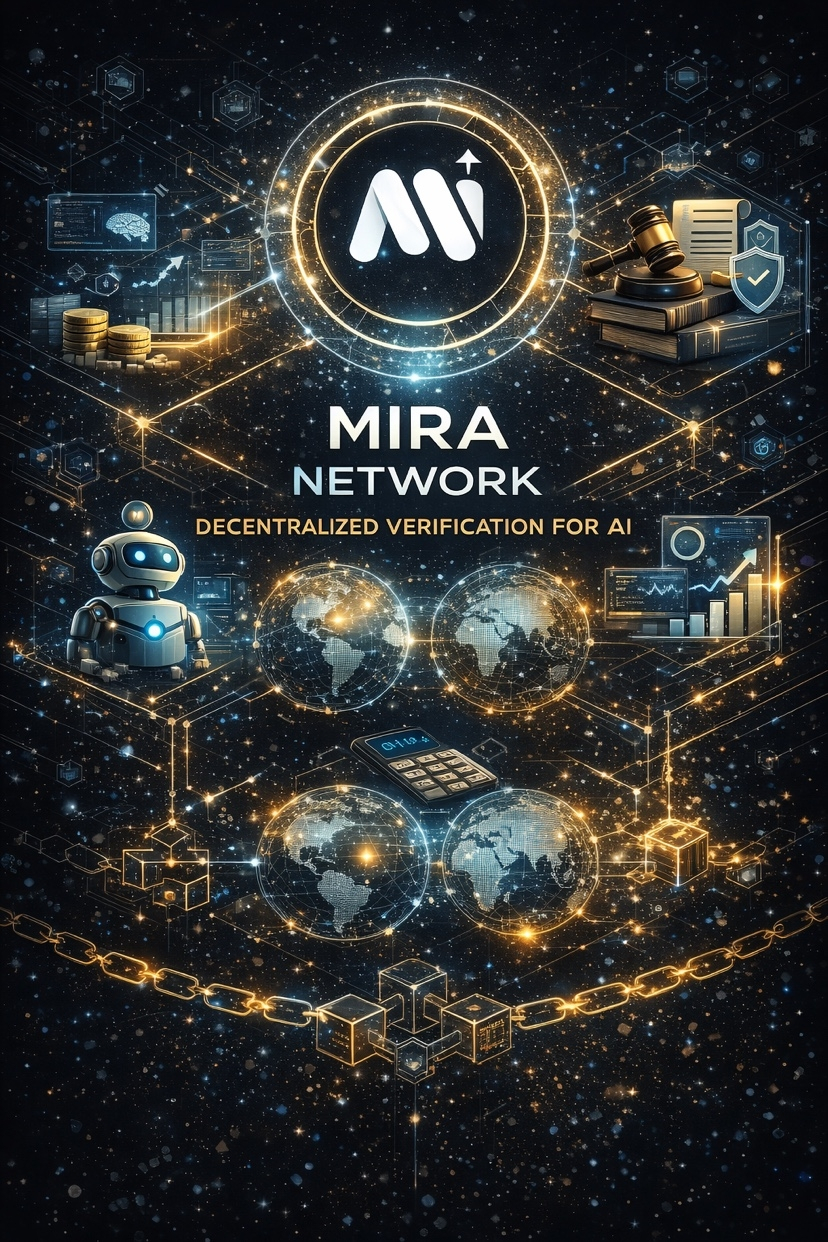
Mira Network’s applications extend across multiple industries. In decentralized finance, AI models are frequently used for risk analysis, trading strategies, and liquidity optimization. Incorrect outputs in these contexts can lead to financial losses. By verifying AI-generated insights before execution, Mira strengthens confidence in automated financial systems. Similarly, in healthcare and medical research, AI is often used to interpret complex data and generate recommendations. Verification mechanisms help reduce the risk of misinformation in life-critical applications.
Autonomous AI agents represent another major use case. As blockchain ecosystems evolve, AI-driven agents are expected to execute smart contracts, manage digital assets, and interact with decentralized applications. Without a reliable verification layer, these agents could introduce systemic vulnerabilities. Mira ensures that decisions made by autonomous systems are validated through decentralized consensus before triggering irreversible blockchain actions.
Enterprise adoption of AI also benefits from Mira’s architecture. Large organizations require audit-ready systems that can justify outputs used in strategic decision-making. By providing cryptographic proof of accuracy, Mira enhances corporate governance and compliance standards. Its modular framework allows seamless integration into existing AI workflows without disrupting operational efficiency.
Beyond individual applications, Mira represents a broader convergence between artificial intelligence and blockchain technology. AI excels at generating insights and automating processes, while blockchain ensures transparency, immutability, and decentralized governance. Mira combines these strengths to create a trustless verification infrastructure. This synergy positions the network as a foundational layer for the next generation of intelligent, decentralized systems.
As AI continues to advance toward greater autonomy, the importance of verification will only increase. Governments, enterprises, and decentralized platforms require dependable outputs supported by proof rather than assumption. Mira Network addresses this urgent need by transforming AI reliability into a decentralized, economically secured process.
In essence, Mira is not replacing AI it is reinforcing it. By combining claim-based verification, blockchain consensus, and tokenized incentives, Mira Network builds a framework where artificial intelligence can operate with greater transparency, accountability, and trust.
