Not all of them. But the ones who have never managed to create something concrete beyond a token and a whitepaper—those will disappear.
The market always comes back to the same question: do people really pay to use this network?
Render, for now, can answer yes.
The basic idea
Millions of GPUs are sleeping. Gaming PCs, creative workstations, machines from the crypto era. Power that serves no purpose.
On the other side, there are 3D studios, developers, AI companies looking for compute capacity and paying a lot to get it.
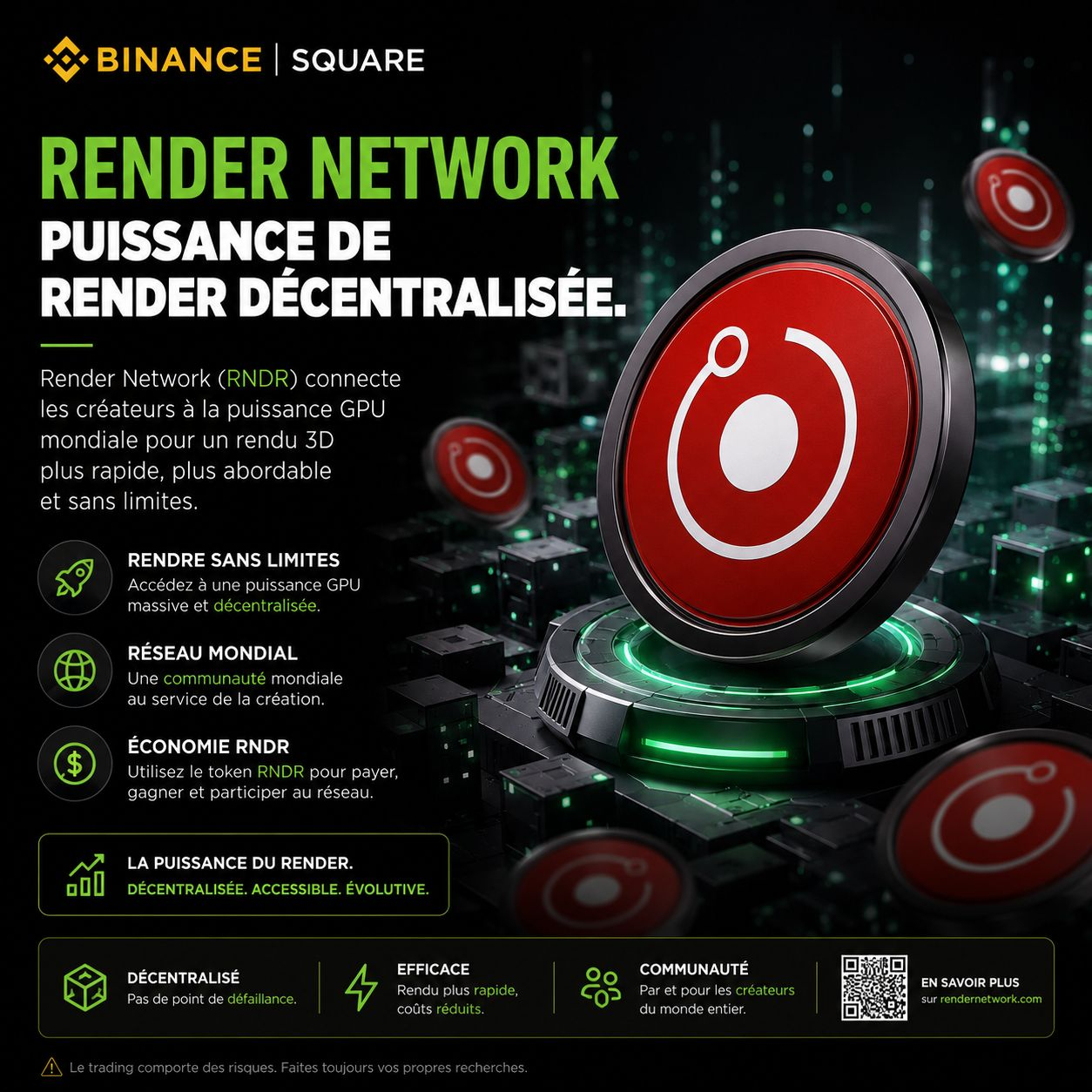
Render connects the two. The RENDER token is the payment method. Simple.
What’s less straightforward is the ambition behind it: the project no longer wants to just do 3D rendering. It wants to become a computing infrastructure for AI. A major pivot. And that’s where everything hinges.
What I found interesting
NVIDIA. Stability AI. Luma Labs. These aren’t partnerships announced in a tweet—these are companies that use the network.
35% of 2025 production comes from Hollywood studios and AI training clients. In 2026, the integration of Salad — 60,000 additional GPUs — was approved by the community with 98.86%.
The network is running. This is not a promise.
The mechanism that benefits token holders
Every time someone uses the network, RENDER tokens go up in smoke. Literally burned. At the same time, new tokens reward those who provide computing power.
Result: the more the network is used, the fewer tokens are in circulation.
By December 2025, a million tokens had already been destroyed. Out of a total supply of 644 million, 80.5% are already in circulation. The remaining tokens are locked until 2051—which limits big massive selloffs in the short term.
Token holders also vote on protocol decisions. It is not a passive token.
Competition is real. Akash Network plays on exactly the same field. And centralized giants like AWS won’t just stand there without reacting.
The price took a hit. After $13.6 in 2024, RENDER is trading around $1.85 in early 2026. The market is waiting for concrete proof that the pivot to AI will hold.
And that’s exactly the real risk—not the technology, but execution. Moving from a 3D rendering network to a general AI infrastructure is ambitious. It can succeed. It can also fail.
The market will sort it out. Render has something that many projects don’t: a utility that can be measured today.
Real clients. Real burns. A GPU market that should grow from $83 billion in 2025 to $353 billion in 2030.
It’s not a guarantee. But in a market that weeds out empty projects, it’s already a difference.

RENDER
1.581
+2.39%