

More than three dozen European banks have lined up behind a single Euro stablecoin project as executives and policymakers grow increasingly concerned about the dominance of the U.S. dollar in the crypto market.
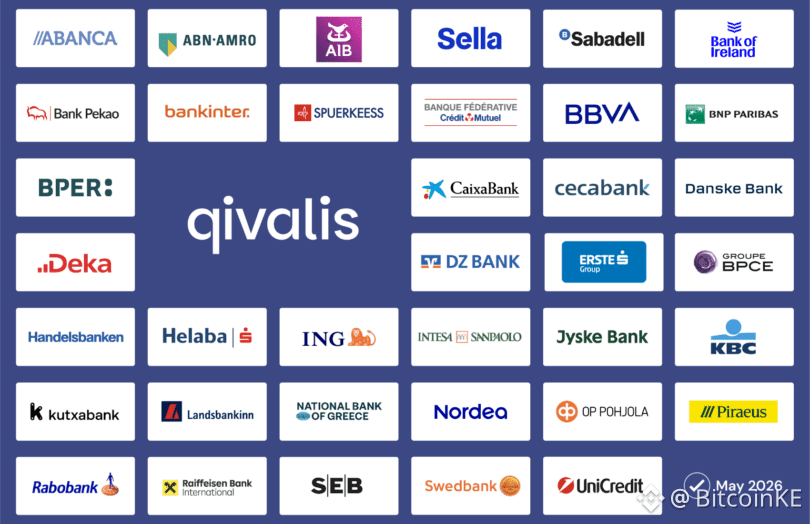
Amsterdam-based Qivalis had already secured backing from some of Europe’s largest lenders, including:
BNP Paribas,
ING, and
UniCredit,
for its stablecoin, which has yet to launch.
STABLECOINS | A Euro Stablecoin is Coming in H2 2026
The project lead, who is also the former Head of @Coinbase in #Germany, has said the project aims to provide a #EUROPEAN ALTERNATIVE to dollar-denominated #stablecoins and support real-time cross-border corporate #payments…
— BitKE (@BitcoinKE) March 3, 2026
The addition of another 25 banks, among them:
ABN Amro,
Intesa Sanpaolo, and
Rabobank
brings the total number of supporting lenders to 37 making the Qivalis initiative Europe’s largest stablecoin project by number of backers.
INSTITUTIONAL | Italy’s Biggest Bank More Than Doubles Exposure to Crypto Assets in Q1 2026
Stablecoins are digital tokens typically pegged to sovereign currencies and are widely used by traders to move funds in and out of cryptocurrencies.
Traditional banks are increasingly exploring stablecoins as a way to speed up and reduce the cost of back-office operations such as settlement, collateral management, and payments.
Qivalis is betting that launching its stablecoin with a critical mass of banks, along with their existing customers and payment networks, will help drive adoption and make the token more competitive with existing euro-denominated stablecoins.
European bankers have become increasingly concerned about the dominance of dollar-backed stablecoins and the growing influence of crypto firms in areas traditionally controlled by banks.
STABLECOINS | Europe Should Develop More Euro-Backed Stablecoins to Counter Dollar-Pegged Assets, Says French Finance Minister
Of the roughly $320 billion in stablecoins currently in circulation, almost all are denominated in U.S. dollars, with issuance dominated by Tether’s USDT and Circle’s USDC.
Christine Lagarde, President of the European Central Bank (ECB), said in May 2026 that the rising use of dollar-backed stablecoins in Europe posed a ‘legitimate concern that risks entrenching dollar dependency.’ Another senior official at the European Central Bank warned in 2025 that the growth of dollar stablecoins could weaken the ECB’s control over monetary policy.
STABLECOINS | The European Central Bank Warns Increased Stablecoin Use May Weaken Monetary Policy Flows
Jan-Oliver Sell, chief executive of Qivalis, told the Financial Times that ‘the European sovereignty angle’ was important, adding that the geopolitical environment was making it ‘attractive for people to think about an alternative to the U.S. dollar.’
Several euro-denominated stablecoins already exist though adoption has remained limited compared with their dollar rivals.
Circle’s EURC token is currently the largest euro stablecoin with a market capitalization of about $450 million, according to CoinMarketCap data, while its dollar-backed stablecoin has a market capitalization of roughly $77 billion.
Société Générale became the first major bank to launch its own stablecoin, Forge, in 2023, but the token has only about $123 million in circulation.
Another euro stablecoin, Eurite, has roughly $60 million in trading volume.
STABLECOINS | Spain Leads European Retail Market for This Euro Stablecoin in Q1 2026
This latest statistic comes 2 months after the European Central Bank warned that increased #dominance and use of #dollar-pegged #stablecoins is likely to #import foreign #monetary conditions…
— BitKE (@BitcoinKE) April 30, 2026
Sell said Qivalis is also in discussions with several non-European banks operating in countries that receive significant remittance flows from Europe about joining the consortium.
“We’re not competing with payments in Europe because payments in Europe work,” Sell said, adding that stablecoins would instead be used for cross-border transfers and immediate, or “atomic,” settlement.
Qivalis has applied for a license from the Dutch central bank and expects approval in the second half of the year.
“We are looking to be operationally ready by the time the licence comes so we can go live ASAP,” Sell said.
STABLECOINS | Financial Institutions and Corporate Treasury Teams Driving Stablecoin Adoption in Europe
Stay tuned to BitKE for deeper insights into European stablecoin space.
Join our WhatsApp channel here.
Follow us on X for the latest posts and updates
Join and interact with our Telegram community
_________________________________________