

A few nights ago I found myself reading the Fabric whitepaper after seeing people discuss robotics on Binance Square. At first I thought it was just another AI or robotics project. But the deeper I read, the more it felt like Fabric isn’t trying to build a single robot. Instead, it’s trying to build the infrastructure that robots themselves might run on in the future.
Today most robots operate in isolated environments. A warehouse robot works only inside one company’s system. A delivery robot is controlled by the software of the company that built it. The data they generate, the improvements they learn, and the decisions they make all stay inside closed networks.
Fabric proposes a different model.
The project introduces a decentralized coordination layer designed for robotics systems. Instead of robots being controlled only by private infrastructure, Fabric connects data, compute resources, governance, and ownership through public ledgers. This means contributors from anywhere could help improve the system.
The whitepaper describes the development of ROBO1, a general-purpose robot that acts as the first reference machine for the network. But the interesting part is not only the robot itself. It’s the ecosystem around it.
In Fabric’s model, researchers can contribute training data. Developers can improve software modules. Hardware contributors can help design better components. And instead of these contributions disappearing into a company’s private database, they are coordinated through the protocol and rewarded through the network’s incentive system.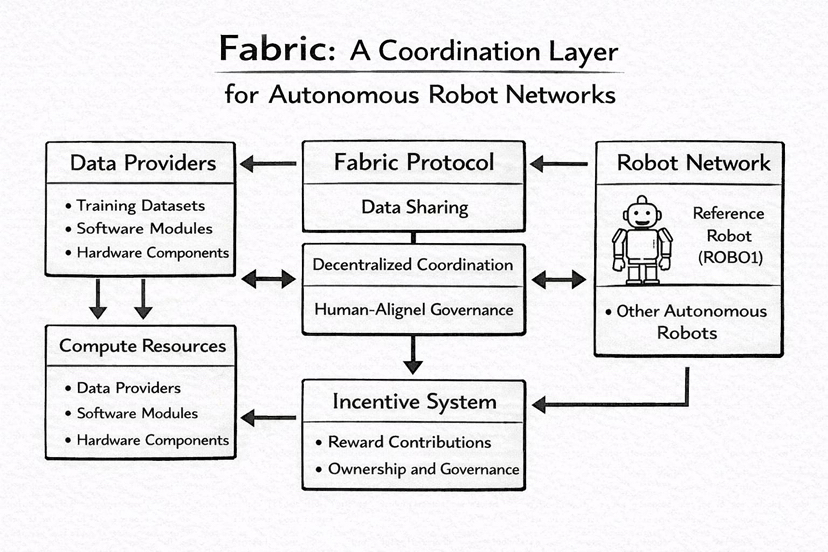
This creates something that traditional robotics development struggles with: open collaboration at scale.
Another important idea in the whitepaper is machine–human alignment. Fabric doesn’t assume that autonomous machines should operate without oversight. Instead, governance mechanisms allow human participants to guide how the network evolves. In other words, robots may act autonomously, but their development still remains accountable to a broader community.
When you step back, Fabric begins to look less like a robotics company and more like an operating layer for robotic systems. Just like the internet allowed computers to communicate globally, Fabric could allow robots to coordinate development, data sharing, and incentives across an open network.
It’s still an early vision. But if robotics continues moving toward autonomy and AI-driven systems, infrastructure like this might become necessary.
Because in the future, the real challenge may not be building smarter robots.
It may be building a system where robots can evolve together without losing human oversight.
@Fabric Foundation #ROBO $ROBO
