
How @walrusprotocol is Building the Foundation for Private, Censorship-Resistant Data Storage on Sui Blockchain
In the rapidly evolving landscape of decentralized storage solutions, a new contender has emerged with a unique focus that addresses two critical web3 pillars: privacy and scalability. The Walrus Protocol, powered by its native token, represents more than just another decentralized storage project—it's a specialized infrastructure layer designed for the privacy-first future of blockchain applications. Built on the high-performance Sui blockchain, Walrus offers developers and users a fundamentally different approach to data storage that could reshape how we think about permanence and accessibility in the decentralized web.
The Core Innovation: Why Walrus Matters Now
Most decentralized storage solutions focus primarily on cost reduction and distribution. While these are valuable, @walrusprotocol starts from a different premise: what if storage could be both decentralized and fundamentally private by design? In an era of increasing surveillance and data exploitation concerns, this positioning isn't just innovative—it's essential.
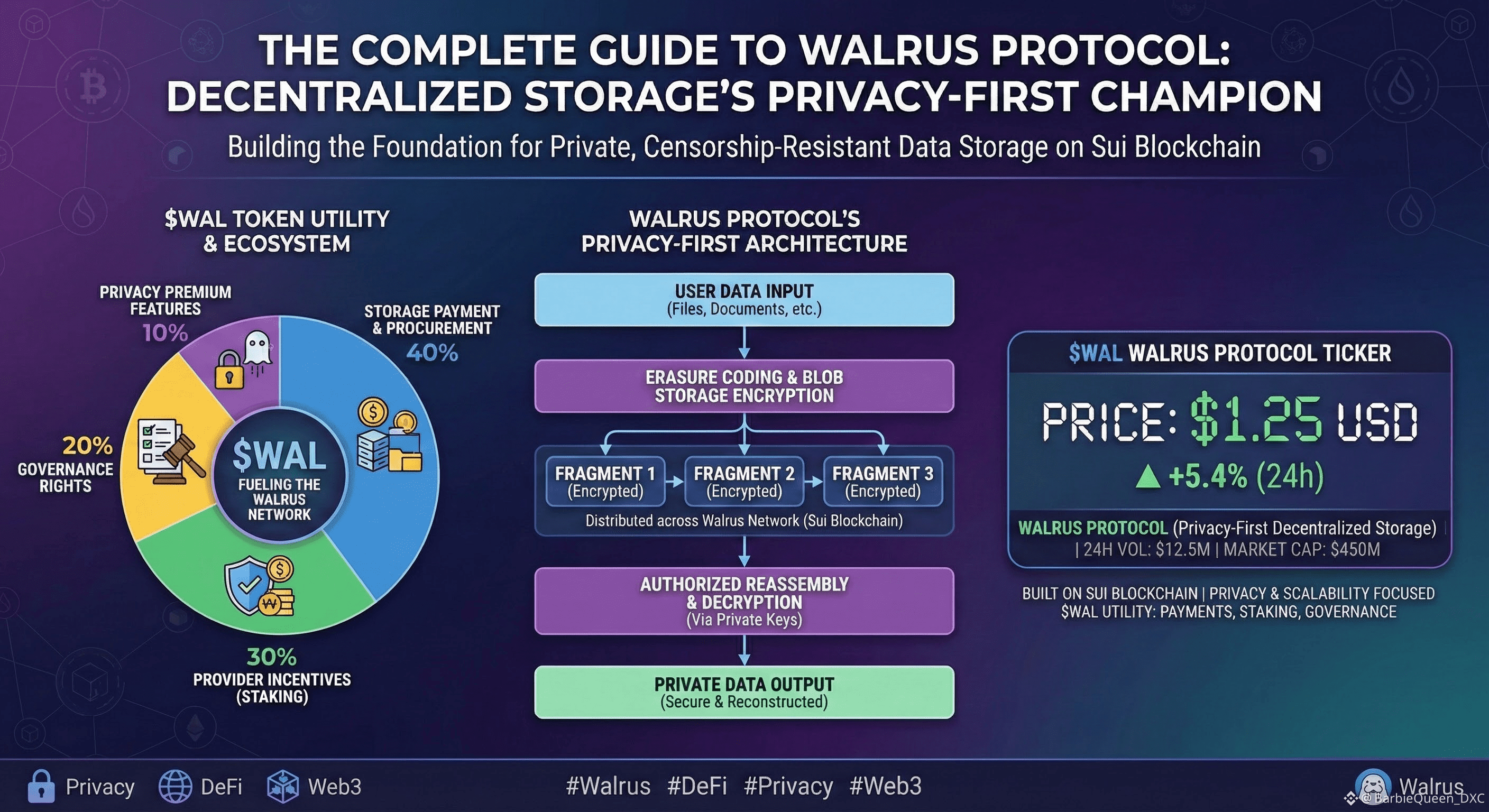
The protocol achieves this through a sophisticated technical architecture combining erasure coding and blob storage mechanisms. For non-technical readers, here's what this means in practice: instead of simply duplicating files across multiple nodes (which creates privacy vulnerabilities), Walrus breaks data into coded fragments, distributes them across its network, and ensures that only authorized parties can reconstruct the original information. This approach provides inherent privacy while maintaining the robustness expected from decentralized systems.
Technical Deep Dive: Understanding the Sui Advantage
Walrus's choice to build on Sui blockchain is strategic and noteworthy. Sui's object-centric model and parallel transaction processing capabilities offer distinct advantages for storage protocols:
1. High Throughput at Low Cost: Storage operations require numerous micro-transactions for proof-of-storage and retrieval operations. Sui's architecture handles these efficiently, keeping operational costs minimal—a critical factor for making decentralized storage economically viable.
2. Native Asset Programmability: The token integrates seamlessly with Sui's Move programming language, allowing for sophisticated tokenomics and utility functions that would be more complex on other chains.
3. Horizontal Scalability: As the Walrus network grows, Sui's ability to scale horizontally means storage capacity and retrieval speeds can increase without fundamental redesigns.
This technical foundation allows Walrus to offer what few competitors can: enterprise-grade storage performance with web3-native privacy features.
$WAL Token: Beyond Simple Utility
The token functions as the lifeblood of the Walrus ecosystem, but its utility extends far beyond simple transaction fees:
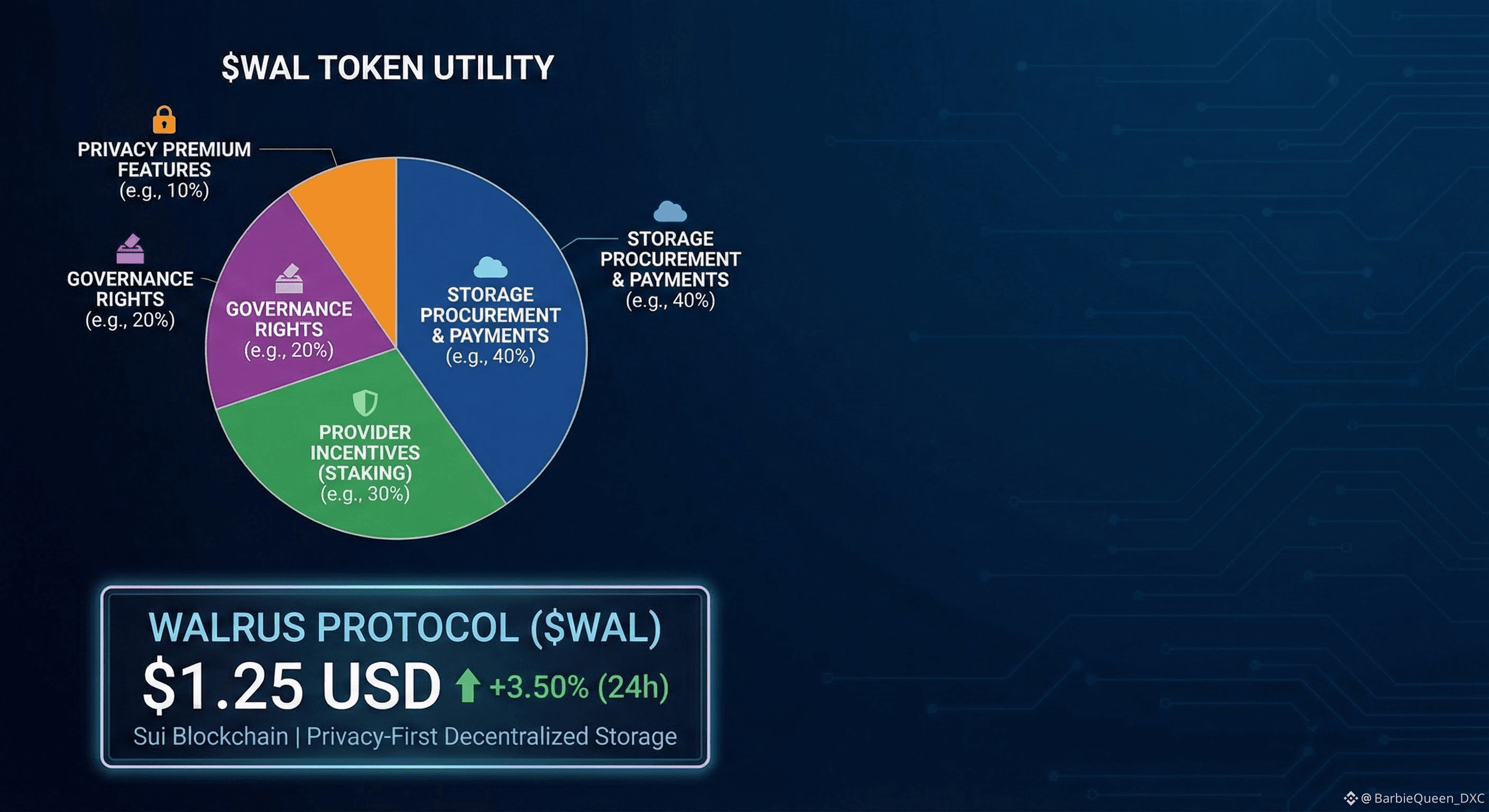
· Storage Procurement & Payments: Users spend to purchase storage space and retrieval services.
· Provider Incentives: Storage providers stake as collateral and earn tokens for providing reliable, available storage.
· Governance Rights: Token holders participate in protocol upgrades, parameter adjustments, and treasury allocations.
· Privacy Premium Features: Advanced privacy features may require locking or burning, creating deflationary pressure.
This multi-faceted utility creates a circular economy where token demand directly correlates with network usage—a sustainable model often missing in single-use token systems.
Real-World Applications: Where Walrus Excels
The true test of any infrastructure protocol is its practical application. Walrus Protocol shines in several specific use cases:
1. Privacy-First dApps: Decentralized applications handling sensitive data (health records, financial documents, private communications) can leverage Walrus for compliant, secure backend storage.
2. Web3 Media & NFTs: Beyond simple metadata, Walrus enables private, unlockable content for NFTs—imagine token-gated videos, music, or documents that remain encrypted until ownership is verified.
3. Enterprise Blockchain Solutions: Companies exploring blockchain for supply chain or document management need both transparency for verification and privacy for competitive data. Walrus's architecture supports this paradox perfectly.
4. Decentralized Social Networks: The next generation of social media will require storing user data without central control while maintaining user privacy—a challenge Walrus is uniquely positioned to solve.
Competitive Landscape: How Walrus Differentiates
While compared to projects like Filecoin, Arweave, or Storj, Walrus occupies a specialized niche:
· vs. Filecoin: While both offer decentralized storage, Walrus emphasizes built-in privacy mechanisms rather than relying on external encryption layers.
· vs. Arweave: Walrus focuses on mutable, private storage versus Arweave's permanent, public archive model.
· vs. Traditional Cloud: Offers censorship resistance and cryptographic privacy guarantees that AWS, Google Cloud, and Azure cannot provide without significant custom implementation.
This differentiation is crucial—Walrus isn't trying to be everything to everyone, but rather the best solution for specific privacy-sensitive applications.
The Road Ahead: Challenges and Opportunities
No project launches without challenges. For Walrus, key hurdles include:
· Network Effects: Storage networks become more valuable as they grow, requiring strategic partnerships to bootstrap initial capacity.
· Regulatory Navigation: Privacy-focused technologies often face heightened regulatory scrutiny, requiring careful compliance architecture.
· Developer Adoption: Convincing developers to build with a new storage standard requires robust tooling and documentation.
However, the opportunities are substantial. As data privacy regulations tighten globally and blockchain adoption increases, demand for Walrus's specific value proposition will likely grow exponentially. The protocol's focus on serving the burgeoning Sui ecosystem provides a clear initial market, while its technical design allows for expansion to other chains through bridging solutions.
Conclusion: Building the Private Foundation of Web3
The Walrus Protocol represents more than technical innovation—it embodies a philosophical stance about the future of data: that users should control their information with both autonomy and privacy. In a digital landscape increasingly dominated by surveillance capitalism and centralized control, solutions like Walrus offer a alternative path forward.
For developers building the next generation of dApps, for enterprises exploring blockchain transformation, and for users demanding genuine data sovereignty, @walrusprotocol $WAL provides infrastructure that aligns with core web3 values without compromising on performance or privacy. As the Sui ecosystem matures and privacy concerns become ever more pressing, Walrus is positioned not just as a storage solution, but as essential infrastructure for the trustworthy decentralized web.#walrus @Walrus 🦭/acc $WAL

