Beyond Authorization: Why Newton's Real Architecture Is About Safe Evolution, Practical Governance, and Future-Proof Privacy
Most blockchain discussions focus on features. They ask whether a protocol supports AI, privacy, authorization, or decentralized governance. Those questions matter, but they often overlook something more fundamental: how a protocol continues to evolve without forcing every application to rebuild from scratch.
After examining Newton Protocol's documentation across its integration guides, policy architecture, security model, deployment process, and long-term privacy roadmap, one theme becomes increasingly clear.
Newton is not simply building an authorization network. It is building an infrastructure designed to evolve while keeping developer integrations stable.
That ambition brings significant strengths. It also introduces new operational boundaries that deserve careful attention.
The most compelling aspect of Newton is not any single cryptographic primitive or policy engine. It is the separation between application logic and the mechanisms responsible for authorization, governance, and privacy. That separation allows the protocol to strengthen security over time without requiring developers to redesign everything they have already built.
This philosophy becomes especially visible when integrating Newton into existing upgradeable smart contracts.
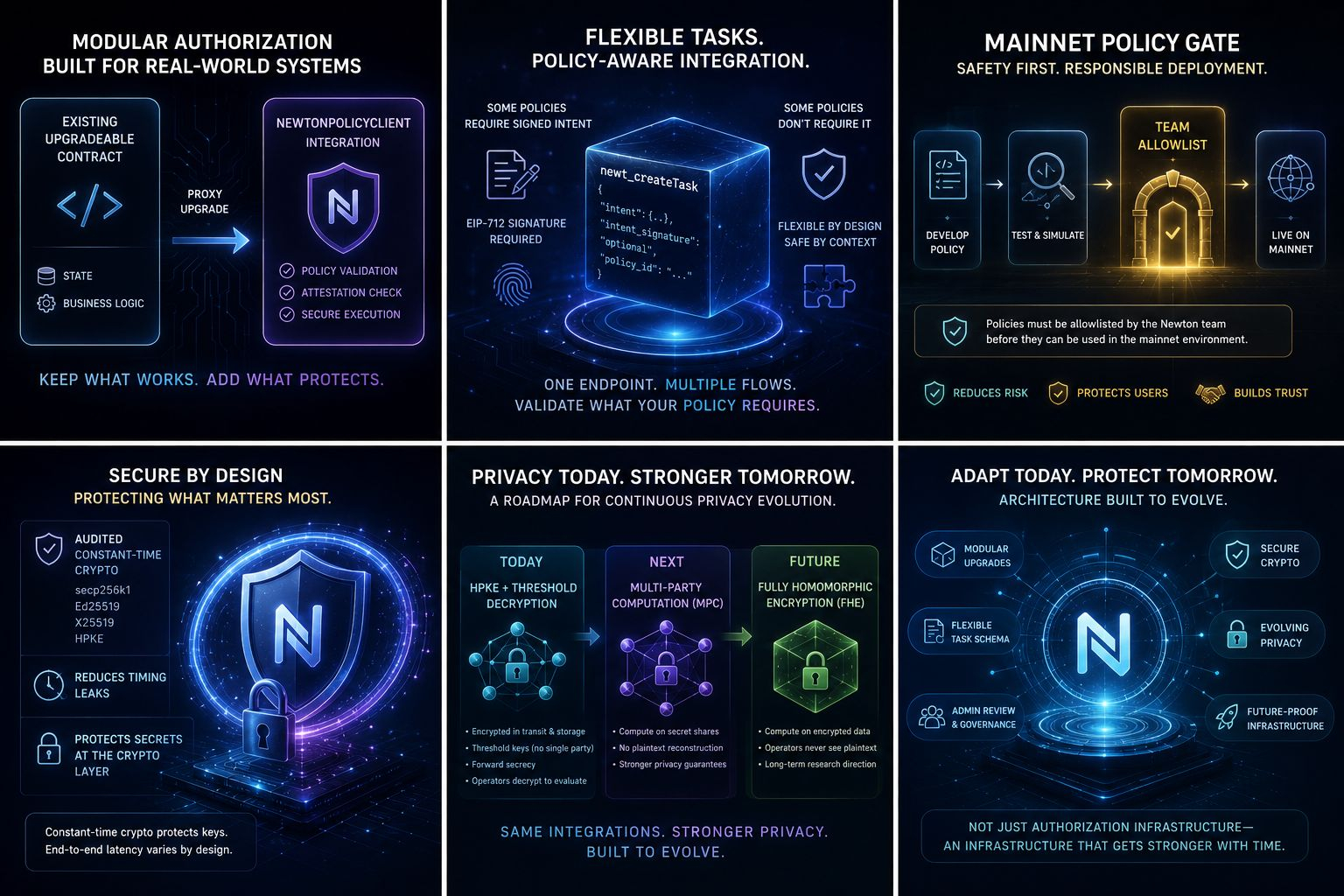
Instead of forcing developers to deploy entirely new contracts, Newton allows an existing proxy-based application to inherit NewtonPolicyClient through an upgrade. Business logic, contract state, and deployed infrastructure can remain largely intact while selected execution paths begin requiring policy attestations before execution.
For production systems already managing valuable assets, that modularity is extremely attractive.
But modularity shifts risk rather than eliminating it.
The proxy upgrade itself becomes one of the most security-sensitive moments in the entire integration lifecycle.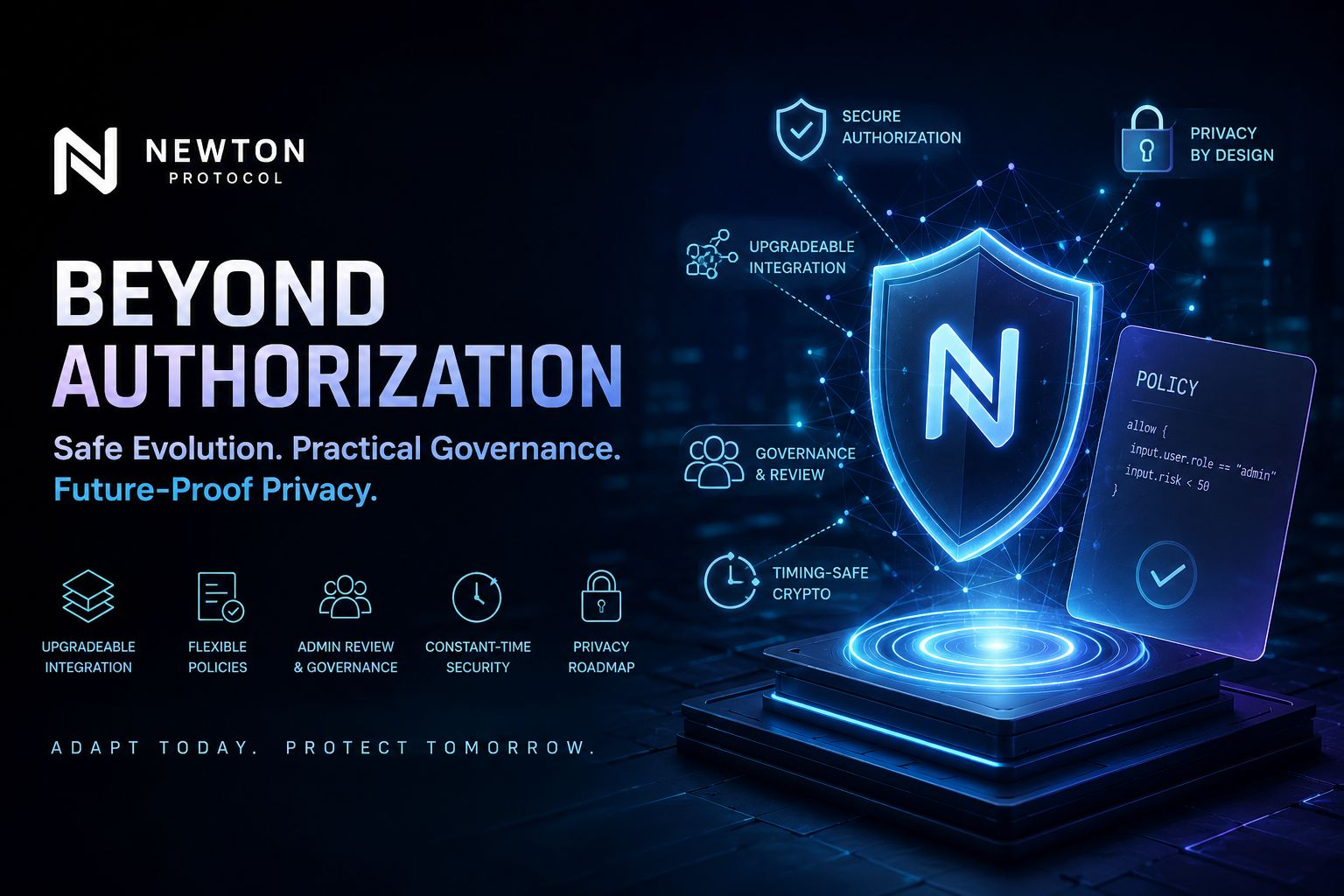
Newton's documentation requires developers to preserve storage layout, append new storage variables rather than insert them, initialize the policy client only once, and carefully configure ownership and TaskManager addresses.
The dedicated initialization flag prevents repeated initialization.
However, it cannot guarantee that the first initialization was performed correctly.
If incorrect addresses are supplied during that first execution, the contract may still complete initialization while remaining improperly configured.
The security challenge therefore becomes concentrated around a relatively small number of administrative actions.
Storage migration introduces another important consideration.
Upgradeable contracts rely on preserving storage ordering across versions.
Adding new variables incorrectly may corrupt unrelated application state even if Newton's authorization logic itself is technically correct.
The authorization layer may appear successfully integrated while hidden storage corruption undermines the application beneath it.
This illustrates an important distinction.
Newton reduces redevelopment effort.
It does not eliminate upgrade discipline.
Execution flow deserves equal attention.
Adding a new Newton-protected function does not automatically secure older execution paths performing the same operation.
Every relevant business path must explicitly validate attestations before execution.
Authorization exists only where developers intentionally enforce it.
The protocol cannot automatically protect logic that bypasses validation.
This emphasis on explicit protection reflects a broader design philosophy throughout Newton.
Flexibility exists, but flexibility also demands careful integration.
That same pattern appears in Newton's task creation interface.
The shared newt_createTask endpoint marks intent_signature as optional.
Initially this appears inconsistent.
Closer examination reveals something more nuanced.
Different policies require different inputs.
Some workflows require EIP-712 signed intent because the policy references input.intent_signature or because the selected PolicyClient depends upon identity-backed authorization.
Other workflows do not.
The shared endpoint therefore remains flexible enough to support multiple authorization models simultaneously.
Yet flexibility introduces integration complexity.
A frontend may successfully satisfy the base request schema while still omitting information required by its chosen policy.
The request can fail before policy evaluation even begins.
Developers therefore need validation that understands not only the endpoint schema but also the specific policy and authorization flow they intend to execute.
In other words, schema validation alone is insufficient.
Flow-aware validation becomes equally important.
Newton's governance model introduces another interesting balance between decentralization and operational safety.
Policy evaluation itself is decentralized.
Operators retrieve relevant data, execute Rego policies, generate BLS signatures, and collectively produce verifiable authorization proofs.
But policy admission into the production environment follows a different path.
Newton's documentation states that policies intended for mainnet beta must first be allowlisted by the Newton team.
Developers remain free to write policies, deploy supporting contracts, and perform testing.
However, production usage requires administrative approval before the operator network begins evaluating those policies on mainnet.
This distinction matters.
The decentralized operator network determines whether an approved policy evaluates correctly.
It does not determine which policies enter production in the first place.
That admission boundary sits outside operator consensus.
This should not automatically be viewed as centralization in the negative sense.
Authorization policies directly influence whether protected transactions execute.
Poorly designed policies may reject legitimate activity, approve unintended behavior, or depend on unreliable external data.
Administrative review can reduce operational risk during an early-stage network.
At the same time, the governance implications remain significant.
Questions naturally arise regarding review standards, approval consistency, timelines, appeal mechanisms, policy removal, and whether allowlisting remains permanent or gradually transitions toward broader decentralized governance as the protocol matures.
Newton openly documents the current process.
That transparency deserves recognition.
Security extends beyond governance into cryptographic implementation itself.
Many discussions treat response time purely as a performance metric.
Newton recognizes that timing can also become a security issue.
The protocol relies on audited constant-time implementations for cryptographic operations including secp256k1, Ed25519, X25519, and HPKE.
These implementations are designed to reduce timing differences linked to secret key material, limiting opportunities for attackers to infer sensitive information through repeated measurements.
That protection represents a meaningful security boundary.
However, Newton does not claim that every authorization request completes in identical time.
Policy evaluation, network communication, external data retrieval, and distributed coordination naturally produce different latency across different tasks.
This distinction is important.
Constant-time cryptography protects secret-dependent operations.
It does not imply constant-time network behavior.
Applications should therefore distinguish between cryptographic timing protections and broader application-level latency patterns.
Perhaps the most forward-looking aspect of Newton appears in its privacy roadmap.
Many blockchain projects present privacy as a feature.
Newton instead approaches privacy as an evolving capability.
Today's implementation protects authorization requests using Hybrid Public Key Encryption based on RFC 9180, combining X25519, HKDF-SHA256, and ChaCha20-Poly1305.
Rather than encrypting data for a single trusted party, requests are encrypted to threshold public keys collectively generated across the operator network.
No single participant controls complete decryption authority.
Fresh ephemeral keys provide forward secrecy while authenticated associated data binds ciphertexts to specific application and blockchain contexts, reducing replay risks across environments.
Equally important is Newton's honesty regarding current limitations.
During today's evaluation process, participating operators reconstruct plaintext before executing policy logic.
Sensitive information remains protected during storage, transmission, and key management, but operators performing evaluation can still observe the underlying inputs.
Newton documents this limitation rather than marketing stronger privacy guarantees than currently exist.
That transparency increases confidence in the architecture.
The roadmap then outlines how privacy may strengthen over time.
Future Multi-Party Computation would allow operators to evaluate authorization policies over secret-shared data without reconstructing plaintext.
Applications would continue submitting identical authorization requests while the underlying privacy guarantees become substantially stronger.
Beyond MPC, Newton identifies Fully Homomorphic Encryption as a long-term research direction.
Instead of presenting FHE as an imminent capability, the documentation realistically acknowledges today's computational limitations while designing the surrounding architecture to remain compatible with future advances.
This reveals the protocol's broader engineering philosophy.
Newton is not optimizing around one permanent cryptographic solution.
It is optimizing around cryptographic evolution itself.
Developers integrate with stable authorization interfaces while the underlying security mechanisms continue improving over time.
That architectural separation resembles durable infrastructure in other domains.
Applications remain stable while implementation layers evolve beneath them.
Viewed together, these architectural decisions reveal a consistent pattern.
Modular upgrades reduce migration costs but concentrate security around initialization.
Flexible task schemas support diverse authorization models but require deeper integration awareness.
Administrative allowlisting strengthens production safety while introducing governance considerations.
Constant-time cryptography protects sensitive operations while acknowledging broader application latency.
Upgradeable privacy architecture enables future cryptographic improvements without forcing ecosystem-wide redevelopment.
None of these design choices eliminate trade-offs.
Instead, Newton repeatedly chooses adaptability over rigidity, transparency over exaggerated claims, and gradual evolution over disruptive redesign.
That may ultimately become its strongest architectural characteristic.
The protocol is not attempting to predict the final form of decentralized authorization.
It is building an authorization framework capable of becoming more secure, more private, and more sophisticated as both cryptography and decentralized infrastructure continue to evolve.
For long-lived blockchain infrastructure, that ability to evolve may prove just as valuable as the security guarantees the protocol provides today.
Final Thoughts
Newton's architecture suggests that the future of decentralized authorization will depend not only on stronger cryptography, but also on safe upgrades, thoughtful governance, and infrastructure that can evolve without disrupting the applications built upon it. That long-term adaptability may ultimately become one of its greatest strengths.
What do you think? Does designing for continuous evolution make authorization infrastructure more resilient, or do upgradeability and governance introduce new trust assumptions that developers must carefully manage?