
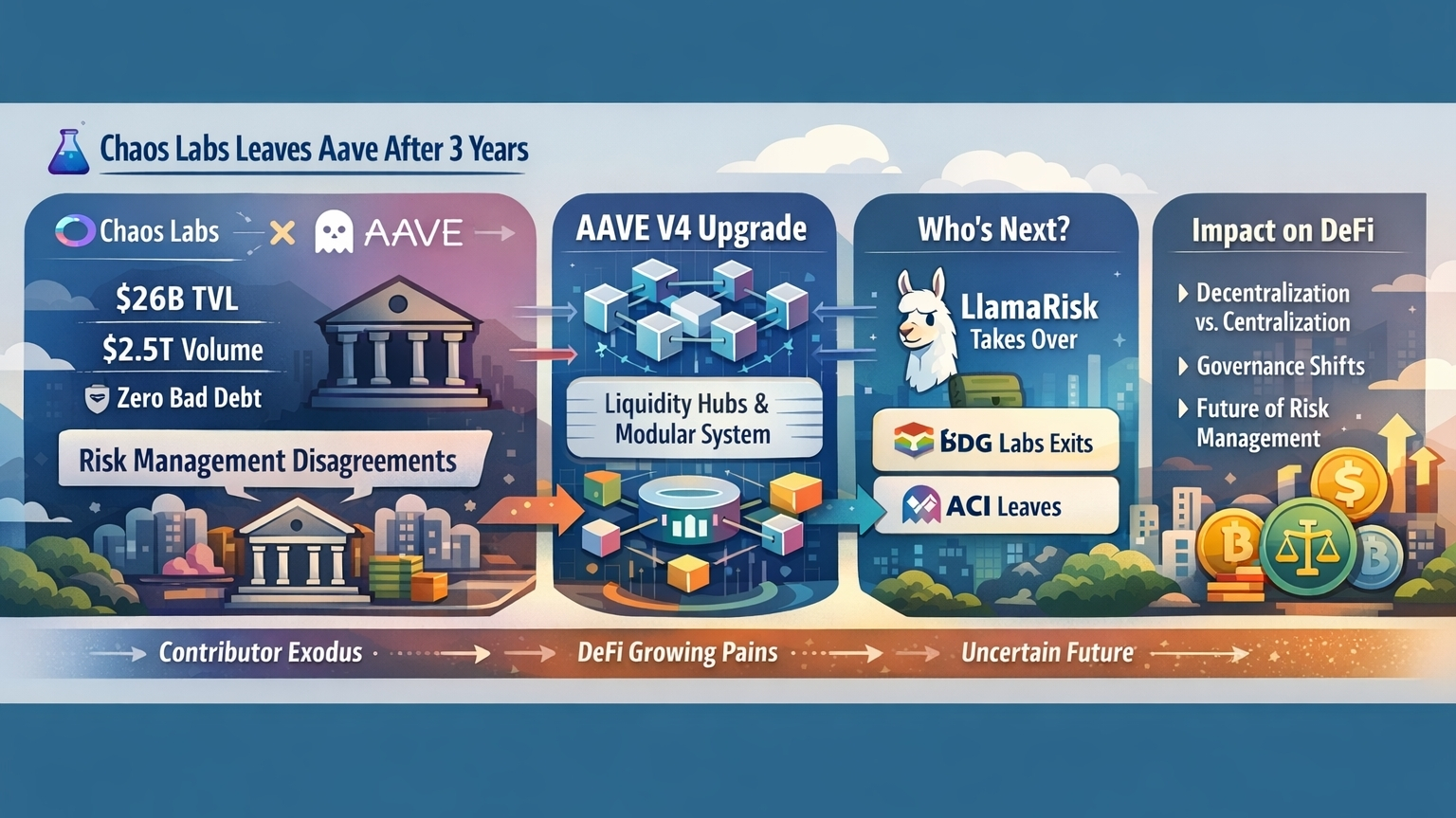

A Quiet Exit That Speaks Loudly
In the fast-moving world of decentralized finance, partnerships often begin quietly and end even more quietly. But sometimes, an exit tells a much bigger story.
That’s exactly what happened when Chaos Labs announced it was leaving after three years of working closely together.
On the surface, it may look like a routine split between a protocol and a service provider. In reality, it reflects deeper tensions around how DeFi should evolve as it grows into something much larger than its original vision.
The Role Chaos Labs Played Behind the Scenes
For years, Chaos Labs wasn’t just another contributor—it was deeply embedded in how Aave functioned.
It helped determine how loans were priced, how risky assets were handled, and how the protocol responded during volatile market conditions. In many ways, it acted like a silent risk engine, constantly adjusting the system to keep it stable.
During this time, Aave expanded massively. Billions of dollars flowed through the platform, and despite extreme market swings, it managed to avoid major losses that could have shaken user confidence.
That kind of consistency doesn’t happen by accident.
So Why Did They Leave?
When Chaos Labs announced its departure, it didn’t point to a single issue. Instead, it described a growing mismatch in direction.
At the heart of it was a simple but important question:
What should risk management look like in a system this big?
Chaos Labs believed that as Aave grew, its risk layer needed to become more structured, more resourced, and closer to the standards seen in traditional financial systems.
Aave, however, leaned toward keeping things more distributed—avoiding too much control in the hands of any single provider.
That difference in thinking slowly turned into a gap neither side could close.
The Pressure of What Comes Next
Another major factor behind the decision was the upcoming evolution of the protocol.
Aave is preparing for a new version that introduces more flexibility and complexity into how markets are structured. While this opens the door for innovation, it also makes risk management significantly more demanding.
For Chaos Labs, this wasn’t just an upgrade—it was a turning point.
More complexity means more responsibility, more monitoring, and more pressure to get things right. And according to their view, the support and structure around that responsibility weren’t keeping up.
It Wasn’t Just About Money
It’s easy to assume disagreements like this come down to funding. But Chaos Labs made it clear that the situation was more nuanced.
Yes, there were concerns about sustainability. Running risk systems at this scale requires serious resources, and the engagement had reportedly been under strain for some time.
But even beyond that, there was a deeper issue: alignment.
No amount of funding can fix a situation where both sides fundamentally disagree on how something should be done.
Aave’s Perspective: Keep It Decentralized
Aave didn’t push back aggressively, but its response made its position clear.
The protocol continues to support a model where multiple independent teams contribute to risk management rather than relying on a single dominant player.
From Aave’s point of view, this approach:
Reduces dependency on any one provider
Keeps governance more balanced
Adds resilience through diversity
In short, Aave is choosing decentralization over concentration—even if that comes with added complexity.
What Happens Now?
With Chaos Labs stepping away, the immediate focus shifts to continuity.
is expected to take on a larger role in maintaining the system’s stability. The team is already familiar with Aave’s structure, which should help make the transition smoother.
For users, the key question is simple:
Will everything continue to run as expected?
In the short term, the answer appears to be yes. But the long-term outcome will depend on how well the new setup performs under real market conditions.
A Bigger Pattern Emerging
What makes this situation more interesting is that it’s not happening in isolation.
Other contributors have also stepped away from Aave in recent months, including:
Each departure had its own reasons, but together they suggest something larger is happening inside the ecosystem.
It’s not necessarily a sign of weakness—but it does indicate change.
Why This Moment Matters
This isn’t just about one partnership ending.
It’s about how DeFi is maturing.
As protocols grow, they begin to face challenges that look very similar to traditional finance:
Managing large-scale risk
Defining responsibility
Balancing independence with coordination
Chaos Labs and Aave simply chose different paths on how to handle those challenges.
And that’s what makes this moment important.
Looking Ahead
The next chapter will be shaped by a few key factors.
How smoothly the transition is handled.
How well the new system adapts to increased complexity.
And whether Aave can continue attracting strong contributors without centralizing control.
If everything works, Aave could come out stronger—more decentralized and more resilient.
If not, this exit may be remembered as an early warning sign.
Final Thoughts
Chaos Labs leaving Aave isn’t just an ending—it’s a reflection of growth.
When systems get bigger, the stakes get higher. Decisions become harder. And alignment becomes more important than ever.
Both sides made choices based on what they believe is the right path forward.
Now the rest of the DeFi space will be watching closely to see which vision holds up over time.