
As the cryptocurrency industry matures users are looking beyond speculation and focusing on security reliability and long term usability. A modern blockchain platform must offer more than simple token transfers. It must provide strong infrastructure transparent validation and efficient performance. Mira is positioned as a future ready platform designed to support buying storing and sending cryptocurrencies within a secure and decentralized environment.
At the center of the ecosystem is MiraNet the smart contract based Mira blockchain that powers the entire network. MiraNet is built to remove reliance on centralized intermediaries such as banks or financial institutions. Instead of trusting a single authority transactions are verified through decentralized consensus and cryptographic validation. This structure ensures that users maintain control of their assets while benefiting from a transparent and tamper resistant ledger.

MiraNet operates through a distributed network of nodes which form the backbone of the system. Each node maintains a copy of the ledger and participates in transaction validation. When a transaction is initiated it is verified by multiple nodes before being confirmed and added to the blockchain. These nodes continuously communicate and update one another which helps maintain data consistency across the network. Because verification is decentralized incorrect or fraudulent transactions are rejected quickly by consensus mechanisms reducing the likelihood of invalid data entering the ledger.
One of the core advantages of MiraNet is the elimination of trusted third parties. Traditional financial systems rely on centralized authorities to approve and record transactions which can introduce delays higher costs and potential vulnerabilities. MiraNet replaces this structure with protocol level verification where algorithmic consensus ensures accuracy. This reduces operational friction and supports faster transaction processing while maintaining network integrity.
Smart contracts play a critical role within the Mira ecosystem. Mira features a smart contract language designed to simplify formal verification. Formal verification is a mathematical process used to confirm that a smart contract performs exactly as intended. This approach helps reduce coding errors and potential vulnerabilities before deployment. By making verification more accessible Mira strengthens both developer confidence and user trust in decentralized applications built on its blockchain.
MiraNet uses a Delegated Proof of Stake consensus mechanism to balance decentralization with efficiency. In this model bonded stakeholders validate transactions by staking tokens and participating as validators. Because validators have economic incentives tied to network performance they are motivated to act honestly and maintain system stability. Compared to energy intensive consensus mechanisms this model requires significantly less computational power resulting in improved scalability lower energy consumption and faster confirmation times.
Cost efficiency is another important component of the network design. Blockchain congestion in many ecosystems often leads to unpredictable transaction fees. MiraNet reduces this risk by operating on a more computationally efficient consensus structure which lowers overall operational costs. These efficiencies contribute to more stable and affordable transaction fees for users while preserving security standards.
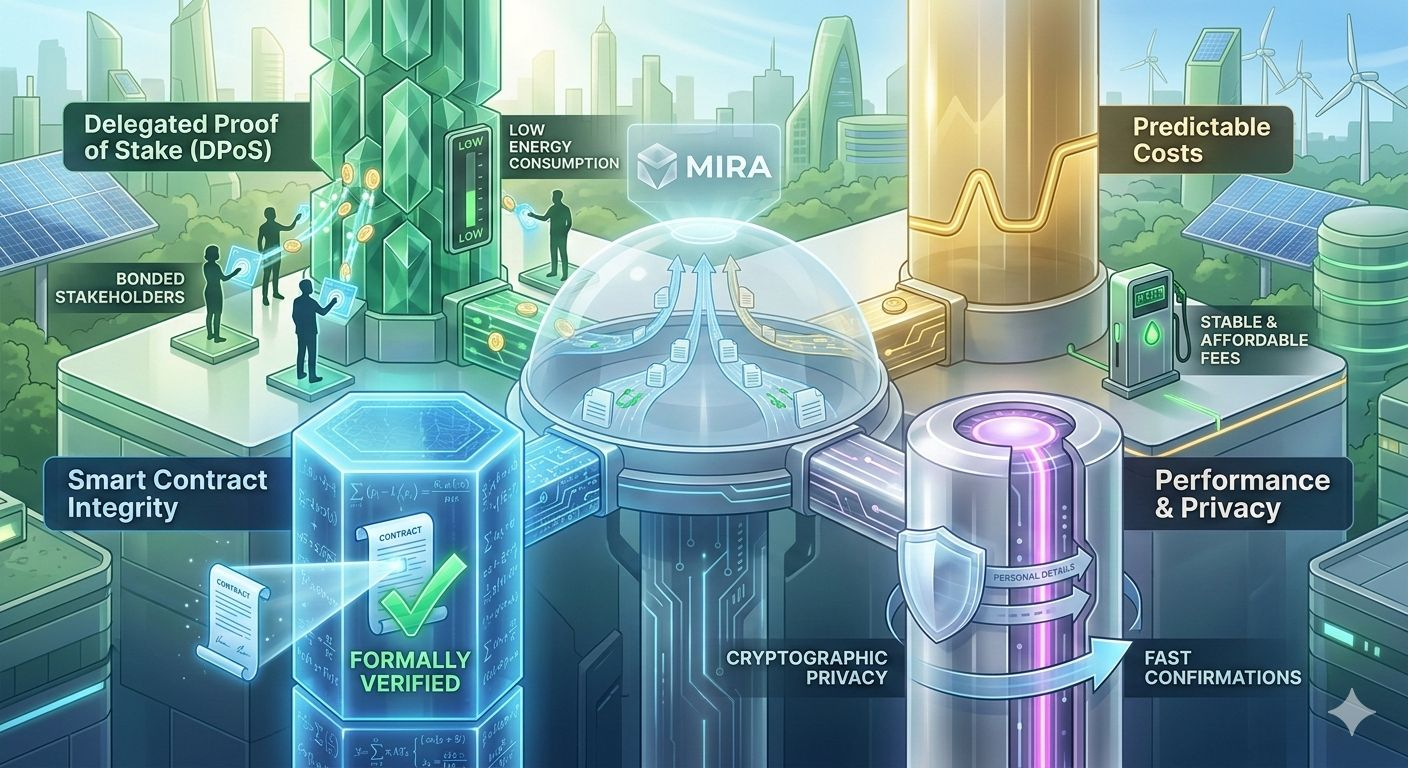
Network stability is reinforced through the bonded validator model. Validators have a financial stake in maintaining accurate operations which discourages malicious behavior. This economic alignment helps create a self regulating environment where long term sustainability is prioritized over short term manipulation.
Privacy and security are integrated into the system architecture. While blockchain technology is inherently transparent Mira ensures that transactions remain cryptographically secured and that users are not required to expose unnecessary personal information. This balance between transparency and privacy supports responsible usage while maintaining the decentralized principles of the network.
Performance is equally important in today’s digital economy. MiraNet is engineered to provide faster transaction confirmations compared to traditional financial rails and many legacy blockchain systems. Efficient node communication and optimized consensus processes help reduce latency and improve throughput. This makes everyday activities such as transferring funds interacting with smart contracts and managing digital assets more practical for both individual and institutional participants.
From a structural perspective Mira is designed with long term adaptability in mind. The modular blockchain infrastructure efficient validation model and emphasis on formal verification provide a strong technical foundation. As digital asset adoption continues to expand platforms that combine scalability security and sustainability are better positioned to support future innovation.
In Mira delivers a decentralized blockchain environment where transactions are cryptographically secured validated by distributed nodes and confirmed through an energy efficient consensus mechanism. By removing reliance on centralized intermediaries simplifying smart contract verification and promoting cost stability the platform aims to create a secure and reliable infrastructure for digital asset management. As the broader cryptocurrency market evolves solutions that prioritize integrity efficiency and user control will continue to shape the next phase of blockchain adoption and Mira is structured to operate within that future oriented framework.
