The Trump family's WLFI halved in two hours. Then the team pointed at Binance!
Behind the scenes, World Liberty was saving its own loan by selling ETH, not WLFI. Traders who bought WLFI with borrowed money had no such exit. They became the sellers.
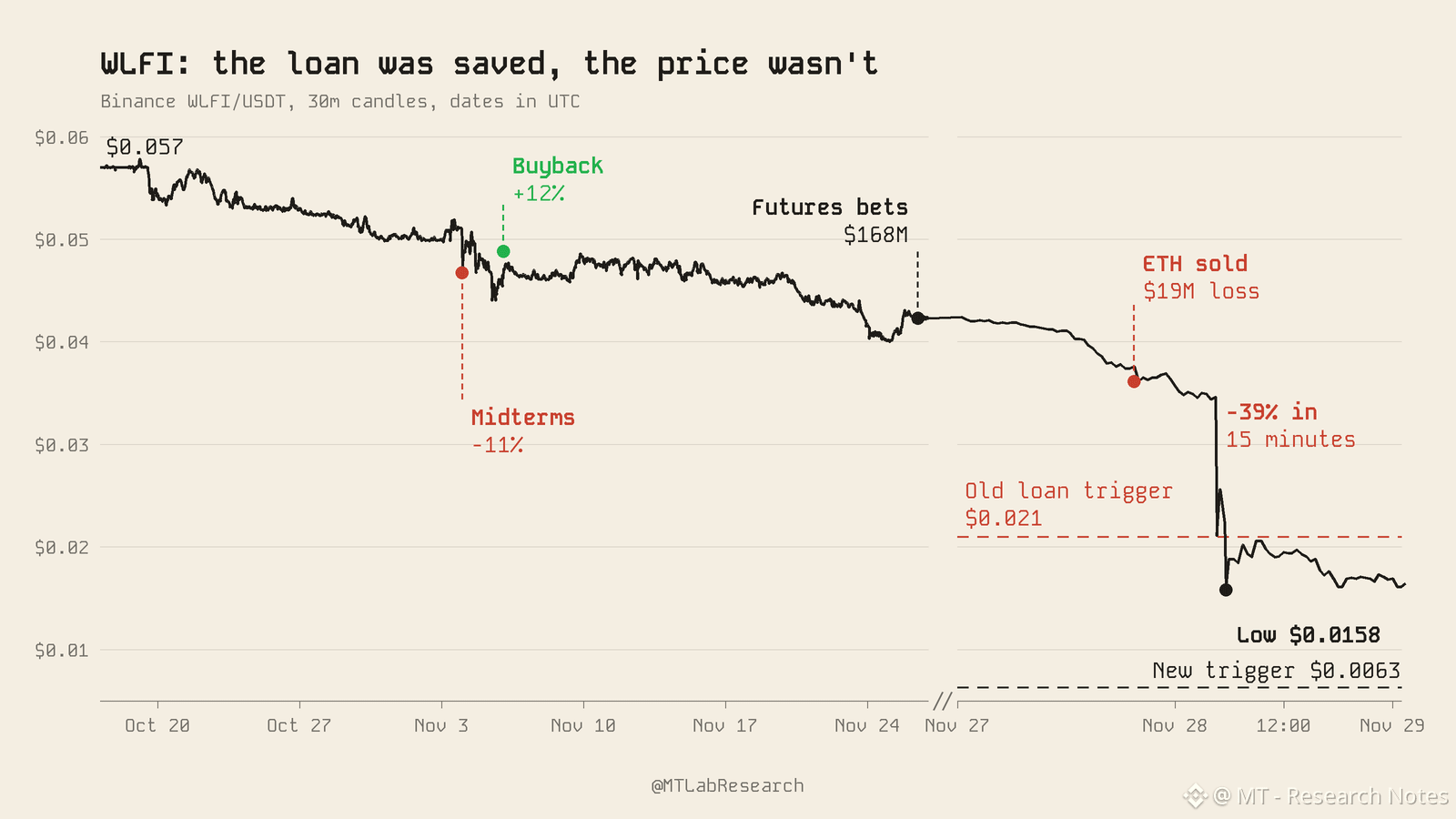
> Oct 17, 2026: WLFI sat at $0.057 and slid with BTC.
> Nov 4: Democrats won the House and named World Liberty a likely Oversight target. WLFI fell 11% overnight. It bounced 12% around a Nov 6 buyback with no size, then faded.
> Nov 25-26: open interest (money in futures bets) rose to $168M.
> Nov 27: the loan. In April, World Liberty pledged about 5B WLFI to borrow $75M on Dolomite, a protocol co-founded by its own CTO. By Friday, WLFI under $0.021 meant liquidation: the protocol sells the collateral. So it sold 12,121 ETH near $1,655, bought near $3,244, a $19M loss, to cut the debt.
> Nov 28: WLFI held near $0.035 for hours after the sale.
> At 04:30 UTC, heavy selling hit Binance: about $26M in 30 minutes, roughly 50x the recent pace. WLFI hit $0.0211, then $0.0158. About $20M of futures bets were force-closed, 86% longs. Binance even closed some winning shorts when its insurance fund couldn't cover the losses. Open interest fell 82% in four hours.
> 12:37 UTC: the team's first post said Binance closed those positions and WLFI "had no involvement". The team mentioned the ETH sale only at 20:09 UTC.
The old $0.021 line broke. The loan survived. Its trigger now sits near $0.0063.
What was on each side's mind?
- World Liberty: keep 5B WLFI away from a forced sale, even at a loss
- Leveraged longs: buy the dip at $0.04, then get sold at $0.02
- Justin Sun, suing over frozen WLFI: calls to delist
What the WLFI chart teaches:
- A loan backed by a token is a price line everyone can see on-chain
- Open interest rising while price falls is fuel, not support
- A team defending its treasury is not defending your entry price
Would you hold a token if its own team borrows against it? $WLFI
Experience, not financial advice.
#WorldLibertyActsToCutLiquidationRisk