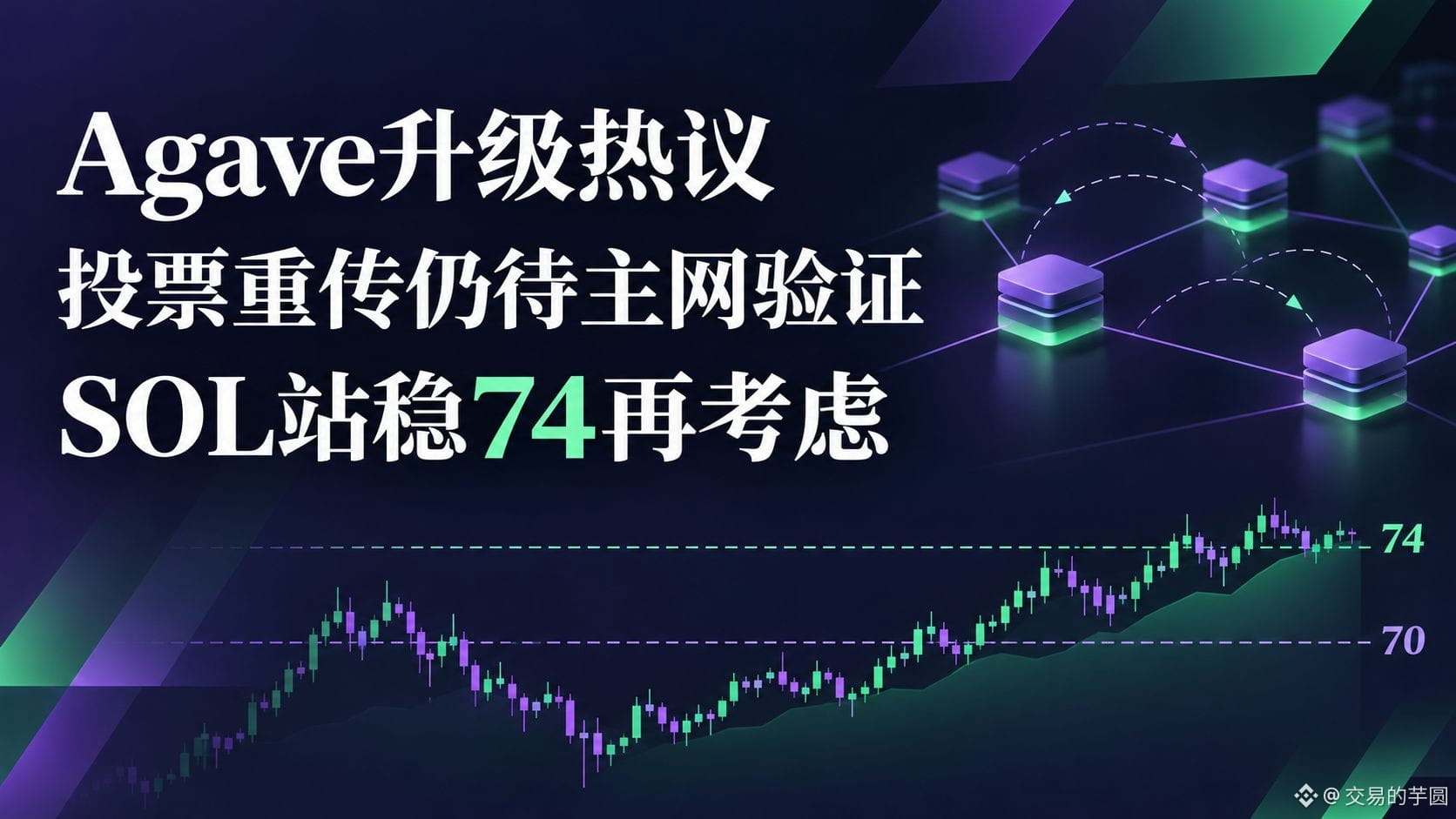
Agave upgrade sparks debate|Vote retransmission is a validator revenue issue|SOL still needs to hold $70
My view is to first check the node version and price confirmation. I wouldn’t interpret an “urgent upgrade” as meaning Solana has gone down, nor describe optimizations in a development branch as already fully active on mainnet. The hot topic on Binance Square right now is #AnzaUrgesSolanaNodesUpgradeAgave, and SOL is also trending in the six-hour rankings. Anza’s Agave v4.4.2 is the stable version recommended for mainnet validators. The official Solana status page still shows mainnet and RPC as operational, with no incidents recorded on November 28. Another version that’s easy to confuse with it is v4.5.0-rc.1: Anza labels it a mainnet upgrade candidate, but currently recommends it for testnet and development networks. Ordinary token holders do not need to transfer funds or authorize unfamiliar websites because of a node upgrade notice.
This time, I’m more focused on the vote transmission mechanism behind the upgrade than on the version number itself. The Solana Foundation’s November 26 engineering weekly report said Agave plans to retransmit validator votes that may earn rewards three additional times, reducing reward losses caused by packet loss. Anza’s original pull request #17006 further explains that QUIC datagrams themselves are not retransmitted; the additional sends apply only to votes for reward leaders, while other voting paths remain unchanged. The code was merged into the main branch on November 25 and backported to the 4.5 release candidate. This explains why node operators care about the upgrade: vote delivery rates can affect validator earnings and operational stability. But this is an improvement to a specific path. “Retransmitted three times” does not directly imply doubled throughput, an immediate rise in network-wide rewards, or inevitable buying pressure for SOL. Retransmissions also use network resources, so the effects will need to be verified through adoption rates and operational data.
The market has not offered clear positive confirmation. A Kraken spot snapshot shows SOL at around $71.17, below the opening price of $71.60 on that basis; the 24-hour high was $73.83 and the low was $70.05. Farside’s tally shows net outflows of about $900,000 from U.S. SOL funds on November 27, mainly from the GSOL line. The amount is relatively small, but at least it does not support the claim that “institutional money is pouring in.” I see around $70 as short-term support and the $73.80–$74 range as the zone where buyers would regain the initiative. If the mainnet status turns abnormal, the recommended mainnet version changes again, or SOL breaks below $70 and then rebounds weakly, I would lower my current mildly cautious view. I would consider increasing exposure again only if SOL holds above $74 and fund flows improve consistently.
If I were trading this myself, I would not chase the price. I’d keep only a conditional, unleveraged spot long setup, with a maximum allocation of 1% of total capital. The trigger would be a four-hour close above $74, followed by a retest that holds $73.80–$74, while the official status page remains normal. After entry, I’d take half off at the first target of $76.50, reduce further at the second target of $79, and trail the stop on the remaining position using rising four-hour lows. The initial stop would be below $72.20, with the position size reduced based on the actual entry price so that the loss on a single trade does not exceed 0.25% of total capital. If SOL quickly falls back below $73.80 after breaking above it and fails to reclaim that level in two four-hour candles, I’d close the entire position. If the price breaks below $70 first, this long setup is invalidated outright. Without a trigger, this is only a plan—not an executed trade or a profit.
#AnzaUrgesSolanaNodesUpgradeAgave #SOL
The above is solely my personal market observation and does not constitute investment advice.