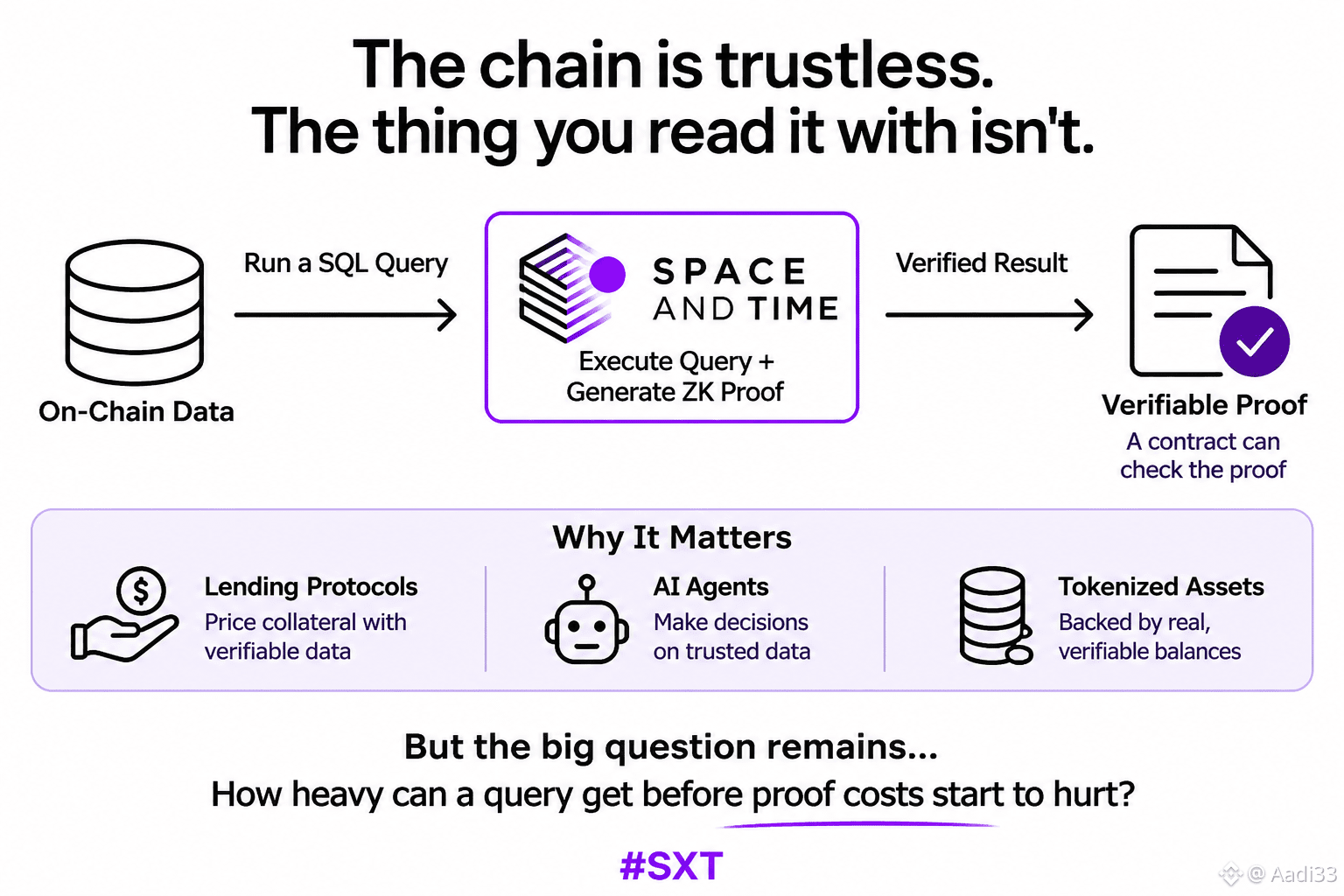
The chain is trustless. The thing you read it with isn't.
Dashboards, indexers, the API your bot pulls from. They're all relying on a server to give you the right answer.
And most of the time, we just accept it because the number looks right.
@SpaceandTime is trying to fix that gap.
It executes SQL queries and attaches a ZK proof showing that the computation was performed correctly against committed data. A smart contract can verify that proof instead of blindly trusting the backend.
That's the interesting part.
A lending protocol pricing collateral using data nobody can independently verify. An AI agent making decisions based on information it has to take on faith. Tokenized assets relying on balances supplied by a centralized backend.
Different applications, same underlying problem.
We've spent years removing trust from blockchain transactions, but the data-reading layer still has a trust problem.
One question remains, though.
How expensive does proof generation become as SQL queries grow more complex and AI agents start requesting verifiable data continuously?
Because verification is useful, but it also needs to scale.
$SXT #SXT