Although quantum computers aren’t yet a real threat to Ethereum, Vitalik clearly isn’t taking any chances—he’s put a lot of work into addressing the issue.
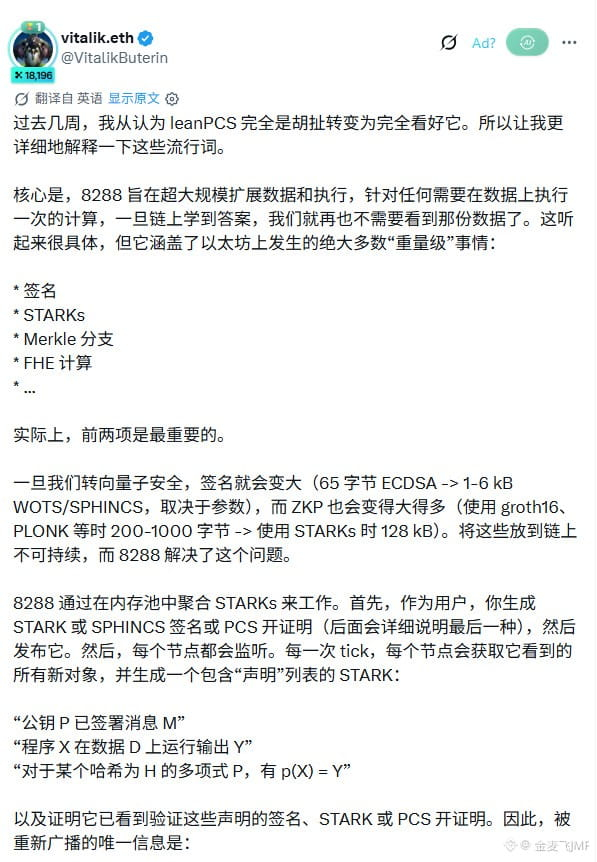
Just yesterday, November 16, Vitalik revealed that he’s very optimistic about a new technology called leanPCS, which could help accelerate Ethereum’s quantum-resistant upgrade.
The problem, however, is the sheer size of the data. Ethereum transaction signatures are currently just 65 bytes, but quantum-resistant signatures could grow to 1,000–6,000 bytes, and some STARK proofs even exceed 128 KB.
If all of that were written to the blockchain, transaction fees could rise sharply.
To address this, the EIP-8288 proposal backed by Vitalik has come up with a clever solution:
"Nodes could bundle and verify the massive signatures and proofs before a transaction is included in a block, then transmit just one compact aggregate proof on-chain, while using leanPCS to further reduce verification costs."
However, the proposal is still at the draft stage, and no launch date has been set.
$ETH