Son Shouts “It Blew Up Again” Under the Covers at Midnight; Retired Accountant Mom Pulls Out Her Abacus, and a Week Later She’s in Charge of the Family’s Risk Management
Wang Xiufen is fifty-eight this year. Before retiring, she worked as an accountant at a state-owned enterprise for thirty years. She could work an abacus faster than a calculator, earning her the nickname “Wang the Penny.” If the books were off by even a cent, she could track it down by three in the morning.
Her son, Zhang Xiaokai, is twenty-nine and a programmer. Last year, he said he wanted to “save on rent by moving back home,” and moved in. Wang Xiufen was pretty happy about it—until one night at two in the morning, when she got up and heard a muffled scream from his room:
“Blown up… blown up again…”
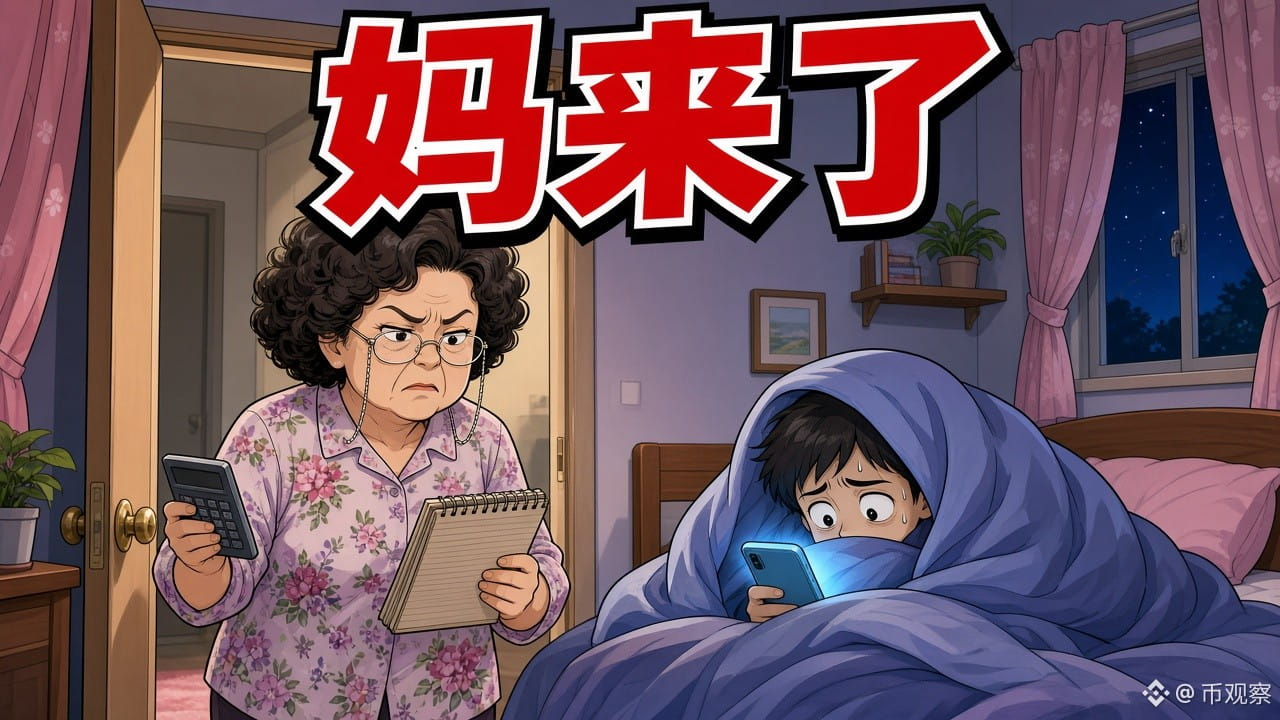
Her first thought was that his phone battery had exploded. Her second was that something had happened to her son. She pushed open the door. The room was dark, with only a screen glowing under the covers. The blanket was puffed up like a little mountain, and the mountain was shaking.
“Zhang Xiaokai, what blew up?”
There was three seconds of silence under the covers. “Mom, it’s nothing. It’s… a game.”
“A game can blow up three thousand yuan of yours?”
Wang Xiufen had sharp eyes. She spotted the string of red negative numbers on the screen at a glance. After thirty years in accounting, she was naturally allergic to red ink.
She didn’t yell at him that night. She just turned around and went back to bed. The next morning, when Xiaokai got up, he found three things on the dining table: an abacus, a hardcover ledger, and a cup of hot tea. Wang Xiufen sat across from him wearing her reading glasses and arm sleeves, looking as if she were about to hold an annual audit meeting.
“Export all your records for the past year. Every last one.”
Xiaokai reluctantly exported them. Wang Xiufen clicked away on the abacus all morning, then slapped the ledger down on the table at noon.
“You made 412 trades in a year: 160 profitable, 252 losing. You paid almost ten thousand in fees. Do you know what your biggest problem is?”
“Bad luck?”
“You can’t hold on when prices rise, you stubbornly hang on when they fall, and when you can’t take it anymore, you put in more money. In the accounting profession, there’s a technical term for that.”
“What term?”
“Squandering your money.”
Xiaokai tried to explain what contracts were, what funding rates were, and how “this time it was because ETFs had seen continuous outflows and the macro news was bearish.” Wang Xiufen raised a hand to cut him off. “I don’t care about money flowing in or out. I only care about one thing: is your money flowing out? Your account has been bleeding money for two hundred out of 365 days this year.”
Then she did something Xiaokai would regret for the rest of his life: she made him teach her.
Xiaokai thought his mom would give up after a couple of days. But Wang Xiufen threw herself into it with the same determination she’d had when studying for her professional exams. In three days, she understood candlestick charts; in a week, she had figured out stop-losses. She even wrote three household rules in brush calligraphy and stuck them on the fridge: Spot trades only—no leverage; if your principal drops by ten percent, get out; no checking the charts after ten at night—it messes with your sleep.
Then she used the money she’d saved on groceries by going square dancing to buy a small amount of $BNB . As soon as she’d bought it, she put her phone face down on the table and went back to studying how to make red-braised pork.
The most ruthless thing was the “Family Risk Management Agreement.” Xiaokai had to stamp his fingerprint on it: every time he wanted to open a contract position, he had to transfer five hundred yuan into his mom’s “risk management fund” first. After transferring it, he had to wait 24 hours to cool off. If he still wanted to open the position after 24 hours, they could talk.
The market had been tumbling all week. Several of Xiaokai’s buddies in the group got liquidated overnight, and the chat was filled with crying-face stickers. Wang Xiufen’s spot holdings had shrunk a little too. She took one look—they were still nowhere near a ten percent loss—and went downstairs to dance at seven on the dot, as usual. Xiaokai stood beside her holding a water bottle in one hand and a fan in the other, looking just like an assistant.
Halfway through the dance, Auntie Li came over. “Xiufen, you’re grinning at your phone. What are you looking at?”
Wang Xiufen held up the screen. “My son’s risk management fund. It’s up 4,500 this month.”
Auntie Li was amazed. “Wow, what kind of investment is doing so well?”
“He wanted to open contract positions nine times this month, and he managed to stop himself all nine times.”
Listening nearby, Xiaokai suddenly realized that this was the first month since he started trading crypto that his account balance hadn’t gone down.
Later, he posted a sentence on his own account, and the comments section exploded: “I recommend every contract trader let their mom audit their account. Not because she understands the market, but because she isn’t afraid of you.”
Wang Xiufen said she’d save that 4,500 for him, and give it back, untouched, the day he brought a girlfriend home. Xiaokai asked what if he never got a girlfriend. Wang Xiufen pushed up her reading glasses. “Then I’ll keep saving it until you don’t want to open contract positions anymore.”
When the market falls, the most expensive thing isn’t the coin—it’s that one moment when you get carried away. Before opening a trade, take 24 hours to cool off. Manage your own position size, and only put in money you can afford to lose. Don’t wait until your mom shows up with an abacus to audit your account.
(The characters in this story are fictional.)