Pancake-stall owner secretly opens a 20x leveraged position. The next day, his wife sticks a note on the stall—and the whole street cracks up
At the entrance to the Eastside farmers’ market, there was a pancake stall run by Liu Dasha. He was forty-two, five-foot-seven, and weighed two hundred pounds. He was a master at making pancakes, with just one little flaw: his phone got hotter than his griddle.
He’d spread the batter, then check the market. Crack an egg, then check the candlesticks. Regular customers knew that when Liu was in a good mood, he’d add an extra spoonful of sauce. When he was in a bad mood, he’d crumble the crispy cracker into tiny bits. His wife, Xiumei, took the payments beside him. She never looked at his phone—only at the payment QR code.
Last Friday morning, Liu was especially excited. He turned to Old Wang, who was waiting in line, and said, “Old Wang, you know what leverage is?”
“Something you use to pry things open?”
“Exactly! Use one yuan to move twenty yuan—that’s how you win big with a little.”
Old Wang glanced at the pancake in Liu’s hand. “So can you turn this one pancake into twenty?”
Liu didn’t answer. He slipped his phone into his pocket, with four words practically written all over his face: ‘We’re having a feast tonight.’
He’d gone long on $BNB with 20x leverage. His reasoning was simple: some sunglasses-wearing influencer in a short video said, “It’s due for a rebound.” Liu figured those sunglasses looked expensive, so the guy must know his stuff.
Saturday went pretty well at first. His account was in the green. When he closed up at noon, Liu hummed as he bought Xiumei a candied hawthorn skewer.
Xiumei asked what had gotten into him. He said, “You wouldn’t understand. It’s unrealized profit.”
“Can unrealized profit buy candied hawthorn?”
“It could buy a whole truckload.”
“Then settle last month’s flour bill first.”
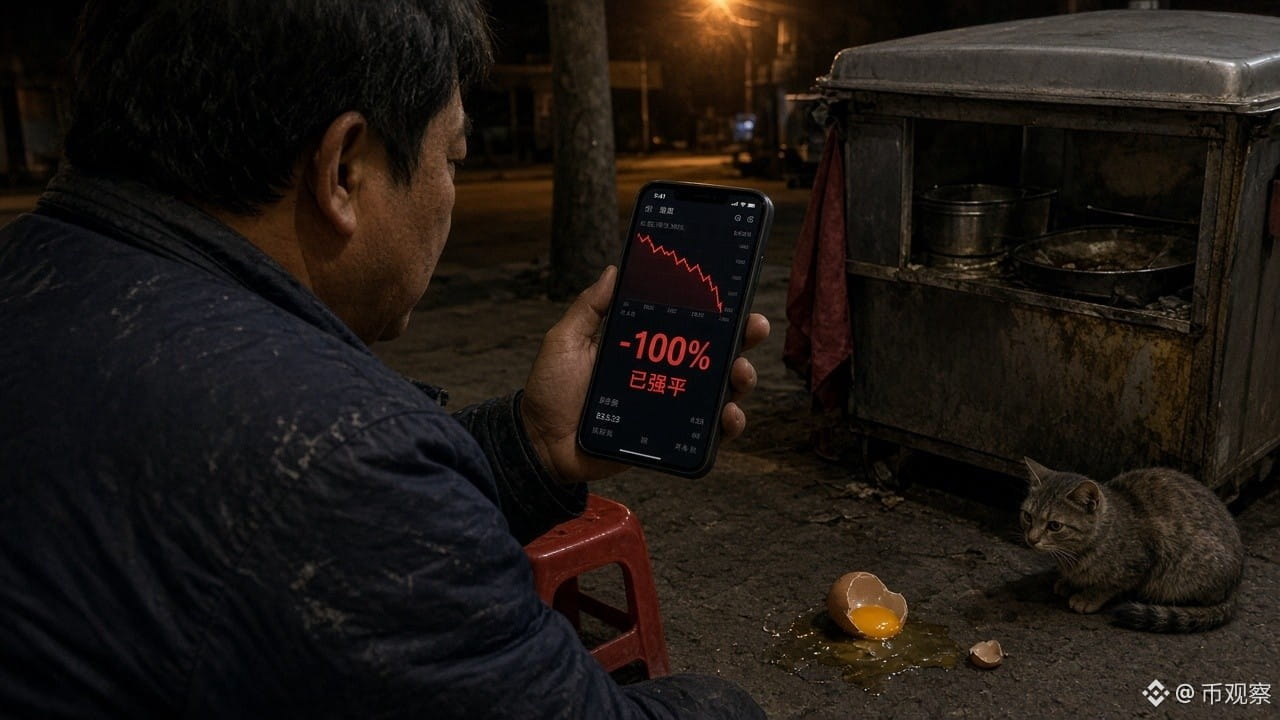
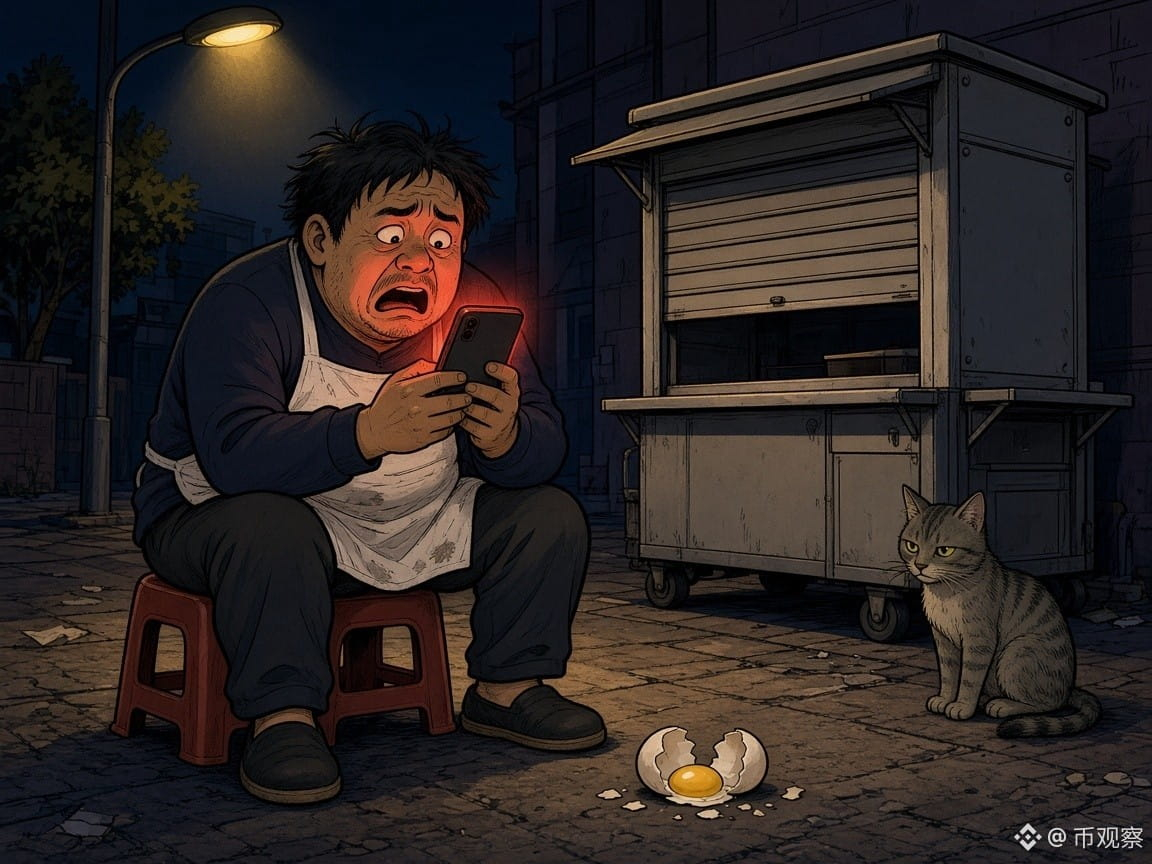
The trouble started Saturday night. The whole market was sliding. $BTC plunged straight through 66,000, the altcoins followed it down, and Liu’s long position sank right along with them. He checked his phone in bed, rolled over, and checked again. By one in the morning, he’d given up trying to sleep. He threw on his clothes, went downstairs, and sat beside his closed-up pancake cart, keeping watch over his screen like a night guard.
A stray cat crouched across from him, staring. He fished an egg out of the cart to feed it, but his hand shook and the egg slipped, smashing on the ground.
At that very moment, a notification popped up on his phone. Liu stared at it for five seconds, then five more. Finally, he said to the cat, “Buddy, we’re the same now. Neither of us has a position left.”
The cat turned and walked away. Even it didn’t want to listen.
At six the next morning, Liu opened up with dark circles under his eyes. His pancake-flipping was half a beat slower than usual. The first customer asked for two extra eggs. Liu’s hand trembled, and he looked up to ask, “Are you sure you want those? Once you add them, there’s no turning back.”
The customer jumped. “Then… just one, please.”
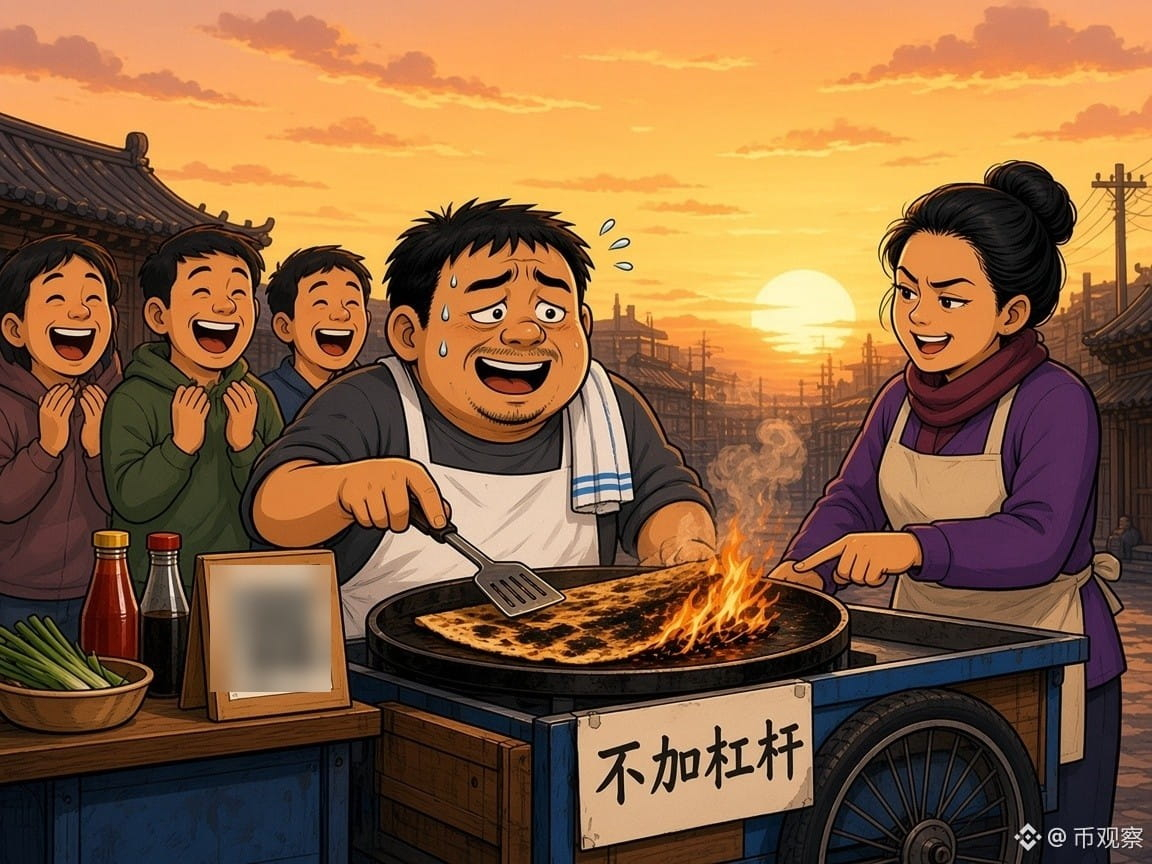
Xiumei didn’t say a word the whole time. At seven, during the morning rush, she pulled a piece of paper from her bag and slapped it in the most visible spot on the cart. Four big characters were written on it: NO LEVERAGE.
At first, the people in line didn’t get it. Someone asked what it meant, and Xiumei quickly explained, “It means one pancake is just one pancake. An extra egg costs one yuan; an extra sausage costs two. We don’t do 20x.”
The whole line doubled over laughing. Old Wang laughed so hard he dropped his pancake. That day, Liu’s stall stayed busy until half past nine—a few people even came just to take a photo of the note.
When they counted up after closing, Xiumei pushed his phone in front of him. “We sold 387 pancakes today and made over 600 yuan in profit. How much have you made with your 20x leverage these past few days?”
Liu lowered his head and calculated for a long time. “Probably… enough to buy 387 pancakes.”
“In profit?”
“In losses.”
Liu still trades, but he’s changed his approach. After closing each day, he puts a small portion of the profits into spot assets. No leverage, and no more listening to sunglasses-wearing influencers. He says making pancakes taught him a lesson: turn the heat up too high and the pancake burns; turn the leverage up too high and you burn yourself.
That “NO LEVERAGE” note is still stuck to the cart, yellowed by years of cooking smoke. Xiumei won’t let him take it down. She says it’s an heirloom.
Now, whenever anyone talks futures with Liu, he taps the note with his spatula and says, “When the market comes crashing down, the first thing you should close isn’t your position—it’s that part of you hoping to make it all back overnight. Keep your position under control, don’t let the griddle get too hot. A position that lets you sleep at night is a good position.”
(The characters in this story are fictional.)