A personal controversy has pushed Nvidia straight to the edge. At the close of trading on November 9, U.S. Eastern Time, Nvidia plunged 4.27%, with its market cap falling below $4.31 trillion—a seven-month low. It shed $190 billion in a single day (about 1.29 trillion yuan)!
Now everyone online is focused on the same deadly question: Could Jensen Huang be fired by the board? The odds of Huang leaving in the short term are low, but the capital market’s concerns are already plain to see.
Then comes the real main event: Nvidia is set to release its Q3 results after the market closes on November 17.
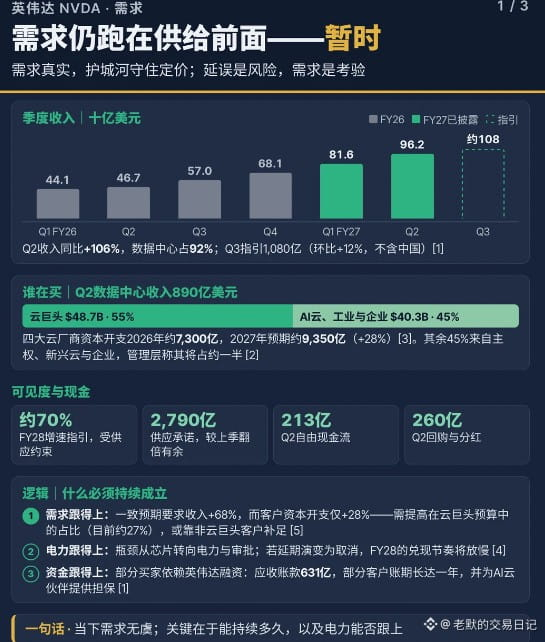
Don’t assume people are worried that Nvidia won’t make money. Goldman Sachs expects both its results and guidance to be strong, with earnings per share potentially beating expectations by 6%, revenue projected at around $108.8 billion—up about 90% year over year—and gross margins as high as 74%. The results themselves will probably be fine; the real risk lies in the makeup of its revenue.
Nvidia’s current growth is essentially a bet on the data center budgets of a handful of mega-customers. Amazon, Google, Microsoft, Meta, and OpenAI are expected to spend more than $800 billion on capital expenditures in 2026. But here’s the problem: four of them have negative free cash flow! People are starting to wonder how much longer this game of burning cash at a furious pace can last.
A more specific risk comes from a downgrade report by Aletheia Capital. Nvidia’s financial commitments under its AI partnership program have ballooned to $165 billion. Put simply, it isn’t just selling chips—it’s also providing “financial backing” for AI cloud providers like CoreWeave and Nebius. If these customers can’t raise money and their funding dries up, Nvidia could face serious problems with its accounts receivable and orders.
#英伟达Q3财报将至:能否化解市场疑虑? $BTC
Now everyone online is focused on the same deadly question: Could Jensen Huang be fired by the board? The odds of Huang leaving in the short term are low, but the capital market’s concerns are already plain to see.
Then comes the real main event: Nvidia is set to release its Q3 results after the market closes on November 17.
Don’t assume people are worried that Nvidia won’t make money. Goldman Sachs expects both its results and guidance to be strong, with earnings per share potentially beating expectations by 6%, revenue projected at around $108.8 billion—up about 90% year over year—and gross margins as high as 74%. The results themselves will probably be fine; the real risk lies in the makeup of its revenue.
Nvidia’s current growth is essentially a bet on the data center budgets of a handful of mega-customers. Amazon, Google, Microsoft, Meta, and OpenAI are expected to spend more than $800 billion on capital expenditures in 2026. But here’s the problem: four of them have negative free cash flow! People are starting to wonder how much longer this game of burning cash at a furious pace can last.
A more specific risk comes from a downgrade report by Aletheia Capital. Nvidia’s financial commitments under its AI partnership program have ballooned to $165 billion. Put simply, it isn’t just selling chips—it’s also providing “financial backing” for AI cloud providers like CoreWeave and Nebius. If these customers can’t raise money and their funding dries up, Nvidia could face serious problems with its accounts receivable and orders.
#英伟达Q3财报将至:能否化解市场疑虑? $BTC