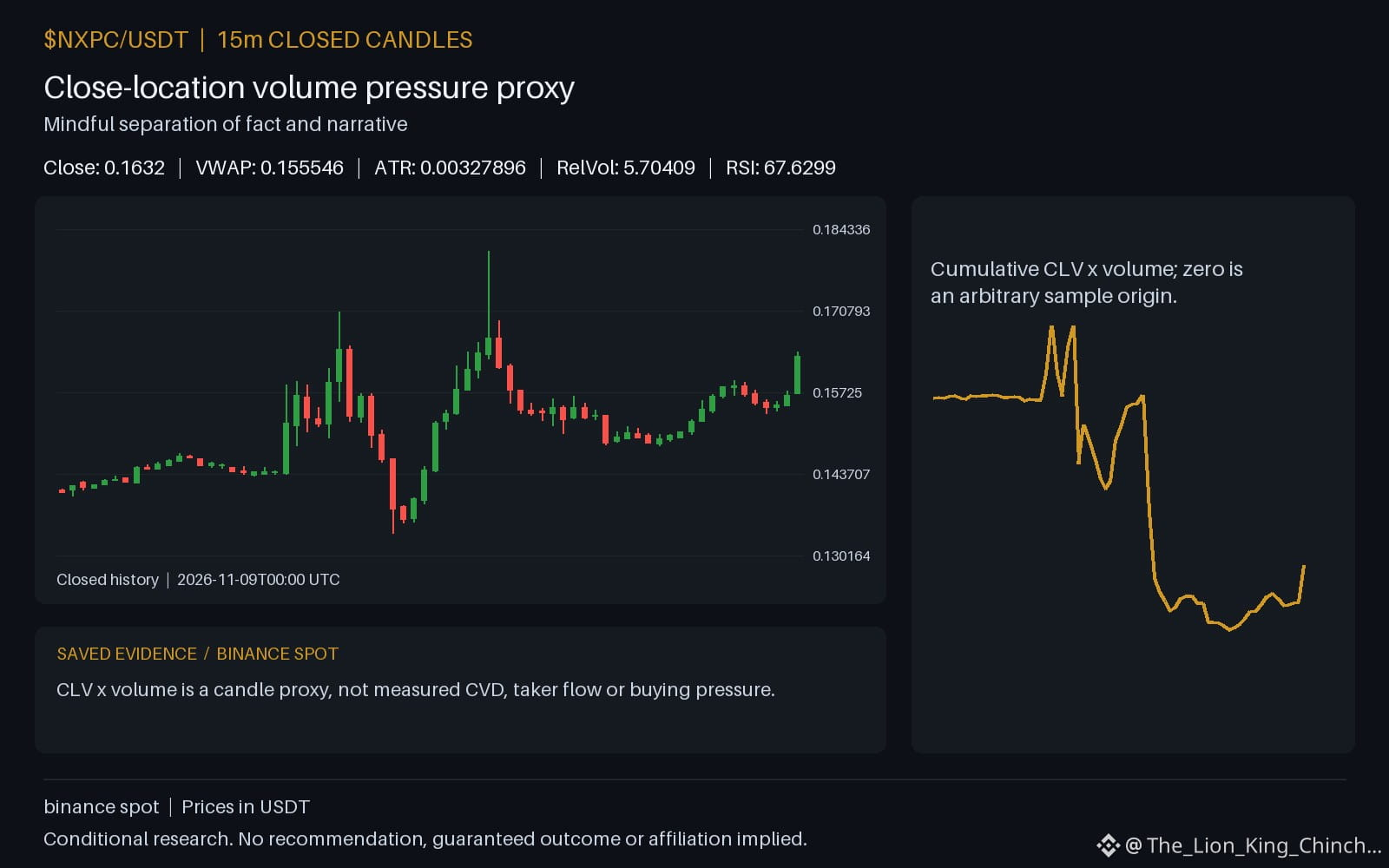
$NXPC: A Closer Look: Separating 'What Happened' From 'What I Tell Myself About It': From a Patient Perspective
A common assumption swaps facts for stories. You see price above resistance. Your mind adds words like “strong” or “confirmed.” Strip those away. What remains? Price is at 0.1632. It sits above the 0.1592 level. Volume is 5.70409 above baseline. The RSI reads 67.6299. That is the record. The rest is narrative.
Consider a counterexample. Imagine two traders watch the same chart. Trader A sees price holding above resistance and feels excited. They chase the entry immediately. Trader B sees the same data but asks first: does this move fit my invalidation logic? They wait. If the price later reverses through support at 0.1484, Trader A’s entry was based on a feeling, not a plan. Trader B avoided the risk entirely. The chart did not change; only the interpretation differed.
This separation protects you from emotional drift. A narrative acts as a filter. It tells you what the data “means” before you verify it. To self-check, write down only the numbers. Price, volume, and levels. No adjectives. If your note sounds robotic, it is accurate. If it sounds persuasive, check for bias.
The trade-off here is patience versus fear of missing out. Acting quickly feels urgent. Waiting feels passive. But waiting allows you to align actions with evidence rather than emotion. You might miss the first part of a move. That is the cost of accuracy. Chasing saves time but adds uncertainty. In this specific context, with price above resistance and elevated volume, the fact is clear. The narrative is optional. Ask yourself: am I trading the number, or the story I built around it? The answer clarifies your next step.
Probabilistic market research, not a recommendation or guaranteed return.
If you described this chart using only verifiable facts and zero emotional adjectives, what would your note say?
#NXPC #RiskManagement