
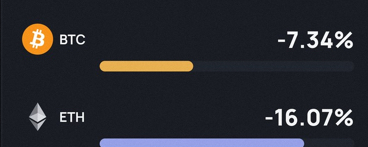

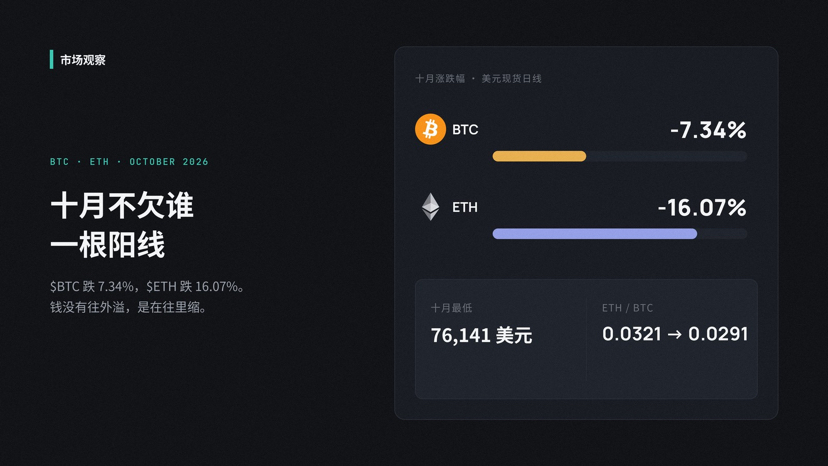
 Based on USD spot daily data (UTC close), $BTC opened October at $83,556 and closed at $77,424, down 7.34%. Last October, it fell 3.96%. For the second year in a row, “Uptober” never showed up.
7.34% isn’t all that much on its own. This June, using the same methodology, $BTC fell 20.46% in a single month. What made this one painful wasn’t the size of the drop, but the timing: many people are used to expecting a rally in October.
This month wasn’t a steady slide all the way down. On October 2, it touched $87,249 intraday, the monthly high. For the next three-plus weeks, daily closing prices held above $80,000. The real damage came at month-end: on October 29, it fell 4.27% in a single day, then dipped to $76,141 intraday the following day, the monthly low.
The backdrop isn’t easy either. In the early hours of October 29 Beijing time, the Fed kept interest rates at 3.75% to 4%. The vote was 10 to 2, with both dissenters favoring another 25-basis-point hike. The statement said inflation “remains elevated.” On the previous trading day, the 10-year U.S. Treasury yield closed at 5.05%. When money itself is this expensive, risk assets have to answer one question first: why are they worth holding?
What’s more worth watching is $ETH.
In the same month, it fell from $2,684 to $2,253, a decline of 16.07%—nearly 9 percentage points deeper than $BTC’s. Dividing the two assets’ month-end prices, ETH’s ratio against BTC fell from about 0.0321 to about 0.0291.
As prices fell, money didn’t flow out; it pulled inward. The more volatile assets were sold first, while the most liquid one was held onto. This doesn’t look like rotation. It looks like defense.
“Uptober,” at the end of the day, is just an old report card. After several years of gains, people summed it up as a pattern. After that pattern was shared around a few times, it became an expectation. And once expectations build, the calendar becomes a reason to add to positions.
Prices don’t follow the calendar. October was supposed to rise—that was a wish traders made on the market’s behalf. The market never agreed.
At the start of November, I’m watching just two levels.
The first is $76,141, October’s low. As of 14:00 Beijing time on November 2, $BTC was around $78,200, less than 3% away. If the price stays above that level, October looks more like a pullback; if it breaks below, it will be hard to treat that late-month move as an isolated event.
The second is the ETH-to-BTC ratio. Until it stops falling, it’s a little too early to talk about an altcoin rally.
As for how November has performed historically, I’m not going to look it up. The more often you do, the easier it is to find yet another calendar-based reason to convince yourself.
You can turn the calendar page, but you have to do your own accounting.
This article reflects only my personal views and does not constitute investment advice.#比特币现货ETF周净流出2.03亿美元