Hello, fellow traders! We’re continuing our third educational series on risk management and capital management. After covering the golden rule and the importance of preserving capital and managing risk ratios in the first post, today we’re moving on to practical application: how to calculate position size and how to control a trader’s number-one enemy—the psychological and emotional side.
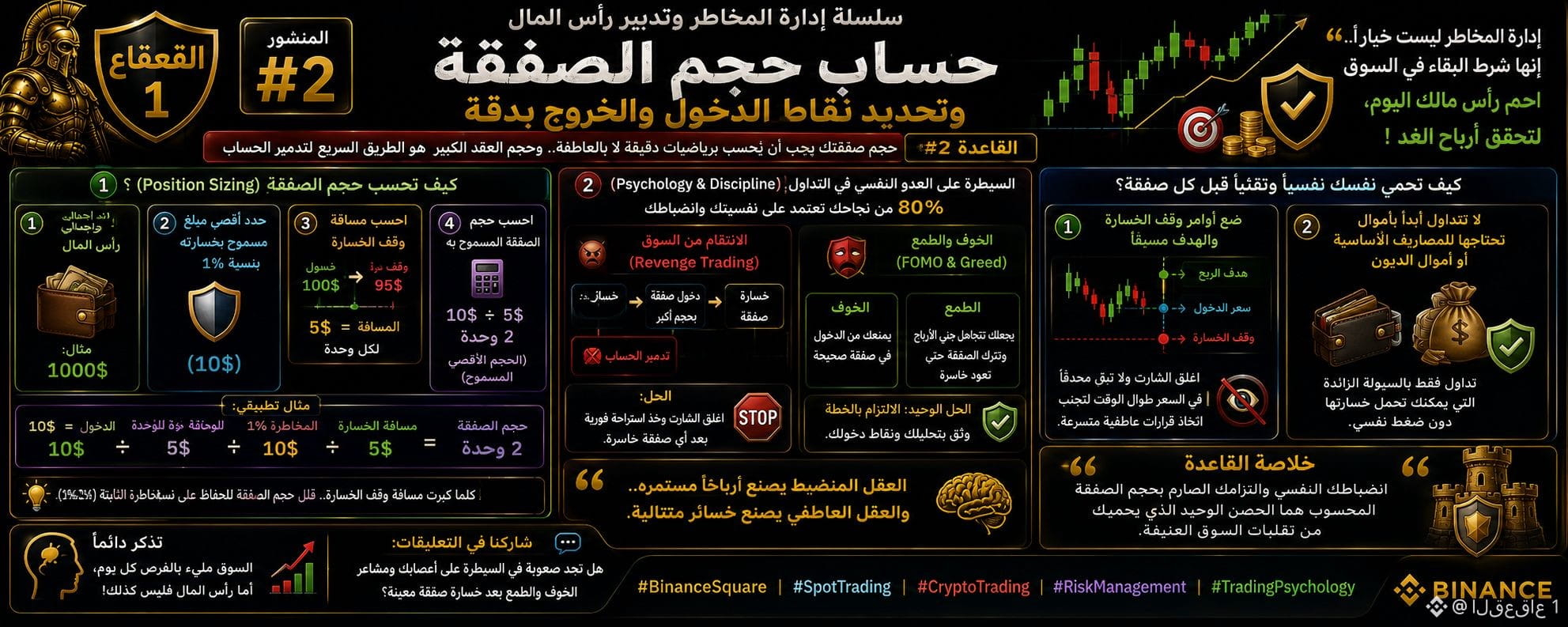
🎯 Rule #2: “Your position size should be calculated with precise math, not emotion. A large position is the fastest way to destroy your account.”
💡 The concept in simple terms:
Many traders choose how much to invest in a trade at random (for example: “I’ll put in my entire balance because this is a great opportunity,” or “I’ll buy a random amount, like $100”).
The right position size is not measured by how much you want to profit, but by the distance between your entry point and your stop-loss point (Stop Loss). The farther away your stop-loss is, the smaller your position size should be, and vice versa. This ensures that your loss never exceeds the safe limit (1% to 2%).
---
🔍 1️⃣ How do you calculate position size in practice (Position Sizing)?
To calculate your position size accurately and avoid surprises, follow this simple formula:
1. Determine your portfolio’s total capital (example: $1,000).
2. Set the maximum amount you’re willing to lose on this trade at 1% (that is, $10).
3. Calculate the stop-loss distance in the cryptocurrency (example: if your entry is at $100 and your stop-loss is at $95, then the loss distance is $5 per unit).
4. Divide the amount you’re willing to lose ($10) by the loss per unit ($5) = 2 units (the maximum amount you’re allowed to buy for this trade).
---
🔍 2️⃣ Mastering trading’s psychological enemy (Psychology & Discipline):
Technical analysis and risk management account for only 20% of your success, while 80% depends on your mindset and discipline.
• Revenge trading:
- After losing a trade, a trader may rush straight into a new trade with a larger position, trying to “make back the loss quickly.” This often wipes out the entire portfolio. The solution: close the chart and take an immediate break after any losing trade.
• Fear and greed (FOMO & Greed):
- Fear keeps you from entering a good trade, while greed makes you ignore taking profits and hold the trade until it turns into a loss. Sticking to your plan is the only cure.
---
🛠 How can you protect yourself psychologically and technically before every trade?
1. Set your stop-loss and take-profit orders in advance, then close the chart. Don’t keep staring at the price all the time, so you can avoid making rushed, emotional decisions.
2. Never trade with money you need for essential expenses or debt payments. Trade only with surplus funds that you can afford to lose without emotional stress.
---
⚖️ Rule summary:
“Your mental discipline and strict adherence to calculated position sizing are the only fortress protecting you from violent market fluctuations.”
💬 Tell us in the comments:
Do you find it difficult to control your nerves and feelings of fear and greed after a particular losing trade?
#BinanceSquare #SpotTrading #TechnicalAnalysis #RiskManagement $BTC $ETH $SOL