
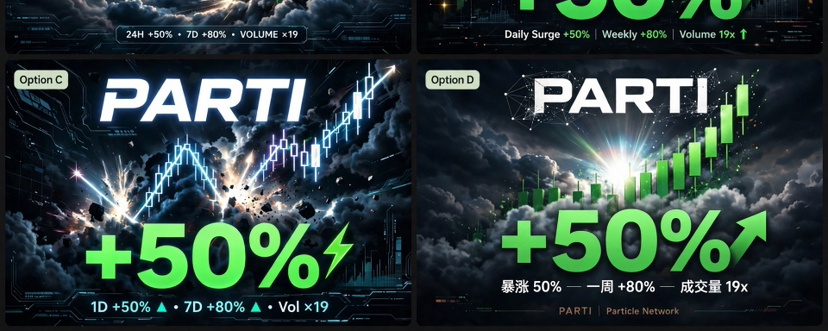

Yesterday at noon, PARTI was still trading sideways around $0.039. By evening, it had surged above $0.06, gaining more than 50% in 24 hours. It was up 80% over the week and 130% over the month. But zoom out a little, and it was still down 45% over the past year—let alone its all-time high of $0.43 in March 2025, from which it had fallen by 90%.
The most unusual thing about this rally wasn’t the size of the gains, but the volume. Spot trading volume over 24 hours rose from $157 million to $180 million, roughly 19 times the previous day’s figure; derivatives volume was about $560 million, with open interest at $22.16 million. Price and volume were both up, but even after combing through the latest news, it’s hard to find any single piece of positive news that can explain the rally.
So what exactly does Particle Network do? In a nutshell, it lets users forget that “chains” even exist.
It’s an L1 focused on chain abstraction, with a core product called Universal Accounts. One account, one balance, works across all chains: no bridges, no switching wallets, and no need to keep gas on different chains. Its flagship app is UniversalX, a chain-abstraction trading product. The new version was recently relaunched after a complete rebuild, and the team says it offers faster charts and better trade execution.
There are two technical milestones worth remembering. In March 2026, it introduced the first chain-abstraction implementation based on EIP-7702, allowing existing wallets to upgrade to Universal Accounts without migrating assets. In September 2025, it announced that it would use the Avalanche tech stack for Particle Chain’s coordination and settlement layer. When the token launched in March 2025, the Binance IDO was 160 times oversubscribed, and 9% of the total supply was airdropped to the community.
The fundamentals aren’t hollow, either. A Messari report in the first quarter of 2025 sparked a rally: Universal Accounts grew 557% quarter over quarter to 110,000, while UniversalX’s average daily trading volume surged 151-fold. In April 2026, it integrated Dynamic, enabling all Dynamic accounts to use chain abstraction without migrating. In September 2026, the team described Universal Accounts V2 as the world’s fastest cross-chain mechanism, based on performance tests.
But don’t rush to chase the rally just yet—there are three signals worth looking at calmly.
First, this surge has no clear positive catalyst and looks more like a burst of capital inflows. Second, funding rates on some platforms are deeply negative: shorts are paying longs, suggesting that many traders are betting against the trend and creating the potential for a short squeeze. Moves like this can come fast and reverse just as quickly. Technically, the RSI has also reached the overbought level of 70. Third, the token distribution presents challenges: only about 233 million tokens are in circulation, or 23.3% of the total supply, and unlocks continue through 2030. On November 25, another 9.3 million tokens are set to unlock, including 6.78 million for private investors and 2.52 million for the team.
