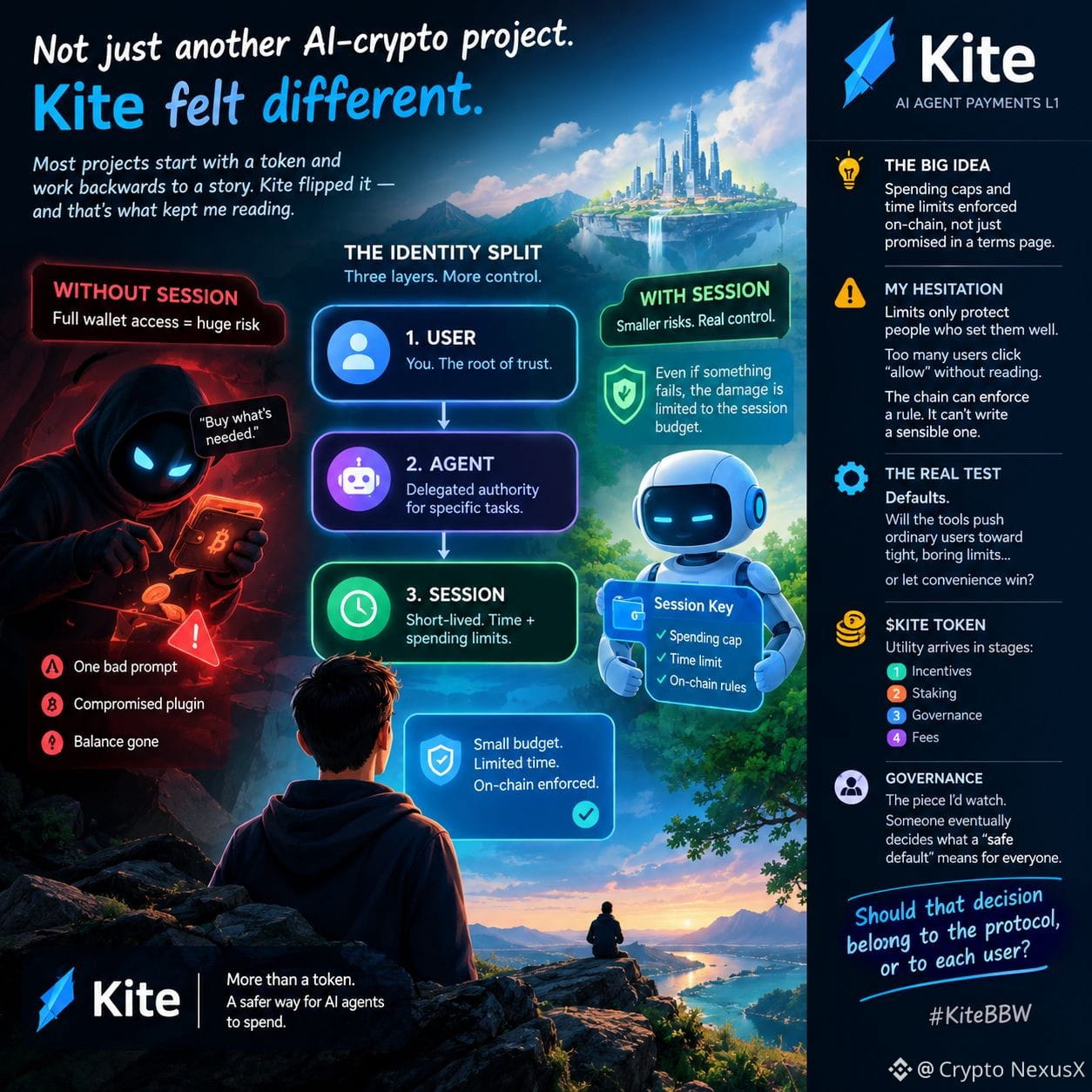
Most AI-crypto projects I read start with the token and work backwards to a story. Kite felt like it went the other way, and that's what kept me reading.
The part that stuck wasn't the speed. It was the identity split. User at the root, an agent underneath with delegated authority, then a session that expires. Sounds like paperwork until you picture the alternative... an agent holding a full wallet key and a vague instruction to "buy what's needed." One bad prompt, one compromised plugin, and the balance is gone.
With a session layer, the worst case shrinks to whatever budget that single task was handed. I think that's the most practical idea in the whole design. Spending caps and time limits enforced on-chain, instead of promised in a terms page.
Here's my hesitation, though. Limits only protect people who set them well. I've watched users click through OAuth screens for years without reading one permission. Why would agent budgets be different? Some will set the cap to "unlimited" because the task keeps failing otherwise. The chain can enforce a rule. It can't write a sensible one.
So the real test might be defaults. Whether the tooling pushes ordinary users toward tight, boring limits... or lets convenience win.
$KITE utility arrives in stages, incentives first, then staking, governance and fees. Governance is the piece I'd watch, because someone eventually decides what a "safe default" means for everyone.
I'm still reading the docs, so call this a working opinion.
Should that decision belong to the protocol, or to each user? #KiteBBW
@KITE AI 中文