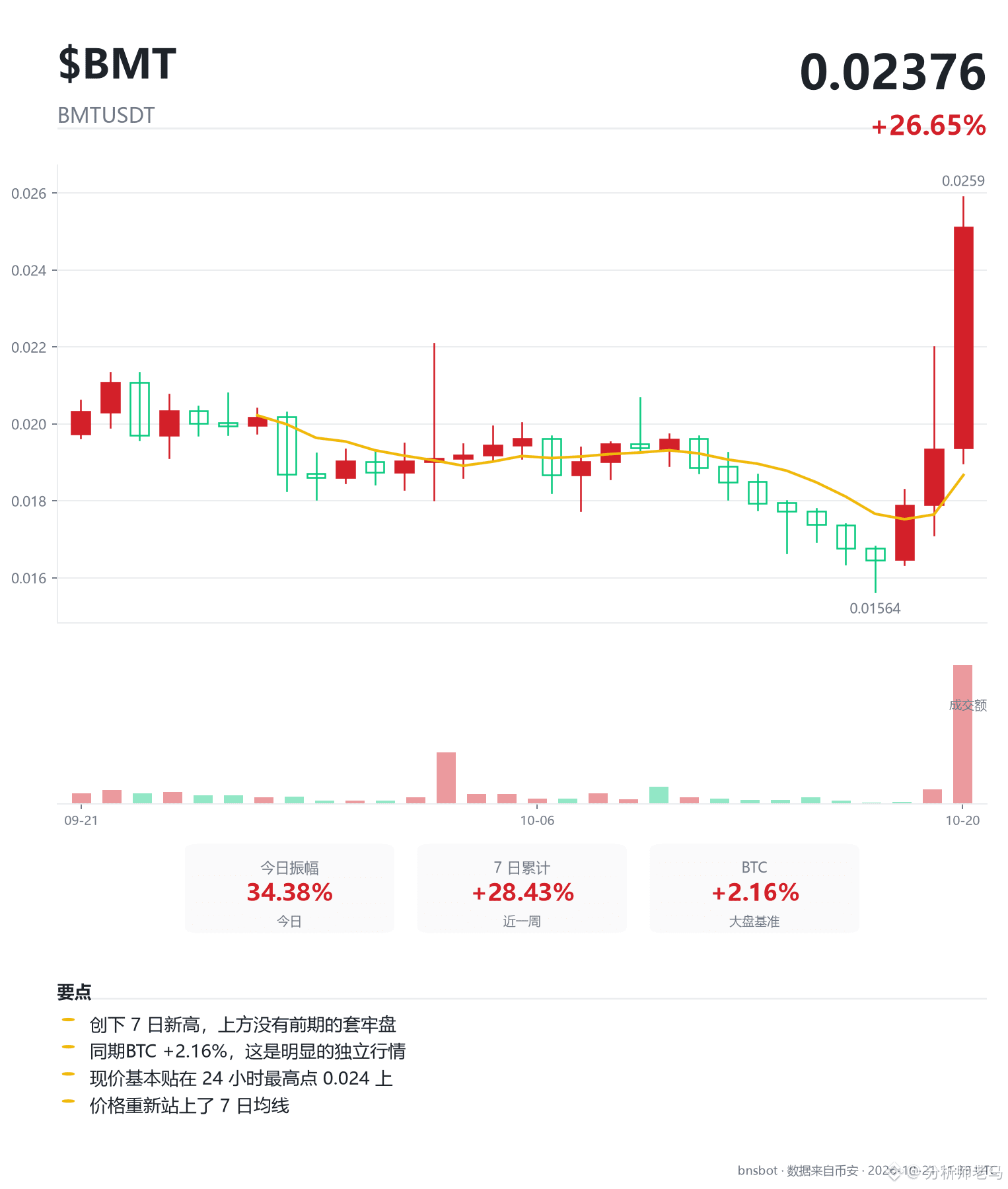
Funding rate annualized at -488.1% — why are shorts in $BMT paying up?
Let’s put that number into perspective: short sellers have to pay nearly 4.9 times their principal in funding fees over a year. Even if they hold for just one day, they’re paying a toll for this trade. Longs, on the other hand, are getting paid. So the split—with 60.2% of accounts long and 39.8% short—isn’t just sentiment; real money is leaning one way.
And money really is flowing in. There’s 4.08 million USDT tied up in the contracts—not a huge market, but open interest has risen 78% in seven days and another 20.66% in the past four hours. Crucially, the price has also risen 36% over the same period. Rising open interest alongside a rising price points to new longs entering, not a hollow rally fueled by short covering. This rally has real support behind it.
But even with that support, the price is now at an awkward level to trade.
The current price is 0.02523, just 3.05% below the first resistance at 0.026, while its average daily move is 6%. In other words, there’s less than half an ATR of upside. The risk/reward ratio looks like 3.35, but there isn’t even room to place a stop-loss. Even closer is the round-number level at 0.025 below, just 0.9% away. The room on either side has been squeezed into a narrow gap. At a time like this, you’re likely to get stopped out at either end.
Look at its recent price action: just a day ago, it surged above 0.02068, spiked to 0.022, then fell back to close at 0.01935—a textbook false breakout. Anyone who bought above 0.02068 is still underwater. The price has climbed back up now, but this same level has already caught traders out once.
The price is also extremely stretched: 43% above its 7-day average and 34.6% above its 25-day average. This isn’t just “strong price action”—it’s “too far from cost basis.” A single pullback could give back a chunk of those gains. Meanwhile, the weekly trend, longer-term cost basis, and 3-day trend are all still pointing up, while the daily moving averages are bearishly aligned. The bigger picture is bullish; in the short term, this is a consolidation after a sharp rally, not a trend reversal.
So the conclusion is clear: the bias is bullish, but it’s not a good time to buy. The first target offers only 3.05% upside, leaving little after fees and slippage. You’d need at least 4% upside for a trade to be worthwhile. If you do trade it, wait for a high-volume move that holds above 0.026—that would confirm a genuine breakout and open up more room. If it falls below 0.02067, admit the trade was wrong. That’s a three-ATR level, not an arbitrary stop.
$BMT $BNB