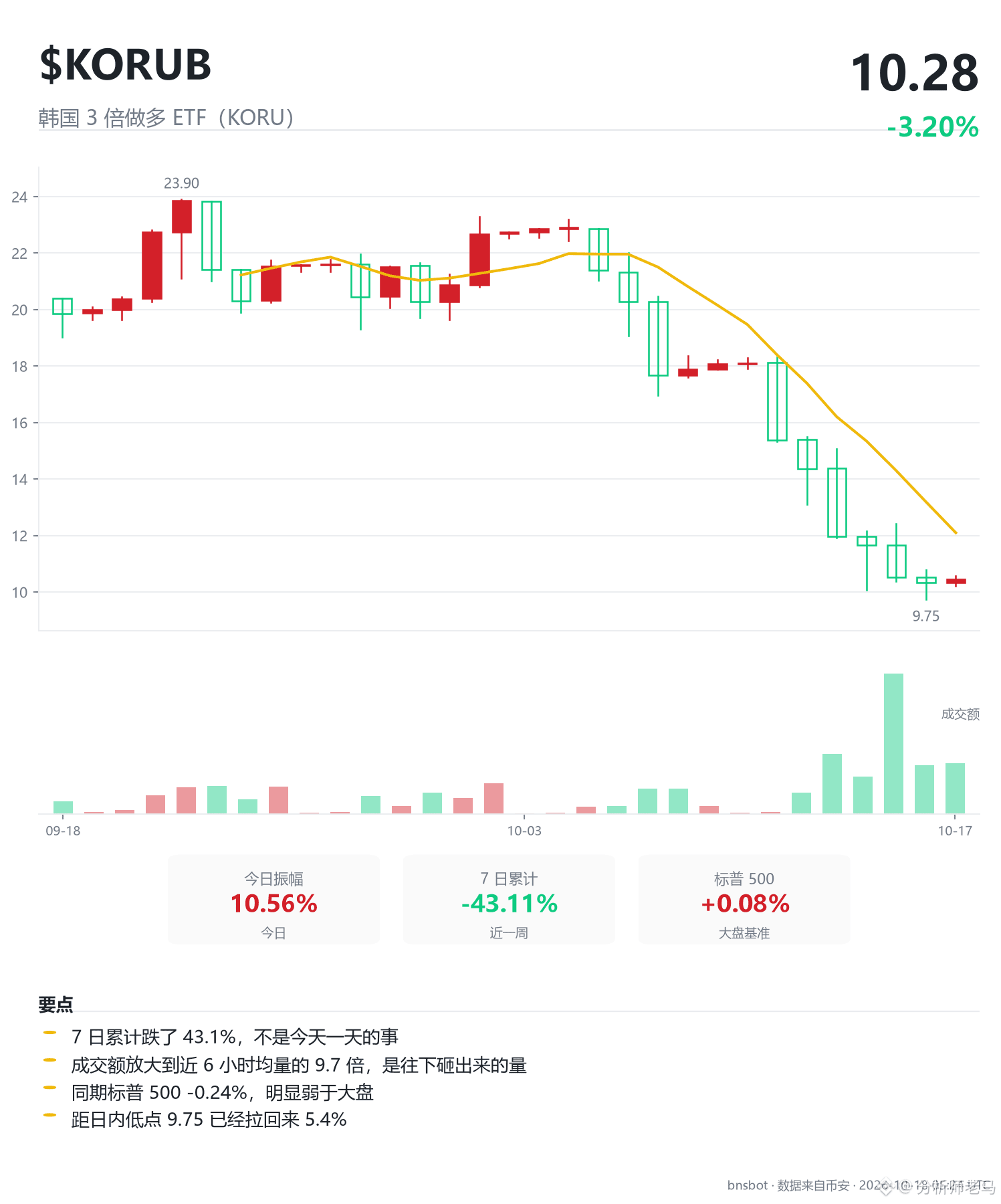
Korea 3x Long ETF (KORU): Bearish alignment, clearly bearish trend
But the most striking thing today isn’t the drop—it’s that 4-hour candle with volume at 3.06 times normal. Price is below the moving averages, yet volume has swelled to three times its usual level. That means someone is stepping in to buy the dip, but buyers haven’t won yet. Over the past eight weeks, the weekly chart is down 17.3%; all the daily moving averages are pressing downward, so bears are in control of the overall direction. On the 12-hour chart, price is already 35.5% below the intermediate-term cost basis; on the 4-hour chart, it’s 8.7% below. These three timeframes set the pace, not the direction. And the pace is simply too fast on the downside.
Just how fast? Price is 20.7% below its 7-day average, and the RSI is 22.1. Trying to catch a bounce here is a countertrend move—not impossible, but it calls for a small position. Price plunged from 25.73 to 9.75, a 62% drop, and has now recovered just 4%. It hasn’t even reached the first rebound level at 15.85, which shows that bears have yet to meet any meaningful resistance.
The problem is the risk/reward. Above, 11 is both a round-number level and a weekly-chart hurdle, 5.16% away from the current price. Below, 10.4 is the weekly extreme low left behind ten days ago; further down, 10 is a round-number level, 4.4% from the current price. But this asset’s average daily move is 20.3%, so the room above and below combined isn’t even enough to fit a stop-loss. A 1.17 risk/reward ratio looks passable, but in practice you’d be betting on a five-point move against a single day’s volatility. Long or short, you could get stopped out for no good reason.
So the bias is bearish, but don’t trade it just yet. If you’re going to wait, wait for a decisive break below 10—that’s when the downside opens up. If it gets back above 16.84, this trade thesis is wrong. The sector isn’t helping either: all three comparable ETFs are falling. The Korea ETF itself is down 0.84%, and it’s 1.28 percentage points weaker than the sector average, so this isn’t just about the broader market.
$KORU
$KORUB