

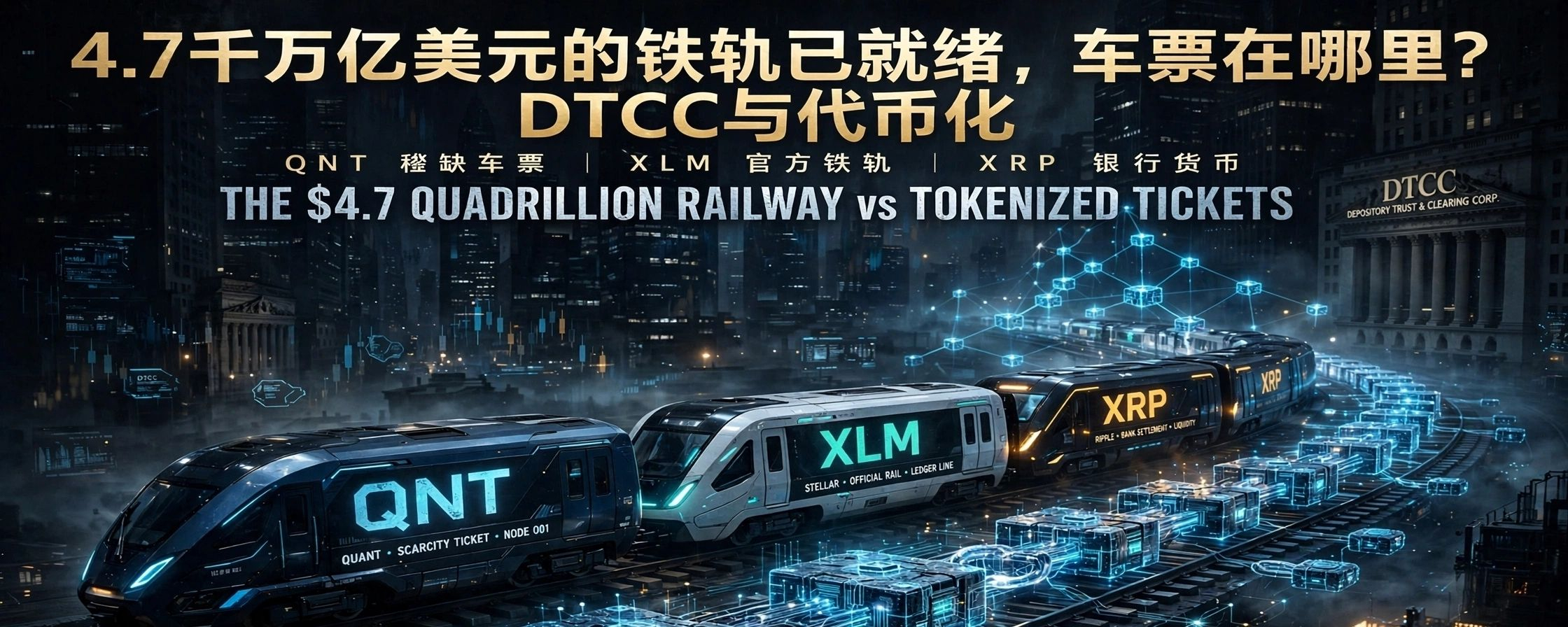

Everyone is talking about the growth of real-world asset tokenization and traditional financial infrastructure entering the world of blockchain. But the more important question isn’t just: What is the value of the assets that will be tokenized? It’s what portion of this activity will create real economic demand for the currency that powers the network.
In 2025, DTCC companies processed securities transactions worth $4.7 quadrillion, and its depository subsidiary provided custody services for securities worth $114 trillion. These are enormous figures, but they describe activity in traditional financial infrastructure; they don’t mean that all of this value will be transferred to the blockchain or to any particular cryptocurrency.
This is where it becomes important to distinguish between the success of the infrastructure, the growth of tokenized assets, and the economic value that may accrue to the network’s native coin.
1. $QNT — Interoperability infrastructure
In September 2026, The Clearing House announced that it had selected Quant to support its on-chain money initiative, aiming to connect blockchain-based financial activity with traditional payment systems, coordinate transactions, and settle tokenized bank deposits.
The Clearing House operates payment networks owned by a group of the largest U.S. banking institutions.
Why is QNT worth watching?
Because successful interoperability solutions in the financial sector could enhance the importance of the technology developed by Quant. The QNT token is used within the Quant ecosystem to access Overledger services under its business model.
But one investment question remains unanswered by the partnership announcement alone: How much additional demand for the QNT token will actually result from institutions using this technology?
It is not enough to say that banks will need to lock up specific amounts of QNT unless this is supported by a publicly announced operational or commercial mechanism. Nor does choosing the technology guarantee that its token’s price will rise.
Risks: The technology may succeed commercially without the economic impact flowing through to the token to the extent investors expect, in addition to valuation, competition, and execution risks.
2. $XLM — A public network entering traditional financial infrastructure
In May 2026, DTCC and the Stellar Development Foundation announced plans to make tokenized assets held by DTCC available on the Stellar network during the first half of 2027.
Tokenization service plans include eligible assets such as Russell 1000 index stocks, exchange-traded funds, and U.S. Treasury securities, subject to applicable regulatory requirements.
Stellar also announced that the value of real-world assets tokenized on its network reached $4 billion on September 1, 2026.
Why is XLM worth watching?
Because the expansion of Stellar’s use in payments and tokenized assets could strengthen its role as general-purpose financial infrastructure. XLM is used to pay network fees and meet minimum balance requirements.
But low base fees raise an important question about the relationship between activity levels and the value of the token.
The base minimum fee is 0.00001 XLM per operation. Assuming the minimum fee is paid for each operation, one billion operations would amount to 10,000 XLM—not a fixed dollar amount, since the monetary value changes with the coin’s price. Fees may also vary during network congestion or when smart contract transactions are executed.
This does not mean that growing usage has no value; it means that transaction volume alone is not enough to estimate economic demand for XLM. The nature of transactions, balance requirements, fee payment mechanisms, and the sustainability of activity should also be examined.
Risks: Tokenized assets on Stellar may grow without XLM’s price rising in proportion to that growth. An announcement about a technical integration also does not guarantee future usage levels or an effect on price.
3. $XRP — Payments and financial infrastructure
XRP is a digital asset associated with the Ripple ecosystem and is used in some payment, liquidity, and transfer use cases, depending on the design of the service in question.
The token has a known supply mechanism, including a historical maximum of 100 billion XRP, with a portion of transaction fees burned. However, fee-related burns do not automatically create scarcity that meaningfully affects the price; their impact depends on the amount burned relative to the circulating supply and market demand.
Why is XRP worth watching?
Because the evolution of digital asset use in payments and cross-border liquidity, as well as developments in the regulatory environment, may affect interest in the Ripple ecosystem and the XRP asset.
But a common misconception needs correcting: ISO 20022 is a standard for exchanging financial messages, not an official endorsement of any particular cryptocurrency. Therefore, XRP should not be presented as the only cryptocurrency officially approved under this standard.
Similarly, discussion of ETFs or market expectations should be based on a specific regulatory status and a reliable source, not merely on a possibility or market rumor.
Risks: Expectations around XRP may rise without translating into proportionate real-world usage. Competition, overall market valuation, and regulatory developments are also influential factors.
Conclusion: Network success is not the same as token success
Tokenization may create new opportunities for financial markets, but it does not guarantee returns for every coin associated with a network that is being used.
Before evaluating any of these projects, ask three questions:
1. Demand: Does using the technology require ongoing demand for the token itself, or can the service be provided with only limited need for it?
2. Value accrual: Is there a clear mechanism linking growth in economic activity to demand for the coin, or does the relationship depend mainly on market expectations?
3. Valuation and risks: Does the current price already reflect expected growth opportunities? What are the risks related to competition, execution, liquidity, and supply?
A technology may benefit from institutional adoption while the effect on its token remains limited. A token may benefit from factors beyond usage, such as liquidity, expectations, and market conditions. There is no simple formula that guarantees an outcome.
Tokenized assets such as $BENJI or $USDY should be evaluated based on their nature, holder rights, risks, and terms. They are not interchangeable substitutes for networks’ native coins, and the growth of tokenization does not guarantee returns on them.
Investment takeaway: Don’t just look for the network that will be used; understand how its use could affect the asset you are considering buying.
Which projects are worth studying? The decision should not be based on promises of a price explosion, but on evidence, value-accrual mechanisms, valuation, and risk management.