



🌍 Key takeaway in one sentence
Global markets took a full “U-turn” this week.
In the first half of the week, U.S. nonfarm payrolls added just 29,000 jobs in September (vs. 90,000 expected), and the unemployment rate rose to 4.2%. Expectations for rate hikes cooled, sparking a global risk-on rally: the Nikkei broke above 70,000, Taiwan stocks hit a record high, and BTC surged to 87K.
In the second half of the week, tensions in the Middle East, combined with a new round of U.S. sanctions on Iran, sent Brent crude soaring from $100 to $105.92. Inflation expectations heated up again, and markets quickly shifted to risk-off.
China’s A-shares got off to a weak start after the holiday on October 8 (Shanghai Composite -0.79%, ChiNext -3.15%), then rebounded in a V-shape on the 9th (trading volume: 1.92 trillion yuan). The week was marked by volatility: “up first, then down, then a recovery.”
What's truly worth remembering is that the expectation of monetary easing following the unexpectedly weak non-farm payrolls data was partially offset by the surge in oil prices.
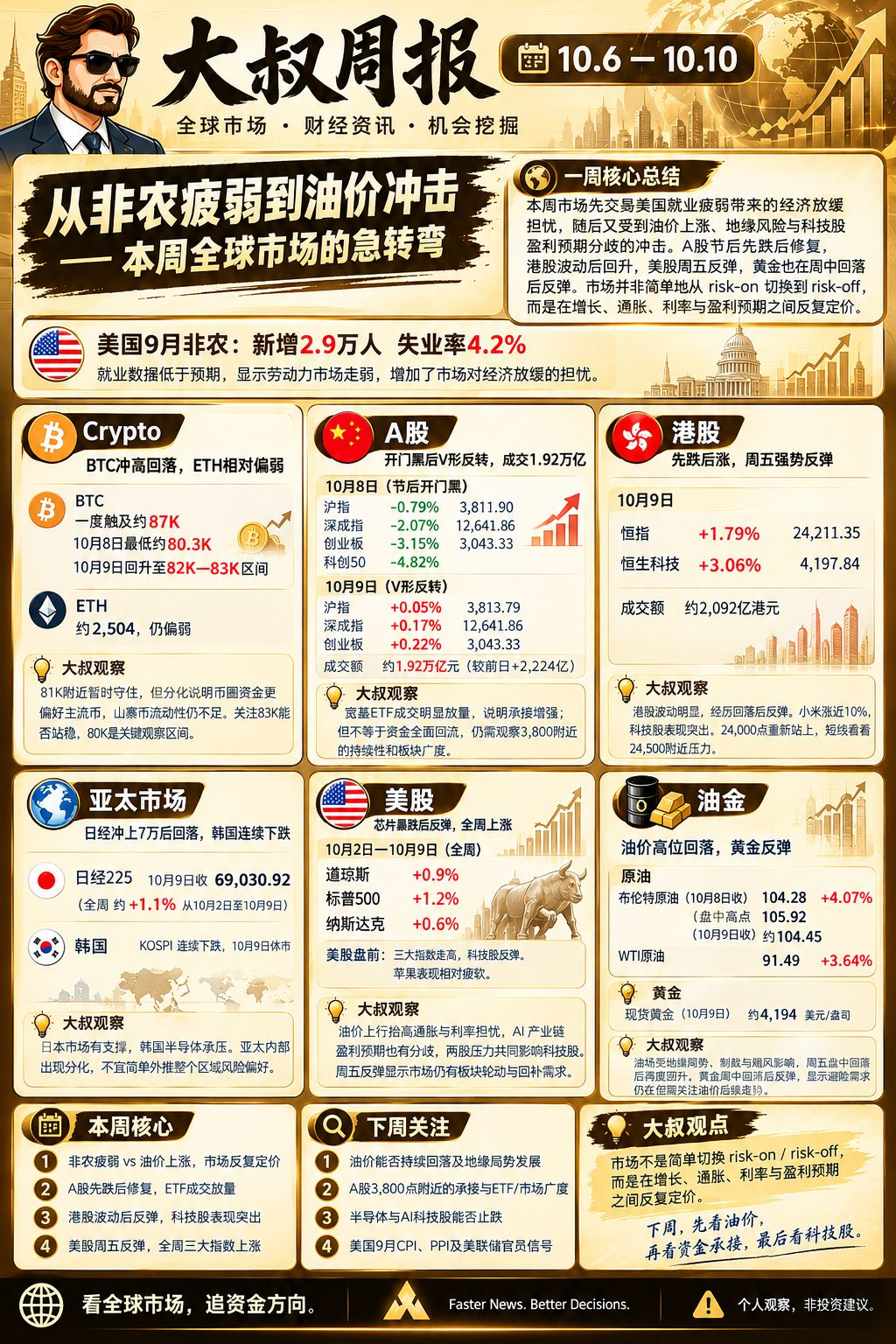
🪙 Crypto|BTC dropped from 87K to 81K and then rebounded to 83K
BTC experienced significant volatility this week.
After the release of the non-farm payroll data on October 2nd, BTC briefly surged to around 87K. However, with the surge in oil prices and cooling risk appetite, BTC fell continuously, hitting a low of around 81K on October 8th, a drop of nearly 6K from its high. It rebounded slightly to around 83K on October 9th.
ETH performed even worse, falling more than BTC this week, hitting a low of around 2,470.
Uncle's observation:
81K was the low for this week, and it has held for now. However, the divergence between BTC and ETH indicates that funds in the crypto market prefer mainstream coins, while altcoins still lack sufficient liquidity.
Next, we'll focus on:
Can the 83K hold its ground?
If oil prices continue to stay above 104, it will be difficult for BTC to see any significant price movements.
80K is the key observation range.
🇨🇳 Chinese A-shares | After a poor opening, a V-shaped reversal occurred, with turnover reaching 1.9 trillion yuan.
A-shares only traded for two days this week (October 8th and 9th).
October 8th (A bad start):
The Shanghai Composite Index fell 0.79% to 3,811.90, the Shenzhen Component Index fell 2.07%, the ChiNext Index fell 3.15%, and the STAR Market 50 Index fell 4.82%. Turnover reached approximately 1.69 trillion yuan, an increase compared to before the holiday. Over 3,700 stocks declined. Technology growth stocks were the hardest hit, with semiconductors, communication equipment, and CPOs showing significant declines.
October 9 (V-shaped reversal):
The Shanghai Composite Index rose 0.05% to 3,813, the Shenzhen Component Index rose 0.17%, and the ChiNext Index rose 0.22%. Turnover reached 1.92 trillion yuan, an increase of 222.4 billion yuan from the previous day. The market rebounded in a V-shape after an intraday dip, with nearly 3,300 stocks rising. The film and media sector saw a surge of stocks hitting their daily limit.
Uncle's observation:
The two-day pattern is quite interesting: the first day saw a high-volume decline, followed by a high-volume V-shaped rebound on the second day. The most important signal on the 9th wasn't the V-shape itself, but the significant increase in trading volume for broad-based ETFs—many core index ETFs saw their half-day trading volume exceed or approach the previous day's full-day volume. This indicates that funds were actively buying around 3800, but major funds were still experiencing a net outflow of 12.6 billion, meaning large funds hadn't fully entered the market yet.
3,800 is the most important level to watch next week. If it holds, a short-term recovery is possible; if it fails to hold, it will likely test lower levels again.
🇭🇰 Hong Kong Stocks | Initial Decline Followed by Rebound, Hang Seng Tech Remains Basically Flat for the Week
Hong Kong stocks will trade for four days this week.
October 6: Hang Seng Index +1.00% to 24,280
October 7: Hang Seng Index -0.62% to 24,130
October 8: Hang Seng Index -1.43% to 23,785, Hang Seng Tech -2.89%
October 9: Hang Seng Index +1.79% to 24,211, Hang Seng Tech +3.06%
The Hang Seng Index rose slightly by about 1% for the week, ending a four-week losing streak. However, it was highly volatile.
Uncle's observation:
Hong Kong stocks are more volatile than A-shares. After falling 1.43% on the 8th, they rebounded 1.79% on the 9th. Hang Seng Tech rose 3% on the 9th, Xiaomi rose nearly 10%, Kuaishou rose over 5%, and Tencent rose over 3%, indicating that tech stocks rebounded first in Hong Kong. The 24,000 level has been regained, with short-term resistance around 24,500. The Hong Kong Stock Connect remained closed this week (October 1-7), resuming only on the 8th; the attitude of southbound funds is worth noting.
🌏 Asia-Pacific Markets | Nikkei falls back after breaking 70,000, South Korea continues to decline
Japan:
The Nikkei 225 rose and then fell this week. It closed at 70,684 on October 6 (+1.05%), surpassing the 70,000 mark. It then underwent a correction, falling 1.42% to 69,042 on October 8 and closing virtually flat at 69,031 on October 9. For the week, the Nikkei fell approximately 2.3%, dropping from above 70,000 back below it.
South Korea:
The KOSPI index fell for two consecutive weeks, down 1.98% on October 7th and 2.35% to 6,644 on October 8th. The market was closed on October 9th. Semiconductor stocks were under significant pressure.
Uncle's observation:
A divergence has emerged within the Asia-Pacific region: the Japanese market is supported (around 70,000), while South Korean semiconductors continue to weaken. This aligns with the global tech stock correction – those that rose significantly earlier are experiencing larger pullbacks this week.
US Stocks | Chip Stocks Rebound After Plunge, Trading in a Narrow Range Throughout the Week
US stocks traded for four days this week. At the beginning of the week, the risk-on sentiment continued following the disappointing non-farm payrolls data, with the Dow Jones, S&P 500, and Nasdaq all closing slightly higher. Mid-week, however, the market weakened due to a surge in oil prices and a sharp drop in chip stocks, with the Nasdaq falling 1.25% and the Philadelphia Semiconductor Index dropping approximately 3.4%. On Friday, tech stocks rebounded, and all three major indices closed higher. For the week, the Dow Jones Industrial Average rose approximately 0.3%, the S&P 500 rose approximately 0.1%, and the Nasdaq fell approximately 0.4%.
Uncle's observation:
This week, chip stocks were the core driver of US stocks. The Philadelphia Semiconductor Index fell about 3.4% on the 8th, with only one of its 30 components closing in positive territory, before rebounding on the 9th. The surge in oil prices was the main variable suppressing tech stocks—higher oil prices → higher inflation expectations → higher US Treasury yields → pressure on tech stock valuations. However, the rebound on the 9th suggests that the market hasn't fully shifted to a defensive stance, but rather resembles sector rotation within a high-level consolidation phase.
🛢️ Oil & Gold | Brent crude surges 4% to close at 104, the biggest variable this week
Brent crude oil surged this week from around $100 to $104.28 (+4.07%), reaching a high of $105.92 during the session. WTI closed at $91.49 (+3.64%).
Driving factors:
Tensions in the Middle East
The United States imposes new sanctions on 17 Iranian oil tankers.
Some crude oil production in the Gulf of Mexico was temporarily shut down due to the hurricane (it has partially resumed as of Friday).
Gold prices remained range-bound at high levels this week, hovering around $4,165.
Uncle's observation:
Oil prices are the biggest variable in global markets this week. The disappointing non-farm payrolls data initially led the market to trade the possibility that "the tightening cycle is nearing its end," but rising oil prices have brought inflation expectations back. If oil prices continue to stay above $104, the Federal Reserve's interest rate path will fluctuate, and the pressure on tech stocks and Bitcoin will not disappear.
The conduction chain is very clear:
Oil price increases → Inflation concerns rise → US Treasury yields remain high → Tech stocks/BTC and other risk assets face pressure
💎 This Week's Core
What really happened this week wasn't simply a matter of "whether it went up or down," but rather a shift in market trading logic.
The first half of the transaction was:
Unexpectedly weak non-farm payrolls → Cooling interest rate hike expectations → Risk-on
The second half of the transaction involved:
Oil price surge → inflation expectations resurface → risk-off
The two conflicting logics led to a volatile market characterized by an initial rise followed by a fall and then a recovery.
The A-share market opened lower but then rebounded sharply, indicating support at 3,800; however, major funds are still flowing out, suggesting that large investors are still on the sidelines. Hong Kong stocks showed greater resilience, with Hang Seng Tech rising 3% on the 9th, leading the rebound. The rebound in US chip stocks after a sharp drop suggests that tech stocks haven't experienced a complete collapse, but rather are consolidating at higher levels.
But this fluctuation will not end as long as oil prices do not fall.
⚡ Stay tuned next week
① Can oil prices fall from 104?
This is a key variable in the global market. Only when oil prices stabilize can risk assets have room to grow.
② Can the A-share market hold at 3,800?
This week's V-shaped rebound indicates support, but we need to see if it can continue next week. Holding above this level suggests a potential recovery; a break below could lead to further declines.
③ Can technology stocks take over?
Film and media stocks rose, but technology growth is still bottoming out. Next week, we'll see if semiconductors and AI can take the lead.
④ US inflation data
Next week, pay attention to the US September CPI and PPI data. If inflation exceeds expectations, the combination of oil prices and inflation will become even tighter.
⑤ Speeches by Federal Reserve officials
The policy signals from the new Federal Reserve Chairman, Warsh, remain a key focus for the market. Following the disappointing non-farm payrolls data, statements from officials will influence interest rate expectations.
🌍 Uncle's Weekly Report Conclusion
This week's market taught us one thing: don't let a single data point change your entire judgment.
The disappointing non-farm payrolls data was indeed good news, but the surge in oil prices largely negated that. The A-share market's poor opening was certainly alarming, but the V-shaped recovery the following day suggests it wasn't all that bad.
The market always swings between two extremes. What we can do is keep an eye on the core variables (oil prices, interest rates, trading volume), avoid chasing highs and lows, and wait for clear signals before taking action.
Next week, let's first look at oil prices.
━━━━━━━━━━━━━━━━━━
Watch global markets, follow the flow of funds. Faster News. Better Decisions.
This is a personal observation and not investment advice.