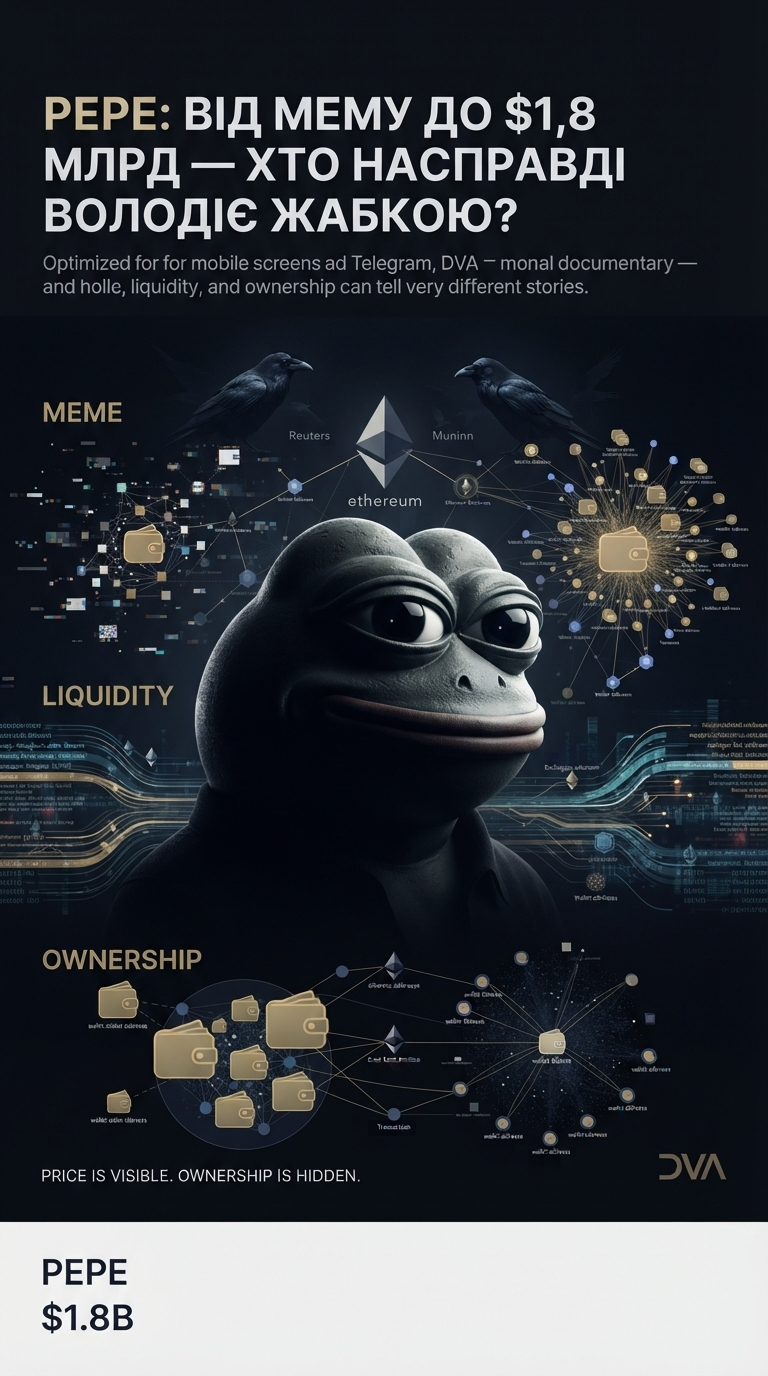

🐸 PEPE: From Meme to $1.8 Billion — Who Really Owns the Frog?
PEPE is an example of how an internet cultural symbol can turn into a crypto asset with a multibillion-dollar market cap.
But the key question isn’t “How much is the frog worth?”
The question is different: who controls its economy—and what exactly are people buying when they buy PEPE?
FACT
PEPE launched in April 2023 as an ERC-20 token on Ethereum.
Its image comes from Pepe the Frog, a character created in 2005 by artist Matt Furie. At the same time, the crypto project stated that it was not affiliated with Furie.
In other words, the character’s creator and the token’s creators are not the same party.
PEPE’s creators initially remained anonymous. Zachary Testa’s name was later associated with the project in the media and crypto community, but it would be inaccurate to call him the legally confirmed “owner of PEPE.”
This is a fundamental distinction.
As of October 7, 2026, PEPE’s market capitalization is about $1.8 billion, and its supply is about 420.69 trillion tokens.
MECHANISM
PEPE does not have its own blockchain.
It is an Ethereum token with a maximum supply of:
420,690,000,000,000 PEPE
At launch, approximately 93.1% of the supply was sent to the liquidity pool, and the LP tokens were burned.
Another 6.9% remained in the team’s multisig wallet for future listings, liquidity, partnerships, and other operations.
An important detail:
PEPE does not have an automatic burn mechanism.
Burns took place through separate transactions—the tokens were sent to inaccessible addresses.
Therefore:
420.69 trillion ≠ automatically a deflationary asset.
Its scarcity depends on actual burns and holder behavior.
RISK
In August 2023, approximately 16 trillion PEPE were moved from a multisig wallet associated with the team—about 3.8% of the total supply at the time.
The estimated value of the transactions was about $15–16 million.
After this, PEPE fell sharply.
The problem was not just the movement of tokens.
The multisig signature threshold was changed from 5/8 to 2/8, further undermining market confidence.
Later, PEPE’s official account stated that three former team members had gained access to the multisig and moved the tokens without the rest of the team’s permission.
But it is important to frame this as a statement by the project, not as a theft conclusively established by a court.
DVA asks a simple question:
If an asset is decentralized, but a significant reserve is controlled by a limited number of keys, how decentralized is it in practice?
WHALES
PEPE illustrates another feature of memecoins:
the number of holders ≠ an even distribution of ownership.
In August 2026, data from Santiment and Nansen showed that the top 100 addresses had increased their holdings by about 6.07% over 30 days, controlling around 85.97 trillion PEPE.
Smart Money addresses increased their positions by about 307% over the same period, although their total holdings amounted to only around 108 billion PEPE—a negligible share compared with the top 100 addresses.
An outflow of about 4.54 trillion PEPE from exchanges was also recorded in a single day—the largest figure since November 2024.
But:
on-chain movement is a fact. The holder’s intent is a hypothesis.
Withdrawing tokens from exchanges may indicate accumulation, long-term holding, OTC transactions, or simply the movement of capital.
So “whales are accumulating” does not yet mean “whales are preparing a pump.”
DVA CHECK
Who created Pepe the Frog?
Matt Furie.
The character comes from his 2005 comic Boy's Club.
Who created the PEPE crypto token?
The project launched anonymously.
Therefore, the claim “PEPE belongs to Zachary Testa” should not be presented as an established fact.
Does PEPE belong to Matt Furie?
No. The crypto project stated that it was not affiliated with the character’s creator.
Is token ownership concentrated?
Yes.
Large addresses control significant amounts of PEPE.
Does this mean control is centralized?
Not automatically.
An address may belong to a private investor, an exchange, a market maker, a custodian, or another entity.
Does PEPE have fundamental value on the level of Bitcoin or Ethereum?
No.
PEPE was created as a memecoin without a traditional utility model, roadmap, or stated intrinsic value.
Its price is largely shaped by demand, liquidity, cultural impact, speculation, and holder behavior.
ANOTHER RISK
In December 2025, the frontend of PEPE’s official website was compromised.
Blockaid researchers detected code associated with Inferno Drainer, and users were redirected to malicious pages designed to steal assets from connected crypto wallets.
The token price did not experience a similar decline—in the following 24 hours, PEPE even rose by about 4%.
The lesson is simple:
website security ≠ blockchain security.
Even if the token itself continues to exist, a frontend compromise creates a separate risk for holders.
ETF: A NEW ACCESS CHANNEL
In 2026, PEPE received another institutional signal.
Canary Capital filed documents with the SEC regarding the Canary PEPE ETF.
The October 2, 2026 filing states that the fund is intended to provide exposure to the price of PEPE, which will be held by custodian BitGo.
The ETF is planned to be listed on Cboe BZX Exchange, with its NAV calculated using the CoinDesk PEPE Benchmark Rate.
But:
an ETF filing ≠ an approved ETF.
And even more importantly:
an ETF ≠ proof of PEPE’s fundamental value.
It is simply a new financial channel for accessing the asset.
DVA RISK ASSESSMENT
Technology risk: medium.
PEPE uses Ethereum rather than its own blockchain.
Concentration risk: high.
Large addresses hold significant amounts of the tokens.
Volatility risk: very high.
The memecoin depends on sentiment, liquidity, and speculative demand.
Team risk: high.
The anonymity of the original creators and the history of the multisig dispute reduce transparency.
Fundamental utility: low.
PEPE is primarily a meme asset and cultural brand, not an infrastructure protocol.
Regulatory risk: uncertain.
The emergence of ETF filings may broaden investor access, but it does not eliminate legal or market risks.
HIGH CONFIDENCE
Confirmed:
• PEPE is an Ethereum ERC-20 token.
• The supply is about 420.69 trillion tokens.
• About 93.1% of the initial supply was sent to the liquidity pool.
• 6.9% remained in multisig.
• PEPE is not affiliated with Matt Furie, the creator of Pepe the Frog.
• About 16 trillion PEPE were moved from the multisig in 2023.
• Large addresses continue to play a significant role in the ownership structure.
• In October 2026, Canary Capital has a Canary PEPE ETF registration filed with the SEC.
• PEPE’s market capitalization is around $1.8 billion.
NOT CONFIRMED
Should not be presented as an established fact:
• that Zachary Testa is legally the owner of PEPE;
• that all large addresses belong to a single “whale”;
• that whale accumulation means a future pump;
• that the movement of 16 trillion PEPE was legally proven to be theft by a specific person;
• that the ETF will definitely be approved;
• that PEPE’s market capitalization alone proves its fundamental value.
DECISION
PEPE is not Bitcoin.
Not Ethereum.
And not even a classic utility token.
It is a market meme packaged as a liquid ERC-20 asset.
Its strength lies in brand recognition, community, liquidity, and its ability to attract capital.
Its weakness lies in concentration, volatility, anonymous origins, and dependence on market sentiment.
So the biggest mistake is to look at PEPE only through its price.
It is better to look at it through three dimensions:
MEME • LIQUIDITY • OWNERSHIP
Who created the meme?
Who created the token?
Who controls a significant portion of the supply today?
And most importantly:
who will be left holding the tokens if market attention disappears?
PEPE illustrates a fundamental feature of the crypto market:
a price can be real even when fundamental value remains a matter of debate.
So a $1.8 billion market cap does not prove that PEPE is “worth” $1.8 billion in fundamental terms.
It proves something else:
the market is willing to value this meme at $1.8 billion right now.
And those are two completely different things.
FACT • VERIFY • RISK • DECISION
DVA — facts without hype.
Not financial advice.
Preserving value and time.
#BTC #DVA #PEPE #hold