

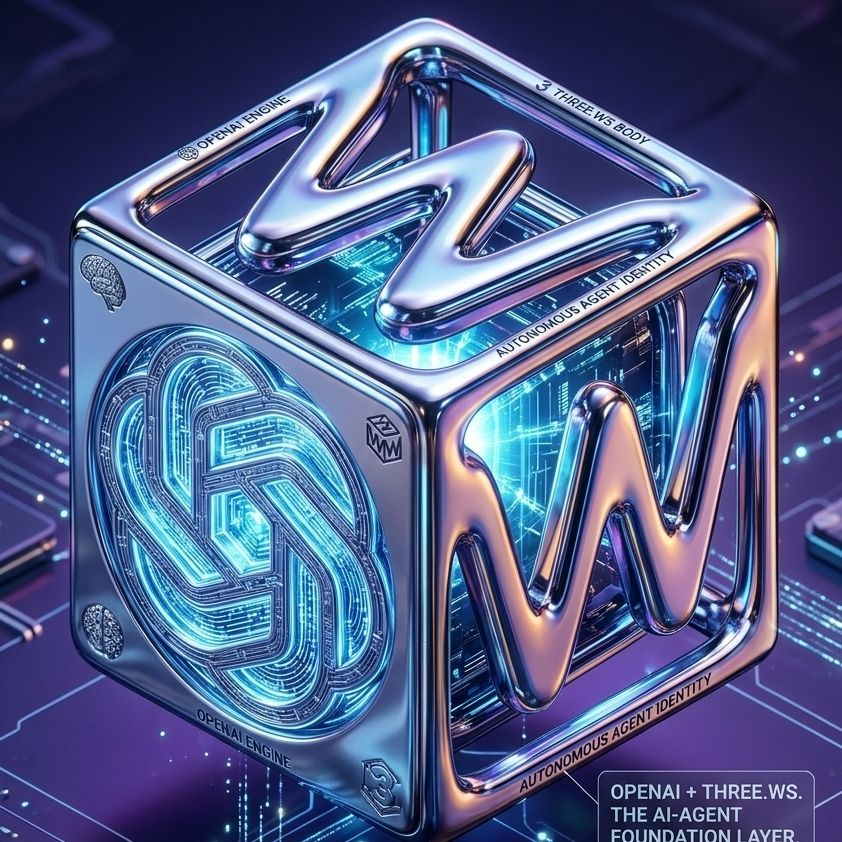
1. The 30 most important points of three.ws (Chinese)
1. three.ws is a 3D AI agent platform built on Solana, giving AI agents bodies, wallets, and on-chain identities.
2. Each agent can have its own independent Solana wallet, enabling self-custody, transfer, and spending of funds.
3. Agents use the x402 protocol to autonomously pay for APIs, data, compute, and service fees; settlement uses USDC or $THREE.
4. three.ws runs a self-hosted x402 facilitator and does not rely on any third-party credentials to complete Solana settlement.
5. The platform has processed over 110,000 on-chain USDC settlements and 800,000+ payment verification events.
6. three.ws is one of the top-ranked self-hosted facilitators on the x402scan facilitator leaderboard.
7. The main GitHub repository has over 11,400 commits, 20–30 per day on average, delivering real products continuously.
8. 101 @three-ws npm packages have been released, of which 42 are MCP servers.
9. Has 72 MCP servers in the official Model Context Protocol registry.
10. Any webpage can deploy an interactive 3D AI agent with just a single line of <agent-3d> tag.
11. Forge / 3D Studio support free text-to-3D without needing an account, wallet, or API Key.
12. Create a bound, animatable 3D virtual avatar with a single front-facing selfie.
13. Provides a native Android APK and deeply integrates Solana Seeker / Saga.
14. Agents can be minted as Metaplex Core assets onto the Solana mainnet, so users truly own an on-chain identity.
15. three.ws is a Select member in OpenAI’s partner network.
16. Provide a free 3D Studio connector for ChatGPT, including 9 no-key 3D tools.
17. three.ws is an IBM Business Partner, and agents use the IBM Granite model at runtime.
18. Access enterprise-grade AI governance via IBM watsonx.ai.
19. Granite Guardian handles governance checks and runs in a self-hosted manner on NVIDIA L4 GPU as a second channel.
20. three.ws is an NVIDIA Inception member, and the 3D generation channel runs on NVIDIA GPU / NIM.
21. Integrated with AWS, Google Cloud, and Alibaba Cloud, entering the enterprise procurement and distribution process.
22. Every time funds move, seven layers of agent guards are involved: blacklist, manual approval, capabilities, permissions, transaction guards, spending envelope, and x402 budget.
23. x402 Preflight verifies whether the seller can settle before payment, preventing payment failures after signing.
24. The platform commits to using 50% of revenue for $THREE market buybacks.
25. Every x402 settlement triggers a small $THREE purchase, forming a micro-buy loop.
26. A launchpad priced in $THREE, with each graduating token locking about 12.3 million $THREE.
27. $THREE is live on Kraken.
28. Historical ATH market cap is about $16.38 million; current market cap is about $710,000.
29. Developer Nicholas Resendez (nirholas) has conducted security research for Apple, Microsoft, AT&T, and the U.S. Department of Defense.
30. Key risks: thin liquidity, weak marketing, and heavy reliance on developers for token revaluation—shifting from “pure builders” to “operators.”
---
II. Main article body
From NVIDIA’s security platform to three.ws: a two-layer security architecture for the agent economy and undervalued infrastructure
When NVIDIA builds a hardware-trust layer for AI agents, a Solana project with a market cap of only about $710,000 is already guarding every on-chain transaction at the software layer.
In September 2026, NVIDIA released the Open Agent Safety Platform, together with more than 100 industry partners, to establish a “trust layer” for autonomous AI agents. OpenShell runs agents in a sandbox, while Sentry isolates out-of-bounds behavior at millisecond-level speed in a separate hardware layer. Big names such as SpaceXAI, Anthropic, Microsoft, Cisco, CrowdStrike, Palantir, and others have joined.
This marks the moment AI safety officially shifts from “model alignment” to “infrastructure enforcement.” But this discussion overlooks a key question: when an agent needs to move real money, who protects the wallet?
The answer might be a Solana project called three.ws.
1. What is three.ws?
three.ws is a Solana-based 3D AI agent platform. It enables AI agents to be more than just text in a chat window—they act as economic entities with bodies, wallets, and on-chain identities.
Each agent can have its own independent Solana wallet, paying autonomously for API, data, and compute fees via the x402 protocol. The platform runs a self-hosted x402 facilitator and does not rely on any third-party credentials to complete settlement. As of now, three.ws has processed over 110,000 on-chain USDC settlements and 800,000+ payment verification events.
On the x402scan facilitator leaderboard, three.ws ranks among the top self-hosted facilitators. This means it does not rely on external service providers—it builds and operates the settlement layer itself.
II. Technical infrastructure: from single-line HTML to the MCP ecosystem
The core entry of three.ws is extremely simple: any webpage can deploy an interactive 3D AI agent with just a single line of <agent-3d> tag.
Behind this is a complete set of infrastructure:
· Free text-to-3D: Forge / 3D Studio support text generation of 3D models without needing an account, wallet, or API Key.
· Selfie-generated avatars: a single front-facing selfie can generate a bound, animatable 3D virtual avatar.
· Native Android app: deeply integrated with Solana Seeker / Saga, allowing you to mint agents directly on your phone.
· On-chain identity: agents can be minted as Metaplex Core assets onto the Solana mainnet, so users truly own it.
· MCP ecosystem: 101 @three-ws npm packages have been released, including 42 MCP servers; the official registry lists 72 MCP servers.
The main GitHub repository has accumulated over 11,400 commits, with 20–30 per day on average. In the crypto industry, that number alone says a lot.
III. Enterprise partnerships: OpenAI, IBM, NVIDIA, AWS, Alibaba Cloud
three.ws’s enterprise integration network is its most fundamental difference from the vast majority of micro-cap projects.
OpenAI Select Partner: three.ws is a Select member in OpenAI’s partner network, providing a free 3D Studio connector for ChatGPT, including 9 no-key 3D tools. This means ChatGPT users can generate, view, and download 3D models directly within the conversation.
IBM Business Partner: Agents use the IBM Granite model at runtime, and enterprise-grade AI governance is accessed through watsonx.ai. Granite Guardian handles governance checks, vetoing jailbreaks, harmful or fraudulent behavior.
NVIDIA Inception member: the 3D generation channel runs on NVIDIA GPU / NIM and receives technical guidance. Granite Guardian runs self-hosted on NVIDIA L4 GPU as a second channel, ensuring governance is always online.
Multi-cloud integration: integrated with AWS, Google Cloud, and Alibaba Cloud, entering the enterprise procurement and distribution process. This means enterprise customers can deploy three.ws agent via existing cloud procurement channels.
IV. Security architecture: seven layers of guards + x402 Preflight
NVIDIA is building an agent safety boundary at the hardware layer. three.ws has already built a safety boundary for economic behavior at the software layer.
Every time funds move, they go through seven layers of agent guards:
1. Security blacklist
2. Manual approval
3. Capability token
4. Permission levels
5. Transaction guard
6. Spending envelope
7. x402 budget
The key design is: the chain is never short-circuited. All seven layers are always running; decisions report which layers were never evaluated for that call, and treat the “blind spot” as a first-class finding.
In addition, x402 Preflight verifies whether the seller can settle before payment, preventing payment failures after signing. This solves a core pain point of the x402 protocol: payment failures should not happen after signatures.
The developer of three.ws, Nicholas Resendez, has done security research for Apple, Microsoft, AT&T, and the U.S. Department of Defense. Security isn’t an afterthought—it’s a first-principles approach.
V. Tokenomics: Demand driven by mechanisms
$THREE is not a narrative token—it’s integrated into every revenue path of the platform:
· 50% revenue buyback: the platform commits to using half of its revenue for market repurchases.
· x402 micro-buy loop: each settlement triggers a small $THREE purchase.
· Launchpad lock: a launchpad priced in $THREE, with each graduating token locking about 12.3 million $THREE.
· Holding tier: holding $THREE grants fee discounts and premium features.
$THREE is live on Kraken. Historical ATH market cap is about $16.38 million; current market cap is about $710,000.
VI. Risks and challenges
three.ws’s technical delivery is clearly stronger than its market valuation, but the risks are real too:
· Thin liquidity: some pools lack sufficient depth, and large trades can cause significant slippage.
· Weak marketing: developers aren’t on Telegram, lacking open community interaction and a growth lead.
· Enforcing a developer transition: token revaluation requires developers to shift from “pure builders” to “operators.”
· Risk of experimental software: agent wallets are hosted software, meaning funds face platform risk.
VII. Conclusion: hardware-layer and software-layer are complementary
NVIDIA is building a safety boundary at the operating-system layer for enterprise agents. three.ws is already constructing a safety boundary at the economic-behavior layer.
A machine that protects the agent’s operation. The funds that a protecting agent can move.
The trust boundary at the hardware layer is coming. The boundary at the software layer is already running.
---
$THREE | three.ws
#THREE #Solana #NVIDIA #OpenAI #IBM #x402 #AI #Crypto #Builders
---
⚠️ Disclaimer: This article is for reference only and does not constitute investment advice. $THREE is a low-market-cap, high-volatility asset. Please do your own research and manage your risks.