



Most often, the question after the first crypto purchase sounds like this: "Okay, I bought it. And what next?"🤔
I went through almost all of these options myself with my own wallet—so I’m writing not from advertising, but from experience. At first, I just held it and worried about every chart, then I figured out that there are calmer ways.
To hold and wait is only one of the options, and it’s not always the best one. In reality, there are several ways, and they differ a lot in risk, entry threshold, and even what exactly the "income is coming from". I gathered four main ones into a single table so you can see the difference at a glance 👇
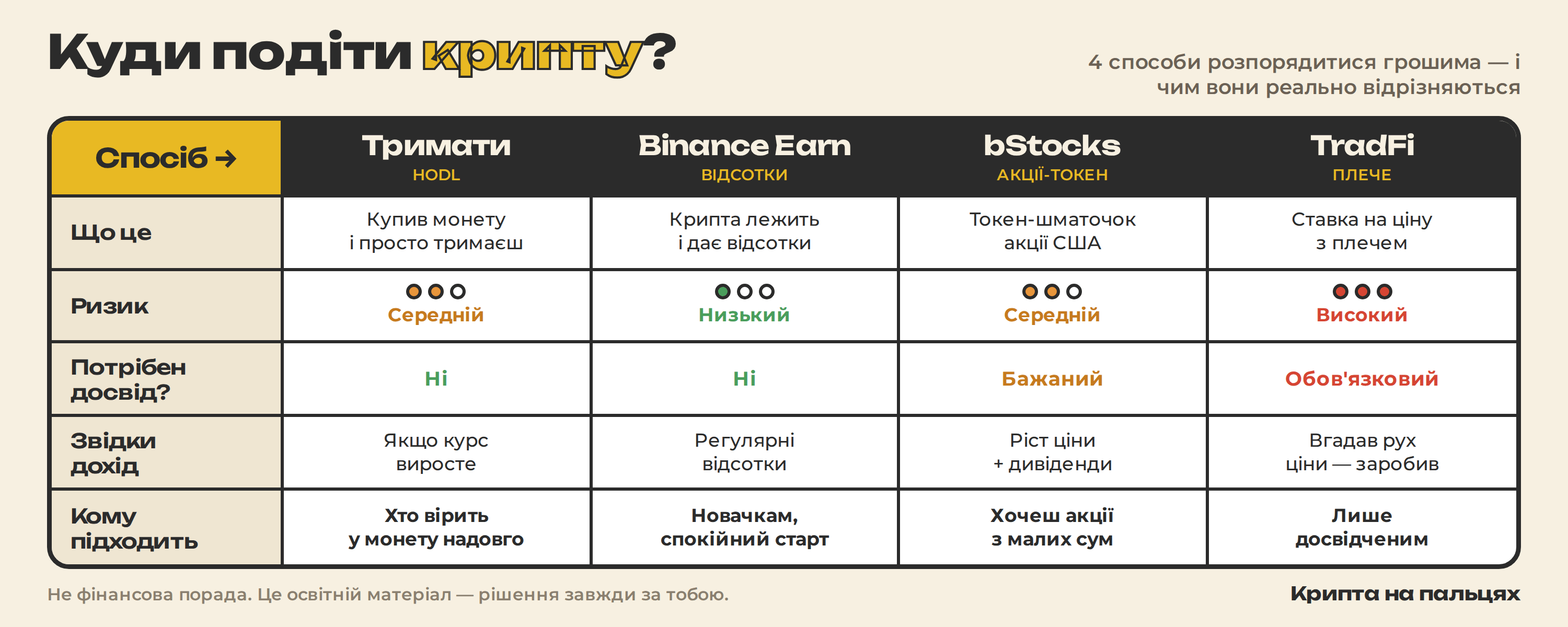
And now, briefly for each one, in simple words:
🔹 Holding (HODL) - you simply buy a coin and wait. You don’t need to do anything, but your profit will happen only if the price goes up. If it drops, you sit in the red and keep waiting. Suitable for those who believe in a particular coin for the long term.
🔹 Binance Earn - crypto isn’t just lying around doing nothing; it earns interest while you don’t do anything. I personally started with Earn too—I added a bit of stablecoins on Flexible just to see how it works. The interest is small, but the fact that your crypto isn’t sitting idle is a nice bonus. The risk is low, the start is calm—this is the gentlest option for a beginner. I broke it down in detail here 👉 [Binance Earn in simple terms: how to make crypto work while you sleep]
🔹 bStocks is the opportunity to buy a piece of shares of a big company (say, Tesla or Apple) in the form of a token, with small amounts and 24/7 access. Income comes from price growth plus dividends, but the risk is like with regular stocks too. I explained it in simple terms here 👉 [How to buy a piece of Tesla for a couple of dollars | bStocks in plain language]
🔹 TradFi - a bet on the asset price using leverage. You can make a lot and quickly here, but you can lose your entire deposit just as fast. This is a tool for experienced people, not for a first step. It’s too early for a beginner here.
⚠️ The main thing you can see from the table: the higher the potential income, the higher the risk. There’s no magic cell here with “lots of money, zero risk,” and anyone who promises that is simply trying to get your money.
There is no universal answer to “where to invest”—it all depends on how much risk you’re willing to take and how well you understand things. But now you can at least see all the options side by side and understand the difference.
So which column are you in right now? Are you holding, earning interest, or doing something more serious already? 👇